You're viewing 1 free preview question for Chemistry SL — subscribe to unlock 99 more, plus the Full Question Bank, Mock Papers & Worksheets.Upgrade
The Ionic Model · Paper 2 — Free Chemistry SL Practice Questions
1ChallengeSAQ-LProperties of ionic compounds7 marksPaper 2~11 min

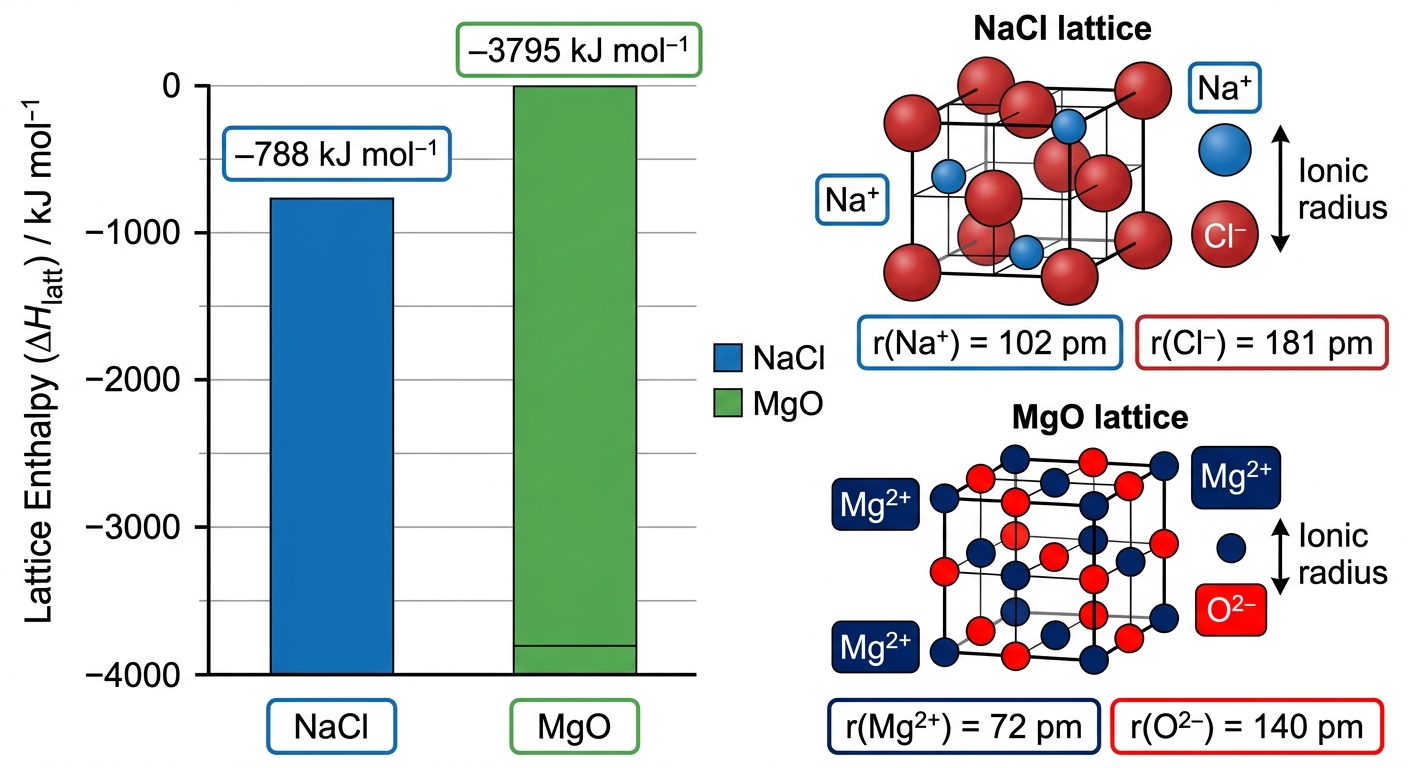
Sodium chloride (NaCl) and magnesium oxide (MgO) are both ionic compounds with the same face-centred cubic lattice arrangement. The melting point of NaCl is and that of MgO is . The lattice enthalpies are: NaCl ; MgO . Ionic radii: , , , .
(a)
State the charge on each ion in MgO and in NaCl. [1 mark]
(b)
Calculate the product of ionic charges for MgO and for NaCl. [1 mark]
(c)
Using your answer to (b), the ionic radii given, and the concept of electrostatic force, explain why the melting point of MgO is significantly higher than that of NaCl. [3 marks]
(d)
The ratio of the lattice enthalpies is greater than the ratio predicted from charge products alone . Deduce one reason, other than ionic charge, why the lattice enthalpy of MgO is more negative than the charge-product ratio predicts, and explain the origin of this additional contribution. [2 marks]

Solutions
That's every free question here — 1 of 100.
+99 more questions, plus Mock Papers & Worksheets, are waiting in Premium.