You're viewing 1 free preview question for Chemistry SL — subscribe to unlock 74 more, plus the Full Question Bank, Mock Papers & Worksheets.Upgrade
The Metallic Model · Paper 2 — Free Chemistry SL Practice Questions
1ChallengeSAQ-LMetallic bonding and electron sea model7 marksPaper 2~11 min

Data
- Electrical resistivity of pure aluminium at
- Electrical resistivity of Duralumin at
- Melting point of pure aluminium
- Melting point of Duralumin
- Atomic radii: ; ; ;
Note: Resistivity is not in the Data Booklet; use the values above as experimental data. Percentage change
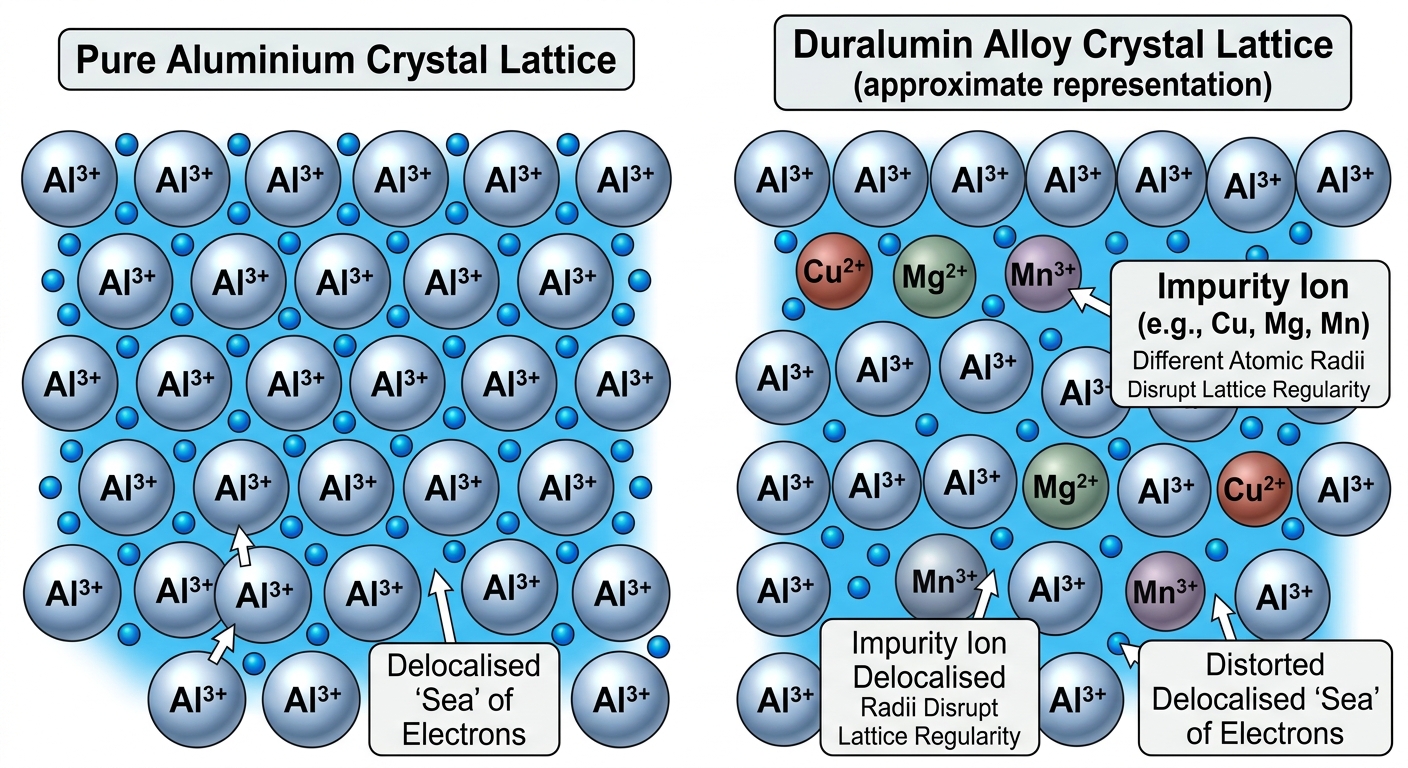
The aerospace alloy Duralumin (approximately aluminium, copper, magnesium, manganese) is stronger than pure aluminium yet maintains good electrical conductivity.
(a)
Calculate the percentage increase in electrical resistivity when aluminium is alloyed to form Duralumin. [1 mark]
(b)
Using the electron sea model and the atomic radii data, explain why Duralumin has a higher electrical resistivity than pure aluminium. [2 marks]
(c)
Using the electron sea model and the atomic radii data, explain why Duralumin has a lower melting point than pure aluminium. [2 marks]
(d)
Evaluate the electron sea model as an explanation for the properties of Duralumin. Identify one specific limitation and suggest how a more sophisticated model would address it. [2 marks]

Solutions
That's every free question here — 1 of 75.
+74 more questions, plus Mock Papers & Worksheets, are waiting in Premium.