Counting Particles by Mass: The Mole · Paper 1 — Free Chemistry SL Practice Questions
Free questions
Open in full, with answers, mark scheme and examiner insights.
Definition of the mole and Avogadro's constant
A student weighs five samples of a pure metal and determines the amount of metal in each sample by a second method. Figure 1 shows the mass of metal against the amount of metal, with the line of best fit through the origin. The metal is sodium (), magnesium () or aluminium ().
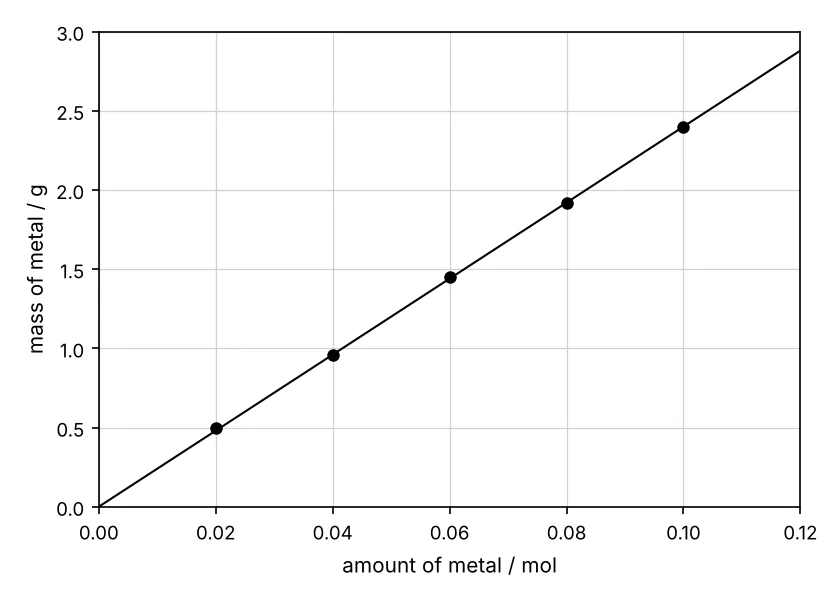
State what the gradient of the line represents.
Determine the gradient of the line of best fit.
Identify the metal.
Calculate the percentage error in the gradient, using the accepted value for the metal.
Suggest one way to improve the reliability of the line of best fit.
revisionprep.com
Summary Answer
Not available for this question.
Model Answer
Not available for this question.
Marking Scheme
Not available for this question.
Examiner Insights
Not available for this question.
Molar mass and its calculation
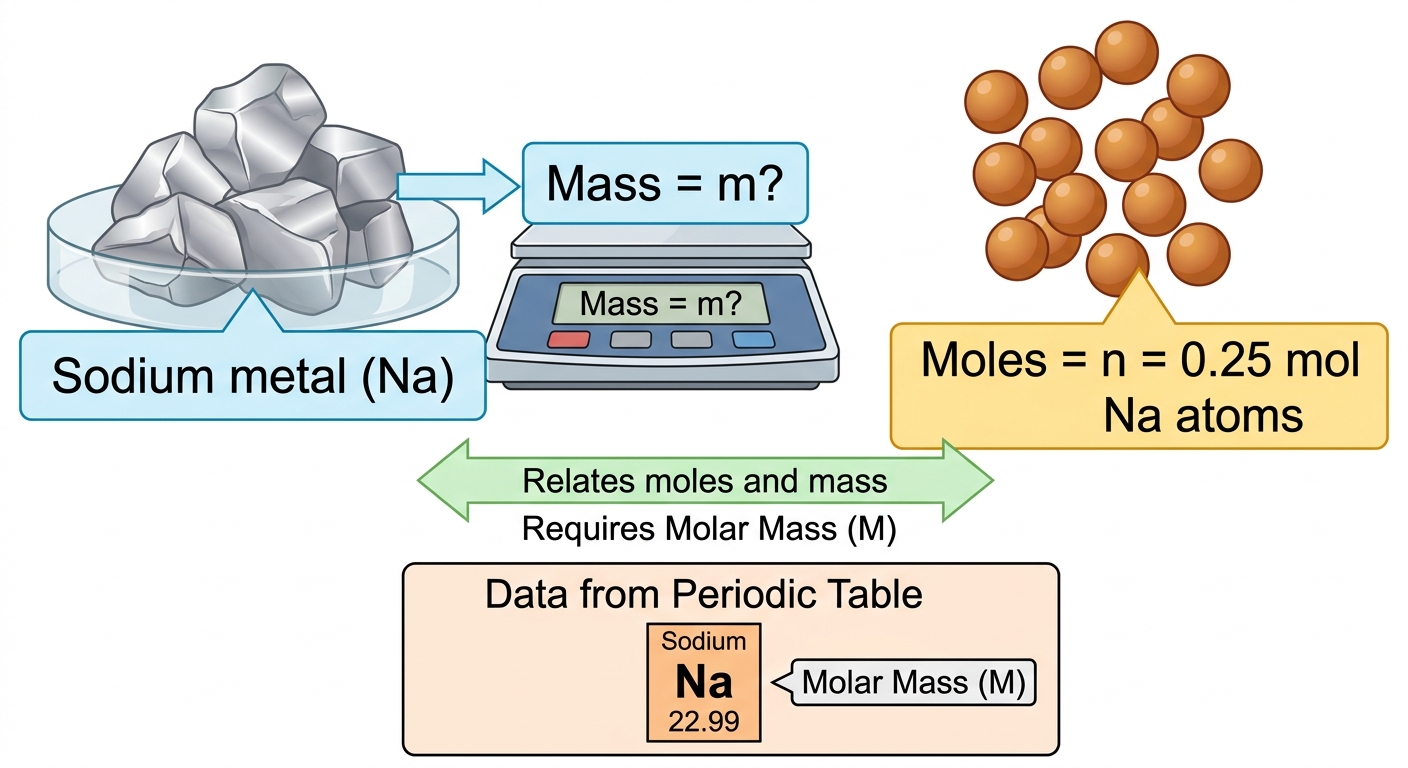
A chemist needs of sodium metal. The molar mass of sodium is . What mass of sodium, in g, should be weighed out?
revisionprep.com
Summary Answer
Not available for this question.
Model Answer
Not available for this question.
Marking Scheme
Not available for this question.
Examiner Insights
Not available for this question.
Definition of the mole and Avogadro's constant
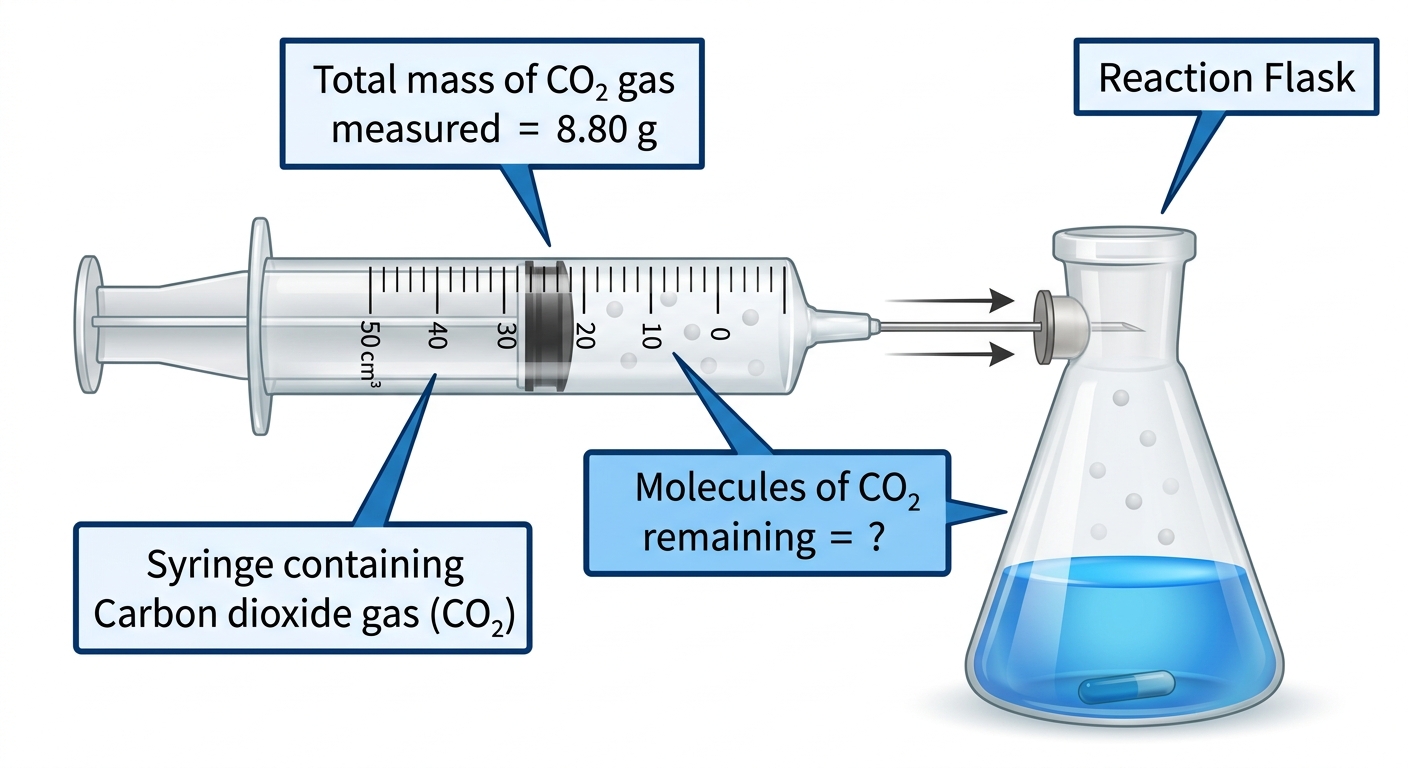
The syringe in the holds of carbon dioxide gas (). Exactly half of the gas is transferred to the reaction flask. How many molecules of remain in the syringe? ()
revisionprep.com
Summary Answer
Not available for this question.
Model Answer
Not available for this question.
Marking Scheme
Not available for this question.
Examiner Insights
Not available for this question.
Molar mass and its calculation
Five students each heat a sample of hydrated copper(II) sulfate, , until all of the water of crystallisation has gone and measure the mass lost. The results are shown in Table 1.
: Cu , S , O , H .

Identify the anomalous result in Table 1 and suggest one reason for it.
Calculate the mean mass of water lost, excluding the anomalous result.
Calculate the percentage by mass of water in the crystals from the experiment.
Calculate the percentage by mass of water in from the formula.
Calculate the percentage error in the experimental value from (c).
Suggest one improvement to the method that would make the result more reliable.
revisionprep.com
Summary Answer
Not available for this question.
Model Answer
Not available for this question.
Marking Scheme
Not available for this question.
Examiner Insights
Not available for this question.
Definition of the mole and Avogadro's constant
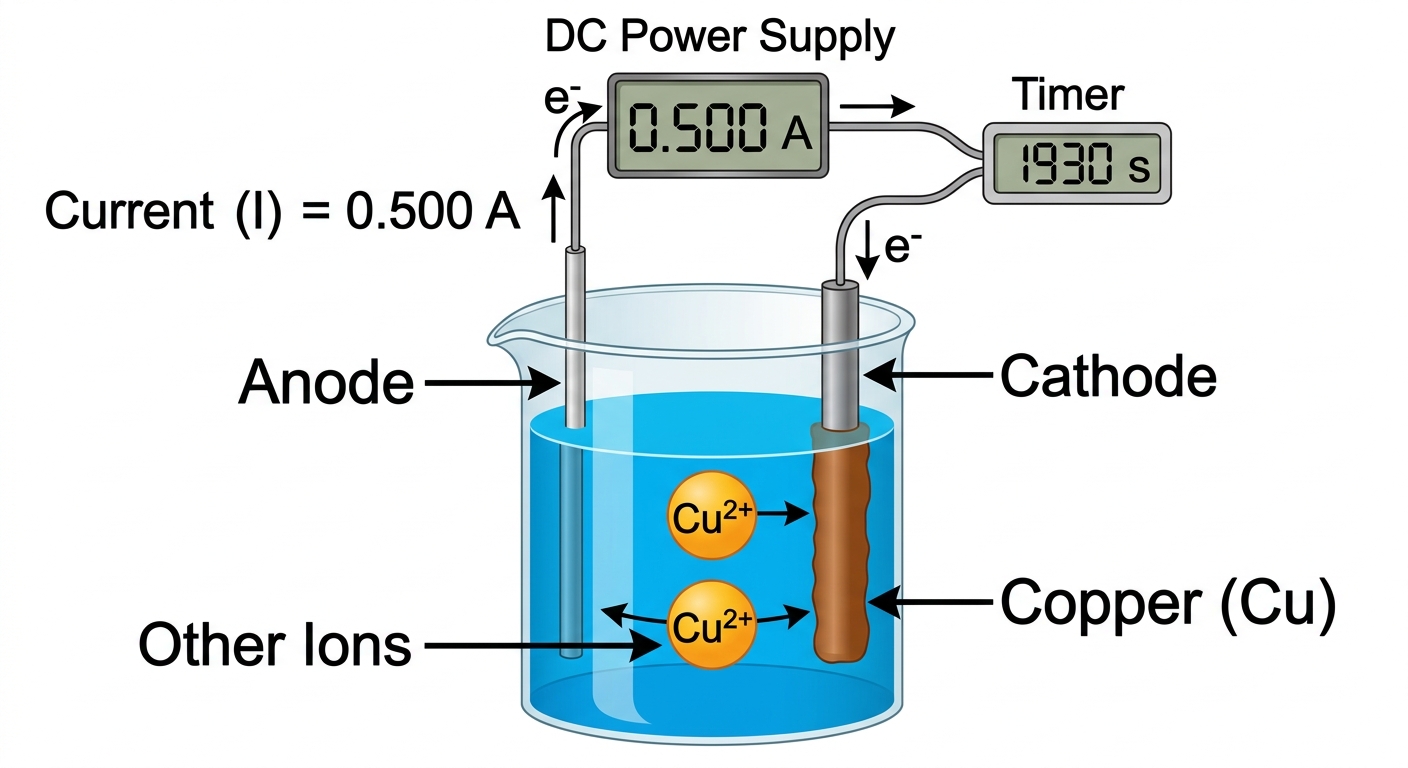
In the cell shown, a current of flows for and of copper () is deposited at the cathode: . What charge, in coulombs, is carried by one mole of electrons, deduced from these data?
revisionprep.com
Summary Answer
Not available for this question.
Model Answer
Not available for this question.
Marking Scheme
Not available for this question.
Examiner Insights
Not available for this question.
Molar mass and its calculation
A student burns different masses of magnesium ribbon in a crucible with a lid and measures the mass of magnesium oxide formed in each experiment. The results are plotted in Figure 1, with a line of best fit drawn through the points that the student considers reliable. The line passes through the origin.
: Mg , O .
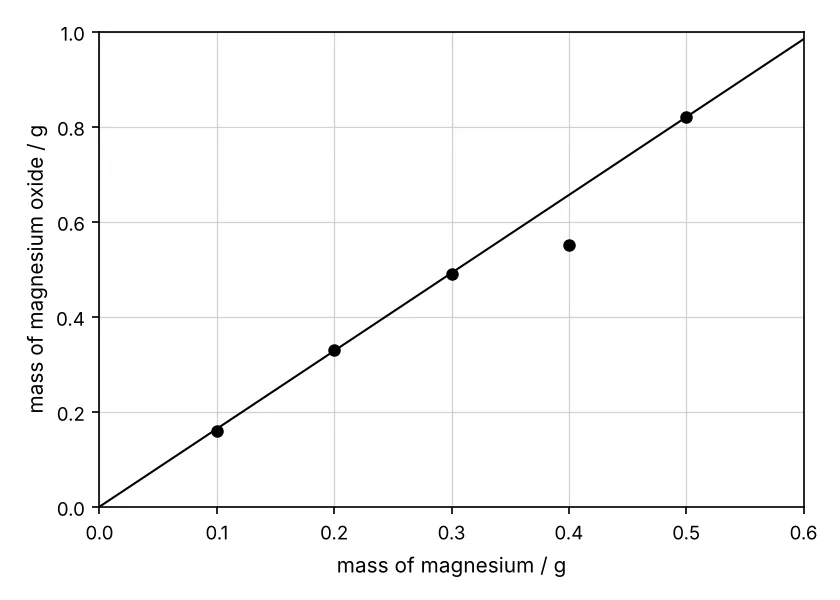
Identify the anomalous point in Figure 1 and suggest one reason for it.
Determine the gradient of the line of best fit.
Calculate the theoretical gradient from the molar masses of magnesium and magnesium oxide.
Calculate the percentage error in the experimental gradient.
State the value of the intercept of the line and explain what a non-zero intercept would suggest about a systematic error.
Suggest one improvement to the procedure that would make the data more reliable.
A similar experiment with a different metal, M, that forms an oxide MO gives a gradient of for mass of oxide against mass of metal. Determine the relative atomic mass of M and identify the metal.
revisionprep.com
Summary Answer
Not available for this question.
Model Answer
Not available for this question.
Marking Scheme
Not available for this question.
Examiner Insights
Not available for this question.
That's every free question here — 6 of 116.
+110 more questions, plus Mock Papers & Worksheets, are waiting in Premium.