Electron Configurations · Paper 1 — Free Chemistry SL Practice Questions
Free questions
Open in full, with answers, mark scheme and examiner insights.
Electron arrangement and atomic orbitals
A student collects data on the number of unpaired electrons in ground-state atoms of the Period 2 elements from boron to neon. Table 1 gives the first measurement and a repeat measurement.
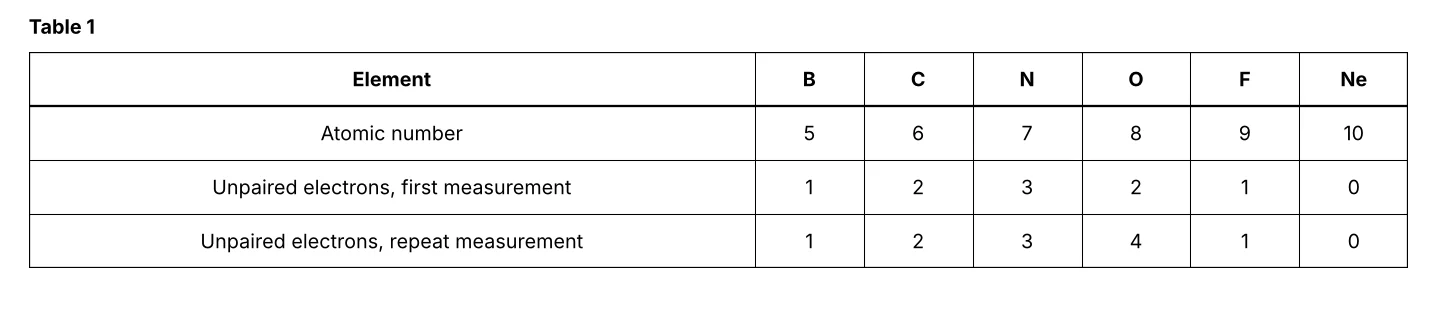
Identify the anomalous result in the repeat measurement.
Deduce the correct number of unpaired electrons in an oxygen atom, using its electron configuration.
Explain, using Hund's rule, why nitrogen has the greatest number of unpaired electrons.
Suggest one way in which the reliability of the data could be improved.
revisionprep.com
Summary Answer
Not available for this question.
Model Answer
Not available for this question.
Marking Scheme
Not available for this question.
Examiner Insights
Not available for this question.
Emission spectra and energy levels (hydrogen spectrum)
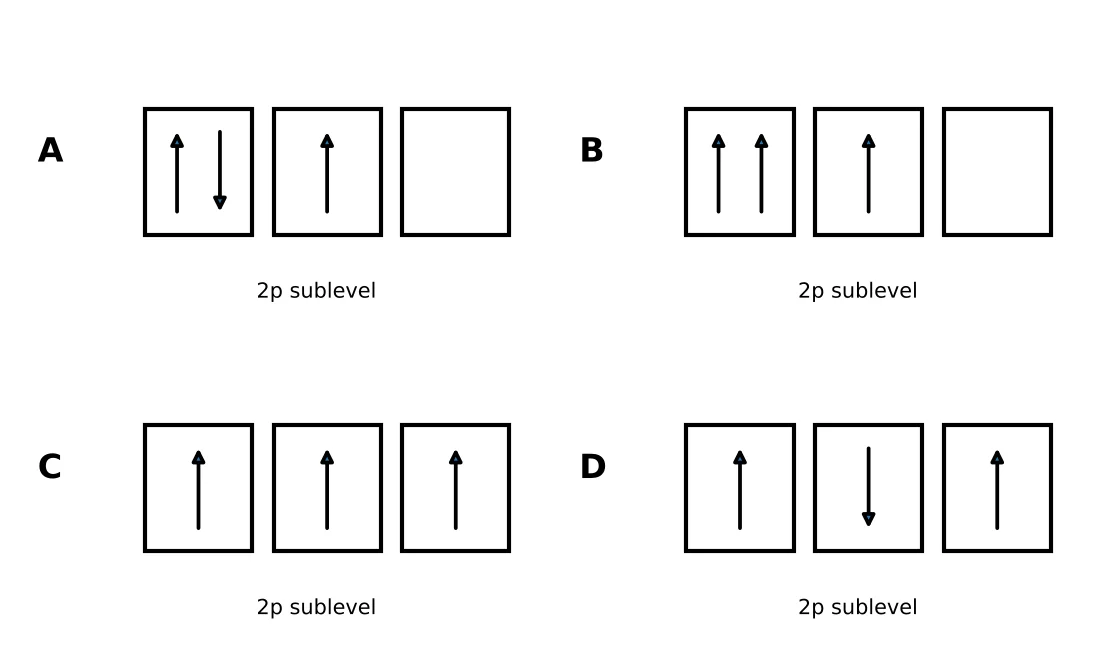
The diagrams show possible arrangements of the three electrons in the 2p sublevel of an atom. Which shows the arrangement in a ground-state nitrogen atom?
revisionprep.com
Summary Answer
Not available for this question.
Model Answer
Not available for this question.
Marking Scheme
Not available for this question.
Examiner Insights
Not available for this question.
Electron arrangement and atomic orbitals
Which statement about the and orbitals of an atom is correct?
revisionprep.com
Summary Answer
Not available for this question.
Model Answer
Not available for this question.
Marking Scheme
Not available for this question.
Examiner Insights
Not available for this question.
Aufbau principle, Pauli exclusion principle, Hund's rule
A computer model gives the relative energies of the sublevels of a neutral potassium atom in arbitrary units (au), shown in Table 1. A more negative value shows a lower energy.

Identify which sublevel is filled after and give a reason.
Calculate the difference in energy between the and sublevels.
Calculate the percentage difference between the energies of and , relative to the energy of .
Deduce the electron configuration of a potassium atom, using the order of energies in Table 1.
Suggest why a model like this is less reliable if the energies are close together.
revisionprep.com
Summary Answer
Not available for this question.
Model Answer
Not available for this question.
Marking Scheme
Not available for this question.
Examiner Insights
Not available for this question.
Aufbau principle, Pauli exclusion principle, Hund's rule
A student predicts the number of electrons in the and sublevels of the ground-state atoms from potassium to zinc, using the Aufbau principle only.
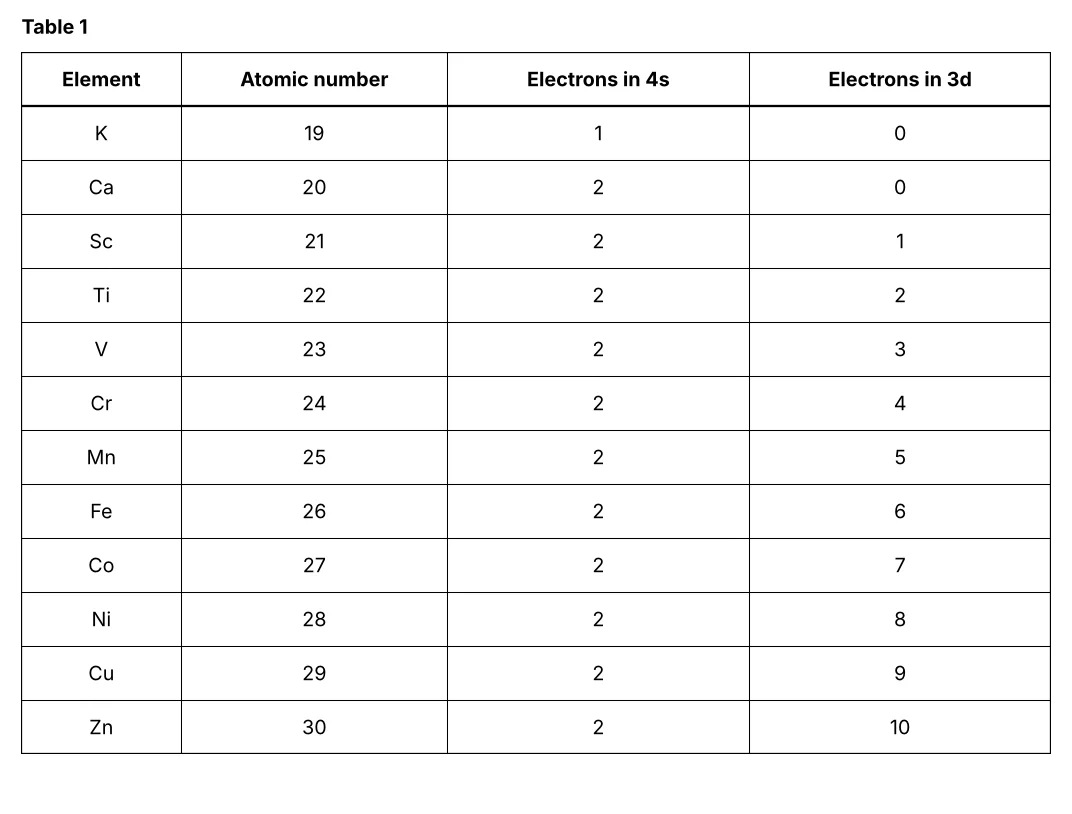
Identify the two elements whose entries do not match their actual ground-state configurations.
State the correct number of electrons in the and sublevels for each of these two elements.
Draw the orbital diagram for the and sublevels of titanium.
Deduce the number of unpaired electrons in a nickel atom, using the table.
State why the table gives two electrons for scandium but no electrons for calcium.
Calculate the percentage error in the number of electrons that the table gives for chromium, compared with the actual value of 5.
Suggest why the table is unreliable for the elements after nickel.
revisionprep.com
Summary Answer
Not available for this question.
Model Answer
Not available for this question.
Marking Scheme
Not available for this question.
Examiner Insights
Not available for this question.
Periodicity of electron configurations
The table shows the number of unpaired electrons in ground-state atoms of the eight consecutive elements from sodium () to argon ().

Explain, with reference to Hund's rule, why the number of unpaired electrons increases from aluminium to phosphorus.
Explain why sulfur has two unpaired electrons although its sublevel contains four electrons.
Explain why both magnesium and argon have no unpaired electrons.
Predict the number of unpaired electrons in a germanium atom ().
Four repeat measurements of the number of unpaired electrons in sulfur give 2, 2, 3 and 2. Identify the anomalous result. Calculate the mean of the other results.
revisionprep.com
Summary Answer
Not available for this question.
Model Answer
Not available for this question.
Marking Scheme
Not available for this question.
Examiner Insights
Not available for this question.
That's every free question here — 6 of 104.
+98 more questions, plus Mock Papers & Worksheets, are waiting in Premium.