Ideal Gases · Paper 1 — Free Chemistry SL Practice Questions
Free questions
Open in full, with answers, mark scheme and examiner insights.
Ideal gas law (PV = nRT)
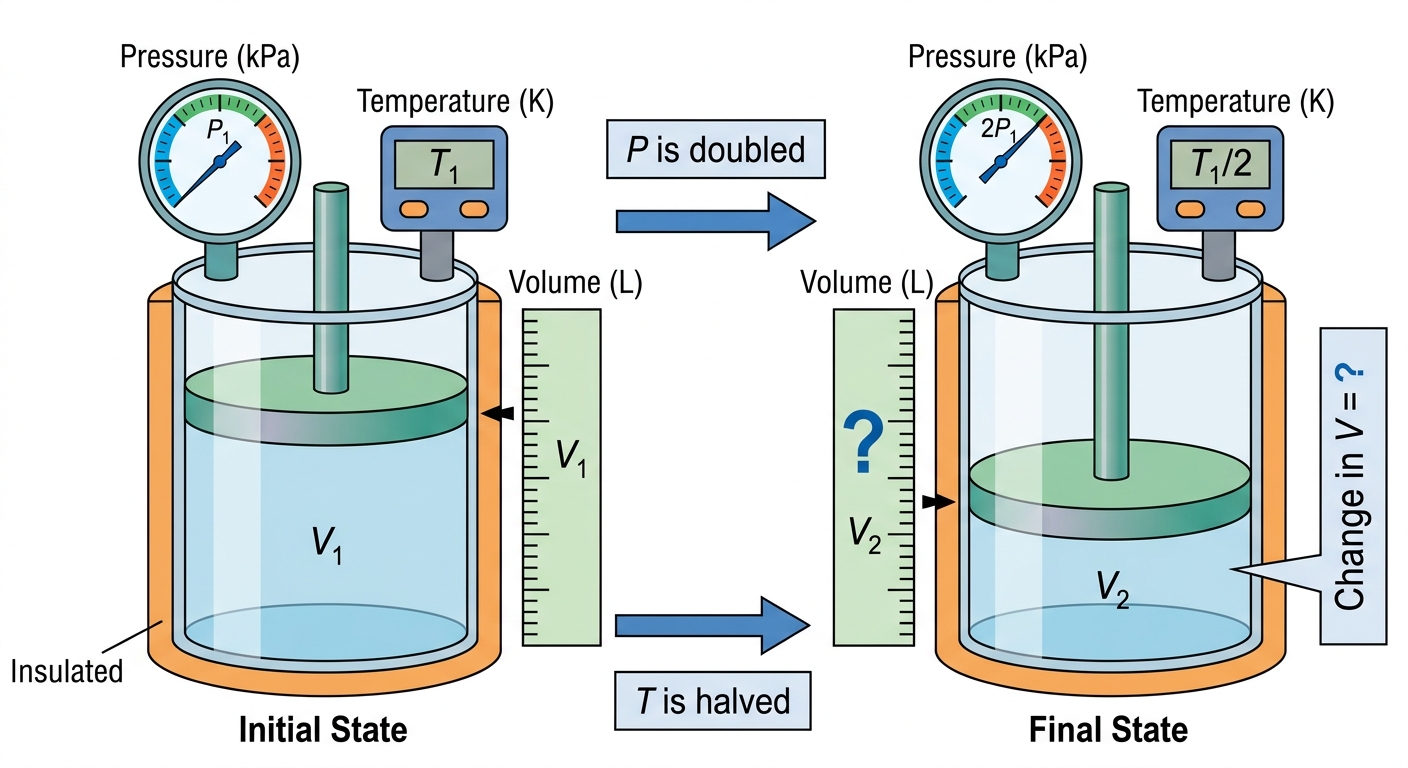
A fixed amount of an ideal gas has its pressure doubled while its absolute temperature is halved. What is the ratio of the final volume to the initial volume?
revisionprep.com
Summary Answer
Not available for this question.
Model Answer
Not available for this question.
Marking Scheme
Not available for this question.
Examiner Insights
Not available for this question.
Gas laws: Boyle's law, Charles's law, Avogadro's law
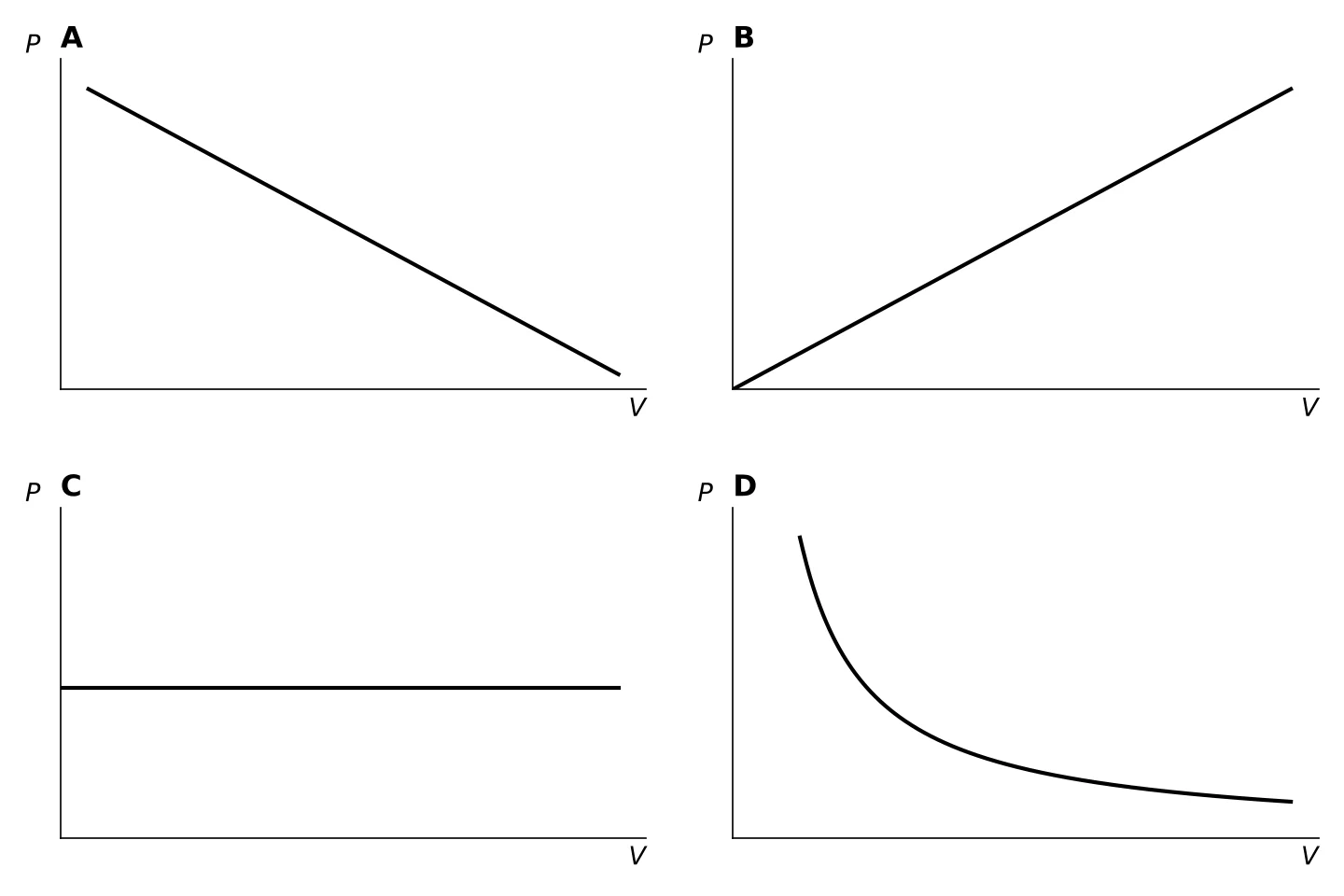
A fixed mass of an ideal gas is kept at constant temperature while its volume is changed. Which graph shows how the pressure varies with the volume ?
revisionprep.com
Summary Answer
Not available for this question.
Model Answer
Not available for this question.
Marking Scheme
Not available for this question.
Examiner Insights
Not available for this question.
Ideal gas law (PV = nRT)
A student heats a fixed mass of nitrogen gas in a rigid flask of volume in a water bath. A pressure sensor records the pressure at five temperatures . The mass of nitrogen in the flask is .
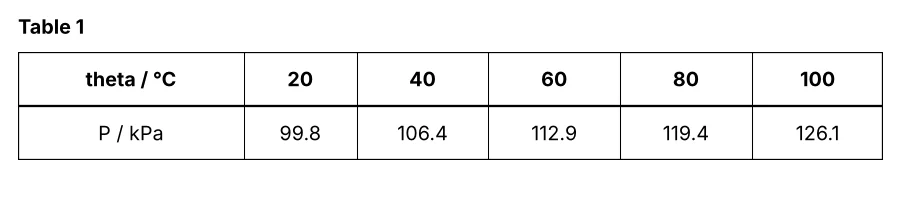
Calculate , in to three significant figures, for the readings at and .
Deduce, using your answers to (a), whether the data support the relationship .
The mean value of for all five readings is . Determine the amount of nitrogen, in mol, in the flask.
Calculate the amount of nitrogen from its mass, and the percentage difference between this value and your answer to (c). .
Suggest one reason why decreases slightly as increases.
Suggest one improvement to the method that would make the temperature readings more reliable.
revisionprep.com
Summary Answer
Not available for this question.
Model Answer
Not available for this question.
Marking Scheme
Not available for this question.
Examiner Insights
Not available for this question.
Gas laws: Boyle's law, Charles's law, Avogadro's law
A student traps a fixed mass of air in a cylinder fitted with a piston and a pressure sensor. The temperature stays at . The student changes the volume in steps and records the pressure .
Calculate the two missing values of in the table.
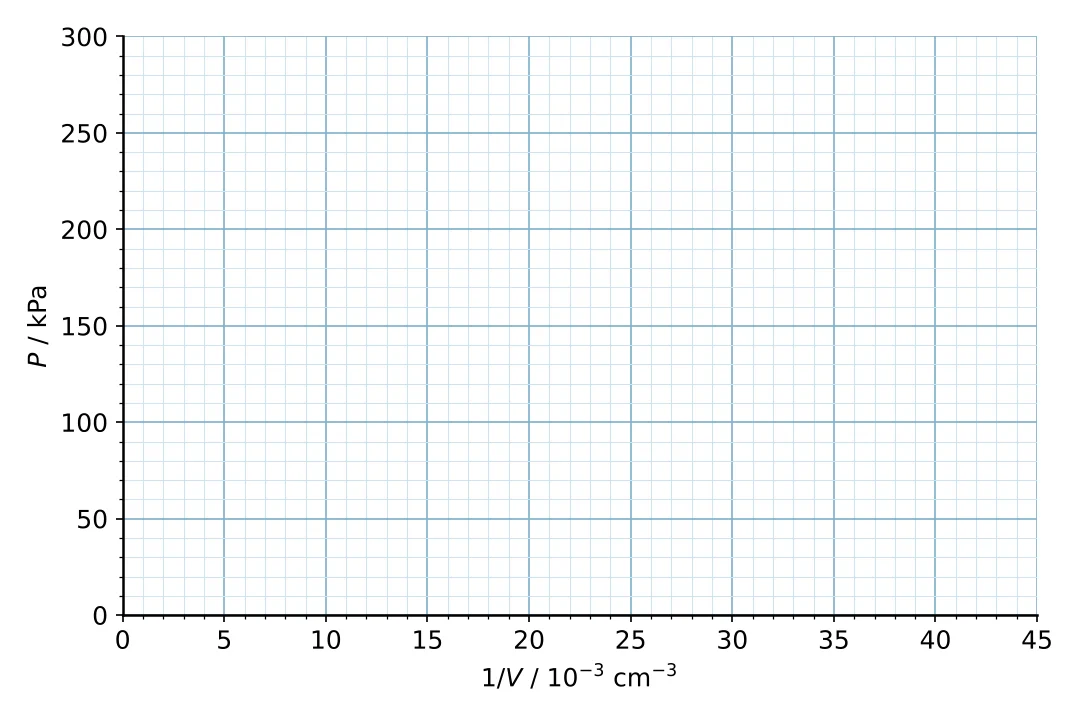
Plot a graph of against on the grid provided and draw the line of best fit.
Determine the gradient of the line of best fit. Give your answer in .
The gradient equals . Calculate the amount of air, in mol, in the cylinder.
revisionprep.com
Summary Answer
Not available for this question.
Model Answer
Not available for this question.
Marking Scheme
Not available for this question.
Examiner Insights
Not available for this question.
Ideal gas law (PV = nRT)
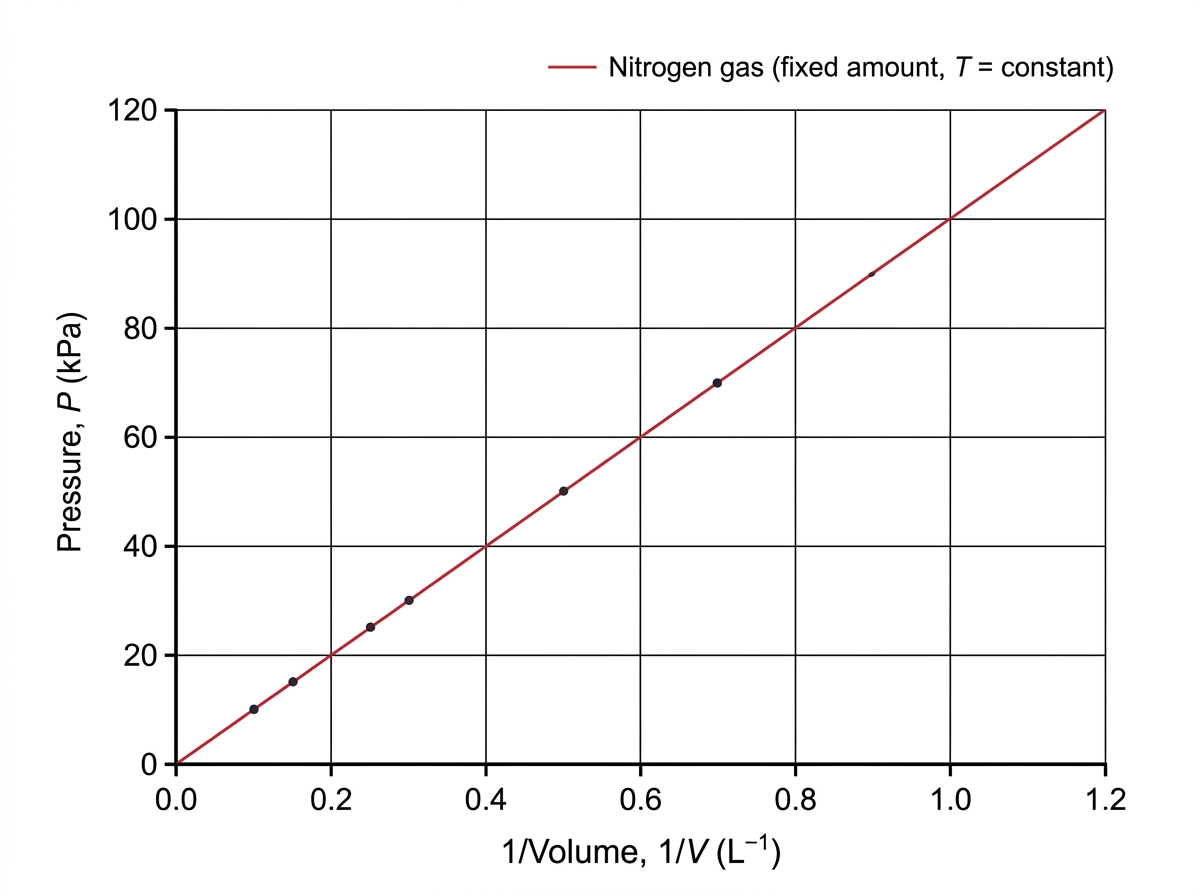
A student investigates of nitrogen gas kept at constant temperature. The graph shows the pressure of the gas against . .
What is the temperature of the gas?
revisionprep.com
Summary Answer
Not available for this question.
Model Answer
Not available for this question.
Marking Scheme
Not available for this question.
Examiner Insights
Not available for this question.
Gas laws: Boyle's law, Charles's law, Avogadro's law
Different amounts of carbon dioxide are placed in a flexible gas bag. For each sample the volume is measured at a constant temperature and a constant pressure of . The graph shows against the amount of gas, with a line of best fit.
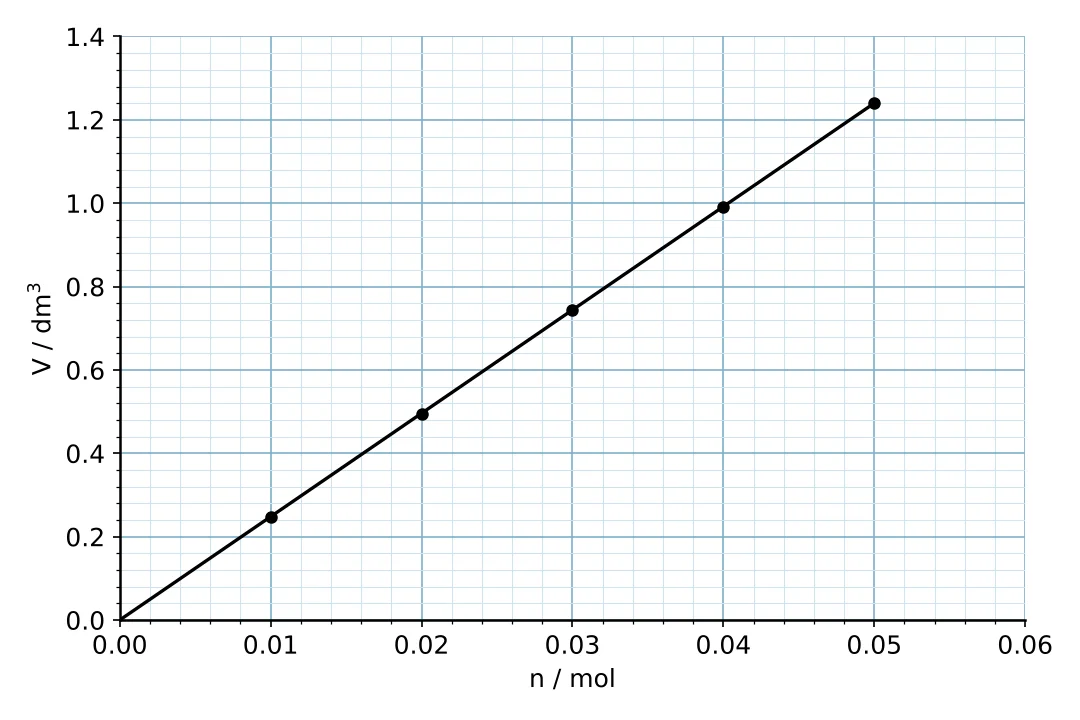
State the relationship between volume and amount of gas shown by the graph.
Determine the gradient of the line of best fit, in .
State what the gradient represents.
Calculate the temperature, in K, at which the measurements were made. Use .
The data booklet gives the molar volume of an ideal gas as at and . Explain why the value from the graph is greater.
revisionprep.com
Summary Answer
Not available for this question.
Model Answer
Not available for this question.
Marking Scheme
Not available for this question.
Examiner Insights
Not available for this question.
That's every free question here — 6 of 115.
+109 more questions, plus Mock Papers & Worksheets, are waiting in Premium.