Counting Particles by Mass: The Mole · Paper 2 — Free Chemistry SL Practice Questions
Free questions
Open in full, with answers, mark scheme and examiner insights.
Definition of the mole and Avogadro's constant
Ammonia, , is used to make fertilisers. A sample of ammonia contains of nitrogen atoms. , ; .
State the amount, in mol, of hydrogen atoms in the sample.
Calculate the number of hydrogen atoms in the sample.
Calculate the mass of the ammonia sample.
revisionprep.com
Summary Answer
Not available for this question.
Model Answer
Not available for this question.
Marking Scheme
Not available for this question.
Examiner Insights
Not available for this question.
Empirical and molecular formulas
Butanedioic acid is a naturally occurring dicarboxylic acid found in amber and used to make biodegradable polymers. A sample of butanedioic acid was found to contain carbon, hydrogen and oxygen by mass.
State the meaning of the term empirical formula.
Calculate the empirical formula of butanedioic acid.
The molar mass of butanedioic acid is . Determine the integer by which the empirical formula must be multiplied.
Deduce the molecular formula of butanedioic acid.
revisionprep.com
Summary Answer
Not available for this question.
Model Answer
Not available for this question.
Marking Scheme
Not available for this question.
Examiner Insights
Not available for this question.
Definition of the mole and Avogadro's constant
Urea, , is a nitrogen fertiliser with a molar mass of . Use .
Calculate the mass, in g, of one molecule of urea.
Calculate the number of urea molecules in of urea.
Determine the number of nitrogen atoms in of urea.
revisionprep.com
Summary Answer
Not available for this question.
Model Answer
Not available for this question.
Marking Scheme
Not available for this question.
Examiner Insights
Not available for this question.
Molar mass and its calculation
A farmer compares three nitrogen fertilisers.
Relative atomic masses: , , , , .
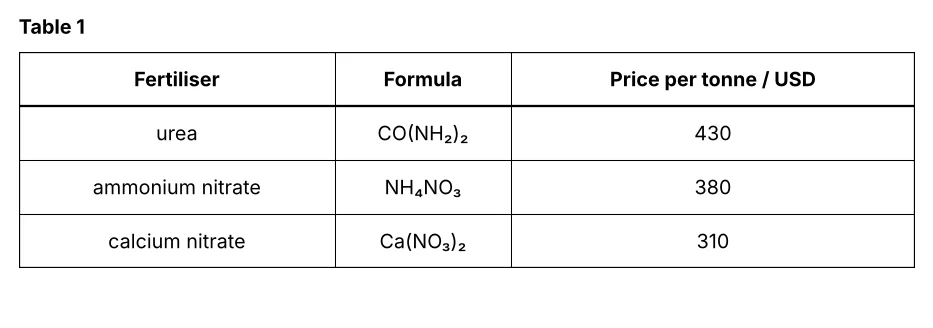
Calculate the percentage by mass of nitrogen in urea.
Calculate the percentage by mass of nitrogen in ammonium nitrate and in calcium nitrate.
Determine which fertiliser is the cheapest source of nitrogen, by finding the cost of one tonne of nitrogen supplied by each fertiliser.
Evaluate whether the cost of one tonne of nitrogen is the only factor that a farmer should consider when choosing a fertiliser.
revisionprep.com
Summary Answer
Not available for this question.
Model Answer
Not available for this question.
Marking Scheme
Not available for this question.
Examiner Insights
Not available for this question.
Molar mass and its calculation
Poly(chloroethene), PVC, is made by joining many chloroethene molecules, , into long chains. A chain of repeat units has the formula .
, , ; .
Calculate the molar mass of the repeat unit, .
Calculate the molar mass of a PVC chain with .
Calculate the mass, in g, of one PVC chain with .
A sample of PVC has an average molar mass of . Determine the average value of .
Evaluate the statement: 'The molar mass of PVC is as exact as the molar mass of ethanol.'
Calculate the number of PVC chains in of PVC with an average molar mass of .
Explain why two samples of PVC that have the same mass can contain different numbers of chains.
Calculate the percentage by mass of chlorine in PVC.
revisionprep.com
Summary Answer
Not available for this question.
Model Answer
Not available for this question.
Marking Scheme
Not available for this question.
Examiner Insights
Not available for this question.
Conversions between moles, mass, and number of particles
A single grain of table sugar, sucrose (), has a mass of . (: C = 12.01, H = 1.01, O = 16.00; ; )
Calculate the molar mass of sucrose.
Calculate the amount, in mol, of sucrose in the grain.
Determine the number of sucrose molecules in the grain.
Determine the total number of atoms in the grain.
A machine counts molecules at a rate of per second. Calculate how many years it would take to count every sucrose molecule in the grain.
Explain why chemists use the mole, and not a count of particles, to describe the amount of sucrose in the grain, with reference to your answer to (e).
Calculate the mass, in mg, of sucrose that contains molecules.
Determine the number of carbon atoms in the grain.
revisionprep.com
Summary Answer
Not available for this question.
Model Answer
Not available for this question.
Marking Scheme
Not available for this question.
Examiner Insights
Not available for this question.
That's every free question here — 6 of 119.
+113 more questions, plus Mock Papers & Worksheets, are waiting in Premium.