You're viewing 1 free preview question for Chemistry SL — subscribe to unlock 74 more, plus the Full Question Bank, Mock Papers & Worksheets.Upgrade
Electron Configurations · Paper 2 — Free Chemistry SL Practice Questions
1ChallengeSAQ-LElectron arrangement and atomic orbitals7 marksPaper 2~11 min

Data
; ; ; .
Formulae: ; ; .
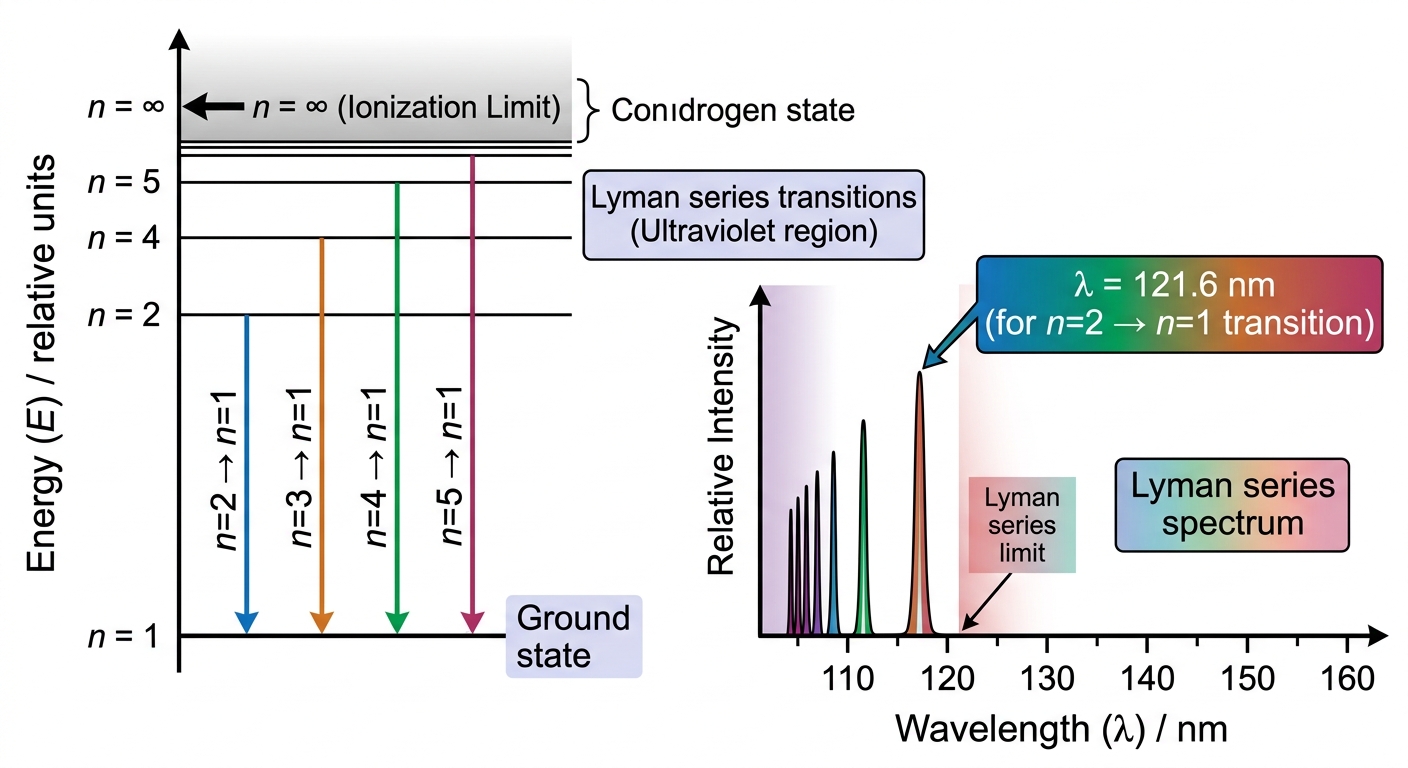
The emission spectrum of atomic hydrogen contains a series of lines in the ultraviolet region known as the Lyman series. These lines correspond to electron transitions from higher energy levels () to the ground state ().
(a)
Calculate the ionization energy of hydrogen in using the Rydberg equation. [3 marks]
(b)
Explain why the lines in the Lyman series converge at shorter wavelengths. [1 mark]
(c)
Calculate the wavelength, in nm, of the spectral line corresponding to the transition . [2 marks]
(d)
Evaluate how the observation of discrete spectral lines and a convergence limit in the Lyman series supports the quantum mechanical model of the atom over the classical (continuous) model. [1 mark]

Solutions
That's every free question here — 1 of 75.
+74 more questions, plus Mock Papers & Worksheets, are waiting in Premium.