Ideal Gases · Paper 2 — Free Chemistry SL Practice Questions
Free questions
Open in full, with answers, mark scheme and examiner insights.
Ideal gas law (PV = nRT)
A student reacts of magnesium with excess dilute hydrochloric acid.
The dry hydrogen gas produced is measured at and . . The molar volume of an ideal gas at and is .
(a) Calculate the volume of hydrogen gas produced, in . [2]
revisionprep.com
Summary Answer
Not available for this question.
Model Answer
Not available for this question.
Marking Scheme
Not available for this question.
Examiner Insights
Not available for this question.
Applications of the ideal gas law
A student collects a sample of an unknown gas X in a gas syringe. The pressure of the gas is and the temperature is . The mass of gas in the syringe is . Use .
State one condition of pressure or temperature under which a real gas behaves most like an ideal gas.
Calculate the molar mass of gas X.
revisionprep.com
Summary Answer
Not available for this question.
Model Answer
Not available for this question.
Marking Scheme
Not available for this question.
Examiner Insights
Not available for this question.
Ideal gas law (PV = nRT)
A student traps a fixed mass of air in a gas syringe at a constant pressure of . The syringe is heated in a water bath and the volume is measured at six Celsius temperatures . The graph shows the results.
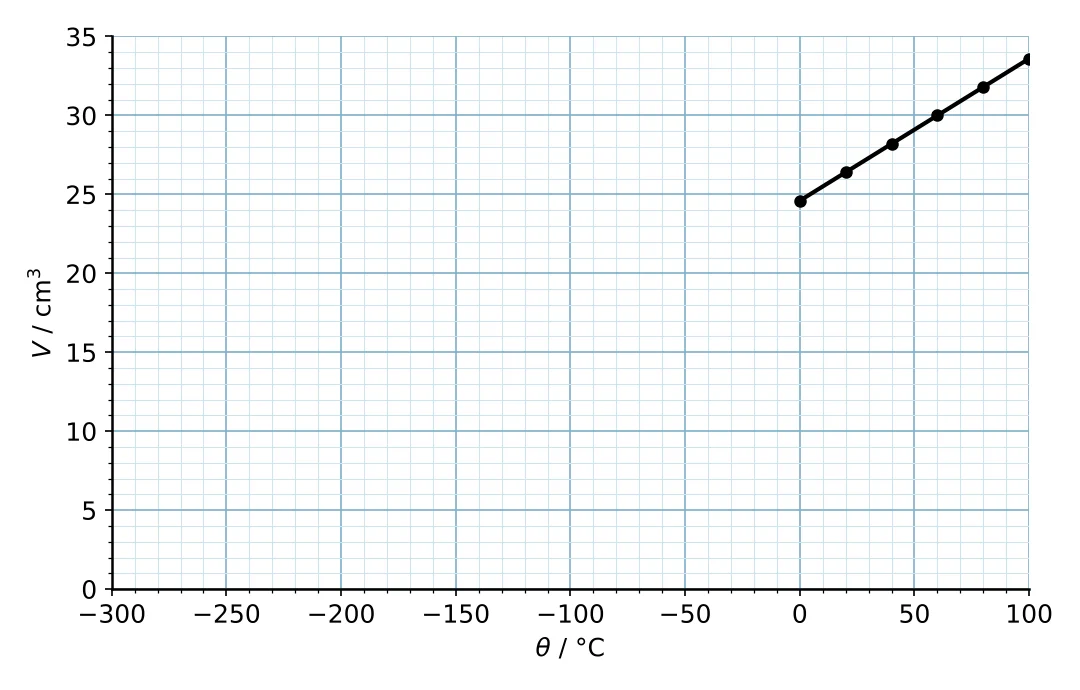
Extend the line on the graph to and determine the temperature, in , at which .
State the relationship between and the temperature in kelvin shown by the graph.
Determine the gradient of the line, in .
Hence calculate the amount of air in the syringe, in mol.
Suggest why a real gas does not actually reach zero volume at this temperature.
Explain, using the ideal gas model, why the graph of against in does not pass through the origin, but a graph of against in kelvin does.
Use the gradient from (c)(i) to calculate the volume, in , of the air at and .
revisionprep.com
Summary Answer
Not available for this question.
Model Answer
Not available for this question.
Marking Scheme
Not available for this question.
Examiner Insights
Not available for this question.
Gas laws: Boyle's law, Charles's law, Avogadro's law
of ethene gas, , is mixed with of oxygen in a gas-tight eudiometer. The mixture is ignited and burns completely. The apparatus is cooled to the starting temperature and pressure, when the water formed is a liquid with a negligible volume.
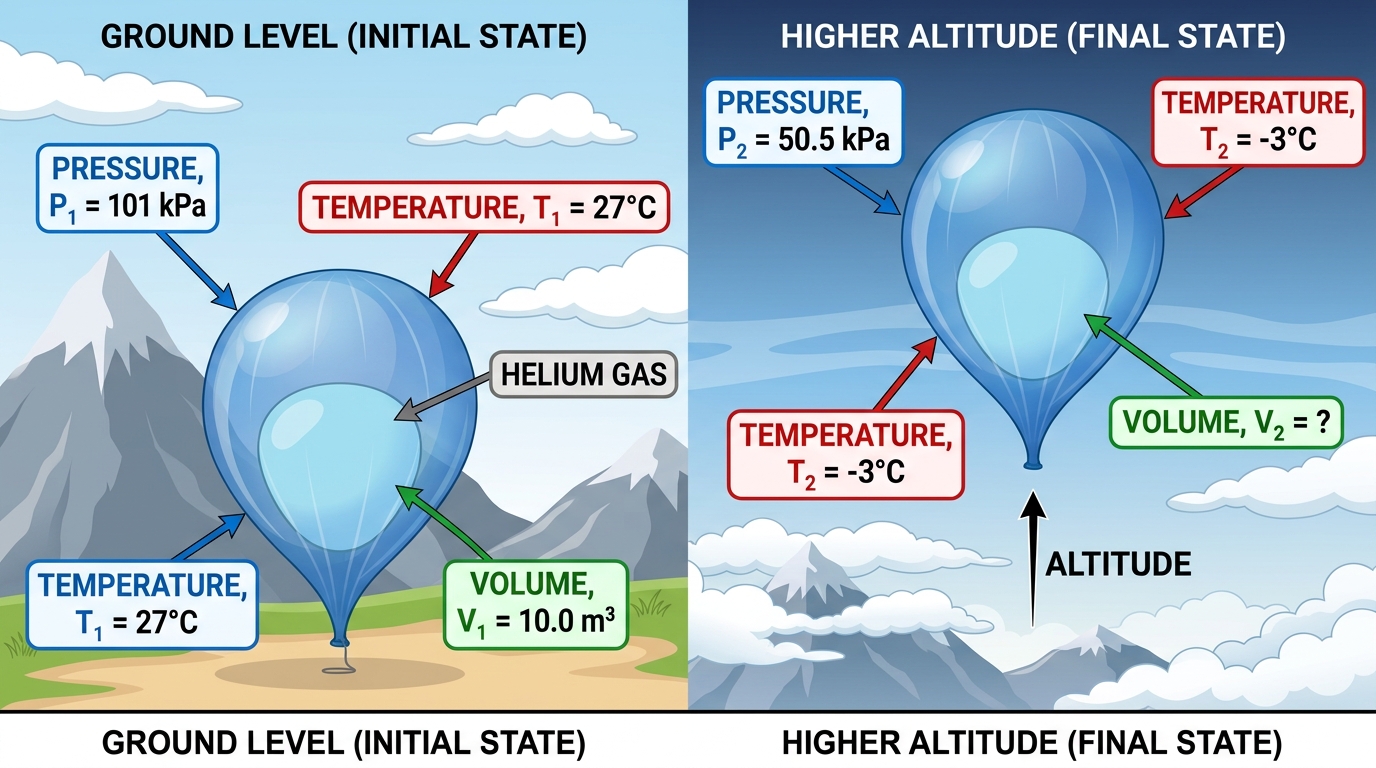
Write the balanced equation for the complete combustion of ethene.
Determine the volume of oxygen that reacts and the volume of carbon dioxide formed.
Determine the total volume of gas in the eudiometer after cooling.
Explain why the volumes of gases in a reaction are in the same ratio as the coefficients in the equation, when measured at the same temperature and pressure.
State one reason why the gas must be cooled to the starting temperature before the final volume is read.
revisionprep.com
Summary Answer
Not available for this question.
Model Answer
Not available for this question.
Marking Scheme
Not available for this question.
Examiner Insights
Not available for this question.
Gas laws: Boyle's law, Charles's law, Avogadro's law
A cylinder fitted with a movable piston contains of oxygen at and . The piston is pushed in, reducing the volume to at constant temperature.
State how the number of oxygen molecules per unit volume changes as the piston is pushed in.
Explain, using the kinetic model, why the pressure of the oxygen increases.
Calculate the pressure of the oxygen at .
The experiment is repeated from the same initial conditions, but the temperature of the gas falls to while the volume is reduced to . Calculate the final pressure.
Compare the effects of the volume change and the temperature change on the pressure in (d)(i).
The oxygen at and is now warmed to with the piston held in a fixed position. Calculate the final pressure.
Explain, in terms of the particles of the gas, why the pressure of the oxygen increases when it is warmed at constant volume.
revisionprep.com
Summary Answer
Not available for this question.
Model Answer
Not available for this question.
Marking Scheme
Not available for this question.
Examiner Insights
Not available for this question.
Real gases vs ideal gases
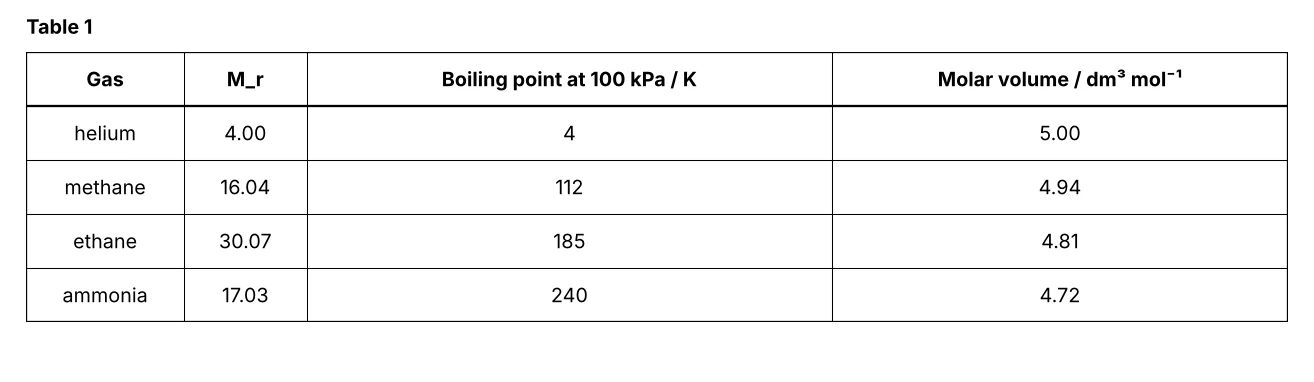
The table shows the measured molar volume of four gases at and .
Calculate the molar volume, in , of an ideal gas at and .
Calculate the percentage by which the molar volume of ammonia is below the ideal value.
Discuss the differences between the measured molar volumes and the ideal value, referring to the assumptions of the ideal gas model and to the properties of each gas.
Calculate the percentage by which the molar volume of helium is above the ideal value.
Predict how the percentage difference between the measured and the ideal molar volume of ammonia would change at and . Give a reason.
revisionprep.com
Summary Answer
Not available for this question.
Model Answer
Not available for this question.
Marking Scheme
Not available for this question.
Examiner Insights
Not available for this question.
That's every free question here — 6 of 116.
+110 more questions, plus Mock Papers & Worksheets, are waiting in Premium.