You're viewing free preview questions. Upgrade to access more Chemistry SL questions.Upgrade
Introduction to the Particulate Nature of Matter · Paper 2 — Free Chemistry SL Practice Questions
1MasterySAQ-SProperties of matter8 marksPaper 2~12 min

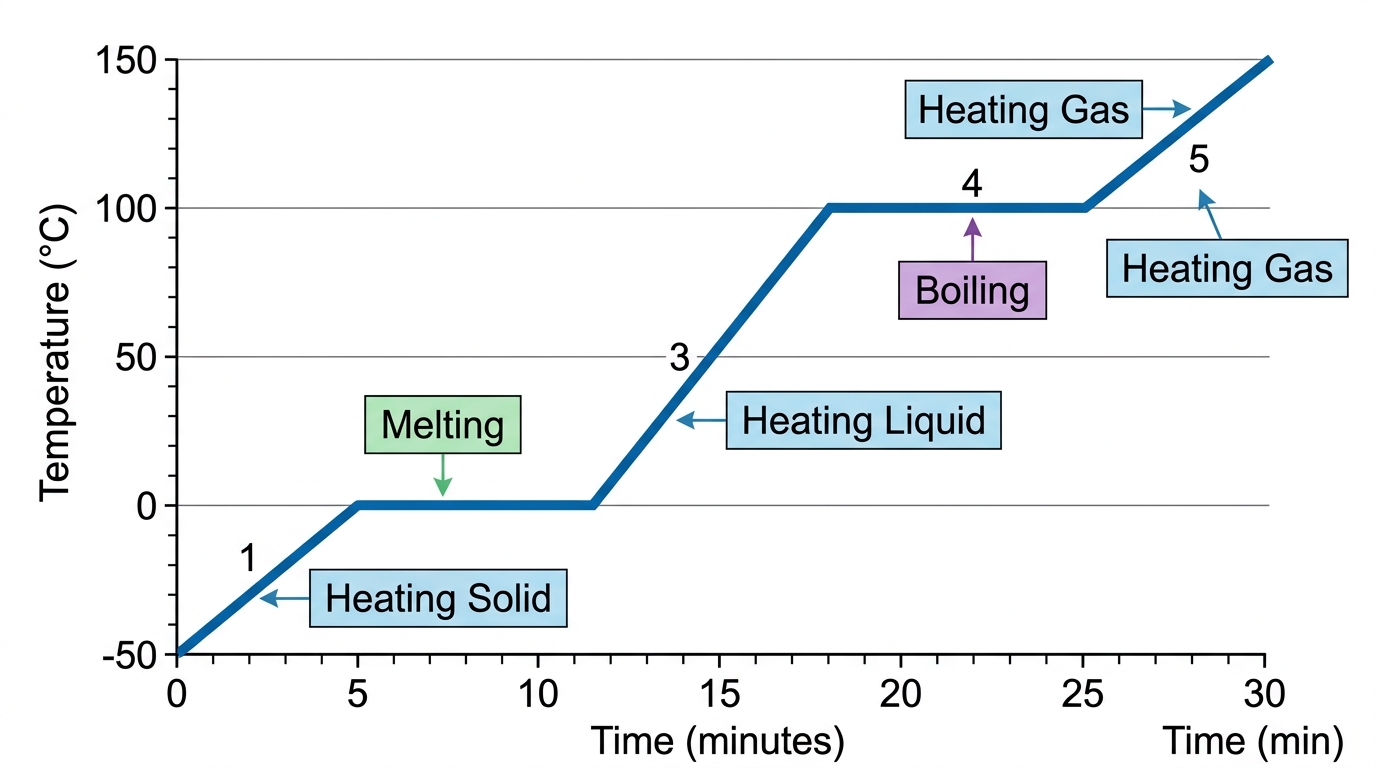
The graph below shows the heating curve of a pure substance. Temperature is plotted against time as the substance is heated from to at a constant rate. The substance has a melting point of and a boiling point of . The specific heat capacity of the solid is and of the liquid is .
(a)
Describe what is happening to the particles of the substance during the plateau at . [2 marks]
(b)
Describe how the physical state of the substance at differs from its state at , in terms of particle arrangement and compressibility. [2 marks]
(c)
Calculate the total energy required to raise the temperature of of the substance from to , excluding any energy required for a change of state. [2 marks]
(d)
The plateau at is longer than the plateau at on the heating curve. Explain why, in terms of intermolecular forces. [2 marks]

Solutions
2MasterySAQ-SProperties of matter7 marksPaper 2~11 min
Data
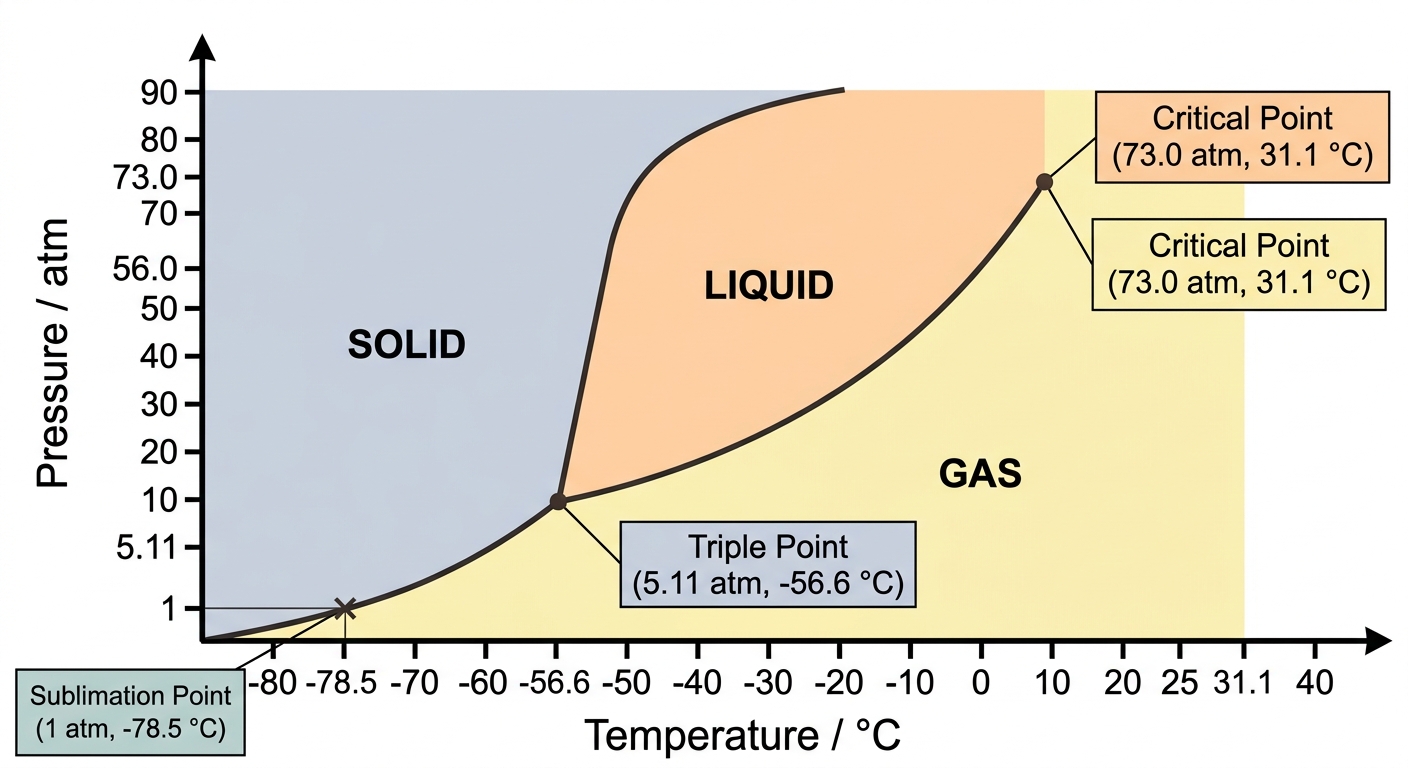
The phase for carbon dioxide () is shown below (not to scale). The triple point of is at and . The critical point is at and . At pressure, solid sublimes at .
(a)
Describe what happens to the physical state of a sample of , initially at and , when it is heated at constant pressure to . [2 marks]
(b)
Describe the arrangement and motion of particles in at the critical point (, ). [2 marks]
(c)
The enthalpy of vaporisation of liquid is . The vapour pressure of liquid at is .
Using the Clausius–Clapeyron equation, calculate the vapour pressure of liquid at . [3 marks]
Solutions
3MasterySAQ-SSolid, liquid, gas phases and changes of state8 marksPaper 2~12 min
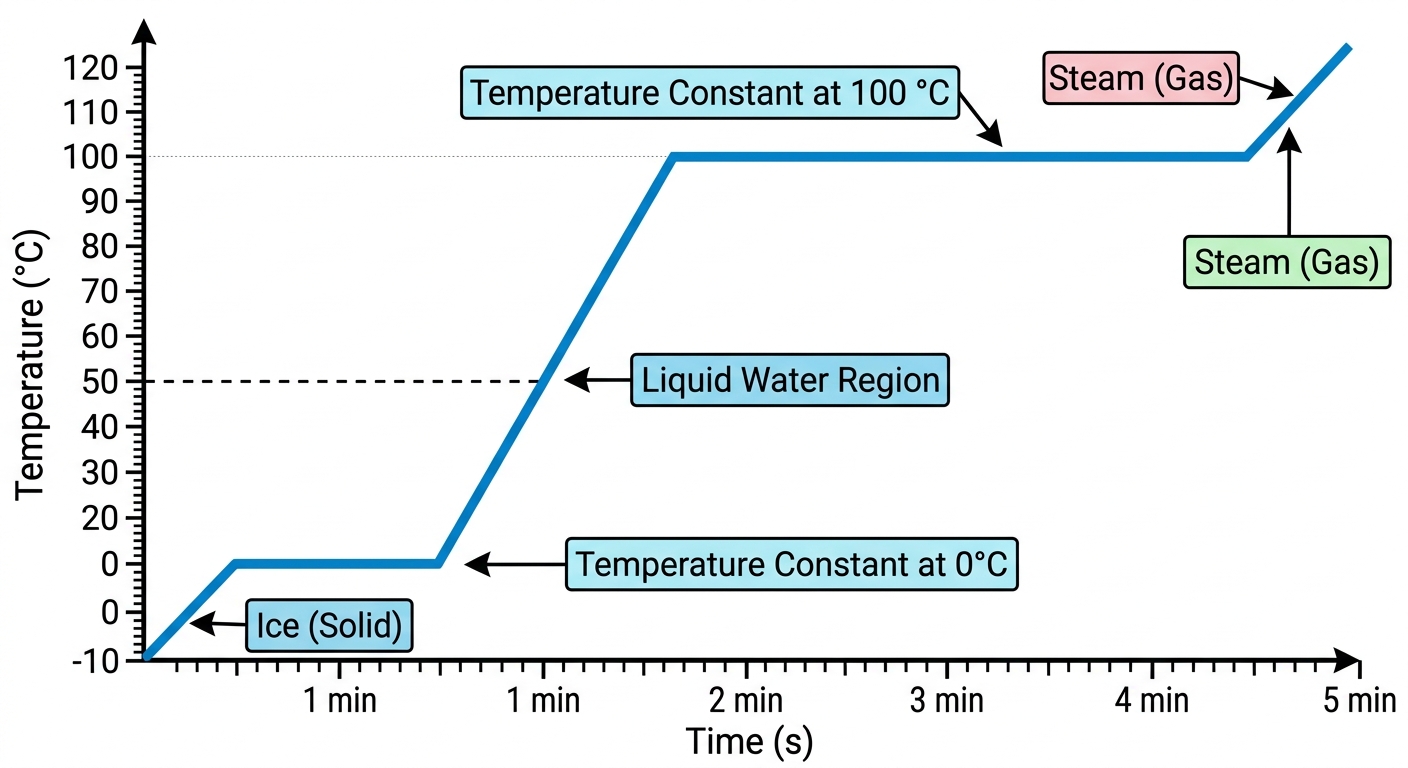
A student investigates the behaviour of a pure sample of water as it is heated from to at constant atmospheric pressure. The student records the temperature every 30 seconds and plots a heating curve. The specific latent heat of vaporization of water is .
(a)
Describe the arrangement and movement of water molecules in the liquid phase at . [2 marks]
(b)
Explain why the temperature remains constant at for several minutes during heating. [2 marks]
(c)
Calculate the energy, in kJ, required to completely vaporize of liquid water at . [2 marks]
(d)
The student repeats the experiment using ethanol instead of water. Ethanol has a lower boiling point and a lower specific latent heat of vaporization than water. Deduce and explain, with reference to intermolecular forces, why ethanol has a lower specific latent heat of vaporization than water. [2 marks]
Solutions
4MasterySAQ-SSolid, liquid, gas phases and changes of state5 marksPaper 2~8 min
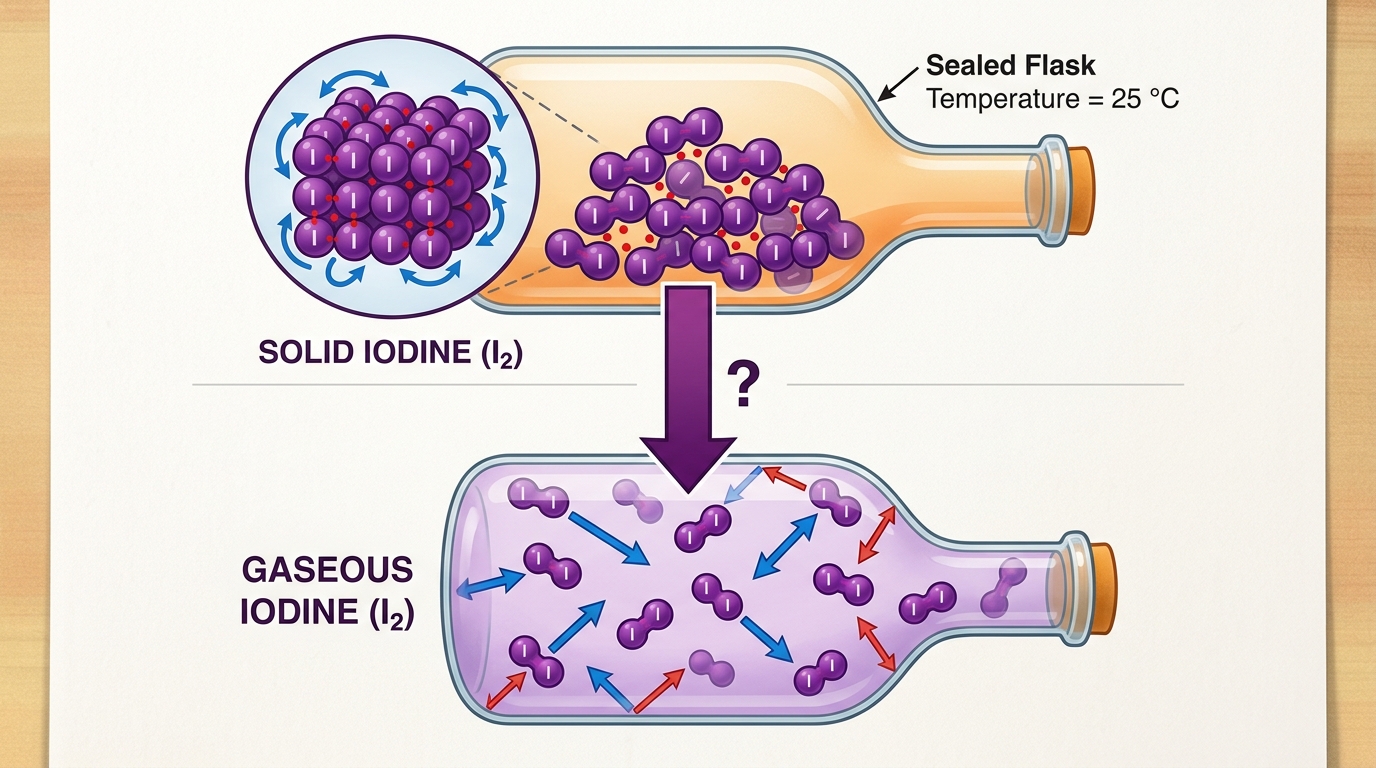
A student places a few crystals of solid iodine () in a sealed flask at and standard atmospheric pressure (). Over time, the solid disappears and a purple vapour fills the flask, with no liquid observed. The triple point of iodine occurs at and .
(a)
State the change of state occurring in the flask. [1 mark]
(b)
Describe the differences in the arrangement and motion of iodine particles in the solid state compared to the gaseous state. [2 marks]
(c)
Using the triple point data, explain why solid iodine converts directly to vapour at and , without forming a liquid. [2 marks]
Solutions
5MasterySAQ-SSolid, liquid, gas phases and changes of state5 marksPaper 2~8 min
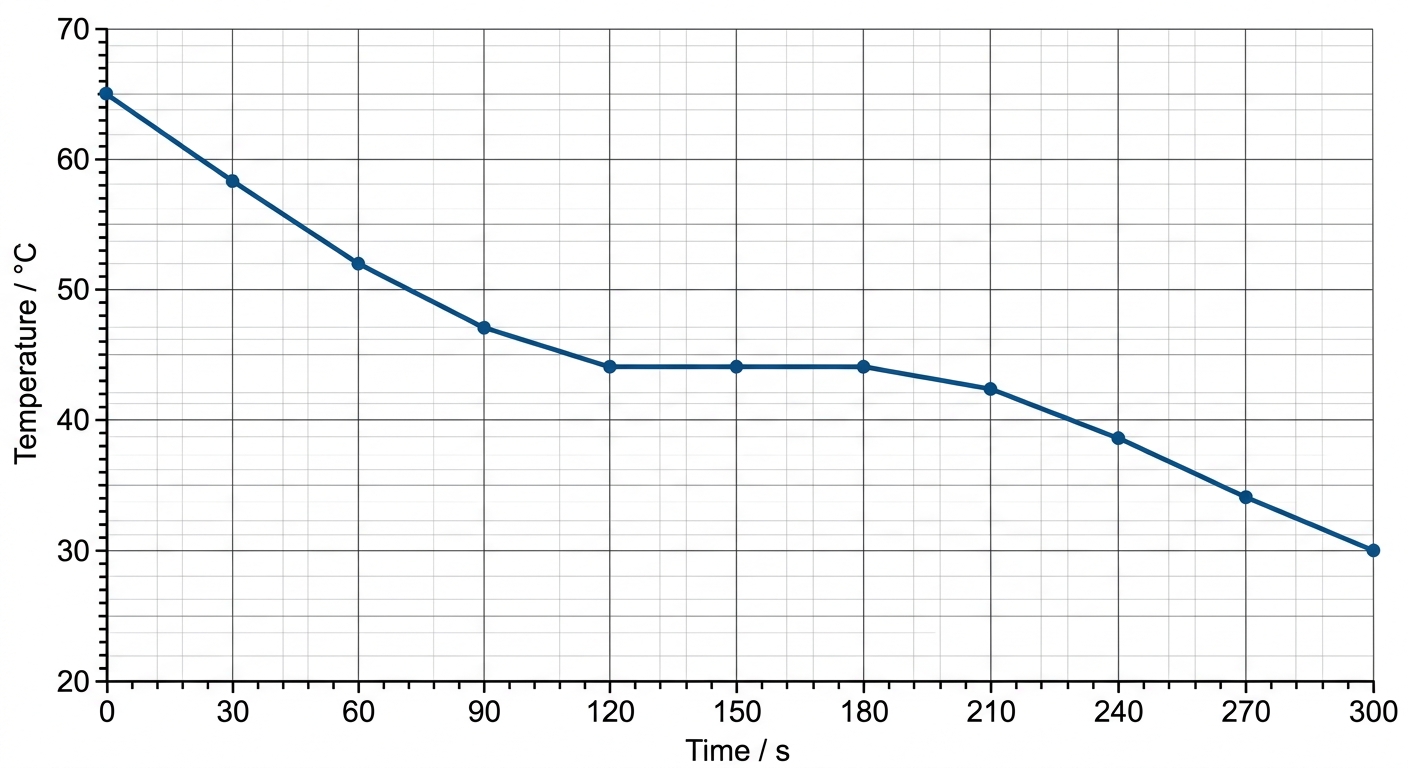
A student investigates the cooling behaviour of lauric acid (, melting point ). The student heats a sample to , then records its temperature every as it cools in air at .
Time / s — 0 — 30 — 60 — 90 — 120 — 150 — 180 — 210 — 240 — 270 — 300
Temperature / °C — 65.0 — 58.2 — 52.1 — 47.0 — 44.0 — 44.0 — 42.3 — 38.5 — 34.1 — 30.0
The specific latent heat of fusion of lauric acid is .
(a)
State the change of state occurring between and . [1 mark]
(b)
Explain, using the particulate nature of matter, why the temperature remains constant at during this interval. [2 marks]
(c)
Calculate the heat energy released as the sample completely solidifies at . [2 marks]
Solutions
6MasterySAQ-SSolid, liquid, gas phases and changes of state5 marksPaper 2~8 min
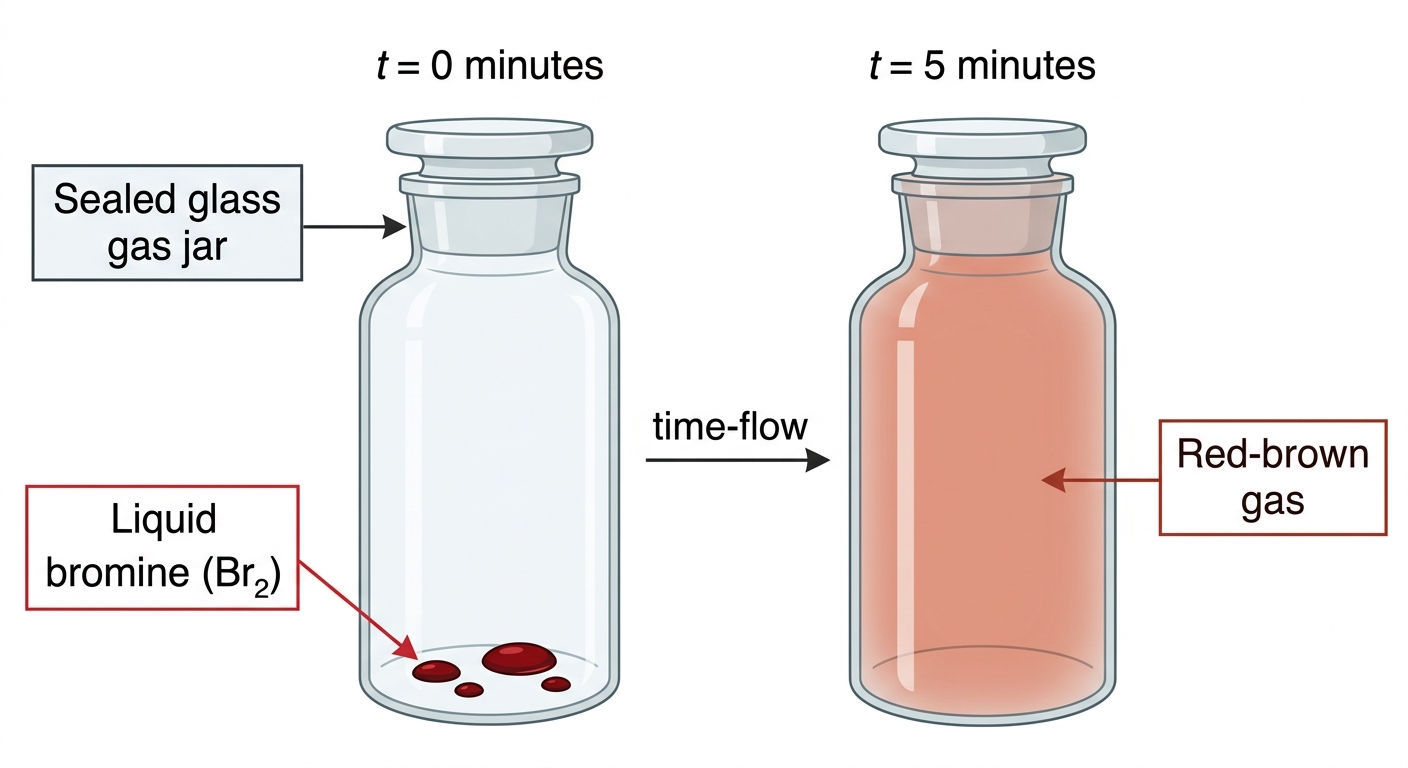
Liquid bromine () is a dark red, volatile liquid at room temperature. A few drops are placed in a sealed gas jar. After 5 minutes, the entire jar contains a uniform red-brown colour, even though no liquid bromine remains at the bottom of the jar.
(a)
State the change of state that has occurred. [1 mark]
(b)
Explain, using the particulate nature of matter, why the colour spreads uniformly throughout the jar. [2 marks]
(c)
Calculate the number of bromine molecules in of bromine gas.
[2 marks]
Solutions
7MasterySAQ-SSolid, liquid, gas phases and changes of state6 marksPaper 2~9 min
Data
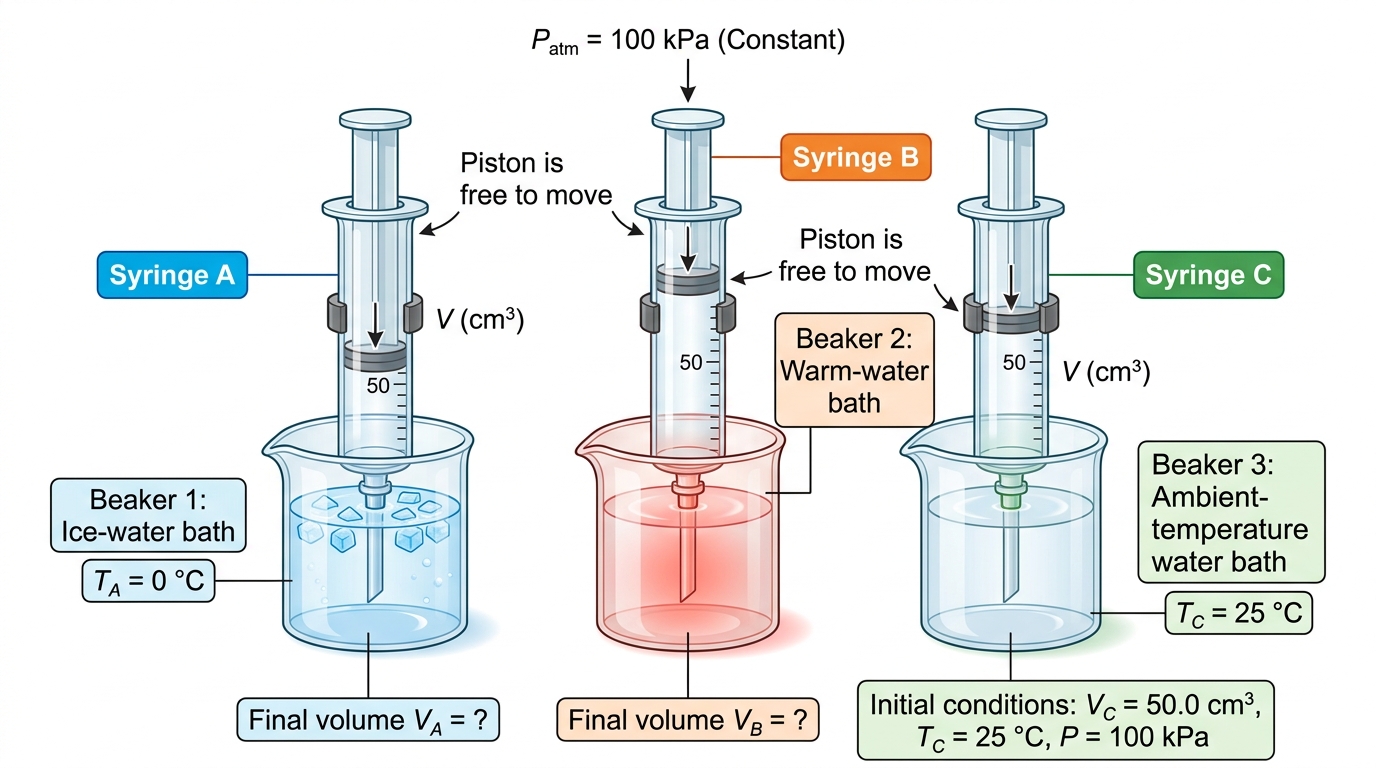
A student places three identical sealed syringes, each containing of the same ideal gas at and , into different water baths. Syringe A is placed in ice water at and Syringe B in warm water at . The plungers are free to move so that pressure remains constant throughout.
(a)
Describe the differences in the motion of gas particles in Syringes A and B after each reaches thermal equilibrium. [2 marks]
(b)
State the relationship between volume and temperature (at constant pressure) and use it to explain why the volume of gas in Syringe A is smaller than in Syringe B. [2 marks]
(c)
Calculate the volume of gas in Syringe A at . [2 marks]
Solutions
8MasterySAQ-SProperties of matter5 marksPaper 2~8 min
A student investigates the physical properties of four unknown substances, W, X, Y, and Z. The results are shown:
- W: Brittle solid, melting point ; does not conduct electricity when solid, conducts when molten.
- X: Soft solid, melting point ; does not conduct electricity in either state.
- Y: Shiny solid, melting point ; conducts electricity when solid and when molten.
- Z: Liquid at room temperature, melting point ; does not conduct electricity; molar mass .
(a)
Describe the bonding and structure of substance W, and explain how two of its properties are consistent with this bonding. [2 marks]
(b)
Identify the type of structure present in substance X and suggest one specific chemical use for a substance with this structure type. [2 marks]
(c)
Substance Z has a molar mass of and does not conduct electricity. Deduce the type of bonding and structure in Z, and explain why Z is a liquid at room temperature rather than a solid or gas. [1 mark]
Solutions
9MasterySAQ-SSolid, liquid, gas phases and changes of state5 marksPaper 2~8 min
A weather balloon is filled with helium gas at ground level where the temperature is and the pressure is . The balloon has a volume of at ground level. The balloon rises to an altitude where the temperature is and the pressure is . The balloon is flexible and expands to maintain internal pressure equal to external atmospheric pressure. Assume helium behaves an ideal gas.
(a)
State, in terms of kinetic molecular theory, how the average kinetic energy of the helium particles changes as the balloon rises. [1 mark]
(b)
Calculate the volume of the balloon at the higher altitude. [2 marks]
(c)
A student claims: "Because the temperature falls as the balloon rises, the balloon must contract." Using your answer to (b) and the combined gas law, evaluate this claim, identifying which variable has the dominant effect on volume. [2 marks]
Solutions
10MasterySAQ-SSolid, liquid, gas phases and changes of state7 marksPaper 2~11 min
A sample of liquid ethanol () is placed in an open beaker in a fume hood at . Over several hours, the liquid completely evaporates. In a separate experiment, the same volume of liquid ethanol is placed in a sealed flask at , and no net change in liquid volume is observed over several days.
(a)
State the term used to describe the equilibrium established between liquid and vapour in the sealed flask. [1 mark]
(b)
Explain, in terms of the particulate nature of matter, why ethanol evaporates completely in the open beaker but not in the sealed flask. [2 marks]
(c)
Calculate the volume of ethanol vapour produced at and when of liquid ethanol evaporates completely. The density of liquid ethanol is and its molar mass is . [2 marks]
(d)
The vapour pressure of ethanol at is . Deduce whether the volume calculated in (c) is consistent with the behaviour observed in the sealed flask, and justify your answer. [2 marks]
Solutions
11MasterySAQ-SSolid, liquid, gas phases and changes of state8 marksPaper 2~12 min
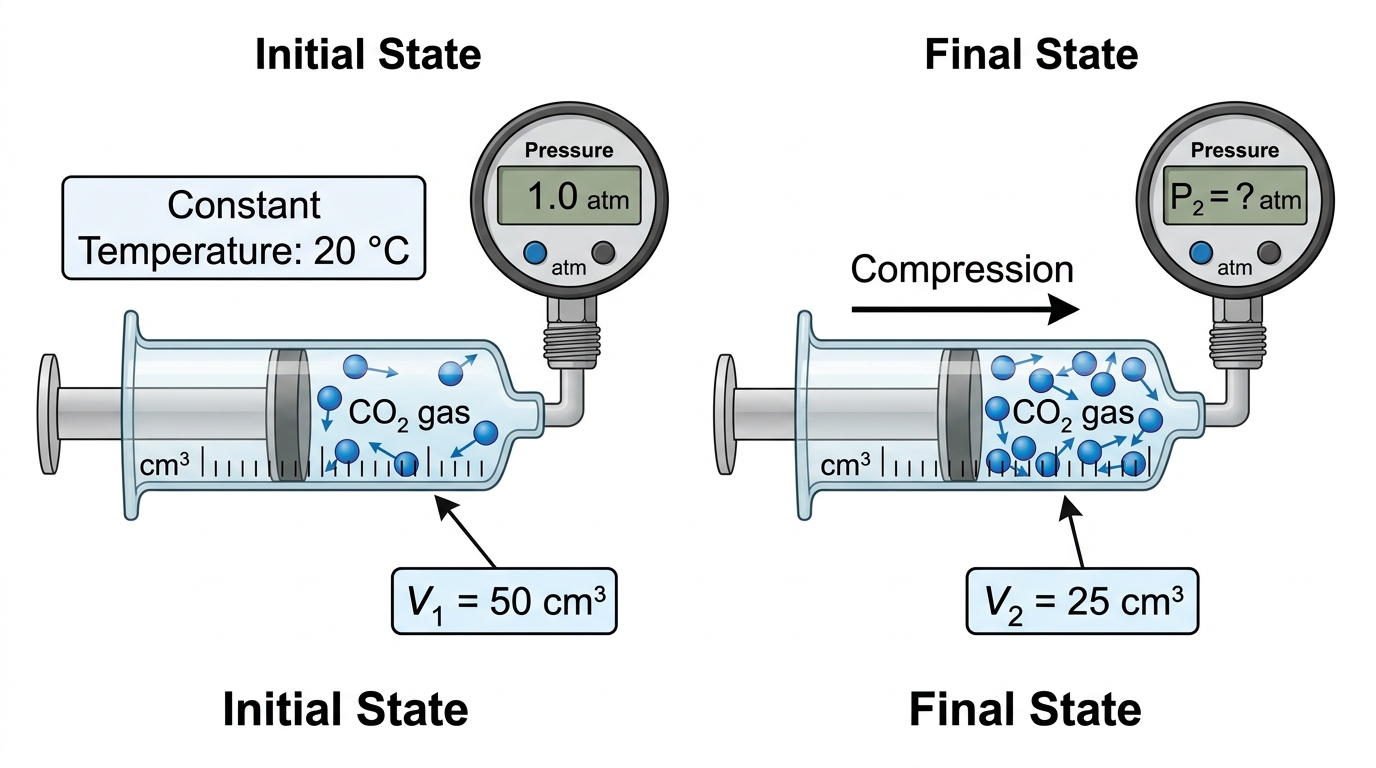
A student compresses a sample of carbon dioxide gas in a syringe at a constant temperature of . The initial volume is at a pressure of .
(a)
State Boyle's Law as a mathematical expression, defining all symbols used. [1 mark]
(b)
Calculate the pressure of the gas after the volume is reduced to , assuming ideal behaviour. [2 marks]
(c)
Using kinetic molecular theory, explain why reducing the volume at constant temperature causes the pressure to increase. [2 marks]
(d)
At very high pressures, the actual pressure of deviates from the value predicted by Boyle's Law. Deduce and explain the direction of this deviation for , referring to intermolecular forces and molecular volume. [3 marks]
Solutions
12MasterySAQ-SProperties of matter7 marksPaper 2~11 min
Iodine () is a solid at room temperature. When gently heated, it sublimes directly from solid to purple vapour without melting. A student places a few crystals of iodine in a sealed flask and heats it gently until the flask fills with purple vapour.
(a)
Describe the change in the arrangement and energy of the particles as solid iodine sublimes. [2 marks]
(b)
State two physical properties of iodine, other than sublimation, that are consistent with it being a molecular (simple covalent) substance. [2 marks]
(c)
Calculate the volume, in , occupied by of iodine vapour at a pressure of and a temperature of .
[3 marks]
Solutions
13MasterySAQ-SProperties of matter7 marksPaper 2~11 min
A student investigates the physical properties of three unknown substances, X, Y, and Z, at room temperature () and pressure (). The student records the following observations:
- Substance X is a brittle, white crystalline solid. It does not conduct electricity when solid, but does conduct electricity when molten. It has a high melting point ().
- Substance Y is a shiny, grey solid. It conducts electricity when solid and can be hammered into a thin sheet without breaking. It has a high melting point ().
- Substance Z is a colourless liquid at room temperature. It does not conduct electricity when pure. It has a melting point of and a boiling point of .
(a)
State the type of bonding and structure present in substance X. [1 mark]
(b)
Explain how the structure of substance X accounts for its high melting point. [2 marks]
(c)
Explain why substance X does not conduct electricity when solid but does conduct electricity when molten. [2 marks]
(d)
A sample of of substance Z is heated to at , converting it entirely to vapour. Calculate the volume, in , occupied by this vapour. Assume ideal gas behaviour.
[2 marks]
Solutions
14MasterySAQ-SSolid, liquid, gas phases and changes of state5 marksPaper 2~8 min
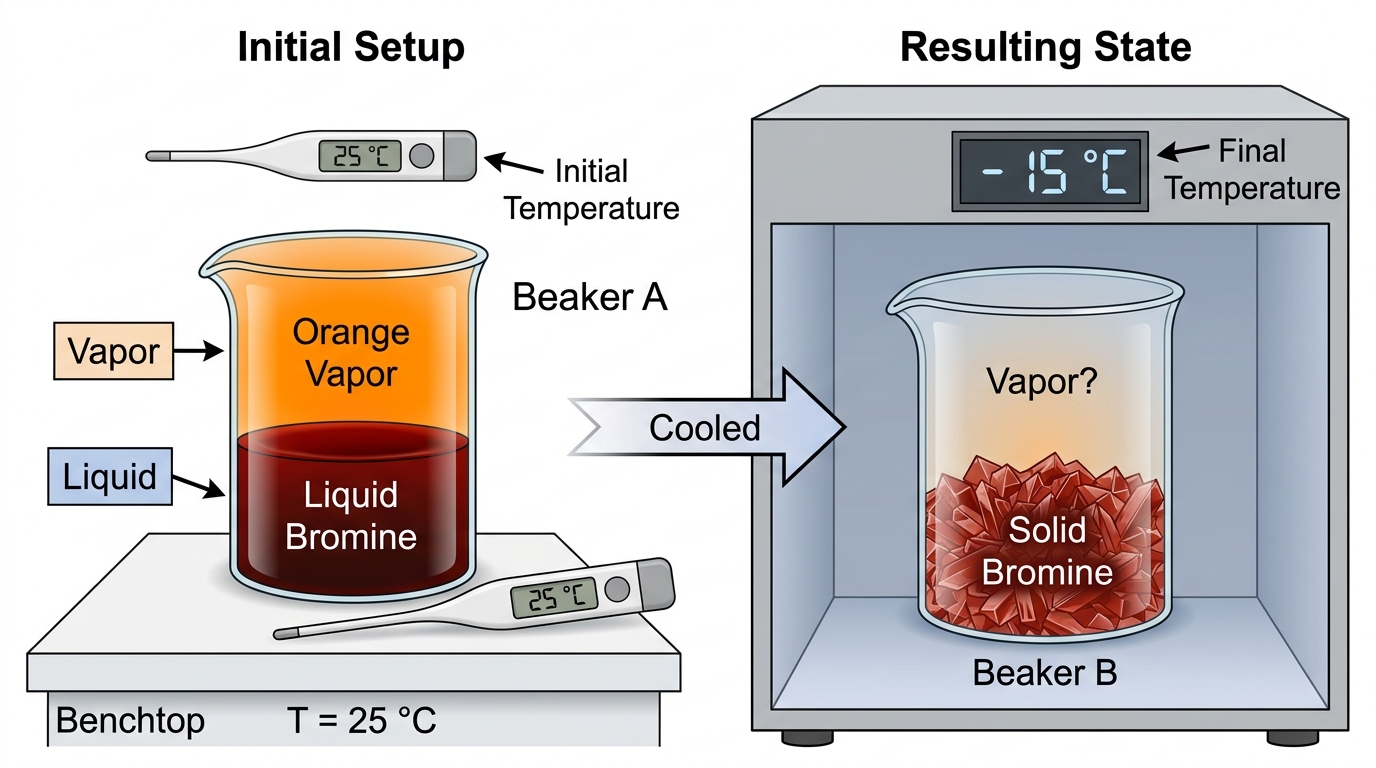
A student examines a sample of bromine, , at room temperature (). Bromine is a dark red liquid that evaporates readily, producing a toxic orange vapour. The melting point of bromine is and its boiling point is .
(a)
State the name of the change of state occurring when liquid bromine at produces orange vapour. [1 mark]
(b)
Describe the changes in particle arrangement and energy as liquid bromine solidifies. [2 marks]
(c)
A student claims that a sample of bromine stored at is entirely in the gaseous state. Evaluate this claim, referring to the data above. [2 marks]
Solutions
15MasterySAQ-SSolid, liquid, gas phases and changes of state5 marksPaper 2~8 min
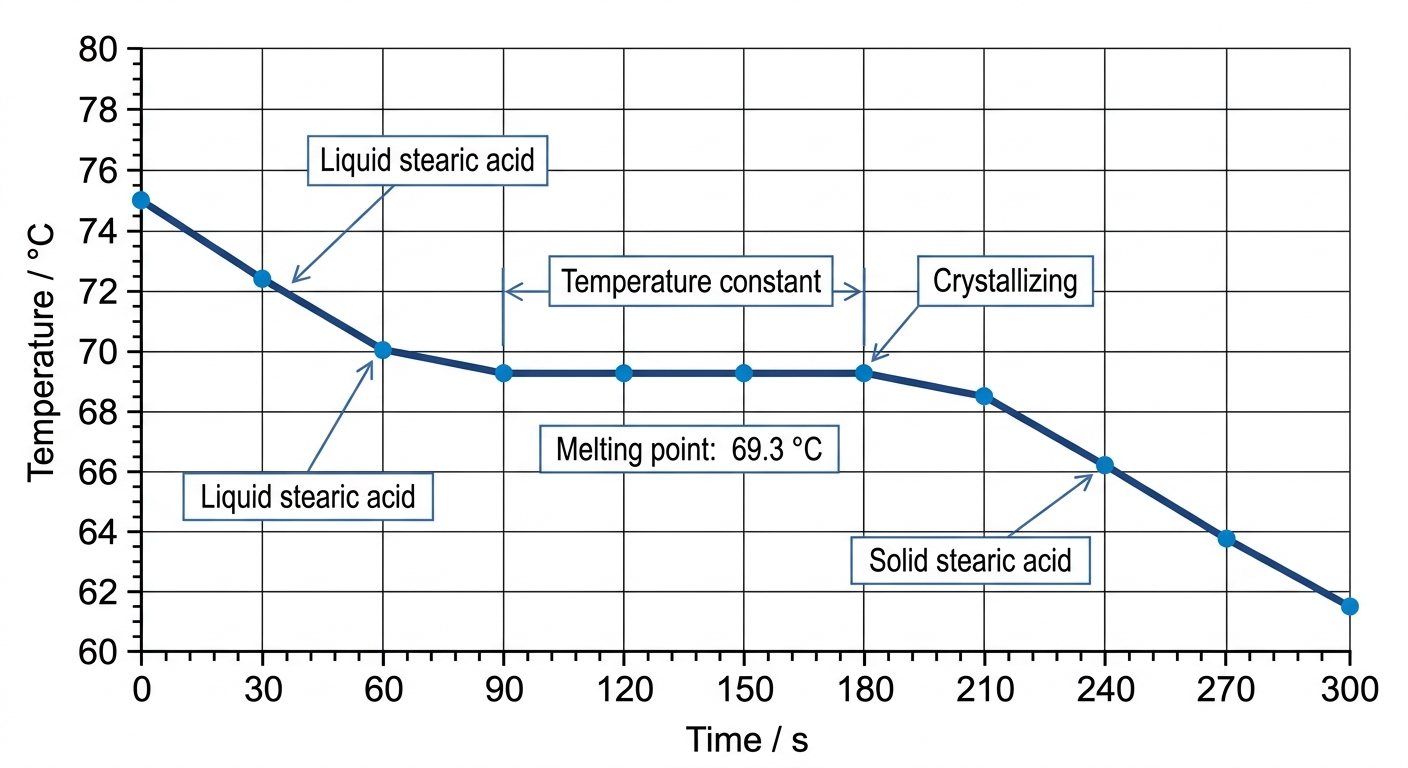
A student investigates the cooling of a pure substance. They heat a sample of liquid stearic acid () to and then allow it to cool in a beaker of still air at . The temperature of the stearic acid is recorded every . The melting point of stearic acid is .
Time / s — 0 — 30 — 60 — 90 — 120 — 150 — 180 — 210 — 240 — 270 — 300
Temperature / °C — 75.0 — 72.4 — 70.1 — 69.3 — 69.3 — 68.5 — 66.2 — 63.8 — 61.5
(a)
State the phase of the stearic acid at and at . [1 mark]
(b)
Calculate the average rate of temperature decrease of the stearic acid between and . Give your answer in . [2 marks]
(c)
Explain, in terms of the particulate nature of matter, why the temperature of the stearic acid remains constant between and . [2 marks]
Solutions
16MasterySAQ-SProperties of matter6 marksPaper 2~9 min
A student measures the density of a sample of liquid ethanol () at and finds it to be . The student then cools the ethanol to , where it becomes a solid with a density of .
(a)
Explain why the density of ethanol increases when it changes from liquid to solid. [2 marks]
(b)
State two physical properties, other than density, that differ between liquid ethanol and solid ethanol, and for each property state which phase has the greater value. [2 marks]
(c)
A sample of ethanol has a mass of .
(i) Calculate the volume, in , occupied by this sample in the liquid state at . [1]
(ii) Determine the percentage decrease in volume when this sample solidifies at . [2 marks]
(ii) Determine the percentage decrease in volume when this sample solidifies at . [2 marks]
Solutions
17MasterySAQ-SProperties of matter7 marksPaper 2~11 min
A student places a block of ice at into a beaker containing of water at . The ice melts completely and the final temperature of the mixture is . Assume no heat is lost to the surroundings. The specific heat capacity of liquid water is and the specific latent heat of fusion of ice is .
(a)
Describe the energy changes that occur at the molecular level when ice melts at . [2 marks]
(b)
Describe how liquid water differs from ice in terms of particle arrangement and density. [2 marks]
(c)
Using an energy balance, calculate the mass of ice that would need to melt to account for all the heat lost by the liquid water as it cools from to . [3 marks]
Solutions
18MasterySAQ-SSolid, liquid, gas phases and changes of state5 marksPaper 2~8 min
A student heated a sample of solid iodine, , in a sealed container. As the iodine was heated, the solid turned directly into a purple vapour without passing through a liquid phase. When the container was cooled back to room temperature, solid iodine crystals reappeared on the walls.
(a)
State the name of the process by which solid iodine converts directly to vapour. [1 mark]
(b)
Explain, in terms of intermolecular forces and energy, why solid iodine undergoes this process rather than melting under reduced pressure. [2 marks]
(c)
Calculate the energy, in kJ, required to convert of solid iodine at its sublimation temperature entirely into vapour.
[2 marks]
Solutions
19MasterySAQ-SSolid, liquid, gas phases and changes of state5 marksPaper 2~8 min
A student prepared a saturated solution of sodium sulfate () in water at by dissolving excess salt in of water and filtering off the undissolved solid. The clear saturated solution was then heated to , and solid sodium sulfate appeared at the bottom of the beaker.
The solubility of is of water at and of water at .
(a)
State the term used to describe the process by which solid forms from the solution heating. [1 mark]
(b)
Explain, using the concept of dynamic equilibrium and Le Chatelier's principle, why solid appears when the saturated solution is heated. [2 marks]
(c)
Calculate the mass of solid that appears when the saturated solution prepared at is heated to . [2 marks]
Solutions
20MasterySAQ-SSolid, liquid, gas phases and changes of state5 marksPaper 2~8 min
A student investigated the cooling behaviour of pure lauric acid (). The liquid was heated to and allowed to cool to room temperature while temperature was recorded every . The temperature dropped steadily from to , remained constant at for several minutes, then dropped again to .
The enthalpy of fusion of lauric acid is .
(a)
State the change of state occurring during the constant-temperature region at . [1 mark]
(b)
Explain, in terms of the particulate nature of matter, why the temperature remains constant during this change of state. [2 marks]
(c)
The energy released during the constant-temperature region was . Calculate the mass of lauric acid used. [2 marks]
Solutions
Showing 20 of 59 free questions