The Nuclear Atom · Paper 2 — Free Chemistry SL Practice Questions
Free questions
Open in full, with answers, mark scheme and examiner insights.
Structure of the atom: Protons, neutrons, electrons
The table gives data for three subatomic particles P, Q and R.
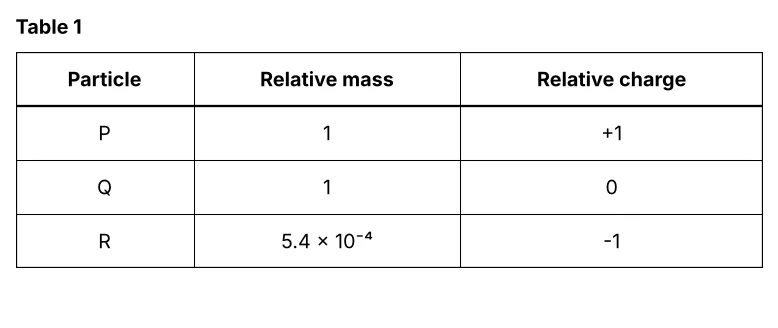
Identify the particles P, Q and R.
State where particle Q is found in an atom.
State why an atom has no overall charge.
revisionprep.com
Summary Answer
Not available for this question.
Model Answer
Not available for this question.
Marking Scheme
Not available for this question.
Examiner Insights
Not available for this question.
Structure of the atom: Protons, neutrons, electrons
Aluminium oxide contains the ions Al and O.
Deduce the number of protons, neutrons and electrons in one Al ion.
Another ion has 8 protons, 10 neutrons and 10 electrons. Write down its nuclide symbol, including its charge.
State why the mass of an Al ion is almost the same as the mass of an Al atom.
revisionprep.com
Summary Answer
Not available for this question.
Model Answer
Not available for this question.
Marking Scheme
Not available for this question.
Examiner Insights
Not available for this question.
Structure of the atom: Protons, neutrons, electrons
Data
Determine how many times heavier a proton is than an electron.
An atom of Fe contains 26 electrons. Calculate the percentage of the total mass of the atom that is due to its electrons.
Suggest why the mass number is defined using only protons and neutrons.
Calculate the mass of the electrons lost when one ⁵⁶Fe atom forms an Fe³⁺ ion, and state whether the mass number changes.
revisionprep.com
Summary Answer
Not available for this question.
Model Answer
Not available for this question.
Marking Scheme
Not available for this question.
Examiner Insights
Not available for this question.
Atomic number, mass number, isotopes
A student studies the data for three species X, Y and Z of the same element.
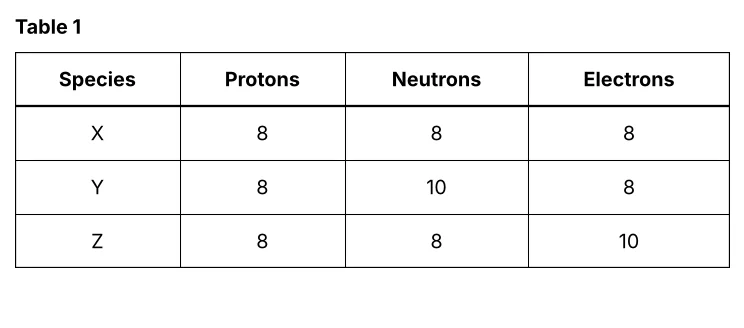
Deduce the relationship between X and Y.
Determine the mass number of Y.
Deduce the charge on Z and write its nuclide symbol, including its charge.
revisionprep.com
Summary Answer
Not available for this question.
Model Answer
Not available for this question.
Marking Scheme
Not available for this question.
Examiner Insights
Not available for this question.
Atomic number, mass number, isotopes
An ion X contains 10 electrons and 14 neutrons. An ion Y has the same number of electrons as X and a mass number of 19.
Deduce the atomic number of X.
Deduce the nuclide symbol, including the charge, for the ion X.
Deduce the atomic number of Y and identify the element.
Determine the number of neutrons in the ion Y.
Another isotope of X has 15 neutrons. State the mass number of this isotope.
State the full electron configuration of the ions X³⁺ and Y⁻.
revisionprep.com
Summary Answer
Not available for this question.
Model Answer
Not available for this question.
Marking Scheme
Not available for this question.
Examiner Insights
Not available for this question.
Relative atomic mass from isotopic abundance
Elements in the periodic table are arranged in order of atomic number. Tellurium (atomic number 52) and iodine (atomic number 53) show that this is not the same as an order by relative atomic mass. Iodine has one stable isotope, I, and its relative atomic mass is 126.9. Naturally occurring tellurium consists of the isotopes below.
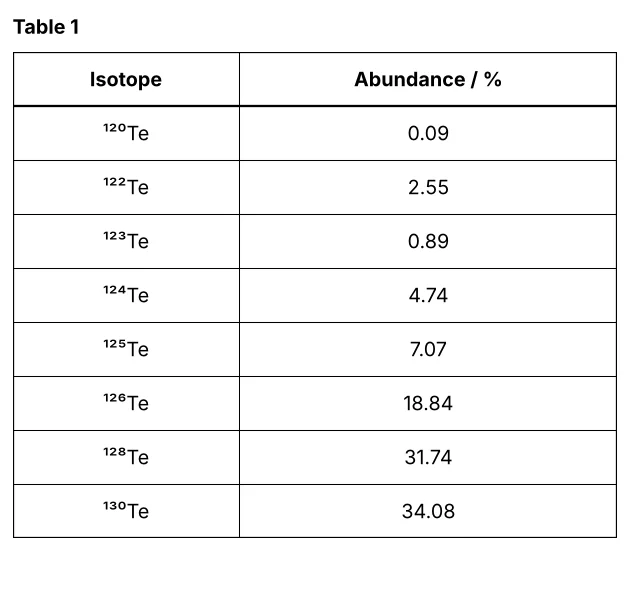
State the number of neutrons in I and in Te.
Calculate the relative atomic mass of tellurium from the table, using mass numbers, to one decimal place.
Explain why tellurium is placed before iodine in the periodic table although its relative atomic mass is greater.
Explain why tellurium atoms can have a greater average mass than iodine atoms although they have fewer protons.
Calculate the relative atomic mass of tellurium in a sample from which all of the ¹³⁰Te has been removed and in which the other isotopes are present in their original proportions. Use mass numbers and give your answer to one decimal place.
Discuss whether the relative atomic masses of tellurium and iodine could be used to decide the order in which they appear in the periodic table.
revisionprep.com
Summary Answer
Not available for this question.
Model Answer
Not available for this question.
Marking Scheme
Not available for this question.
Examiner Insights
Not available for this question.
That's every free question here — 6 of 60.
+54 more questions, plus Mock Papers & Worksheets, are waiting in Premium.