You're viewing 2 free preview questions for Economics HL — subscribe to unlock 59 more, plus the Full Question Bank, Mock Papers & Worksheets.Upgrade
Barriers to Economic Growth and/or Economic Development · Paper 2 — Free Economics HL Practice Questions
1MasteryLAQFactors inhibiting economic development10 marksPaper 2~15 min

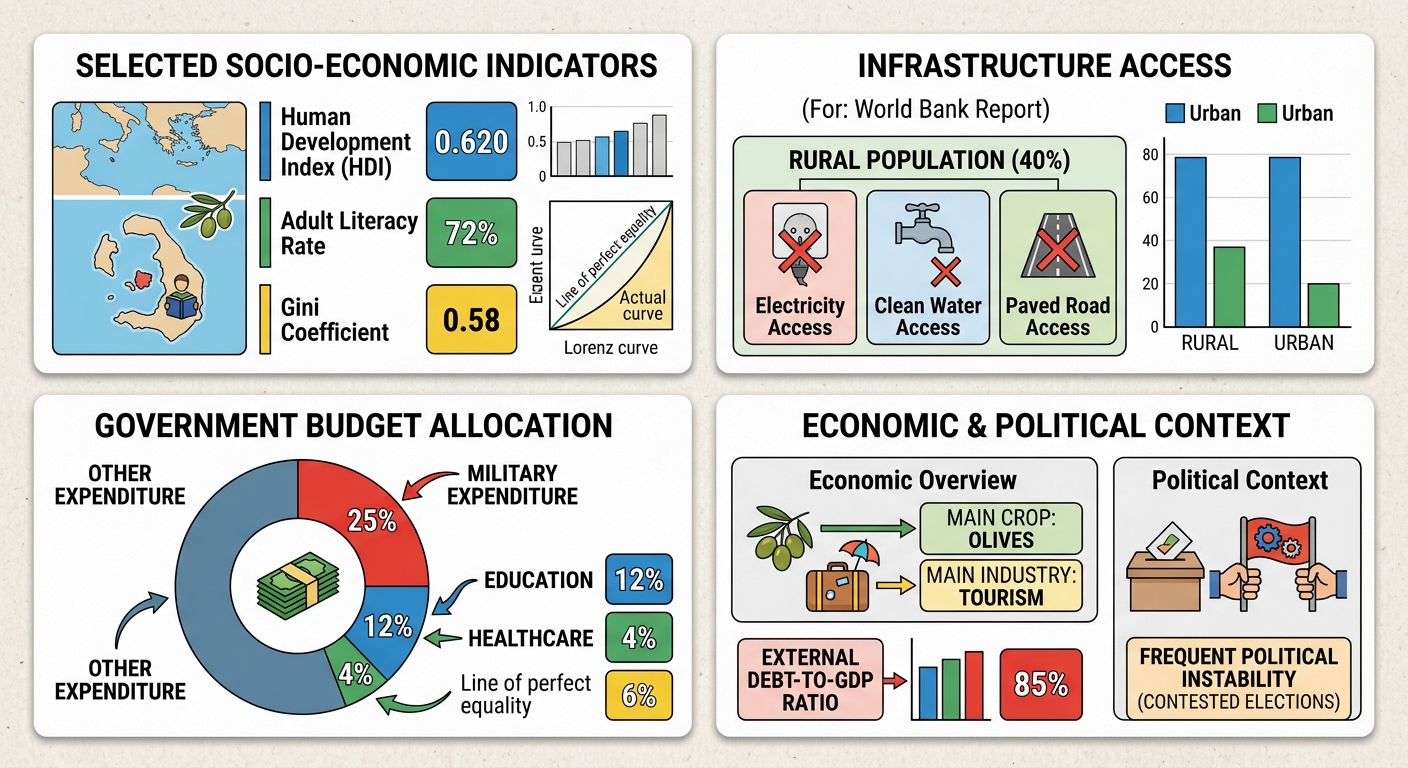
The Republic of Santorini is a small island nation in the Mediterranean Sea. It has a Human Development Index (HDI) of , a Gini coefficient of , and an adult literacy rate of . The economy relies heavily on tourism and the export of a single crop, olives. A recent World Bank report identified that of the population lives in rural areas with limited access to electricity, clean water, and paved roads. The government allocates of its budget to education, to healthcare, and to military expenditure. Santorini has an external debt-to-GDP ratio of and experiences frequent political instability due to contested elections.
(a)
Using the data provided, explain how one internal barrier is inhibiting economic development in Santorini. [2 marks]
(b)
Using the data provided, explain how a different internal barrier is inhibiting economic development in Santorini, and compare its severity to the barrier identified in part (a). [4 marks]
(c)
Discuss the view that improving access to education and healthcare would be more effective than reducing political instability in promoting long-term economic development in Santorini. [4 marks]

Solutions
2MasteryLAQStructural challenges in developing economies10 marksPaper 2~15 min
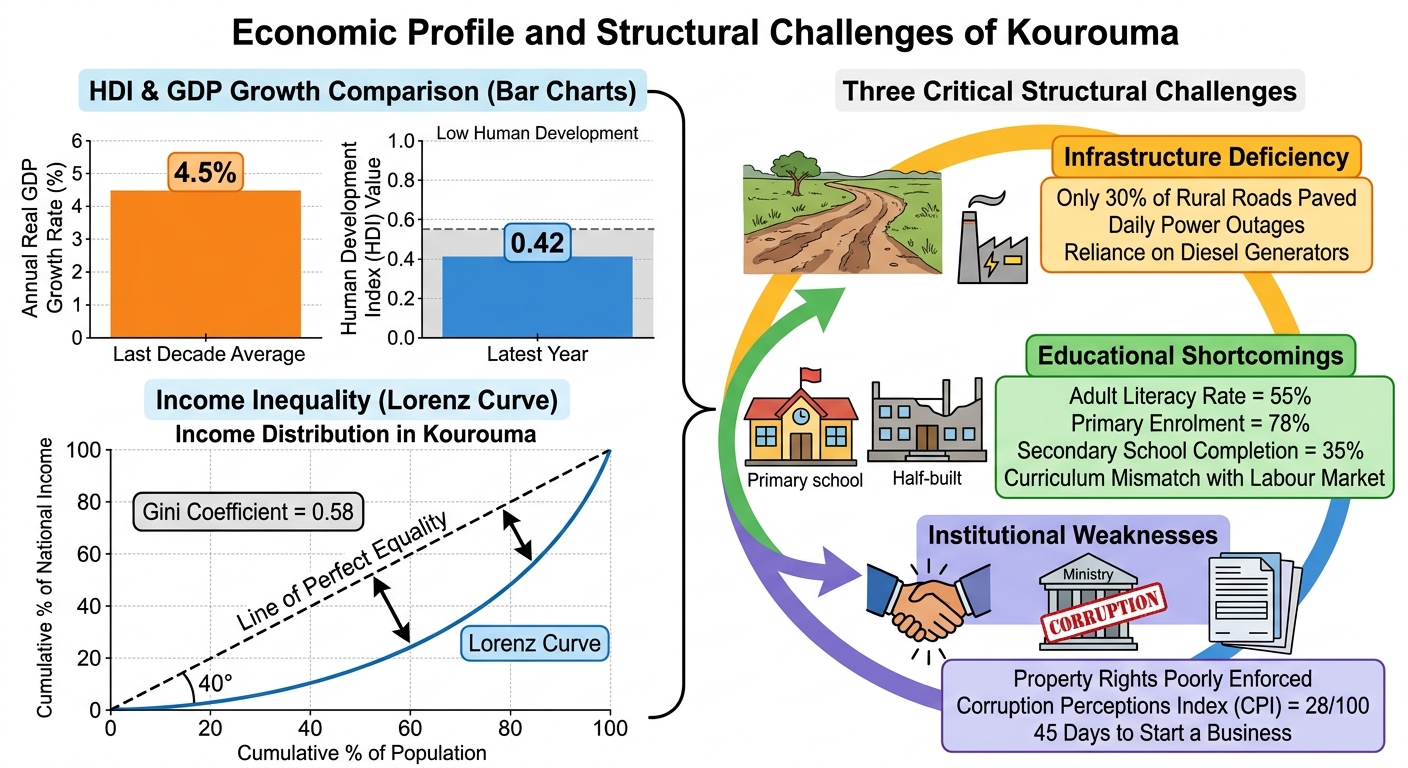
The West African nation of Kourouma has experienced steady GDP growth of per year over the last decade, yet its Human Development Index (HDI) value has barely changed, remaining at . The country has a high Gini coefficient of . A recent World Bank report identified three critical structural challenges:
- Infrastructure Deficiency: Only of rural roads are paved. Power outages occur daily in major cities, forcing firms to rely on expensive diesel generators.
- Educational Shortcomings: The adult literacy rate is . Net primary school enrolment is , but only of students complete secondary school. The curriculum is not aligned with labour market needs.
- Institutional Weaknesses: Property rights are poorly enforced. Corruption is widespread, with a Corruption Perceptions Index (CPI) score of . Starting a business requires days of bureaucratic procedures.
The government of Kourouma is considering two policy options:
- Option A: A large-scale loan from the International Development Association (IDA) to build a national highway network and a reliable power grid.
- Option B: A conditional cash transfer (CCT) programme that pays poor families USD 50 per month for each child who attends school regularly.
(a)
Using economic theory, explain how two of the structural challenges described in the data could create a cycle of low economic development in Kourouma. [4 marks]
(b)
With reference to the specific data provided, evaluate the potential of either Option A or Option B to break this cycle of low economic development. In your answer, discuss at least one strength and one limitation of your chosen option, and justify whether it is sufficient on its own to raise Kourouma's HDI. [6 marks]
Solutions
That's every free question here — 2 of 61.
+59 more questions, plus Mock Papers & Worksheets, are waiting in Premium.