You're viewing 2 free preview questions for Economics HL — subscribe to unlock 87 more, plus the Full Question Bank, Mock Papers & Worksheets.Upgrade
Economic Integration · Paper 2 — Free Economics HL Practice Questions
1MasteryLAQRegional economic agreements (EU, NAFTA etc.)10 marksPaper 2~15 min

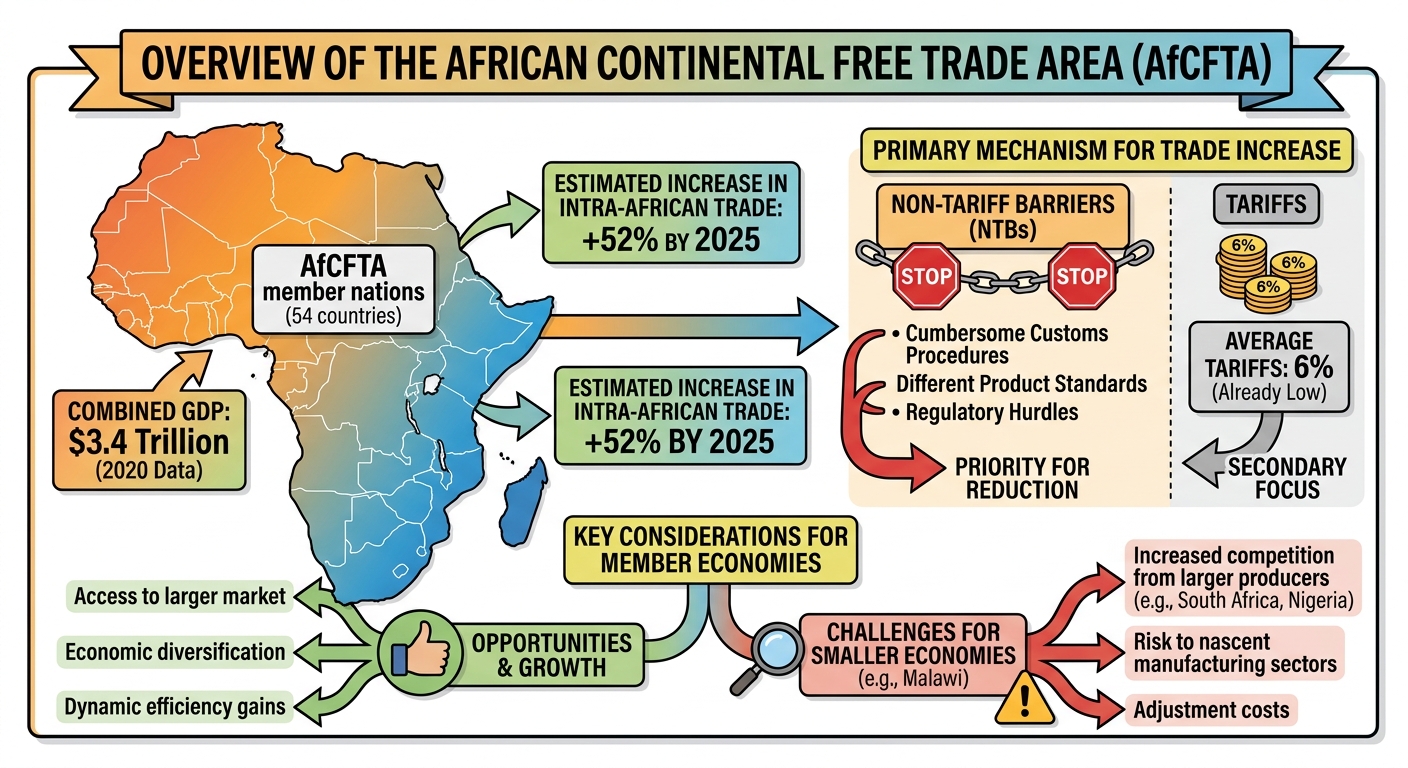
The African Continental Free Trade Area (AfCFTA) came into effect in 2020, linking 54 African nations with a combined GDP of USD 3.4 trillion. The United Nations Economic Commission for Africa estimates that AfCFTA could increase intra-African trade by by 2025, primarily by reducing non-tariff barriers (NTBs) such as cumbersome customs procedures and divergent product standards, rather than tariffs, which averaged only . Smaller economies such as Malawi fear that their nascent manufacturing sectors will be unable to compete with larger producers such as South Africa or Nigeria.
(a)
Explain how the AfCFTA differs from a customs union in terms of each member's external trade policy autonomy. [2 marks]
(b)
Explain one specific mechanism by which reducing NTBs within the AfCFTA could increase economic integration beyond what tariff elimination alone achieves. [2 marks]
(c)
Evaluate whether the dynamic benefits of AfCFTA membership are likely to outweigh the static costs for a small, low-income economy such as Malawi, given that tariffs were already low before the agreement. [6 marks]

Solutions
2MasteryLAQRegional economic agreements (EU, NAFTA etc.)14 marksPaper 2~21 min
Data
In 2023, the European Union (EU) and the Southern Common Market (MERCOSUR) were finalising a long-negotiated free trade agreement. Under the proposed agreement:
- The EU would eliminate tariffs on imports of MERCOSUR agricultural products (e.g., beef, soybeans) over a 10-year period.
- MERCOSUR would eliminate tariffs on imports of EU manufactured goods (e.g., cars, machinery) over a 15-year period.
- Both blocs would adopt common rules on intellectual property and sanitary standards.
- The agreement does not include the free movement of labour or the creation of a common currency.
A trade economist commented: "This agreement will create significant trade creation effects for both blocs, but it may also lead to trade diversion for some MERCOSUR member states, particularly those that previously imported cheaper agricultural inputs from non-member countries like the United States."
(a)
State the type of regional trading agreement that the EU–MERCOSUR deal represents, and identify one piece of evidence from the Data to support your answer. [2 marks]
(b)
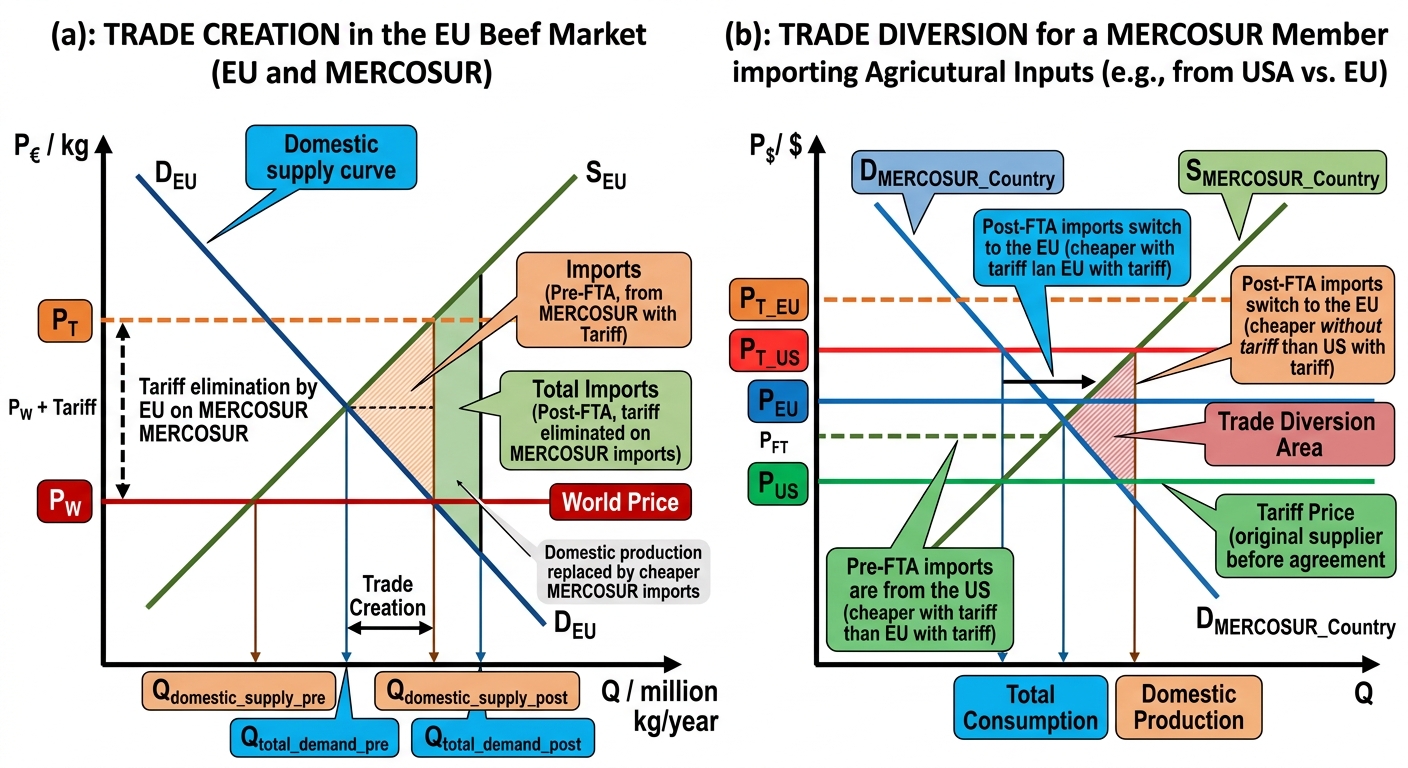
Using a labelled , explain how the EU–MERCOSUR agreement could lead to trade creation in the EU market for beef. In your answer, refer to the Data. [4 marks]
(c)
Using a labelled , explain how the agreement could lead to trade diversion for a MERCOSUR member state that previously imported agricultural inputs from the United States. In your answer, refer to the Data. [3 marks]
(d)
Evaluate the likely economic consequences of this agreement for a developing MERCOSUR member country such as Paraguay, compared with a developed EU member country such as Germany. In your answer, make a justified overall judgement about which country is more likely to benefit in the long run. [5 marks]
Solutions
That's every free question here — 2 of 89.
+87 more questions, plus Mock Papers & Worksheets, are waiting in Premium.