You're viewing 3 free preview questions for Economics HL — subscribe to unlock 51 more, plus the Full Question Bank, Mock Papers & Worksheets.Upgrade
Measuring Development · Paper 2 — Free Economics HL Practice Questions
1MasteryLAQChallenges in measuring development10 marksPaper 2~15 min

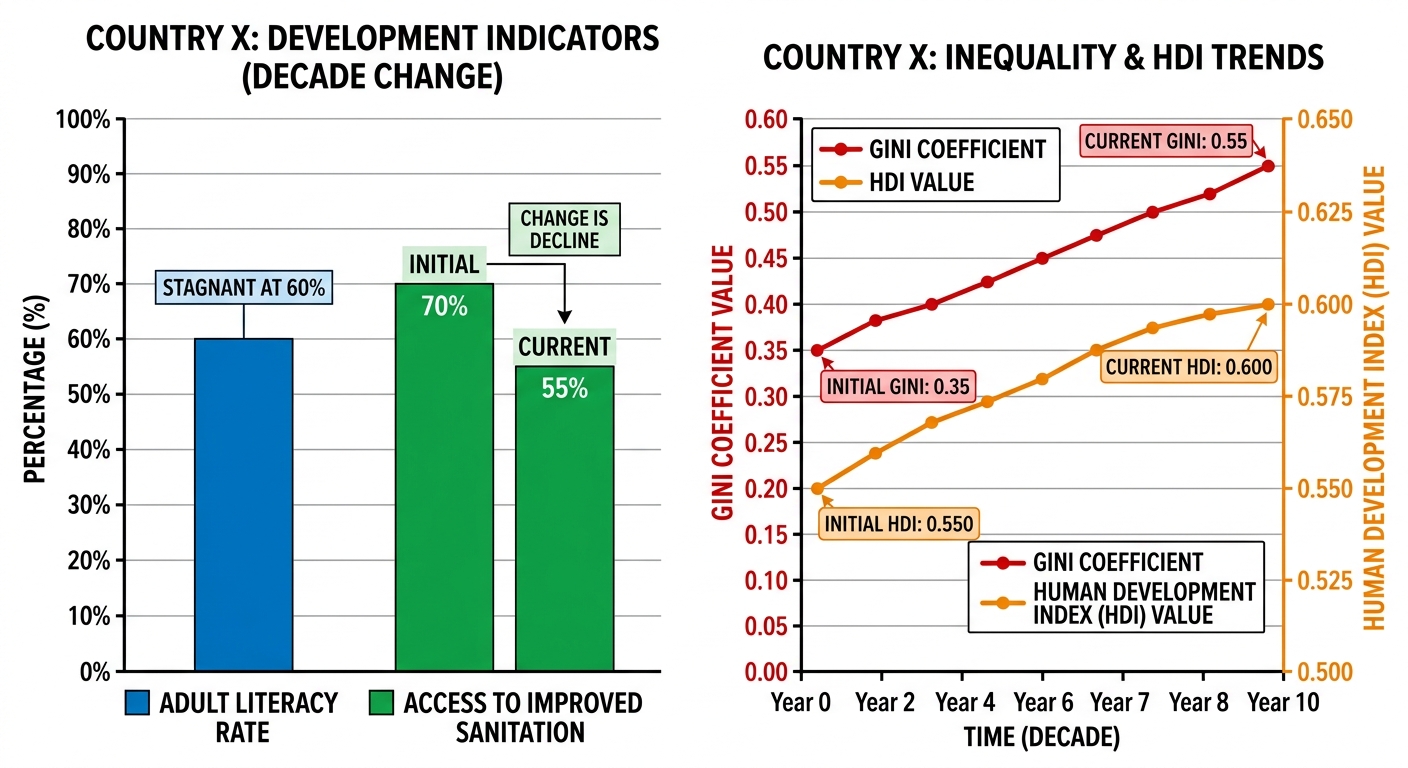
Country X has experienced the following changes over the past decade:
- Real GDP per capita has increased by an average of per year
- The Gini coefficient has risen from to
- The adult literacy rate has remained stagnant at
- Access to improved sanitation has fallen from to of the population
- The Human Development Index (HDI) value has increased from to
(a)
Explain why real GDP per capita growth alone is an inadequate measure of development for Country X. Use economic theory and the data provided to support your answer. [4 marks]
(b)
Evaluate the extent to which the HDI provides a more complete picture of development in Country X than GDP per capita alone, and assess which limitation of the HDI is most significant for policymakers in Country X. [6 marks]

Solutions
2MasteryLAQEconomic, social and environmental factors in development10 marksPaper 2~15 min
Data
HDI is a composite index measuring health (life expectancy at birth), education (mean years of schooling and expected years of schooling), and standard of living (GNI per capita, PPP). HDI values range from 0 to 1. The Gini coefficient measures income inequality, where 0 represents perfect equality and 1 represents perfect inequality.
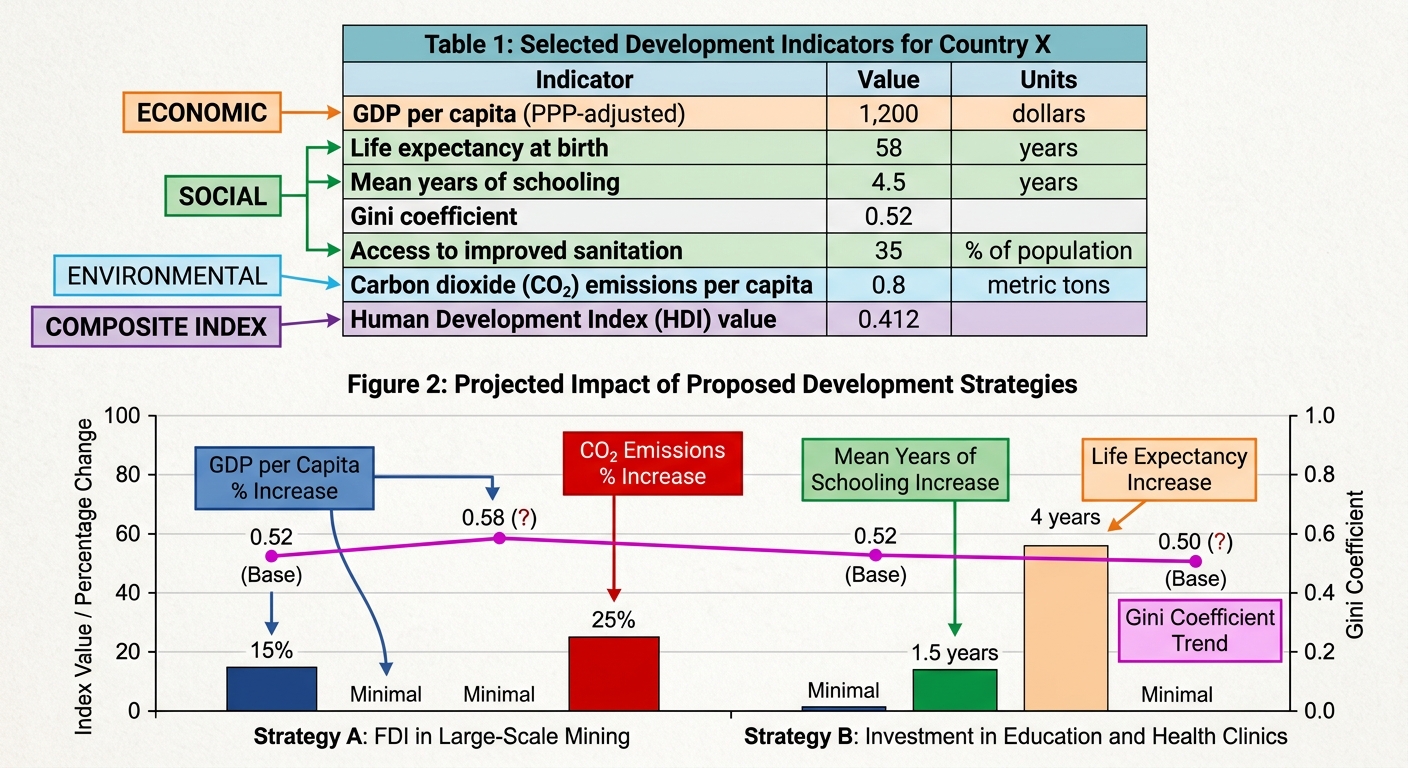
Country X is a low-income country in sub-Saharan Africa with the following development indicators:
- GDP per capita: USD 1,200 (PPP-adjusted)
- Life expectancy at birth: 58 years
- Mean years of schooling: 4.5 years
- Gini coefficient: 0.52
- Access to improved sanitation: 35 percent of the population
- Carbon dioxide emissions per capita: metric tons
- Human Development Index (HDI) value: 0.412
The government of Country X is considering two alternative development strategies:
- Strategy A: Attract foreign direct investment (FDI) into large-scale mining operations, projected to increase GDP per capita by over five years, requiring the resettlement of 20,000 rural farmers and increasing emissions by .
- Strategy B: Invest USD 200 million in primary schools and rural health clinics, projected to increase mean years of schooling to 6.0 years and life expectancy to 62 years over five years, with minimal environmental impact.
(a)
Using the data provided, explain how each of the three HDI dimensions reflects the level of development in Country X. [4 marks]
(b)
Evaluate the extent to which the HDI is a useful measure for comparing Strategy A and Strategy B as development options for Country X. [6 marks]
Solutions
3MasteryLAQEconomic, social and environmental factors in development10 marksPaper 2~15 min
Data
HDI is a composite index based on health, education, and standard of living. GII measures gender disparities in reproductive health, empowerment, and labour market participation. MPI measures overlapping deprivations in health, education, and living standards at the household level.
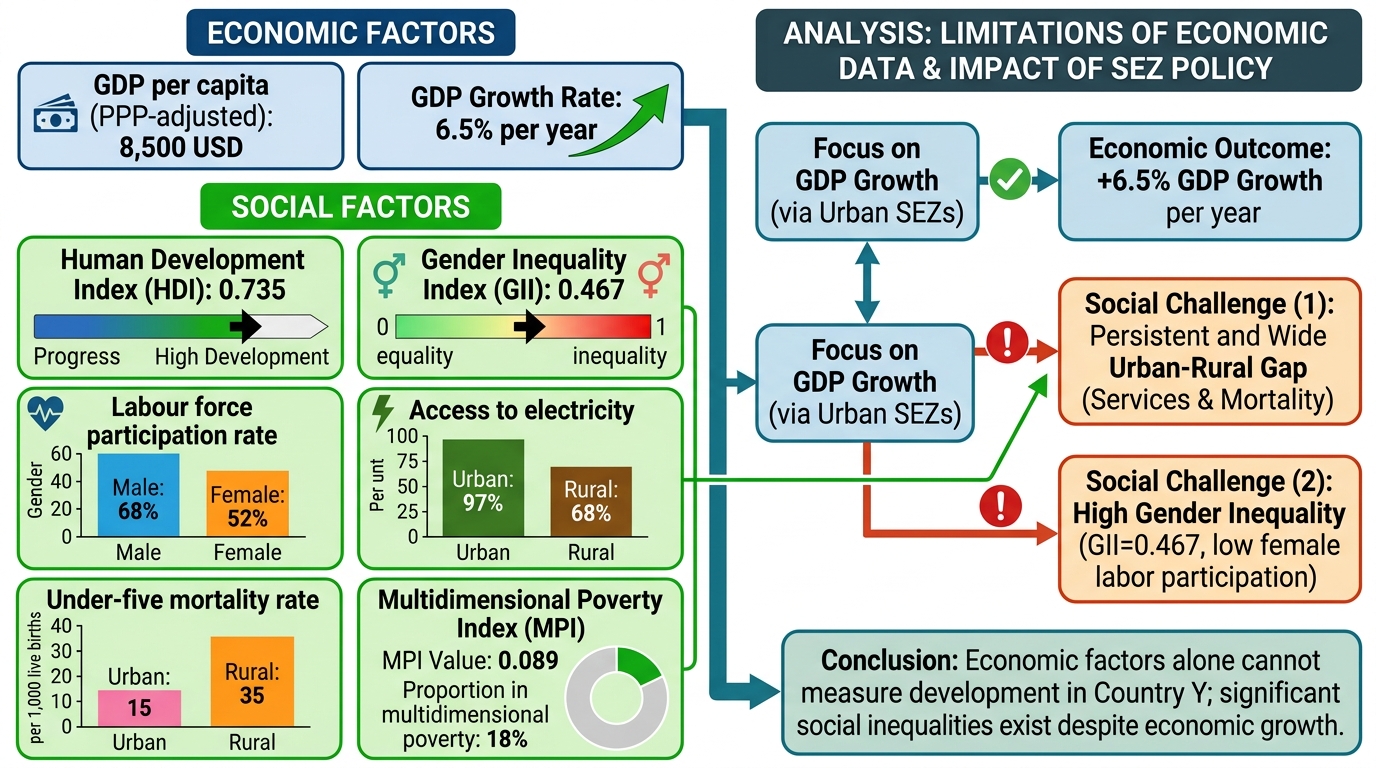
Country Y is a middle-income country in Southeast Asia with the following development characteristics:
- GDP per capita: USD 8,500 (PPP-adjusted)
- Human Development Index (HDI):
- Gender Inequality Index (GII): (where $0 =$ perfect equality, $1 =$ maximum inequality)
- Labour force participation rate: male, female
- Access to electricity: of urban areas, of rural areas
- Under-five mortality rate: per live births (urban: ; rural: )
- Multidimensional Poverty Index (MPI): ; of the population in multidimensional poverty
The government of Country Y has implemented a policy promoting export-oriented manufacturing in urban Special Economic Zones (SEZs). GDP growth has risen to per year, but the urban–rural gap in access to services has widened.
(a)
Explain why GDP per capita alone is insufficient to measure the level of development in Country Y. Use at least three specific data points from the text to support your answer. [4 marks]
(b)
Evaluate the likely impact of the SEZ policy on social development in Country Y. In your conclusion, make a justified judgement about whether the net effect on social development is positive or negative, using the data provided. [6 marks]
Solutions
That's every free question here — 3 of 54.
+51 more questions, plus Mock Papers & Worksheets, are waiting in Premium.