You're viewing free preview questions. Upgrade to access more Economics HL questions.Upgrade
What is Economics? · Paper 1 — Free Economics HL Practice Questions
1FoundationSAQ-SThe problem of scarcity and choice6 marksPaper 1~9 min

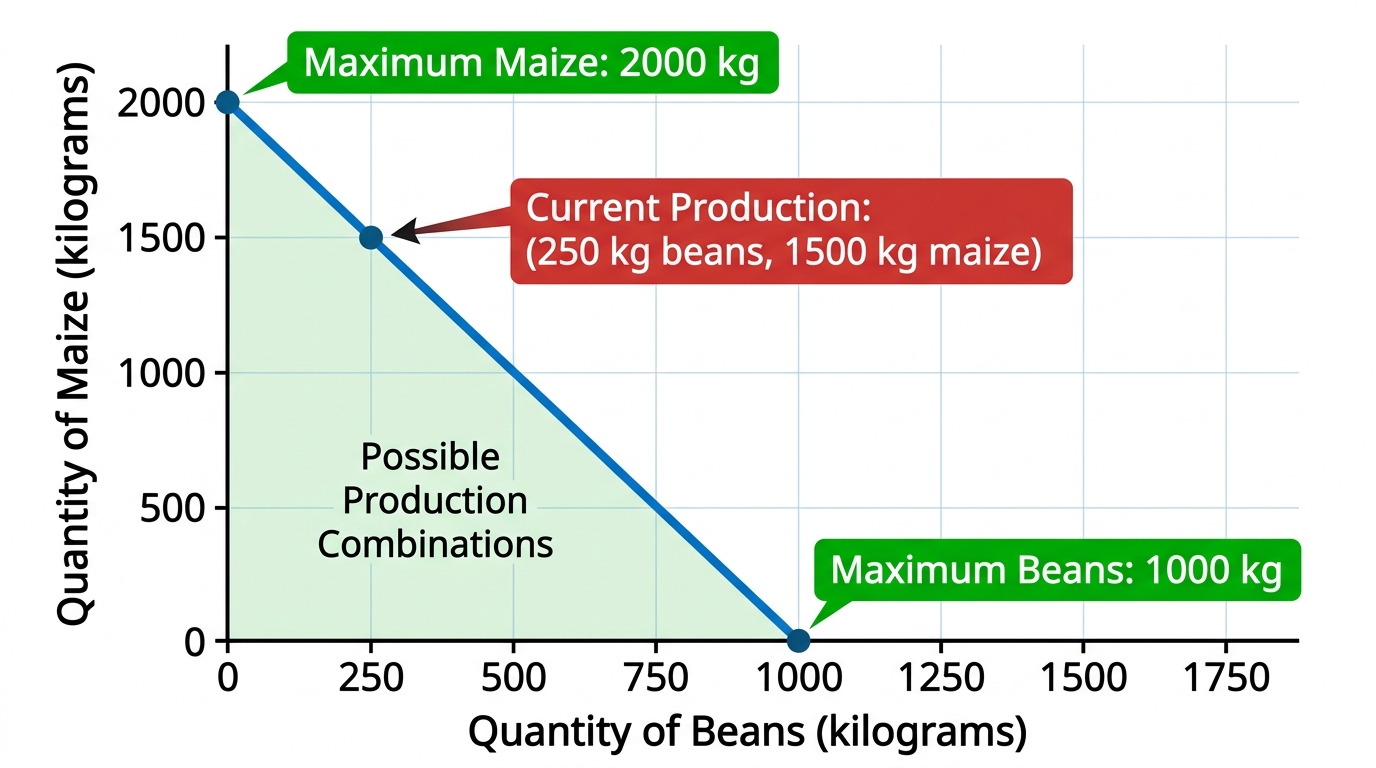
A farmer in Kenya has a fixed plot of land. In one growing season, she can produce either of maize or of beans, or any linear combination along her production possibilities frontier (PPF). She currently produces of maize and of beans.
(a)
State the economic problem of scarcity as it applies to this farmer. [1 mark]
(b)
Calculate the opportunity cost, in kilograms of beans, of producing of maize rather than of maize. [2 marks]
(c)
Evaluate whether the farmer's current production point represents an efficient use of her land. [3 marks]

Solutions
2FoundationSAQ-SThe problem of scarcity and choice8 marksPaper 1~12 min
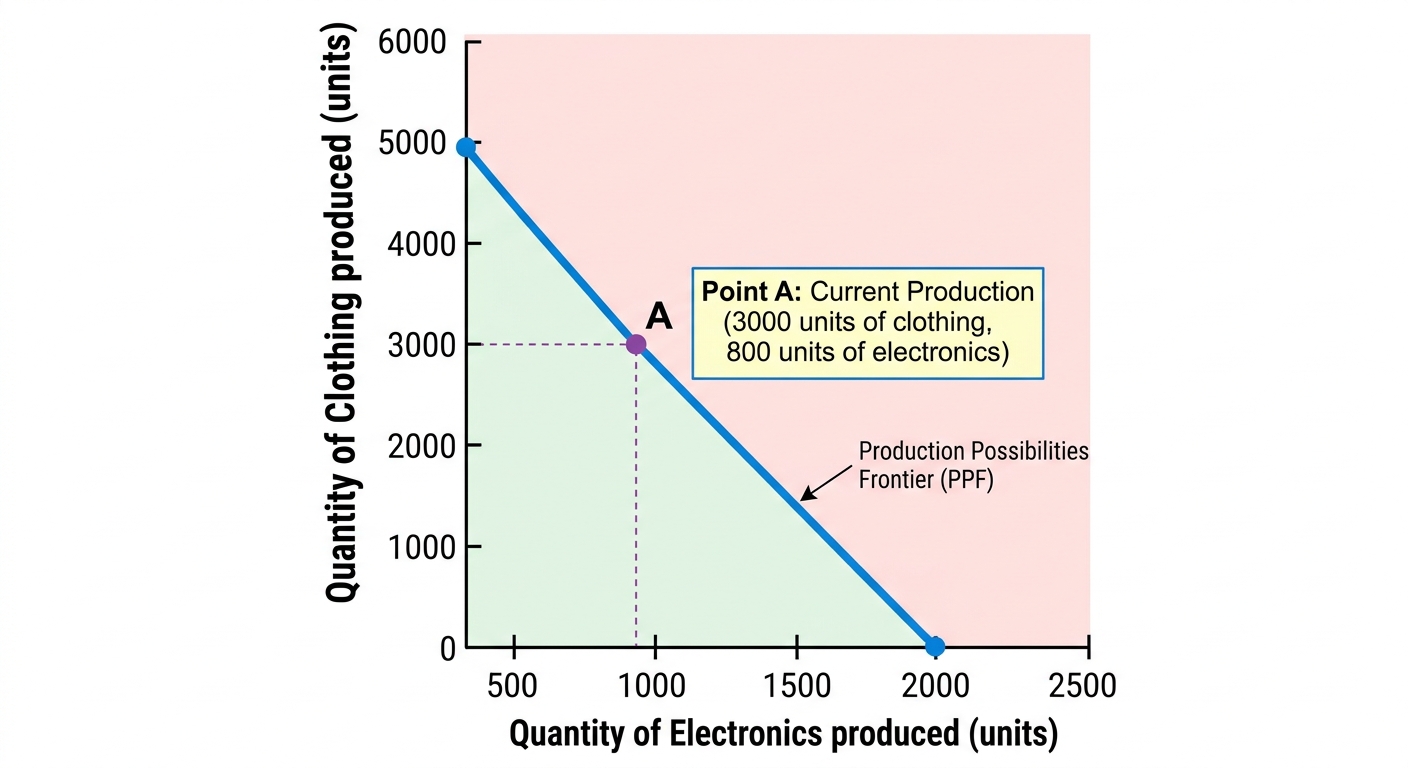
A factory in Bangladesh has a fixed amount of capital and labour. It can produce either units of clothing or units of electronics, or any combination along a straight-line PPF. It currently produces units of clothing and units of electronics.
(a)
State two factors of production used by this factory. [2 marks]
(b)
Calculate the opportunity cost of increasing electronics production from to units. [2 marks]
(c)
The factory manager proposes shifting production to units of clothing and units of electronics by importing additional machinery. Evaluate whether this proposal would move the factory's PPF. [4 marks]
Solutions
3FoundationSAQ-SThe problem of scarcity and choice8 marksPaper 1~12 min
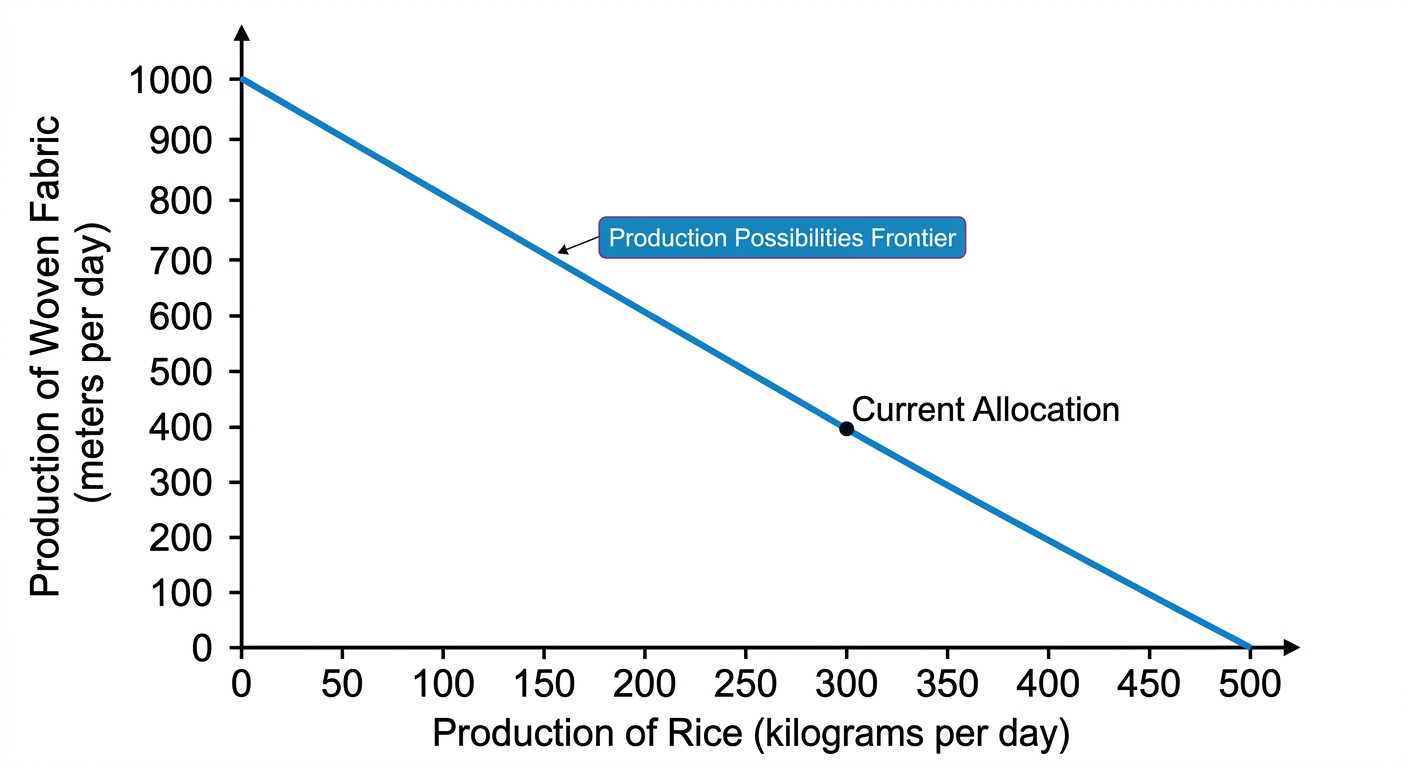
A small Vietnamese village has workers. Each worker can produce either of rice per day or of woven fabric per day. The village currently allocates workers to rice and workers to fabric.
(a)
State the opportunity cost of allocating one worker to rice production. [1 mark]
(b)
Calculate the total daily output of rice and fabric under the current allocation. [2 marks]
(c)
Explain, using the concept of scarcity, why the village faces a resource allocation problem. [2 marks]
(d)
The village is considering reallocating workers from fabric to rice. Deduce the effect of this reallocation the village's production possibilities, and explain one factor that would determine whether this reallocation improves the village's economic welfare. [3 marks]
Solutions
4FoundationSAQ-SThe problem of scarcity and choice5 marksPaper 1~8 min
Data
$
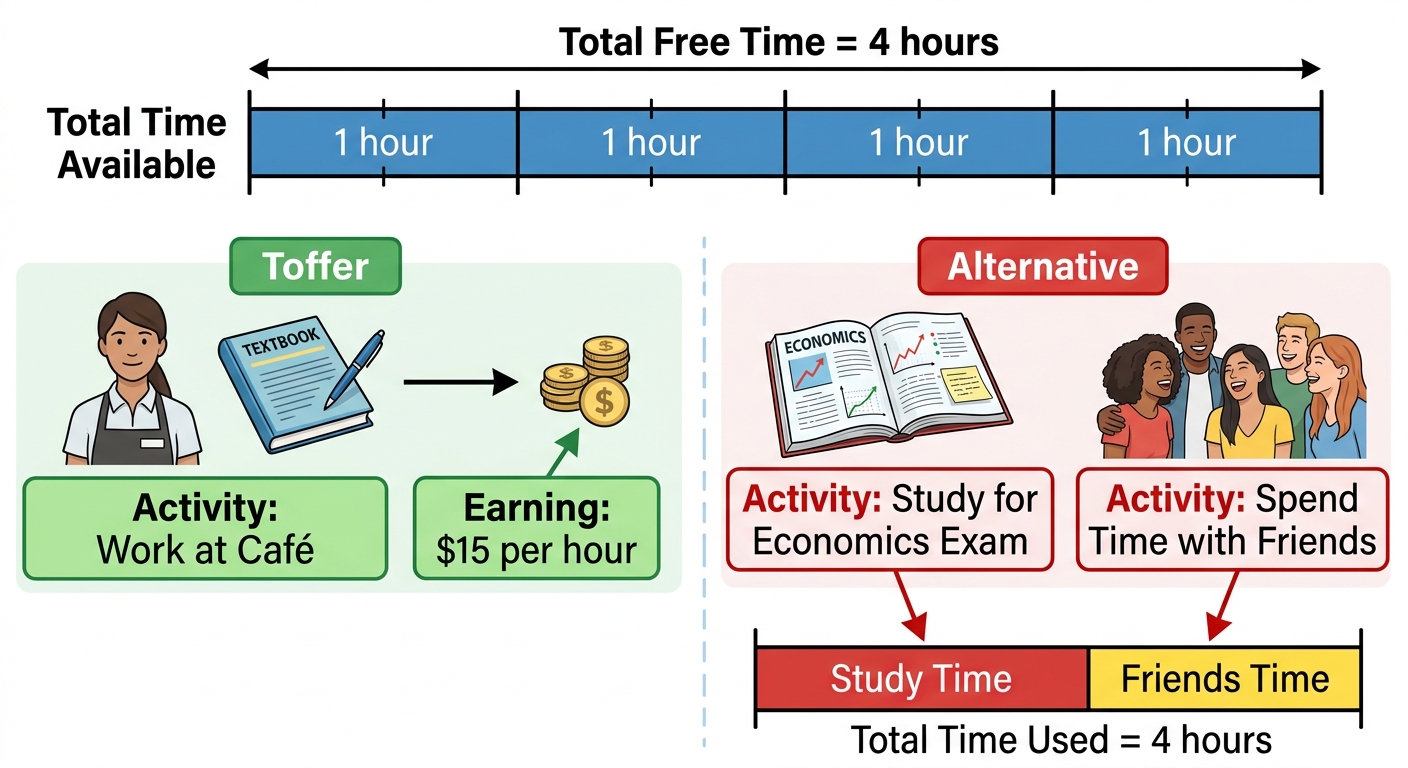
A student has hours of free time after school. She can either work at a café earning USD per hour, study for an economics exam, or spend time with friends. She chooses to study for hours and spend hour with friends.
(a)
State the economic problem of scarcity as it applies to the student's situation. $ [1 mark]
(b)
Calculate the opportunity cost of her decision to study for hours. $ [2 marks]
(c)
Explain whether the student's decision to study rather than work is necessarily rational. $ [2 marks]
Solutions
5FoundationSAQ-SBasic economic questions: What, how and for whom?4 marksPaper 1~6 min
A government is designing a new healthcare system. It must allocate its limited budget among three options:
- Free primary care clinics for all citizens
- Subsidised specialist treatments for the elderly
- High-tech cancer treatments available only to those who can pay
(a)
Define the economic question "for whom to produce?" and identify which one of the three options above most directly addresses it. [1 mark]
(b)
Explain how the decision to fund free primary care clinics for all citizens, rather than high-tech treatments available only to paying patients, reflects a value judgement about equity. In your answer, refer to the trade-off this choice creates with allocative efficiency. [3 marks]
Solutions
6FoundationSAQ-SThe problem of scarcity and choice4 marksPaper 1~6 min
A small island nation has limited resources. In one year it can produce a maximum of tonnes of fish or tonnes of timber, or any combination along a straight-line production possibility frontier (PPF). Currently it produces tonnes of fish and tonnes of timber.
(a)
Define the term "scarcity". [1 mark]
(b)
Using the data provided, explain how the island's production situation illustrates the concept of scarcity. [3 marks]
Solutions
7FoundationSAQ-SBasic economic questions: What, how and for whom?4 marksPaper 1~6 min
A clothing manufacturer is considering two production methods for making jeans:
- Method A: Labour-intensive; highly skilled workers using hand-sewing techniques, producing pairs per day at a daily wage cost of USD 400.
- Method B: Capital-intensive; automated sewing machines operated by a few low-skilled workers, producing pairs per day at a daily operating cost of USD 600.
(a)
Distinguish between capital-intensive and labour-intensive production methods. [1 mark]
(b)
Using the data above, explain why a profit-maximizing firm would choose Method B over Method A. [3 marks]
Solutions
8FoundationSAQ-SBasic economic questions: What, how and for whom?4 marksPaper 1~6 min
A small farming village faces a severe drought. Its limited water supply can support only one of the following uses:
- Option 1: Grow wheat sold to a foreign buyer for cash income
- Option 2: Grow vegetables for local consumption
- Option 3: Grow cotton for a textile factory in the nearest town
(a)
Identify which of the three fundamental economic questions is most directly illustrated by the village's decision. [1 mark]
(b)
Explain how choosing Option 2 over Option 1 reflects the economic problem of scarcity, with reference to opportunity cost. [3 marks]
Solutions
9FoundationSAQ-SBasic economic questions: What, how and for whom?4 marksPaper 1~6 min
A local government has a limited budget and must choose between building a new public hospital or a new sports stadium. The hospital would provide healthcare services free at the point of use to all residents. The stadium would generate tourism revenue and create entertainment employment.
The government chooses to build the hospital.
(a)
Define the term "what to produce" as a basic economic question. [2 marks]
(b)
Explain the opportunity cost the government faces in choosing to build the hospital rather than the stadium. [2 marks]
Solutions
10FoundationSAQ-SBasic economic questions: What, how and for whom?4 marksPaper 1~6 min
A furniture company is deciding whether to produce its chairs using skilled craftspeople (labour-intensive method) or using automated robotic assembly lines (capital-intensive method). Both methods produce chairs of identical quality.
(a)
Define the term 'How to produce?' as one of the three basic economic questions. [2 marks]
(b)
Using the context of the furniture company, explain one economic factor that could determine which production method is chosen. [2 marks]
Solutions
11FoundationSAQ-SBasic economic questions: What, how and for whom?4 marksPaper 1~6 min
A local government in a developing country must allocate its entire annual budget to exactly one of three options: building a new hospital in a rural area, constructing a high-speed rail line connecting two major cities, or providing subsidies for solar panels on low-income homes.
(a)
Define the term opportunity cost. [2 marks]
(b)
Using the scenario above, explain how the government's budget decision illustrates the economic question of 'What to produce?' [2 marks]
Solutions
12FoundationSAQ-SBasic economic questions: What, how and for whom?4 marksPaper 1~6 min
A country produces a large surplus of rice. The government must decide whether to distribute the rice for free to low-income families, sell it at market price to all consumers, or export it to earn foreign currency.
(a)
Define the term 'for whom to produce?' as one of the three fundamental economic questions. [2 marks]
(b)
Using the scenario, evaluate which of the three distribution options best addresses the 'for whom to produce?' question from an equity perspective. [2 marks]
Solutions
13FoundationSAQ-SBasic economic questions: What, how and for whom?4 marksPaper 1~6 min
A small island nation has only enough land to grow either coffee or wheat. Historically, it grew coffee for export, but a recent drought has made wheat farming more reliable. The government is debating which crop to support.
(a)
Define the term 'opportunity cost' and identify the opportunity cost faced by this island nation's government. [2 marks]
(b)
Using the three basic economic questions, explain why the government's decision about which crop to support cannot be made independently of decisions about production methods and distribution of output. [2 marks]
Solutions
14FoundationSAQ-SBasic economic questions: What, how and for whom?4 marksPaper 1~6 min
A local government must decide how to use a vacant plot of land. Three proposals exist: a public park, a luxury apartment complex built by a private company, or a subsidized housing block for low-income families.
(a)
State which of the three fundamental economic questions illustrated by the government choosing between a park, luxury apartments, and subsidized housing. [1 mark]
(b)
Explain how choosing to build the subsidized housing block rather than the luxury apartment complex addresses the economic question of "For whom to produce?" [3 marks]
Solutions
15FoundationSAQ-SBasic economic questions: What, how and for whom?8 marksPaper 1~12 min
A smartphone manufacturer must decide how to assemble its latest model. Option A uses a highly automated assembly line with robots, requiring fewer workers but a high initial capital investment. Option B uses manual assembly by low-skilled workers, requiring many employees but lower capital costs. The firm operates in a country where wages are rising and labour productivity is low. The firm chooses Option A.
(a)
Define the term 'how to produce' as a basic economic question. [2 marks]
(b)
Explain one economic reason why the firm chose Option A over Option B. [2 marks]
(c)
Evaluate whether choosing a capital-intensive method of production is always the most rational decision for a firm. [4 marks]
Solutions
16FoundationSAQ-SBasic economic questions: What, how and for whom?5 marksPaper 1~8 min
Data
$
An electronics company produces smartphones using one of two methods:
- Method X: Highly automated assembly using robots; low labour requirement, high electricity cost.
- Method Y: Manual assembly; high labour requirement, low electricity cost.
(a)
Define the economic question "How to produce?" $ [1 mark]
(b)
Explain why a company operating in a country with high unemployment might choose Method Y over Method X. $ [2 marks]
(c)
Evaluate whether choosing Method Y is necessarily the most rational decision for the company, even in a country with high unemployment. $ [2 marks]
Solutions
17FoundationSAQ-SBasic economic questions: What, how and for whom?6 marksPaper 1~9 min
A city has a fixed annual budget of USD 50 million. It must choose between building a new sports stadium, which would create 800 temporary construction jobs and generate ticket-revenue for private operators, or a new public library, which would provide free access to books, computers, and study spaces for all residents.
(a)
Define the term 'scarcity' and explain why it forces economies to make choices. [2 marks]
(b)
Using the three basic economic questions (what, how, and for whom to produce), explain how the city's choice between the stadium and the library demonstrates that answering one question simultaneously determines the answers to the other two. [4 marks]
Solutions
18FoundationSAQ-SThe problem of scarcity and choice4 marksPaper 1~6 min
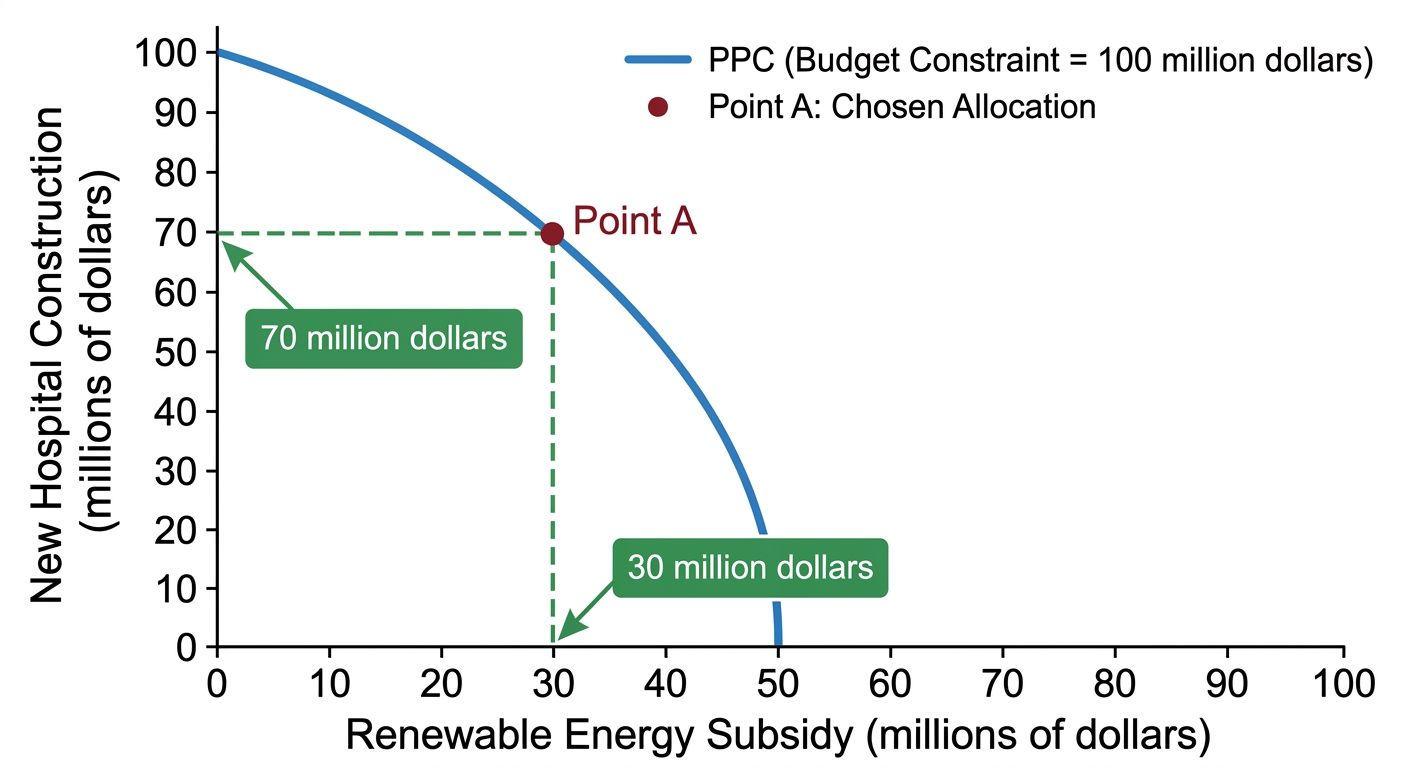
A government has a fixed budget of USD 100 million. It can spend the money on building new hospitals or on subsidising renewable energy. It decides to spend USD 70 million hospitals and USD 30 million renewable energy.
(a)
State the economic concept illustrated by the government's fixed budget of USD 100 million. [1 mark]
(b)
Calculate the opportunity cost of the government's decision to spend USD 70 million hospitals. [2 marks]
(c)
Explain why the government cannot spend USD 80 million hospitals and USD 50 million renewable energy simultaneously. [1 mark]
Solutions
19FoundationSAQ-SDefinition of economics4 marksPaper 1~6 min
A city has a fixed budget of USD 1 million for public projects. It can either build a new park or repair a deteriorating bridge. The city chooses to repair the bridge.
(a)
Define the term opportunity cost. [2 marks]
(b)
Explain why repairing the bridge involves an opportunity cost for the city. [2 marks]
Solutions
20FoundationSAQ-SDefinition of economics4 marksPaper 1~6 min
A farmer in Kenya has a fixed plot of land that can be used to grow either maize or coffee. The farmer chooses to grow coffee, which generates a higher market price per kilogram but requires the entire plot.
-
(a)
Define the term opportunity cost.
- [2 marks]
(b)
Explain the opportunity cost of the farmer's decision to grow coffee rather than maize. [2 marks]
Solutions
Showing 20 of 74 free questions