You're viewing 2 free preview questions for Economics HL — subscribe to unlock 18 more, plus the Full Question Bank, Mock Papers & Worksheets.Upgrade
How Do Economists Approach the World? · Paper 2 — Free Economics HL Practice Questions
1MasteryLAQThe role of data and evidence in economics10 marksPaper 2~15 min

Data
each country's GDP per capita (in US dollars) and annual emissions per capita (in metric tons)
- Qualitative data: interviews with government officials from 5 of the 20 countries, asking them to describe the main trade-offs they face between economic growth and environmental protection
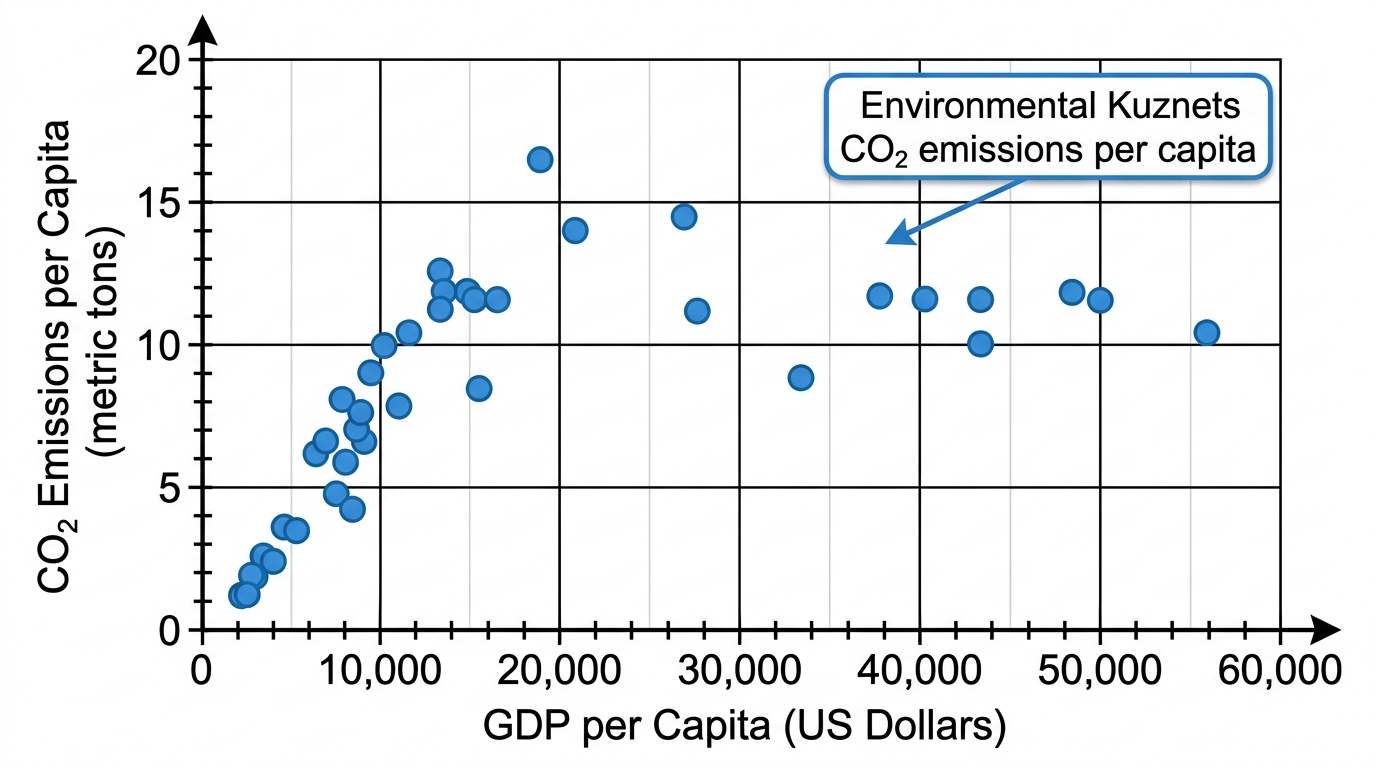
A scatter plot of the quantitative data reveals the following pattern: as GDP per capita rises from USD 2,000 to USD 15,000, emissions per capita rise sharply; for countries with GDP per capita above USD 30,000, emissions per capita level off and, in some cases, fall slightly.
A development economist studies the relationship between income level and environmental quality across 20 countries. She collects:
- Quantitative
(a)
Explain how the quantitative data can be used to test the hypothesis that there is an Environmental Kuznets Curve (EKC) relationship between income and environmental degradation. [4 marks]
(b)
(i) Explain two causal mechanisms that the qualitative interview data could reveal to account for the pattern observed in the quantitative data. [4]
(ii) Evaluate the extent to which combining the qualitative and quantitative data strengthens the economist's ability to establish a causal relationship between income and emissions. [6 marks]
(ii) Evaluate the extent to which combining the qualitative and quantitative data strengthens the economist's ability to establish a causal relationship between income and emissions. [6 marks]

Solutions
2MasteryLAQThe role of data and evidence in economics8 marksPaper 2~12 min
Data
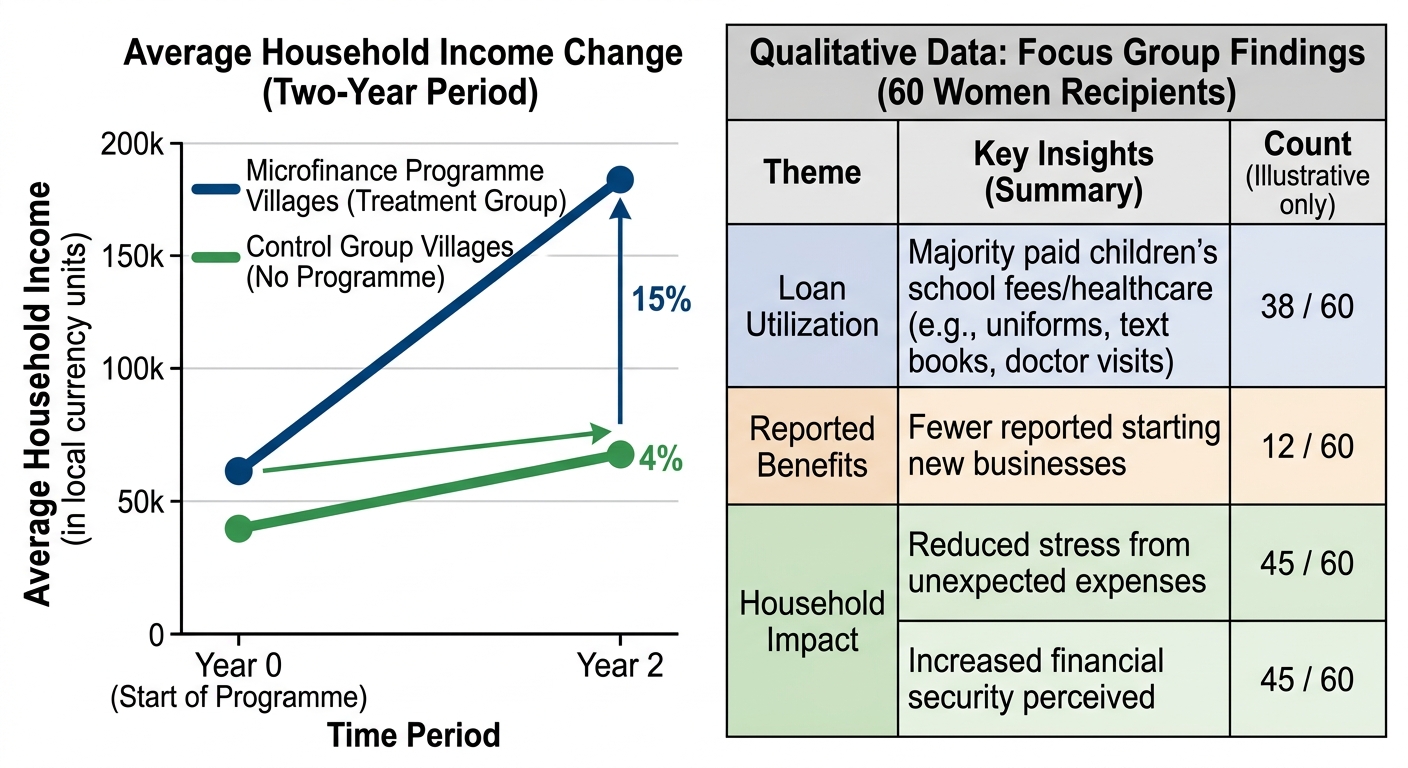
A survey of households shows that average household income in villages with the programme rose by over two years, while average income in a control group of villages without the programme rose by only over the same period.
Qualitative data: Focus group discussions with women who received microloans reveal that many used the money to pay for children's school fees and healthcare, rather than to start businesses. Several women reported feeling less stressed about unexpected expenses.
A government in a developing nation is evaluating the success of a new microfinance programme aimed at reducing poverty in rural areas. Two types of evidence are collected.
Quantitative
(a)
(i) Explain how the quantitative data provides evidence that the microfinance programme was effective. [2]
(ii) Identify and explain one limitation of the quantitative evidence. [2 marks]
(ii) Identify and explain one limitation of the quantitative evidence. [2 marks]
(b)
Evaluate the overall strength of the combined quantitative and qualitative evidence for informing government policy on microfinance. Your answer must reach a reasoned judgement about whether the government should expand the programme. [6 marks]
Solutions
That's every free question here — 2 of 20.
+18 more questions, plus Mock Papers & Worksheets, are waiting in Premium.