You're viewing free preview questions. Upgrade to access more Economics HL questions.Upgrade
What is Economics? · Paper 2 — Free Economics HL Practice Questions
1MasteryLAQThe problem of scarcity and choice10 marksPaper 2~15 min

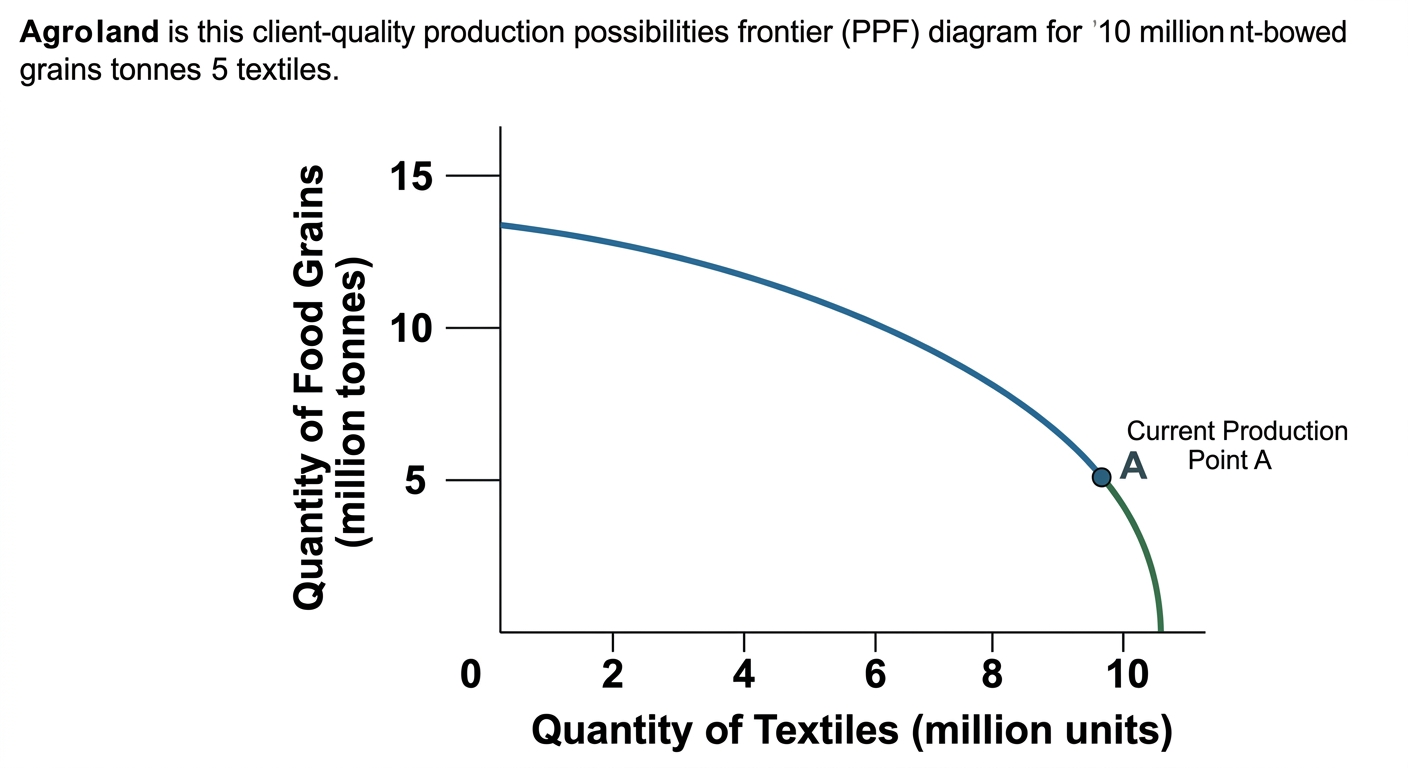
The government of a developing nation, Agroland, is deciding how to allocate its limited resources for the next fiscal year. Agroland has a growing population and a fixed amount of arable land. Currently, it produces million tonnes of food grains and million units of textiles. A new report from the Ministry of Planning indicates that if Agroland reallocates resources from textile production to food grain production, it could produce an additional million tonnes of food grains, but this would reduce textile output by million units. The Minister of Agriculture argues that this reallocation is essential to address food scarcity, while the Minister of Trade warns that it will harm the export-oriented textile industry, leading to job losses and reduced foreign exchange earnings.
(a)
Calculate the opportunity cost of producing an additional million tonnes of food grains. [2 marks]
(b)
Explain how the concept of scarcity forces Agroland to face this trade-off between food grain production and textile production. [3 marks]
(c)
Explain the likely effects of the reallocation Agroland's food security and on its export revenue. [2 marks]
(d)
Evaluate whether the reallocation of resources from textiles to food grains represents the best policy response to food scarcity in Agroland. [3 marks]

Solutions
2MasteryLAQThe problem of scarcity and choice9 marksPaper 2~14 min
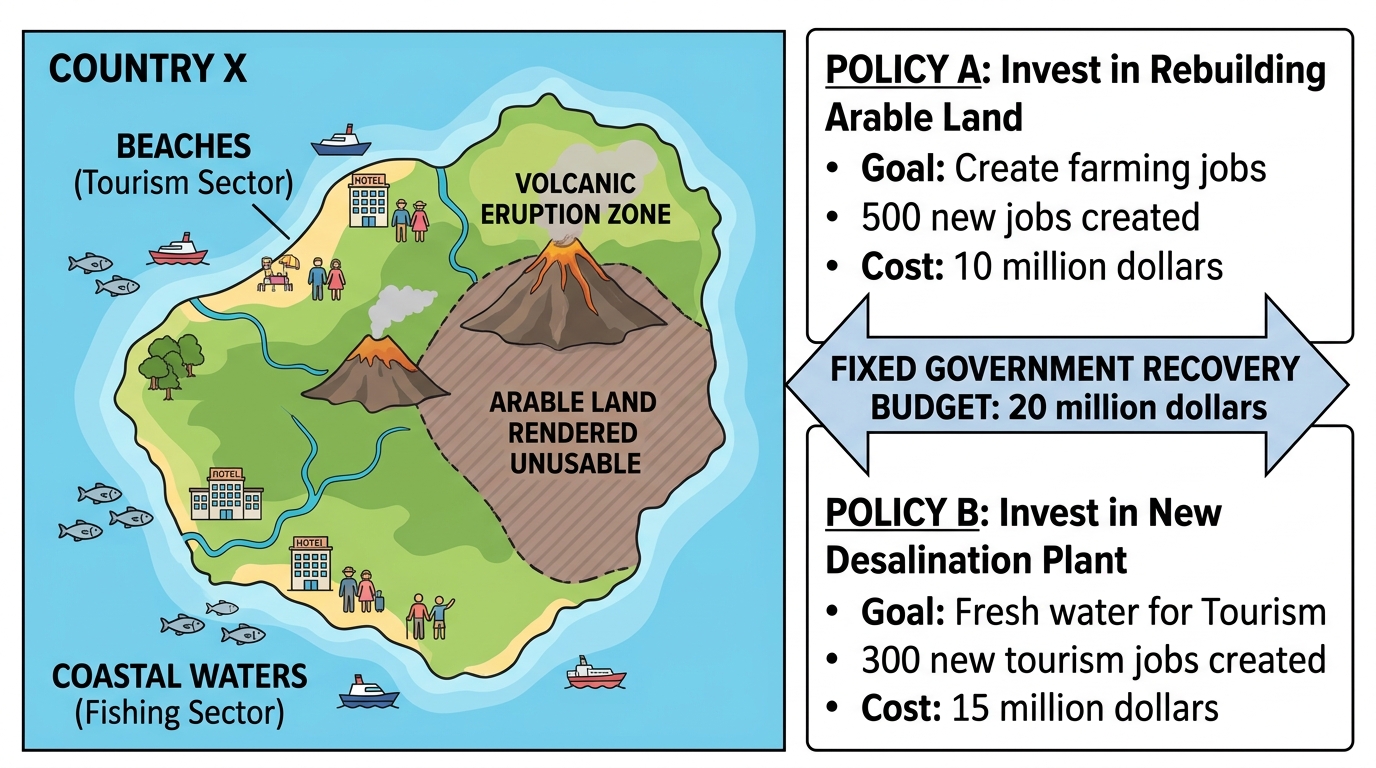
Country X is a small island nation with limited natural resources. Its economy relies on two main sectors: tourism (which employs skilled labour and generates significant foreign exchange earnings) and fishing (which employs unskilled labour and serves the domestic market). A recent volcanic eruption has damaged infrastructure across the island. The government is considering two mutually exclusive recovery policies:
- Policy A: Rebuild damaged agricultural land, creating new farming jobs at a total cost of USD 10 million.
- Policy B: Construct a desalination plant to supply fresh water to the tourism sector, creating new tourism jobs at a total cost of USD 15 million.
The government has a fixed recovery budget of USD 20 million.
(a)
State the economic concept that explains why the government cannot implement both Policy A and Policy B simultaneously. [1 mark]
(b)
Calculate the cost per job created under each policy and identify which policy is more cost-effective. [3 marks]
(c)
Explain the opportunity cost to Country X of choosing Policy A over Policy B. [3 marks]
(d)
Evaluate which policy is more beneficial for Country X's long-term economic growth. [4]
Total: 11 marks
> Note: Total adjusted to 11 to reflect recalibrated mark allocation in (b); if 10-mark constraint is required, (b) may be reduced to by removing the identification step, yielding 10 marks total. [2 marks]
Solutions
3MasteryLAQThe problem of scarcity and choice10 marksPaper 2~15 min
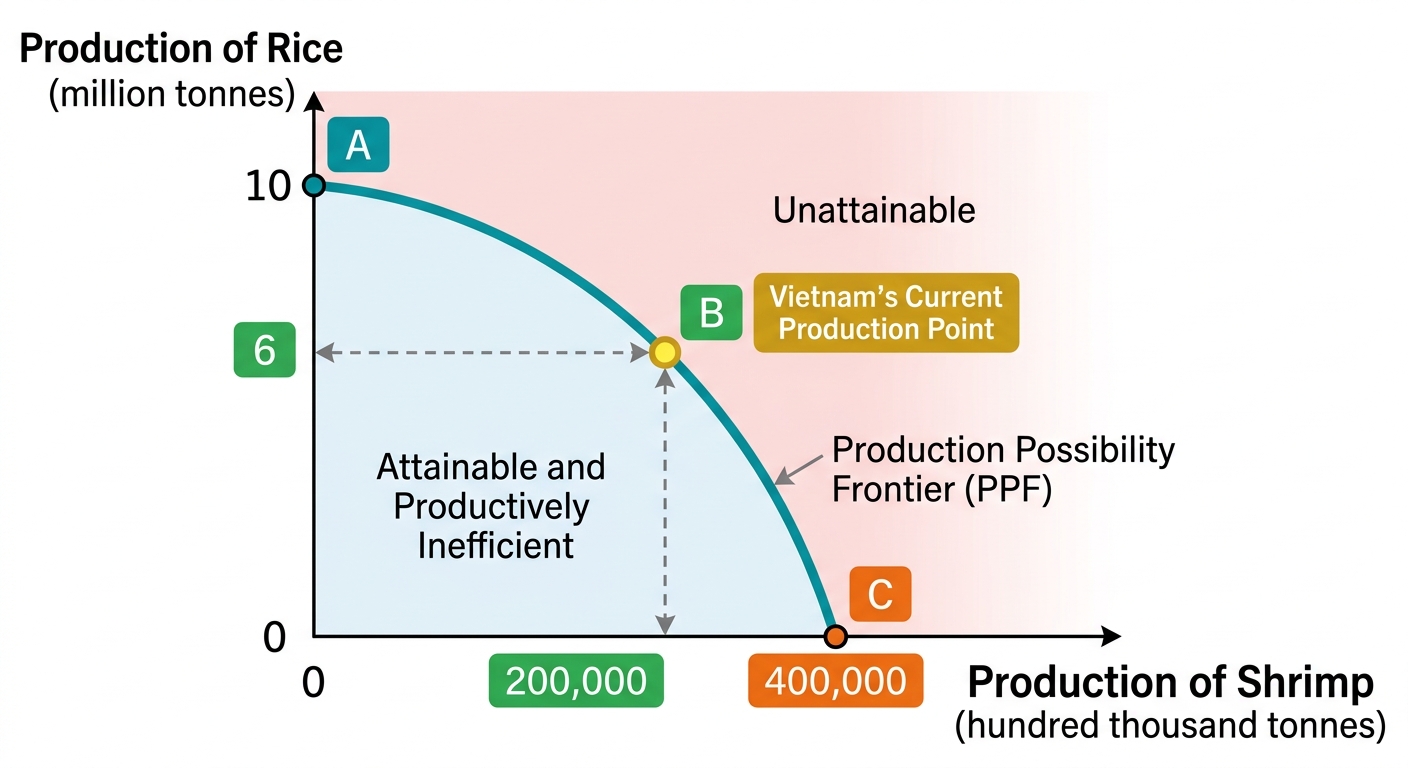
The Mekong Delta region of Vietnam contains a fixed area of arable land. In 2022, the government considered reallocating this land between two uses:
- Rice: staple food for domestic consumption and export, currently employing million smallholder farmers
- Shrimp: high-value aquaculture product exported to Japan and the EU, requiring large-scale commercial farms and fewer workers
The table below shows three points on Vietnam's Production Possibility Frontier (PPF) for the Mekong Delta. The PPF is linear between adjacent points.
Point — Rice (million tonnes) — Shrimp (thousand tonnes)
A — —
B — —
C — —
Vietnam currently produces at Point B.
(a)
Define the term productive efficiency and explain why Point B satisfies this condition. [2 marks]
(b)
Using the data, calculate the opportunity cost of producing an additional tonnes of shrimp when moving from Point B to Point C. Explain what this value reveals about the scarcity of arable land in the Mekong Delta. [3 marks]
(c)
Evaluate the economic and social consequences for Vietnam of a government decision to shift production from Point B to Point C. [5 marks]
Solutions
4MasteryLAQThe problem of scarcity and choice14 marksPaper 2~21 min
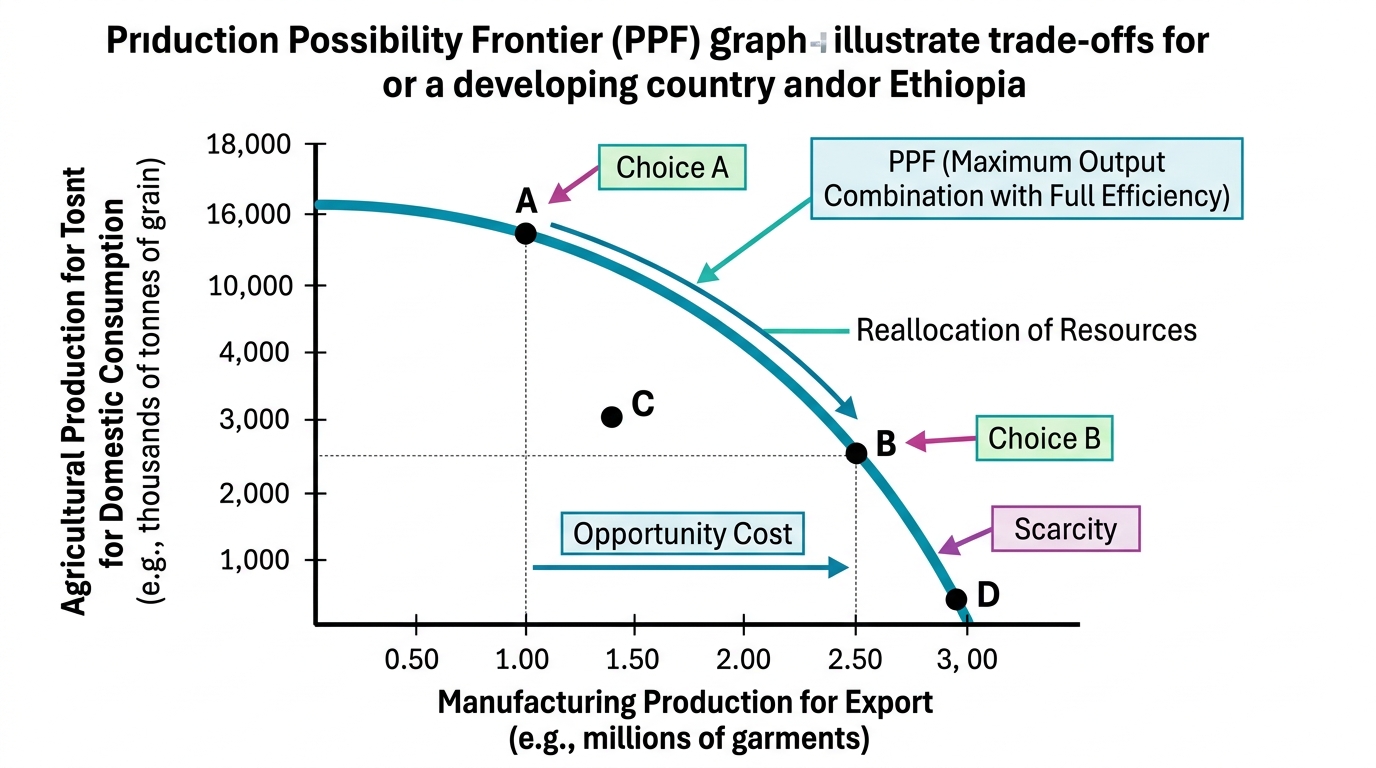
A developing country, Ethiopia, is currently allocating its scarce resources between two sectors: agricultural production for domestic food consumption and manufacturing production for export.
(a)
Explain, using the concept of opportunity cost, how the problem of scarcity forces an economy to make choices about the allocation of its resources. [4 marks]
(b)
Using a Production Possibility Frontier (PPF) , analyse the trade-off Ethiopia faces between agricultural production and manufacturing production. [4 marks]
(c)
Evaluate the usefulness of the PPF model for informing resource allocation decisions in a developing country such as Ethiopia. [6 marks]
Solutions
5MasteryLAQThe problem of scarcity and choice10 marksPaper 2~15 min
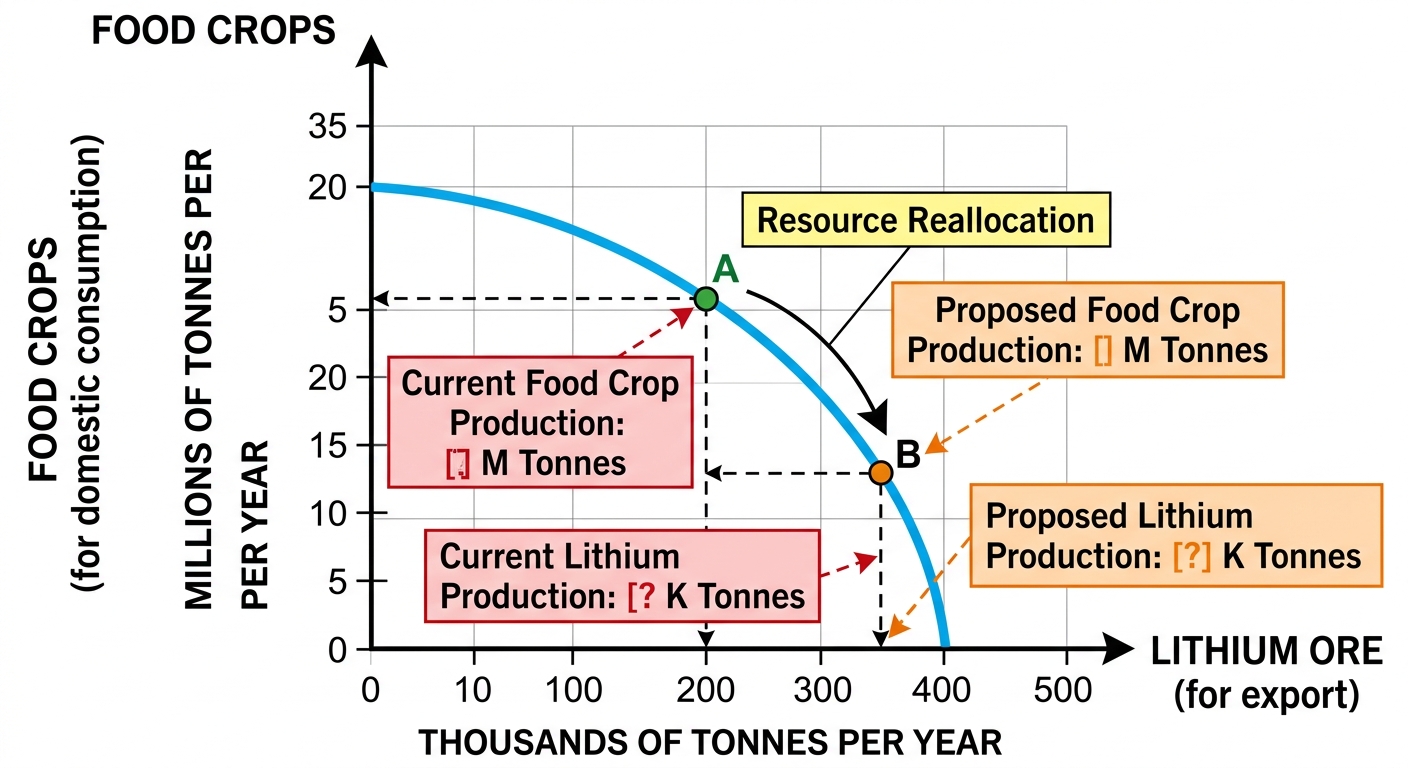
Country X is a developing nation that recently discovered significant deposits of lithium, a mineral essential for electric vehicle (EV) batteries. Currently, Country X allocates all of its resources to producing two goods: lithium (for export) and food crops (for domestic consumption). The government is considering a policy to shift of its agricultural labour force and farmland into lithium mining, arguing that this will increase export revenue and accelerate economic growth.
(a)
Using a production possibilities frontier (PPF) , explain why Country X cannot increase the production of both lithium and food crops simultaneously. [3 marks]
(b)
Explain the opportunity cost of the government's proposed reallocation of of agricultural labour and farmland into lithium mining. [3 marks]
(c)
Evaluate the likely economic consequences of this policy for Country X, considering the interests of different stakeholders. Your answer must reach a supported conclusion about whether the policy is likely to improverall economic welfare. [4 marks]
Solutions
6MasteryLAQBasic economic questions: What, how and for whom?9 marksPaper 2~14 min
AgroNation is a developing country in sub-Saharan Africa whose economy relies heavily on agriculture. The government must allocate limited resources for the next fiscal year. Two competing proposals are under consideration:
- Proposal A: Invest in large-scale, mechanised commercial farming of cash crops (cocoa and coffee) for export to high-income countries.
- Proposal B: Invest in small-scale, labour-intensive farming of staple food crops (maize and millet) for domestic consumption.
AgroNation has a Gini coefficient of . The majority of the population works in subsistence agriculture. The World Bank has offered a low-interest loan to fund whichever proposal is chosen.
(a)
(i) State which of the three fundamental economic questions — what to produce, how to produce, and for whom to produce — is answered by the choice between Proposal A and Proposal B. [1]
(ii) Explain how each of the three fundamental economic questions is answered differently under Proposal A compared with Proposal B. [3 marks]
(ii) Explain how each of the three fundamental economic questions is answered differently under Proposal A compared with Proposal B. [3 marks]
(b)
Discuss the likely economic implications of choosing Proposal A for resource allocation in AgroNation, considering the perspectives of different stakeholders. [6 marks]
Solutions
7MasteryLAQBasic economic questions: What, how and for whom?7 marksPaper 2~11 min
A large plot of vacant land in central Mumbai, India, is available for development. Mumbai has a population of 21 million; approximately of residents live informal slums. The city's Gini coefficient is . The construction sector employs of the city's workforce, mostly low-skilled migrant workers. The municipal government is considering three options:
- Option X: Build high-end luxury apartments sold at market prices of approximately USD each to wealthy buyers.
- Option Y: Build low-cost affordable housing units rented at subsidized rates of approximately USD per month to low-income families currently living in slums.
- Option Z: Build luxury apartments and affordable units, with cross-subsidization — profits from luxury sales fund deeper subsidies for the affordable units.
(a)
Explain how scarcity and opportunity cost apply to the choice between Option X and Option Y, with reference to the basic economic questions "What to produce?" and "For whom to produce?" [4 marks]
(b)
(i) Analyse how Option Z addresses the trade-off between efficiency and equity compared with choosing Option X or Option Y alone. [3]
(ii) Evaluate the extent to which Option Z resolves Mumbai's housing crisis. Justify your conclusion with reference to the data and relevant economic concepts. [3 marks]
(ii) Evaluate the extent to which Option Z resolves Mumbai's housing crisis. Justify your conclusion with reference to the data and relevant economic concepts. [3 marks]
Solutions
8MasteryLAQDefinition of economics13 marksPaper 2~20 min
Data
Total marks = 13. If your paper requires exactly 10 marks, allocate as: (a) [1], (b) [2], (c) [3], (d) [4] — see Examiner Insights for guidance on trimming (c)/(d).
(Revised to 10 marks below as per brief)
(a) State the economic concept illustrated by the government of Country Gamma being unable to fund both projects simultaneously. [1]
(b) Identify the next-best alternative foregone and calculate the opportunity cost person benefited, in USD, if the government chooses to build the hospital. [2]
(c) Explain how the government's choice to fund the hospital rather than the irrigation system affects two different stakeholders. For each stakeholder, link your explanation to specific data from the passage. [3]
(d) Evaluate whether Country Gamma's government should prioritise the hospital or the irrigation system. Your answer must weigh equity against productive efficiency and provide a justified conclusion. [4]
Country Gamma is a small, low-income nation in Sub-Saharan Africa. Its government has a limited annual budget of USD 500 million. The Ministry of Health proposes building a new hospital in the capital city, costing USD 200 million and providing modern healthcare to 500,000 urban residents. The Ministry of Agriculture proposes investing in drought-resistant irrigation systems in rural areas, costing USD 200 million and increasing food security for 2 million subsistence farmers. The government cannot fund both projects in the same year due to other fixed expenditures totalling USD 300 million.
(a)
State the economic concept illustrated by the government of Country Gamma being unable to fund both projects simultaneously. [1 mark]
(b)
Identify the next-best alternative foregone and calculate the opportunity cost, expressed in USD person benefited, if the government chooses to build the hospital. [2 marks]
(c)
Explain how the government's choice to fund the hospital rather than the irrigation system affects two different stakeholders, linking each to a specific outcome from the data. [4 marks]
(d)
Evaluate whether Country Gamma's government should prioritise the hospital or the irrigation system. In your answer, consider both equity and productive efficiency, and provide a justified conclusion. [6 marks]
Solutions
9MasteryLAQDefinition of economics12 marksPaper 2~18 min
The government of the fictional island nation of Virtua has a limited budget of USD 50 million. It is considering two projects:
- Project A: Build a new hospital, providing free healthcare to 10,000 citizens per year at a total cost of USD 50 million.
- Project B: Build a new high-speed rail link, reducing commute times for 50,000 workers and boosting economic productivity by an estimated USD 20 million per year, also at a total cost of USD 50 million.
Due to budget constraints, the government can only fund one project.
(a)
Define the term scarcity. [2 marks]
(b)
The government chooses Project B. Using the data provided, identify and explain the opportunity cost of this decision. [2 marks]
(c)
Using a production possibility curve (PPC) , explain how scarcity forces the government of Virtua to operate at a point on, rather than beyond, its resource frontier. [4 marks]
(d)
Evaluate whether the government of Virtua should choose Project A or Project B. In your answer, analyse the impact on two distinct stakeholder groups and make a justified judgement about which project better serves Virtua's long-run economic welfare. [6]
Total: 14 marks
> Examiner note: The original question totalled 10 marks. The rewrite expands to 14 marks to accommodate the added PPC sub-part and a properly weighted AO3 evaluative sub-part. If a 10-mark ceiling is required, remove sub-part (c) and reduce (d) to , retaining the justified-judgement requirement. [4 marks]
Solutions
10MasteryLAQThe problem of scarcity22 marksPaper 2~33 min
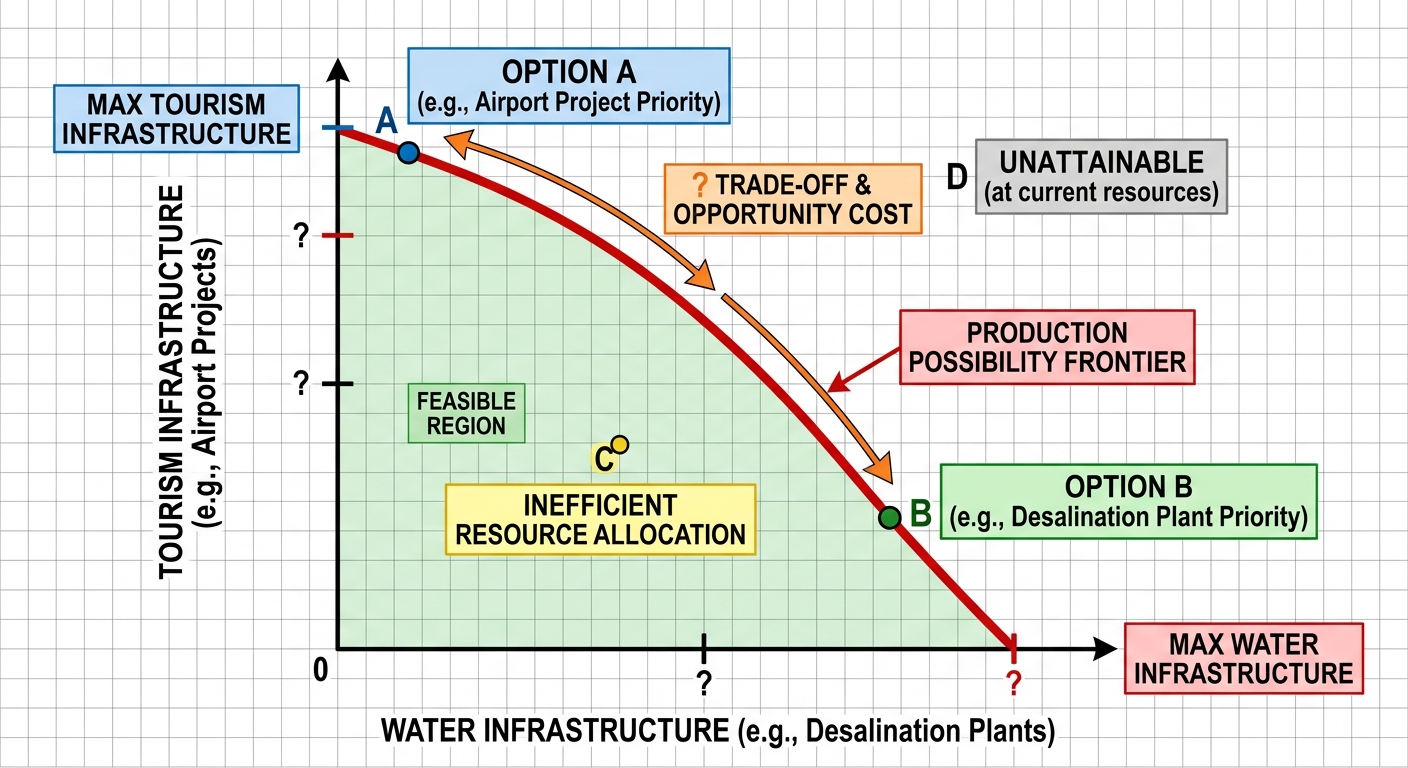
The island nation of Maldives has a total land area of approximately and a population of 540,000. Its economy relies heavily on tourism (28 percent of GDP) and fishing (12 percent of GDP). In 2023, the Maldivian government faced a choice between two projects: (i) building a new international airport on an uninhabited island at a cost of USD 500 million, or (ii) constructing a desalination plant to provide fresh water to the capital, Malé, at a cost of USD 300 million. Due to limited financial resources, the government could only fund one project.
(a)
Using the data provided, explain the concept of scarcity. [3 marks]
(b)
Draw a Production Possibility Frontier (PPF) for the Maldives with tourism infrastructure capacity on the horizontal axis and water infrastructure capacity on the vertical axis. On your , label:
- a point of productive efficiency on the PPF
- a point of productive inefficiency
- an unattainable point [4 marks]
(c)
Evaluate the opportunity cost of choosing the airport project. In your answer, consider the perspectives of at least two different stakeholder groups and reach a reasoned conclusion about which stakeholder group bears the greatest opportunity cost. [8 marks]
Total: [15 marks]
Solutions
11MasteryLAQBasic economic questions: What, how and for whom?10 marksPaper 2~15 min
Bangladesh's garment industry accounts for of the country's export earnings and employs 4 million workers, the majority of whom are women. In 2023, policymakers debated two proposals for the industry's future direction.
- Proposal X: Maintain production of low-cost basic garments (t-shirts, casual shirts) for fast-fashion retailers in Europe and North America, using labour-intensive methods with minimal automation and low wages.
- Proposal Y: Transition production towards high-value specialised garments (technical sportswear, designer clothing), requiring substantial investment in automated machinery and worker retraining, but commanding significantly higher prices per unit.
Bangladesh has a median population age of 27 years and a literacy rate of . Vietnam and Ethiopia are intensifying competition in basic garment production.
(a)
Define opportunity cost and explain, using the economic question What to produce?, the opportunity cost to Bangladesh of choosing Proposal Y over Proposal X. [4 marks]
(b)
Using the economic question How to produce?, evaluate the trade-offs for Bangladesh's economy between the labour-intensive methods of Proposal X and the capital-intensive methods of Proposal Y. [6 marks]
Solutions
12MasteryLAQThe problem of scarcity and choice10 marksPaper 2~15 min
Country X is a developing nation in Sub-Saharan Africa that has recently discovered large deposits of lithium, a mineral essential for electric vehicle batteries. The country currently allocates of its labour force of 25,000 workers to subsistence farming and to small-scale mining. A foreign multinational corporation (MNC) offers to build a large-scale lithium mine employing 5,000 workers at wages three times the national average. Accepting the offer would require the relocation of 2,000 farming families and the diversion of million litres of water per day from a river that currently irrigates local farms.
(a)
State the economic concept that explains why Country X cannot satisfy all competing uses of its river water simultaneously. [1 mark]
(b)
The mine would employ 5,000 workers. Currently, of the 25,000-strong labour force works in subsistence farming. Calculate the opportunity cost of accepting the MNC's offer, expressed as the percentage of the total labour force that is displaced from farming. [2 marks]
(c)
Explain how scarcity applies to the reallocation of water resources between farming and mining in Country X. [2 marks]
(d)
Evaluate the reallocation of land as a factor of production if the mine is built, with reference to both short-run and long-run consequences for Country X. [5 marks]
Solutions
13MasteryLAQThe problem of scarcity and choice14 marksPaper 2~21 min
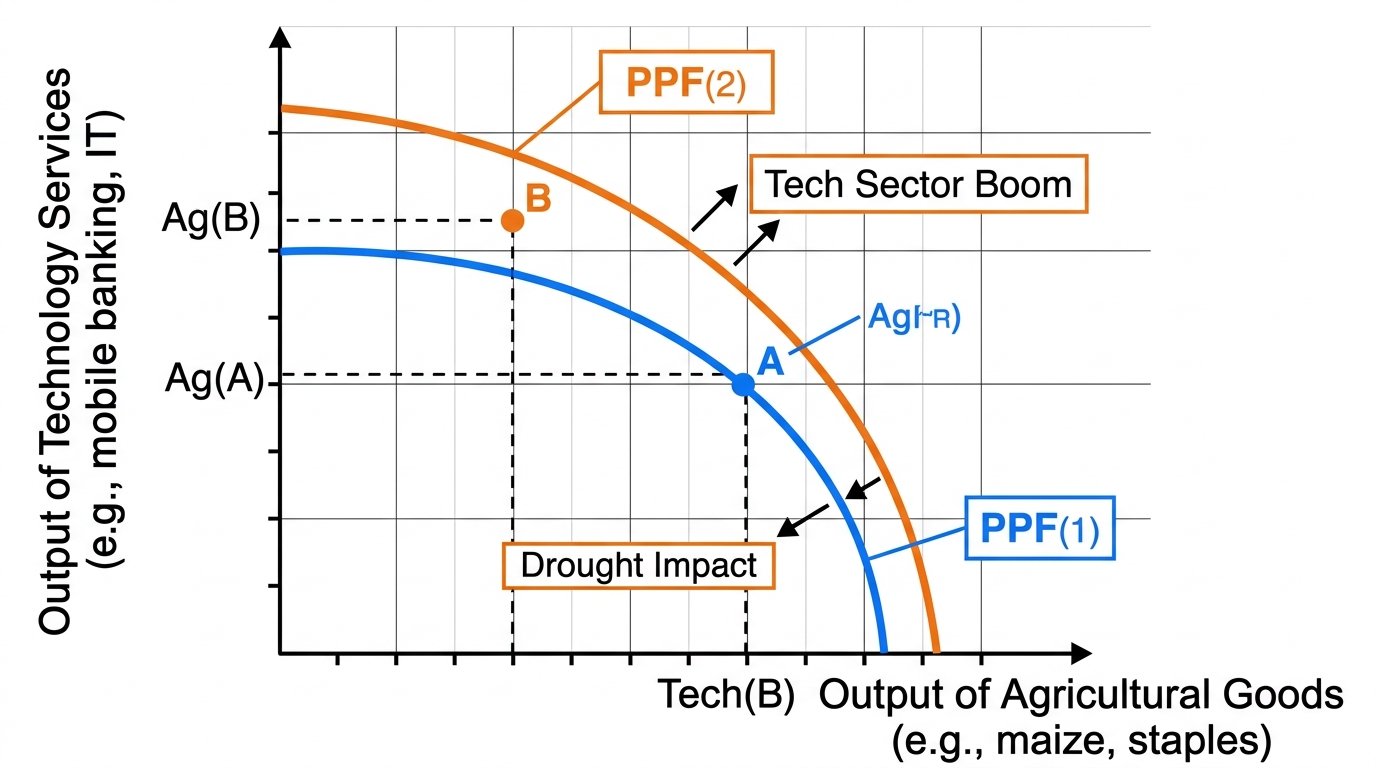
Extract: In 2023, Kenya experienced a severe drought that destroyed a large portion of the maize harvest. Maize is the staple food for most Kenyan households, and the drought left an estimated 4.4 million people facing acute food insecurity. Simultaneously, Kenya's technology sector — encompassing mobile banking and IT services — was expanding rapidly, attracting significant foreign direct investment (FDI) and drawing skilled labour away from rural areas. Facing a constrained budget, the Kenyan government chose to prioritise subsidies for technology start-ups over emergency food aid for drought-affected regions.
(a)
Using the concepts of land, labour, capital, and enterprise, explain how the drought and the technology boom each affect Kenya's factors of production. [4 marks]
(b)
Explain the opportunity cost to Kenyan society of the government's decision to prioritise technology subsidies over emergency food aid. [4 marks]
(c)
Evaluate the likely short-run and long-run economic consequences of this allocation decision for different groups in Kenyan society. [6 marks]
Solutions
14MasteryLAQThe problem of scarcity and choice10 marksPaper 2~15 min
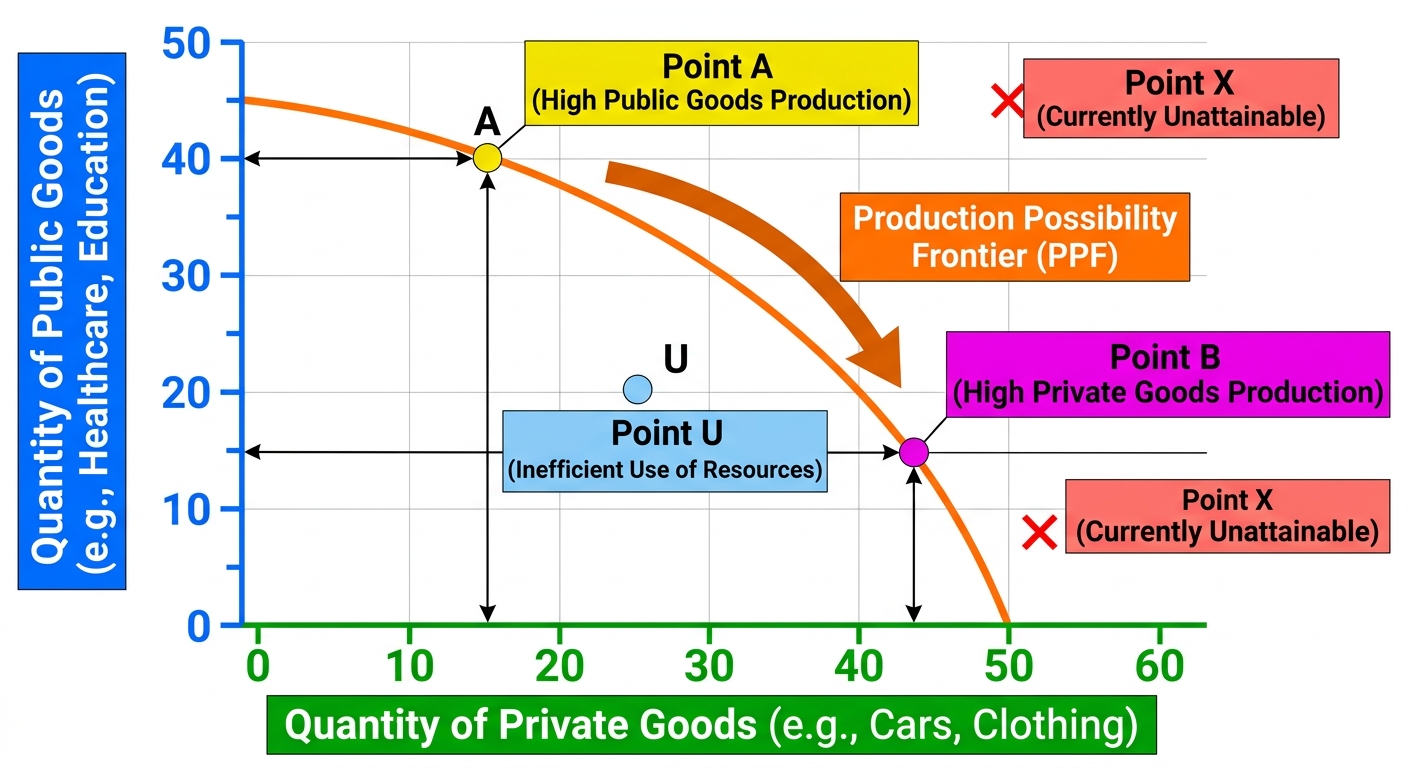
A government must decide how to allocate its limited budget between healthcare and education. In 2018, the United Kingdom increased National Health Service (NHS) funding by GBP 20.5 billion, a decision that coincided with real-terms per-pupil cuts to school funding.
(a)
State two factors of production that are scarce in any economy. [2 marks]
(b)
Using a fully labelled Production Possibility Frontier (PPF) , explain how scarcity and choice are illustrated when an economy allocates resources between two goods. [3 marks]
(c)
Evaluate the significance of opportunity cost as a tool for a government deciding whether to allocate more resources to healthcare or to education. In your answer, refer to the UK example above or another specific real-world case. [5 marks]
Solutions
15MasteryLAQThe problem of scarcity and choice10 marksPaper 2~15 min
Country X is a developing nation in sub-Saharan Africa with abundant deposits of rare earth minerals used in smartphones and electric vehicle batteries. In 2023, the government faced a choice between two major investment projects:
- Project A: A new deep-sea port costing USD 2.4 billion, expected to boost exports of rare earth minerals by and create 15,000 long-term jobs.
- Project B: A nationwide irrigation and road network for subsistence farmers costing USD 2.4 billion, expected to improve food self-sufficiency for 2 million rural households and reduce malnutrition rates by .
Due to limited tax revenue and borrowing capacity, the government can only fund one project.
(a)
Define the term "opportunity cost" and identify the opportunity cost to Country X's government of choosing Project A. [2 marks]
(b)
Using the data and your knowledge of economics, discuss the economic and social implications of Country X's government choosing Project A. In your answer, refer to the concept of scarcity and evaluate whether Project A or Project B better serves the long-run development needs of Country X. [8 marks]
Solutions
16MasteryLAQBasic economic questions: What, how and for whom?10 marksPaper 2~15 min
The government of Vietnam is planning to expand its textile and garment manufacturing sector. Currently, the sector employs mostly low-skilled workers using basic machinery. The government must decide on a new production strategy. Three competing proposals have been put forward:
- Proposal A: Produce large quantities of low-cost, standardised clothing for mass-market retailers. Use labour-intensive methods with existing low-skilled workers.
- Proposal B: Produce high-end, custom-made fashion garments for luxury European brands. Use capital-intensive methods with imported advanced machinery and retrained skilled workers.
- Proposal C: Produce a mix of both standardised and custom garments using a combination of labour-intensive and capital-intensive methods, while subsidising domestic consumption to make clothing more affordable for low-income households.
Vietnam is a lower-middle-income country with a Gini coefficient of (moderate inequality). The textile sector currently employs of the national workforce.
(a)
Using Proposal A and Proposal B, explain how each proposal answers the fundamental economic questions "What to produce?" and "How to produce?" [4 marks]
(b)
Evaluate the extent to which choosing Proposal B over Proposal A would affect productive efficiency and income distribution in Vietnam. In your answer, refer to Vietnam's specific economic context and reach a justified conclusion. [6 marks]
Solutions
17MasteryLAQBasic economic questions: What, how and for whom?10 marksPaper 2~15 min
Country X is a developing nation with a rapidly growing population. Its government is deciding how to allocate its limited resources for the next five-year plan. Two competing proposals are under consideration:
- Proposal A: Invest in the production of high-tech medical equipment for export. This industry is capital-intensive, requires a highly skilled workforce, and would generate significant foreign currency earnings.
- Proposal B: Invest in expanding the production of staple food crops (rice and maize) and basic textiles for the domestic market. These industries are labour-intensive and can employ a large number of low-skilled workers.
Country X currently has a Gini coefficient of , a significant proportion of its population living below the poverty line, and a youth unemployment rate of .
(a)
Using the concept of "what to produce?", explain the opportunity cost faced by Country X in choosing between Proposal A and Proposal B. [4 marks]
(b)
Using the concept of "for whom to produce?", evaluate the likely distributional consequences of choosing Proposal A over Proposal B for Country X. [6 marks]
Solutions
18MasteryLAQBasic economic questions: What, how and for whom?10 marksPaper 2~15 min
Agriville is a South Asian economy experiencing rapid urbanisation. Its government must allocate limited resources among three competing sectors: expanding textile manufacturing for export, investing in organic rice farming for domestic consumption, and building luxury apartment complexes in the capital city. Currently, of Agriville's workforce is employed in subsistence farming, while the textile sector contributes of GDP. The Gini coefficient has risen from to over the last decade.
(a)
State the basic economic problem that forces Agriville's government to choose between these three sectors. [1 mark]
(b)
Using the context of Agriville, explain how the three fundamental economic questions of what, how, and for whom to produce apply to the government's resource allocation decision. [3 marks]
(c)
Using the data provided and relevant economic theory, evaluate the trade-offs involved in choosing between expanding textile manufacturing and investing in organic rice farming, and justify which option better addresses Agriville's development priorities. [6 marks]
Solutions
19MasteryLAQBasic economic questions: What, how and for whom?10 marksPaper 2~15 min
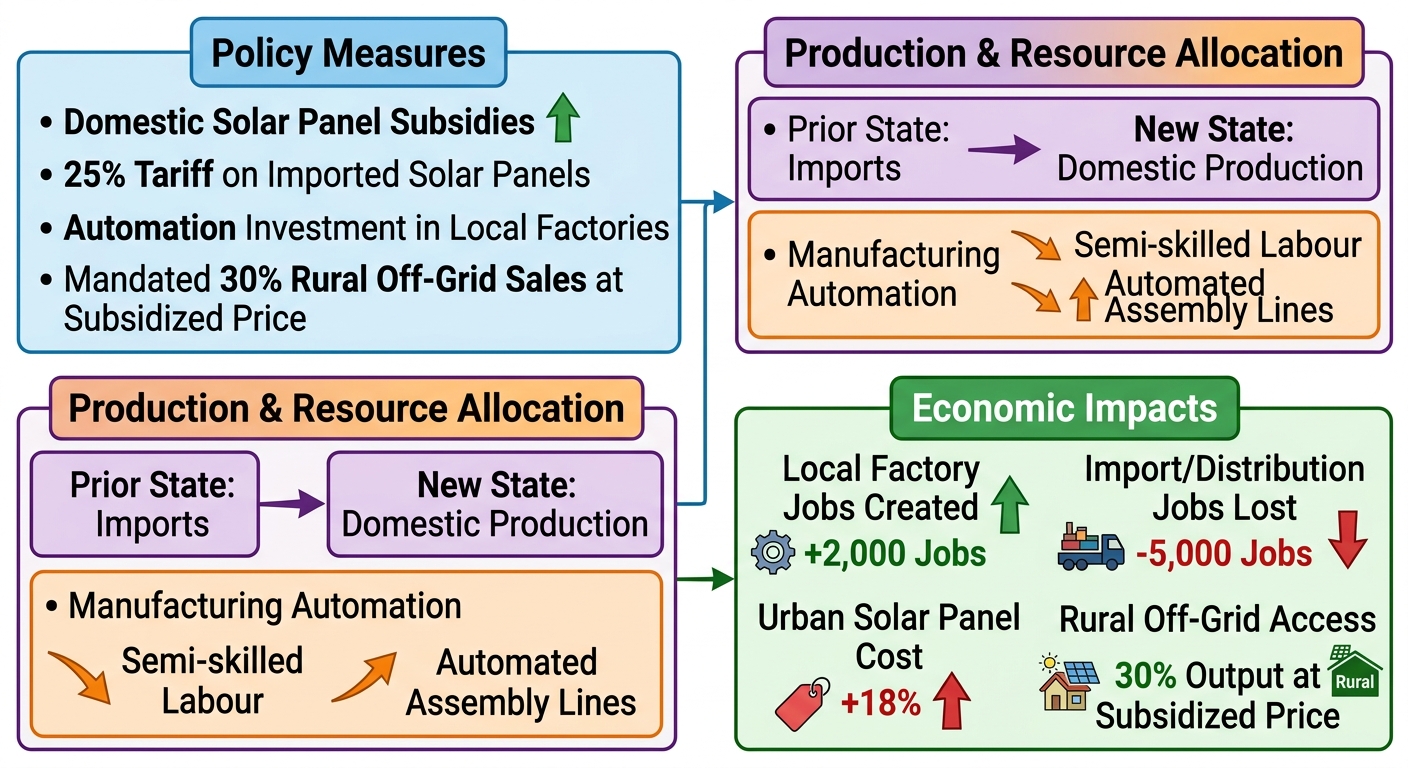
In 2022, the government of Kenya implemented a policy to increase domestic production of solar panels. Previously, Kenya relied almost entirely on imported solar panels from China. The government provided subsidies to local solar panel manufacturers and imposed a tariff on imported solar panels. The policy aimed to answer the three basic economic questions:
- What to produce? Shift production from imported goods to domestically manufactured solar panels.
- How to produce? Manufacturers invested in automated assembly lines, reducing the need for semi-skilled labour.
- For whom to produce? The government mandated that of all solar panels produced must be sold to rural off-grid households at a subsidized price.
A local economist noted that while the policy created 2,000 new jobs in the solar panel manufacturing sector, 5,000 workers lost jobs in the import and distribution sector. Additionally, the cost of solar panels in urban areas rose by .
(a)
Explain the opportunity cost of Kenya's decision to change what is produced from imported to domestically manufactured solar panels. [4 marks]
(b)
Explain how the mandate addresses the basic economic question of for whom to produce. [2 marks]
(c)
Using the data, discuss the extent to which Kenya's policy successfully addresses the for whom question for all affected groups. [4 marks]
Solutions
20MasteryLAQBasic economic questions: What, how and for whom?10 marksPaper 2~15 min
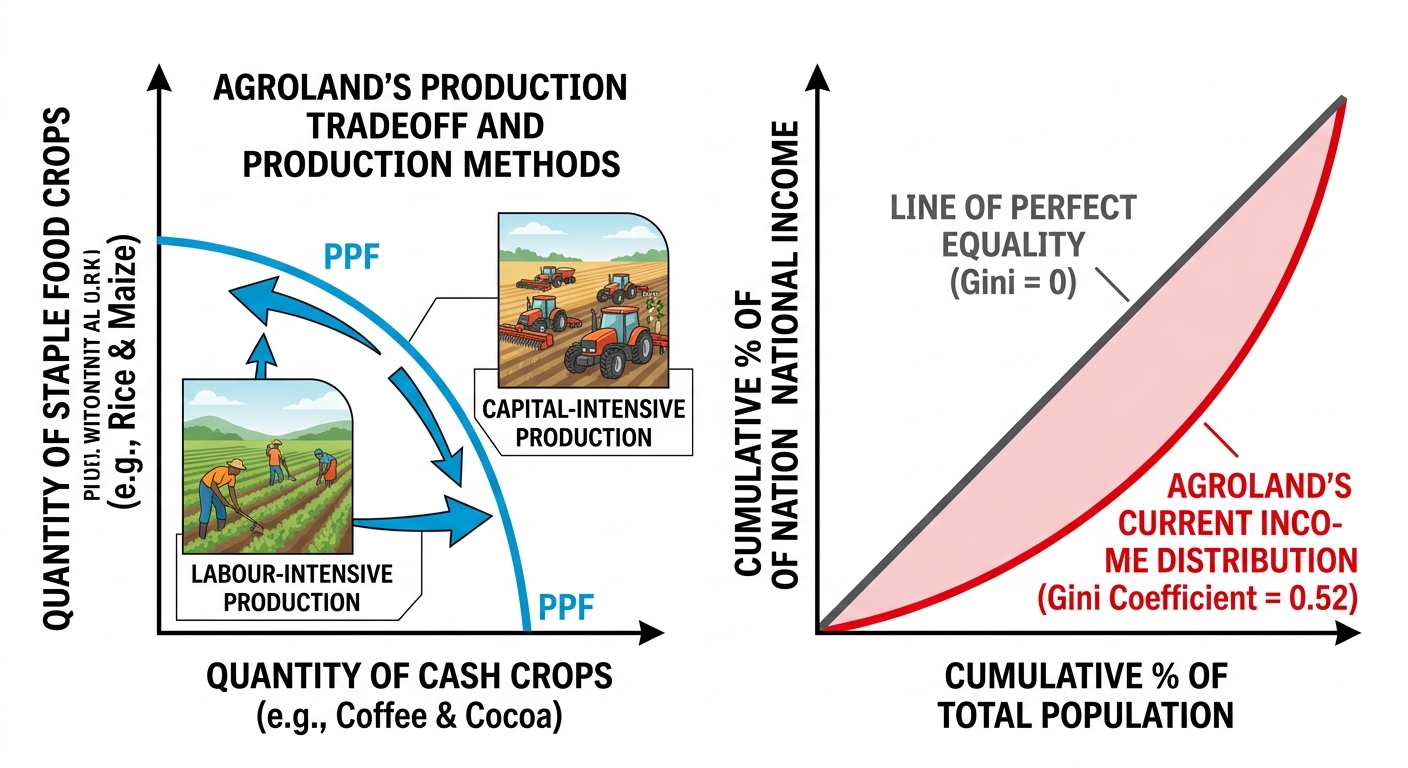
The government of a developing country, Agroland, is planning its national production strategy for the next five years. Agroland has abundant fertile land a young, low-skilled labour force. Currently, the economy primarily produces staple food crops (rice and maize) using labour-intensive methods. The government is considering shifting resources towards producing high-value cash crops (coffee and cocoa) for export, which would require mechanised farming techniques. Producing more cash crops would reduce the output of staple food, potentially raising domestic food prices and affecting low-income households. Agroland has a Gini coefficient of .
(a)
Using the concepts of "what to produce" and "how to produce," explain the opportunity cost of Agroland's proposed shift from staple food crops to cash crops. [4 marks]
(b)
Discuss how the question of "for whom to produce" is affected by this policy shift in Agroland, and evaluate whether redistribution policies could offset the resulting inequality, given Agroland's Gini coefficient of . [6 marks]
Solutions
Showing 20 of 83 free questions