You're viewing 1 free preview question for Economics HL — subscribe to unlock 6 more, plus the Full Question Bank, Mock Papers & Worksheets.Upgrade
How Do Economists Approach the World? · Paper 3 — Free Economics HL Practice Questions
1ChallengeSAQ-LThe role of data and evidence in economics10 marksPaper 3~15 min

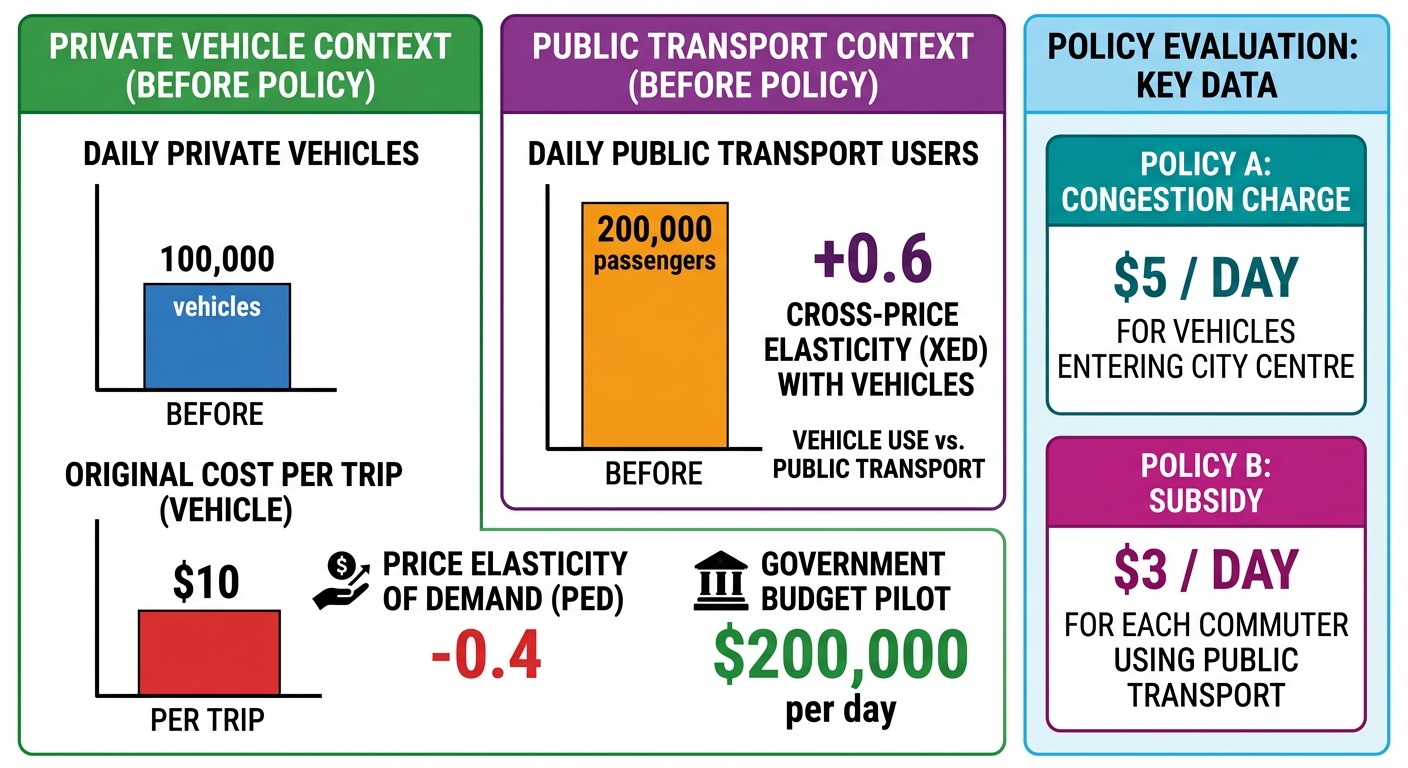
The government of Country X is evaluating two policies to reduce road congestion. Policy A introduces a congestion charge of USD 5 per day for vehicles entering the city centre. Policy B provides a subsidy of USD 3 per day for each commuter using public transport, reducing the effective price of a public transport trip from USD 5 to USD 2.
The following data are available:
- Average daily number of private vehicles entering the city centre (before any policy): vehicles
- Average daily number of public transport users (before any policy): passengers
- Original price per trip for a private vehicle user (fuel, parking, and time cost): USD 10
- Original price per public transport trip: USD 5
- Price elasticity of demand (PED) for private vehicle use:
- Cross-price elasticity of demand (XED) of private vehicle use with respect to public transport price:
- Cross-price elasticity of demand (XED) of public transport use with respect to private vehicle price:
- Government's daily budget for the policy: USD 200,000
(a)
Calculate the expected change in the number of private vehicles entering the city centre under Policy A. [2 marks]
(b)
Calculate the expected change in the number of public transport users a result of Policy A. [2 marks]
(c)
Calculate the expected change in the number of private vehicles entering the city centre under Policy B, given the government's budget constraint. [3 marks]
(d)
Evaluate which policy is more effective at reducing private vehicle use, referring to your calculations and the government's budget constraint. [3 marks]

Solutions
That's every free question here — 1 of 7.
+6 more questions, plus Mock Papers & Worksheets, are waiting in Premium.