You're viewing free preview questions. Upgrade to access more Economics HL questions.Upgrade
What is Economics? · Paper 3 — Free Economics HL Practice Questions
1ChallengeSAQ-LThe problem of scarcity and choice7 marksPaper 3~11 min

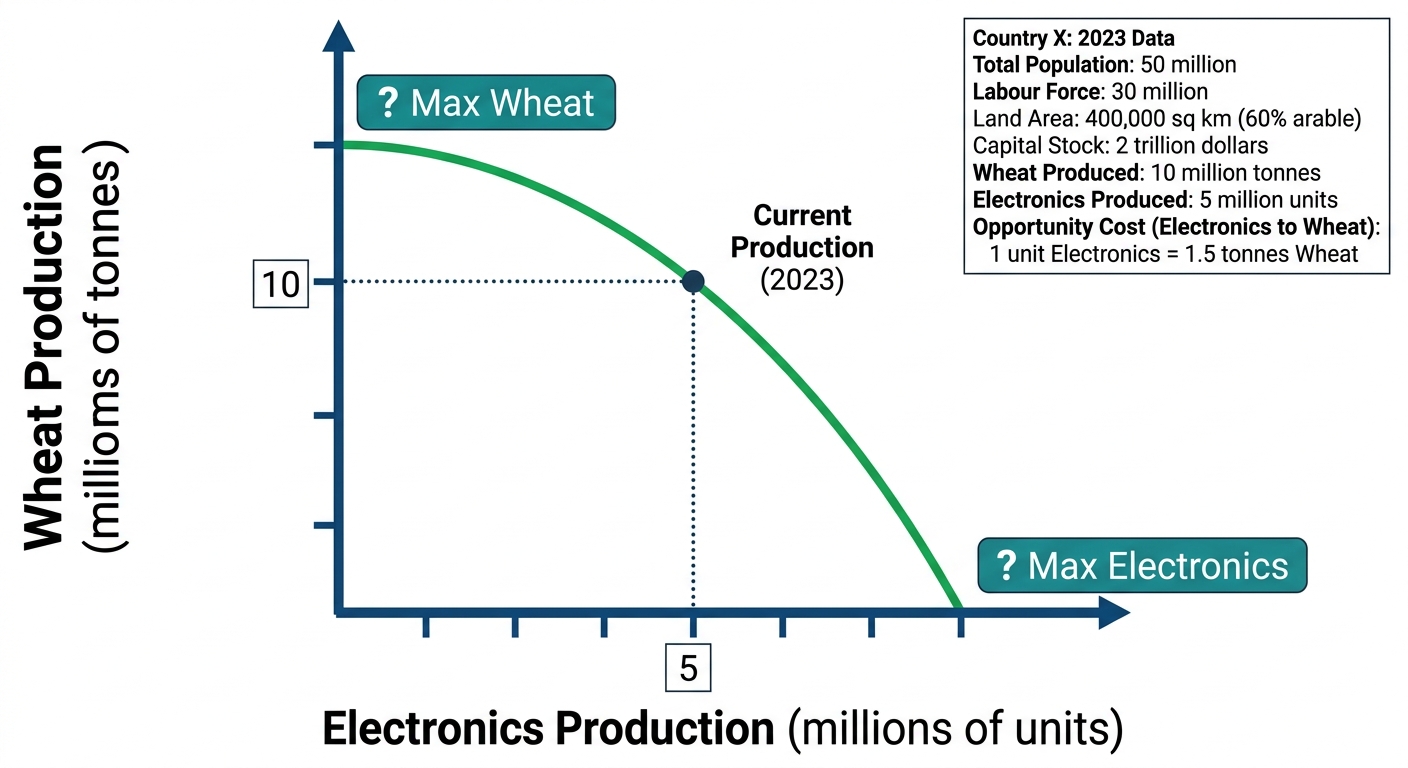
A country (Country X) has a labour force of 30 million people. Currently it produces million tonnes of wheat and million units of electronics. The opportunity cost of producing one additional unit of electronics is tonnes of wheat.
(a)
Calculate the maximum number of tonnes of wheat Country X could produce if all resources were devoted to wheat production. [1 mark]
(b)
Calculate the maximum number of units of electronics Country X could produce if all resources were devoted to electronics production. [1 mark]
(c)
Explain the trade-off faced by Country X if it increases electronics production by million units. [2 marks]
(d)
Calculate the change in wheat output resulting from the increase in electronics production in part (c). [1]
(e) Evaluate the usefulness of the production possibility frontier (PPF) model for a government making resource allocation decisions when technological progress occurs in the electronics sector only. [3 marks]

Solutions
2ChallengeSAQ-LThe problem of scarcity and choice7 marksPaper 3~11 min
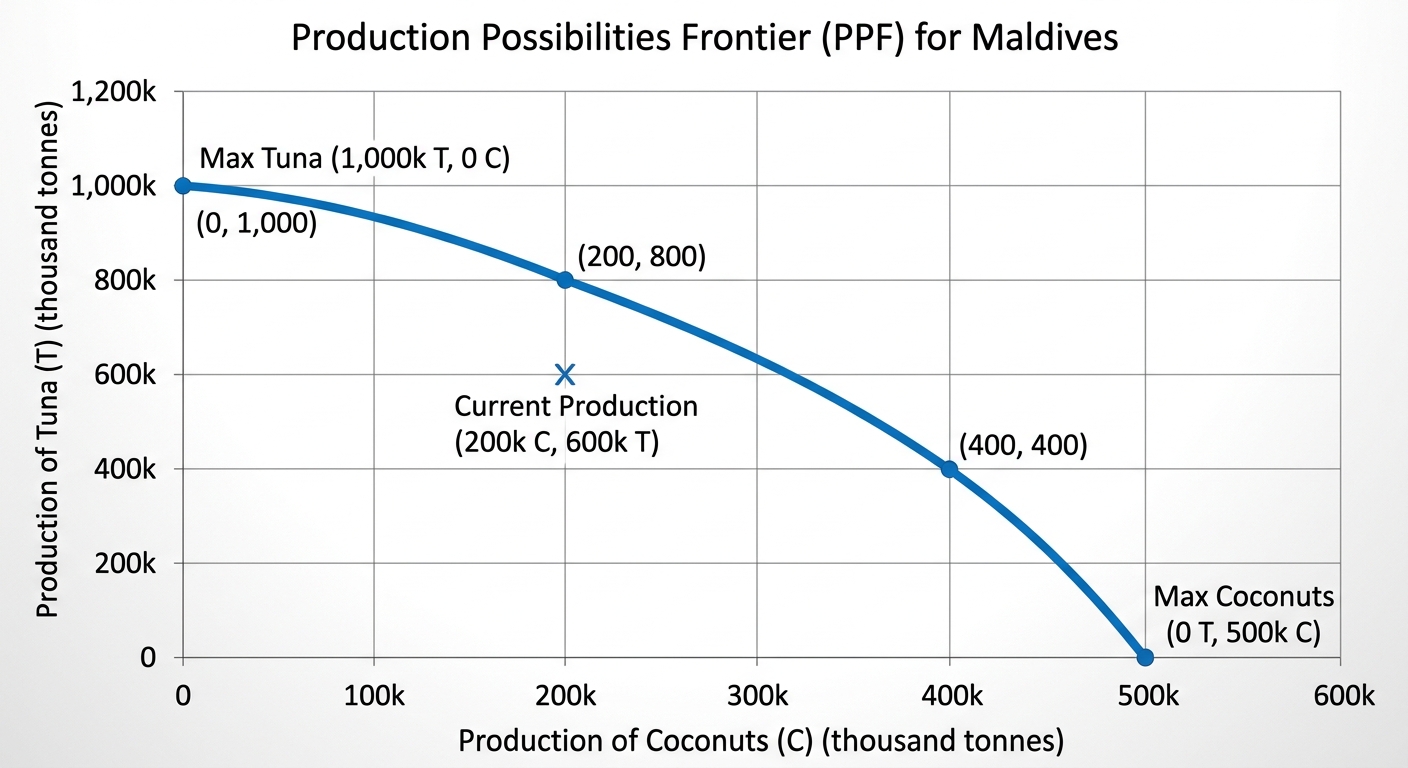
The island nation of Maldives has a total labour force of workers. Each worker can produce either tonnes of tuna or tonnes of coconuts per year. Currently, the economy produces tonnes of tuna and tonnes of coconuts annually.
(a)
Calculate the opportunity cost of producing one additional tonne of tuna in terms of coconuts forgone. [2 marks]
(b)
Explain why the current production point is productively inefficient. [2 marks]
(c)
Evaluate whether the Maldives government should allocate all remaining idle labour to tuna production rather than coconut production. [3 marks]
Solutions
3ChallengeSAQ-LThe problem of scarcity and choice7 marksPaper 3~11 min
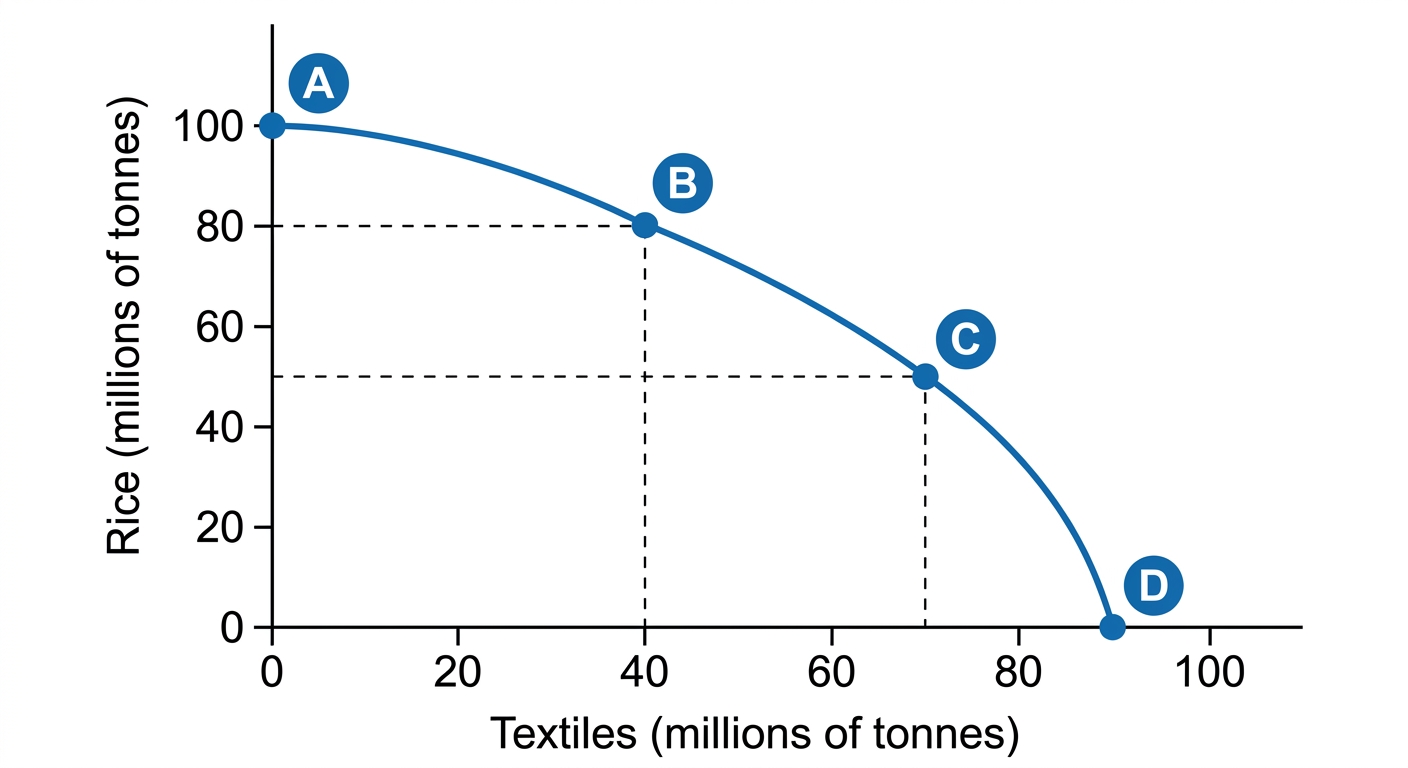
Agriana is a developing country with a total population of 20 million and a labour force of 8 million. It produces only two goods: rice (a basic food staple) and textiles (for export). A severe drought has reduced water availability, a critical input for rice production. The table below shows Agriana's annual production possibilities.
Option — Rice (millions of tonnes) — Textiles (millions of tonnes)
A — 100
B — 80 — 40
C — 50 — 70
D — 0 — 90
(a)
Calculate the opportunity cost of increasing textile production from 40 million tonnes to 70 million tonnes. [2 marks]
(b)
Explain how the shape of Agriana's production possibilities frontier (PPF) illustrates the concept of scarcity. [2 marks]
(c)
Evaluate whether opportunity cost calculations alone are sufficient to guide Agriana's government in deciding how much rice versus textiles to produce during the drought. [3 marks]
Solutions
4ChallengeSAQ-LThe problem of scarcity and choice7 marksPaper 3~11 min
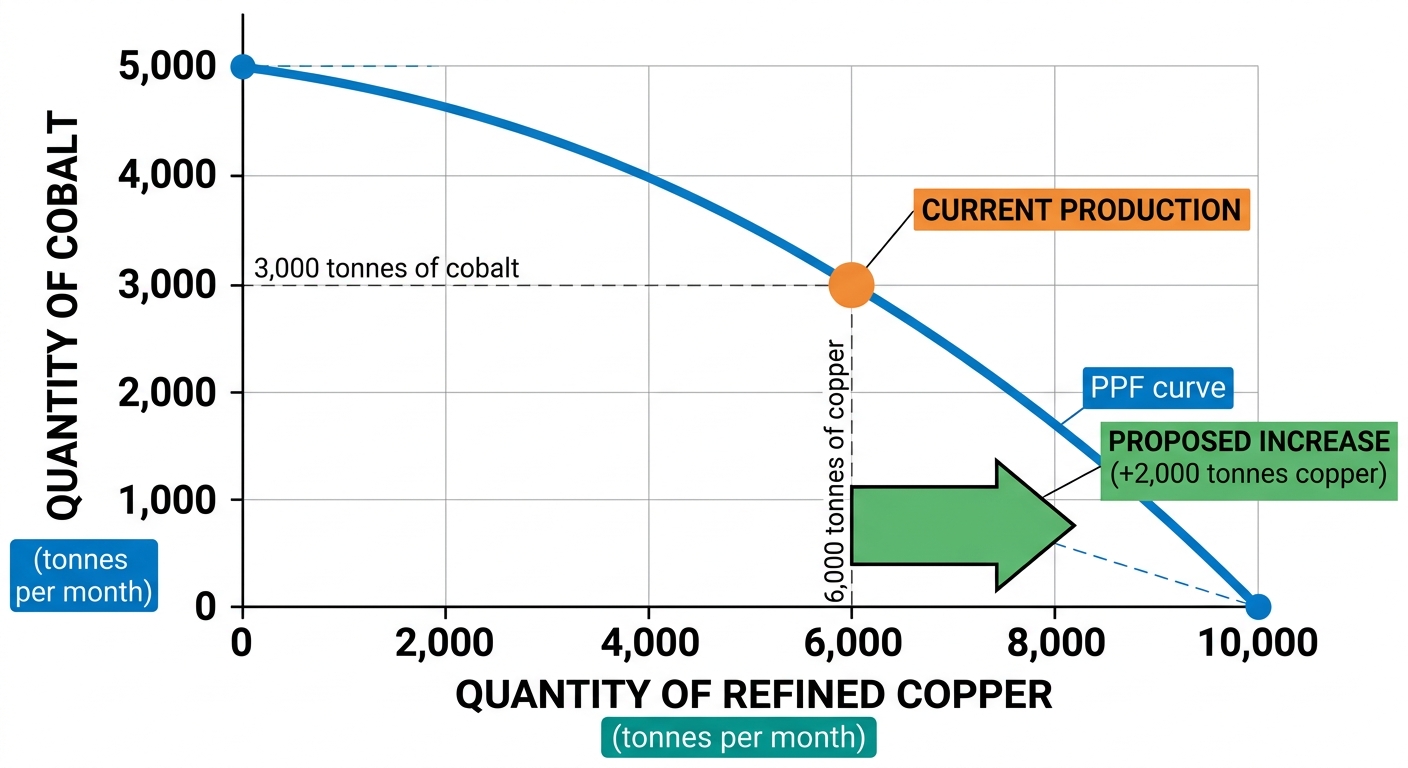
A copper mining company in Zambia uses its existing labour and capital to produce either tonnes of refined copper or tonnes of cobalt per month. The company currently produces tonnes of copper and tonnes of cobalt per month. The government is considering a policy to increase copper production by tonnes per month.
(a)
Calculate the opportunity cost of the proposed increase in copper production. [2 marks]
(b)
Explain one implication of this opportunity cost for Zambia's ability to benefit from the growing global market for electric vehicle batteries. [2 marks]
(c)
Evaluate whether the Zambian government should proceed with the policy. In your answer, consider both the short-run revenue benefits and the long-run risks arising from increased specialisation in copper. [3 marks]
Solutions
5ChallengeSAQ-LThe problem of scarcity and choice18 marksPaper 3~27 min
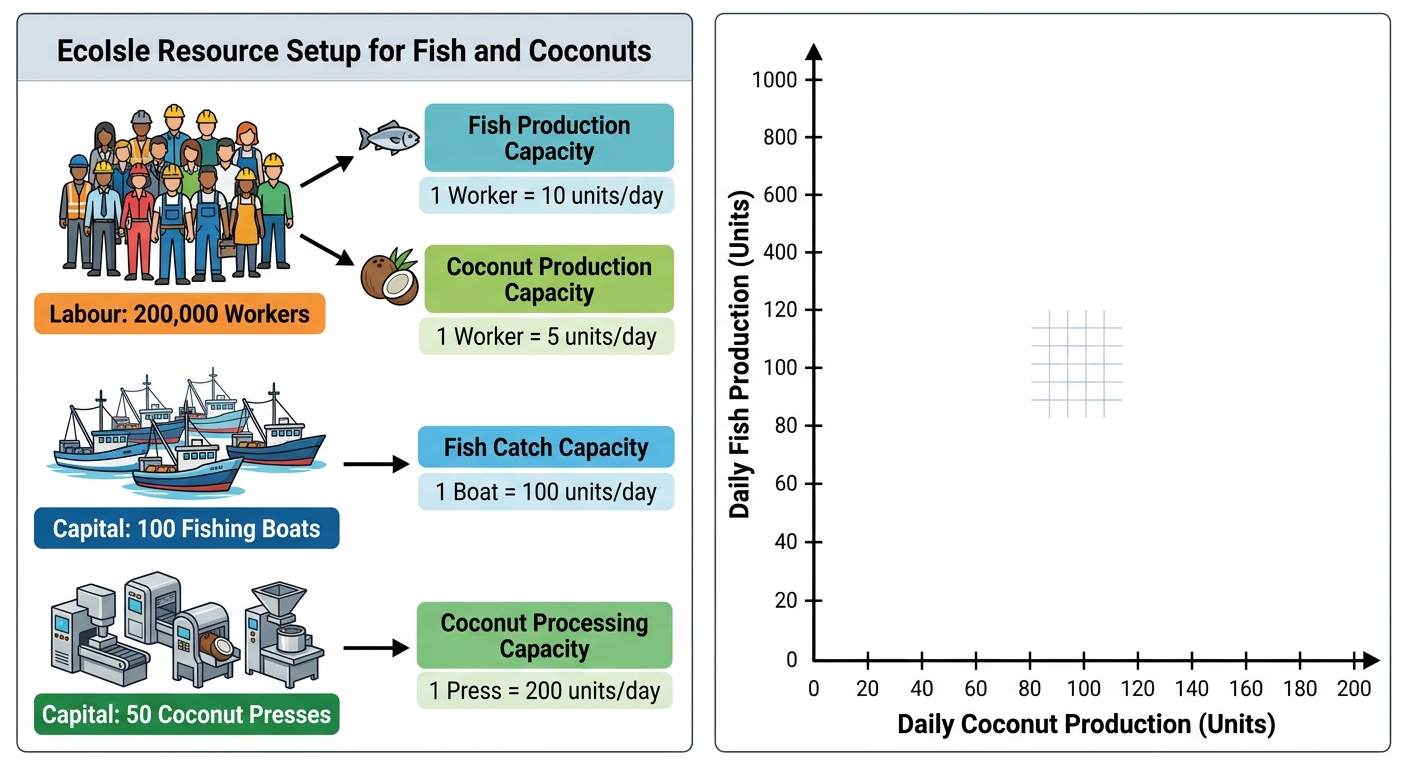
EcoIsle is a small island nation with the following productive resources used exclusively to produce fish and coconuts:
- Labour: workers; each worker produces either units of fish or units of coconuts per day.
- Capital: fishing boats; each boat catches units of fish per day. coconut presses; each press processes units of coconuts per day.
All labour and all capital are fully employed each day. Each worker operates independently of the boats and presses (i.e., labour and capital constraints apply separately).
(a)
Calculate the maximum daily output of fish, identifying the binding constraint. [2 marks]
(b)
Calculate the maximum daily output of coconuts, identifying the binding constraint. [2 marks]
(c)
Explain why a daily output combination of units of fish and units of coconuts is unattainable, using the concept of opportunity cost in your answer. [3 marks]
(d)
Evaluate the role of resource scarcity in forcing trade-offs between fish and coconut production in EcoIsle, with reference to the specific constraints identified above. [4]
Total: [11 marks]
Solutions
6ChallengeSAQ-LThe problem of scarcity and choice8 marksPaper 3~12 min
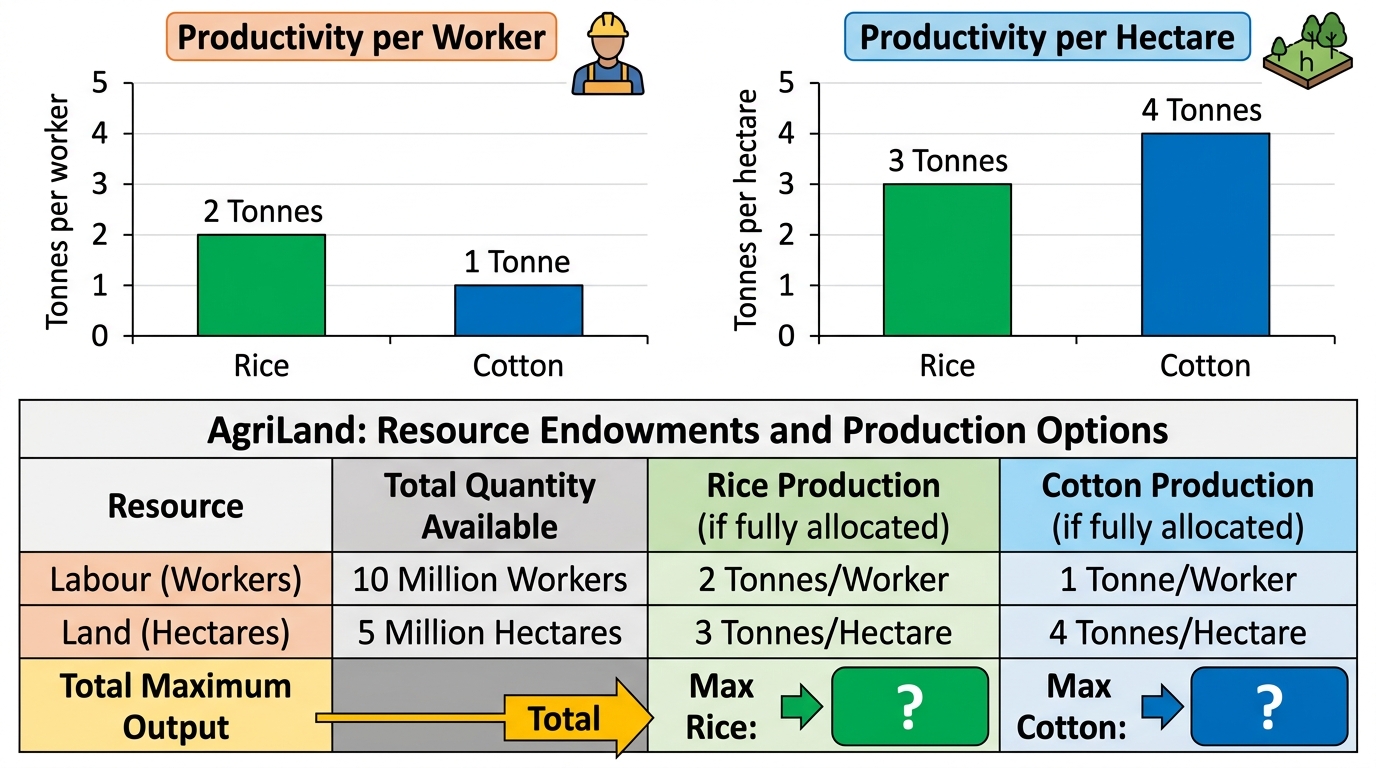
AgriLand is a developing country with two resources: million workers and million hectares of land.
- Each worker can produce either tonnes of rice or tonne of cotton per year.
- Each hectare of land can produce either tonnes of rice or tonnes of cotton per year.
- Workers can only produce using labour; land can only produce using land. The two resources are independent.
(a)
Calculate the maximum output of rice if all workers and all land are used exclusively to produce rice. [1 mark]
(b)
Calculate the maximum output of cotton if all workers and all land are used exclusively to produce cotton. [1 mark]
(c)
Explain, using opportunity cost, why the combination of million tonnes of rice and million tonnes of cotton is unattainable. [3 marks]
(d)
Explain how the concept of opportunity cost assists a government in making resource allocation decisions when labour and land have different productivities in different uses. [3 marks]
Solutions
7ChallengeSAQ-LBasic economic questions: What, how and for whom?7 marksPaper 3~11 min
A small island nation, Maldova, has a labour force of workers. Each worker can produce either of fish or of coconuts per day. Currently, workers produce fish and produce coconuts. The market wage is USD 20 per worker per day, the price of fish is USD 3 per kg, and the price of coconuts is USD 4 per kg. Citizens spend of their income on fish; the government aims to maximise consumer satisfaction.
(a)
Calculate the total daily output, in kg, of fish and of coconuts under the current allocation. [2 marks]
(b)
Calculate the total daily wage income earned by all workers. [1 mark]
(c)
Explain whether the current allocation answers the "what to produce?" question efficiently. [2 marks]
(d)
Evaluate how the answer to the "for whom to produce?" question might change if the government introduces a income tax on all workers and uses the revenue to provide free fish to low-income households. [2 marks]
Solutions
8ChallengeSAQ-LBasic economic questions: What, how and for whom?7 marksPaper 3~11 min
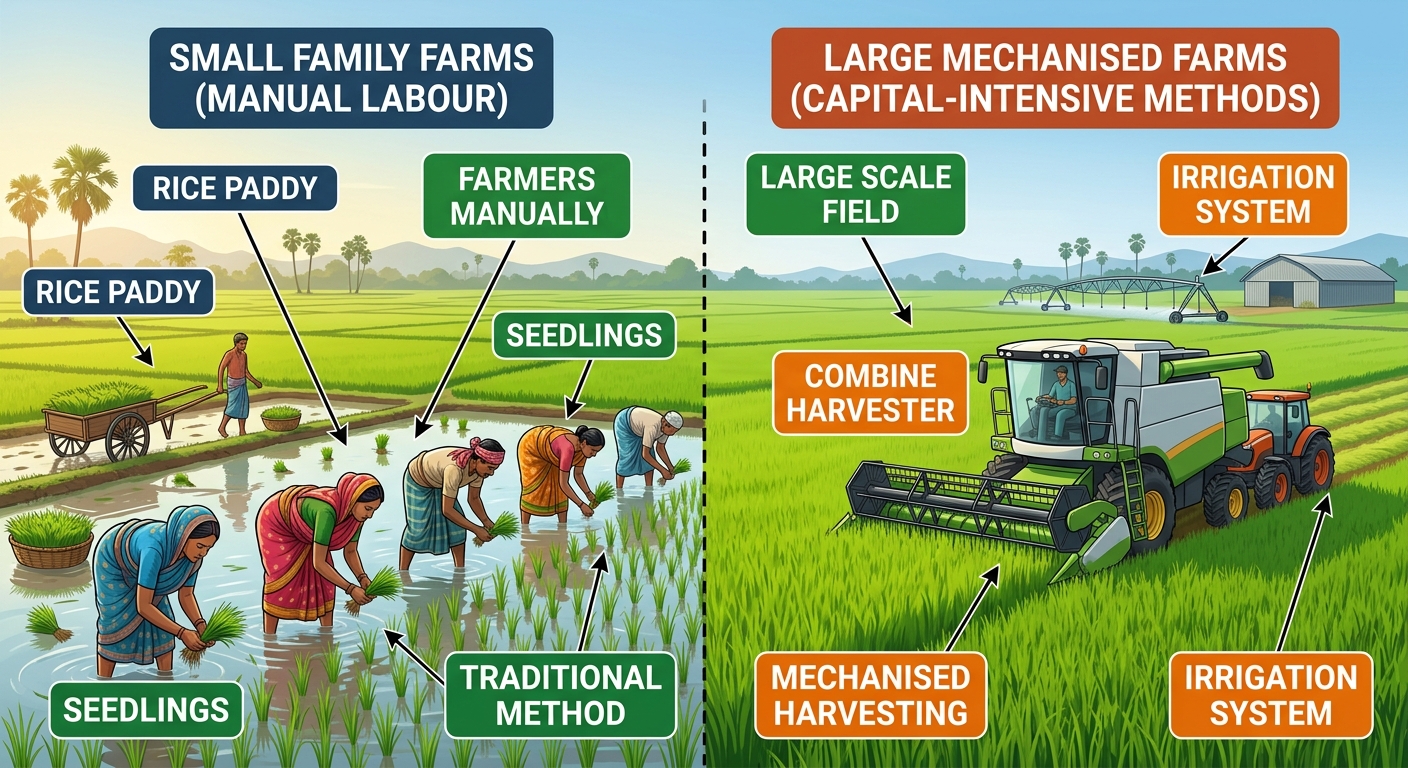
In the agricultural sector of Bangladesh, rice production is organised in two ways: small family farms using manual labour produce tonnes per hectare at a cost of USD 300 per tonne; large mechanised farms using capital-intensive methods produce tonnes per hectare at a cost of USD 200 per tonne. Assume equal land area is devoted to each method.
(a)
Calculate the average cost per tonne of rice under the current production mix. [3 marks]
(b)
Explain how the choice between manual labour and mechanised farming addresses the basic economic question "How to produce?", referring to the trade-off between productive efficiency and employment. [2 marks]
(c)
Evaluate the likely effects on the basic economic question "For whom to produce?" if Bangladesh shifts entirely to mechanised rice farming. [2 marks]
Solutions
9ChallengeSAQ-LThe problem of scarcity and choice7 marksPaper 3~11 min
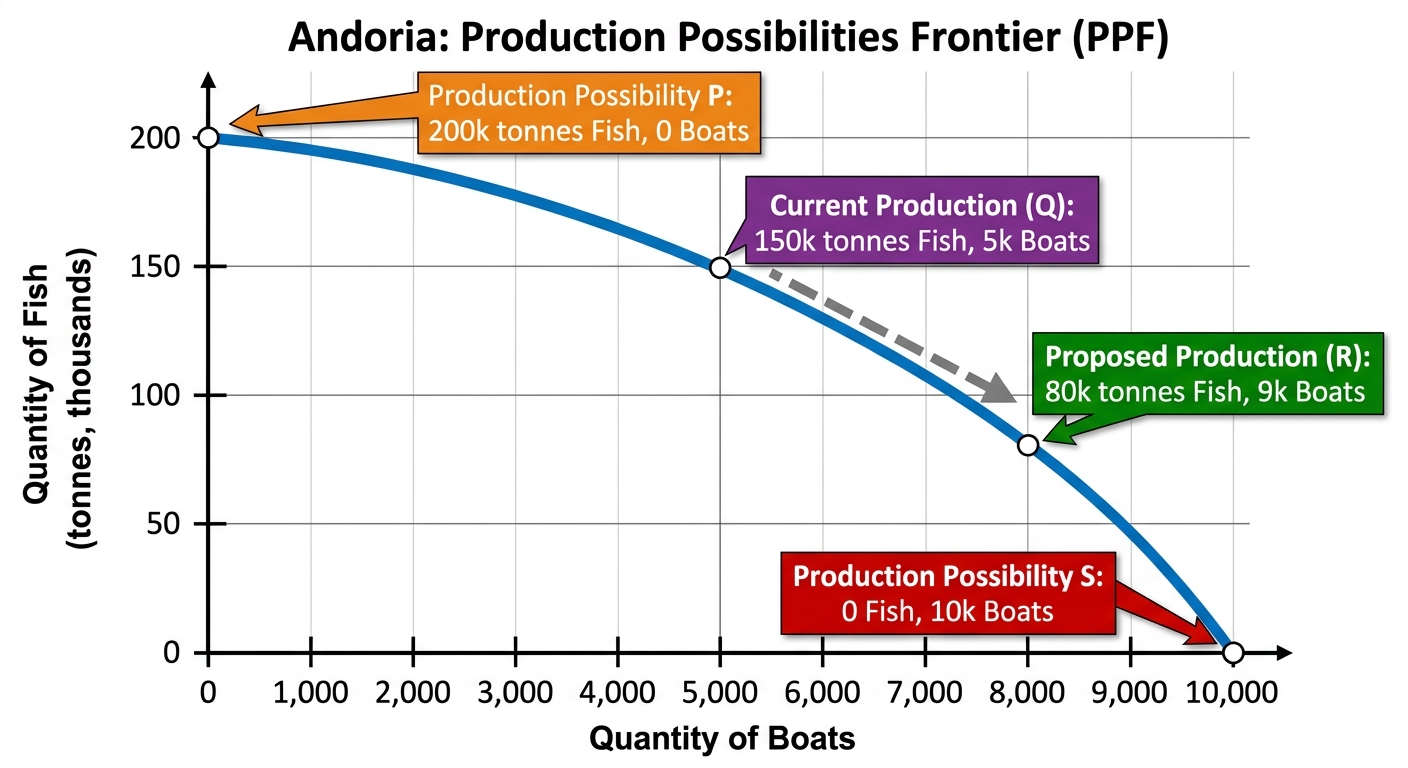
Andoria is a small island nation with limited natural resources. Its labour force is people. The country currently allocates all its resources to producing two goods: fish (for domestic consumption) and luxury boats (for export). The table below shows Andoria's production possibilities per year.
Option — Fish (tonnes) — Boats
P — —
Q — —
R — —
S — —
Andoria's government is considering a policy to increase boat production from to units to boost export revenue. Marine biologists have warned that current fish stocks are declining due to overfishing, and that fish output cannot be sustained above tonnes per year in the long run.
(a)
Calculate the opportunity cost, in tonnes of fish, per additional boat produced when output increases from to boats. [2 marks]
(b)
Explain why the shape of Andoria's PPF is concave (bowed outward from the origin), with reference to the factors of production used in each industry. [2 marks]
(c)
Using the PPF data and the information about declining fish stocks, evaluate whether moving production from option Q to option R is economically justified for Andoria. [3 marks]
Solutions
10ChallengeSAQ-LBasic economic questions: What, how and for whom?7 marksPaper 3~11 min
The government of a developing nation is considering three production options for the next fiscal year, given its limited resources (land, labour, capital, and entrepreneurship):
- Option A: Produce tonnes of wheat and tonnes of steel.
- Option B: Produce tonnes of wheat and tonnes of steel.
- Option C: Produce tonnes of wheat and tonnes of steel.
The government's social welfare function values one tonne of wheat USD 100 and one tonne of steel at USD 200. The nation's Gini coefficient is currently . Wheat is a staple food primarily consumed by lower-income households; steel is an industrial input used by capital-intensive firms owned by higher-income groups.
(a)
Calculate the total social welfare (in USD) for each of the three production options. [2 marks]
(b)
Explain the trade-off the government faces between maximising total social welfare and reducing income inequality when choosing among the three options. [2 marks]
(c)
Evaluate the extent to which the 'how to produce?' and 'for whom to produce?' questions are interdependent in this scenario. [3 marks]
Solutions
11ChallengeSAQ-LBasic economic questions: What, how and for whom?7 marksPaper 3~11 min
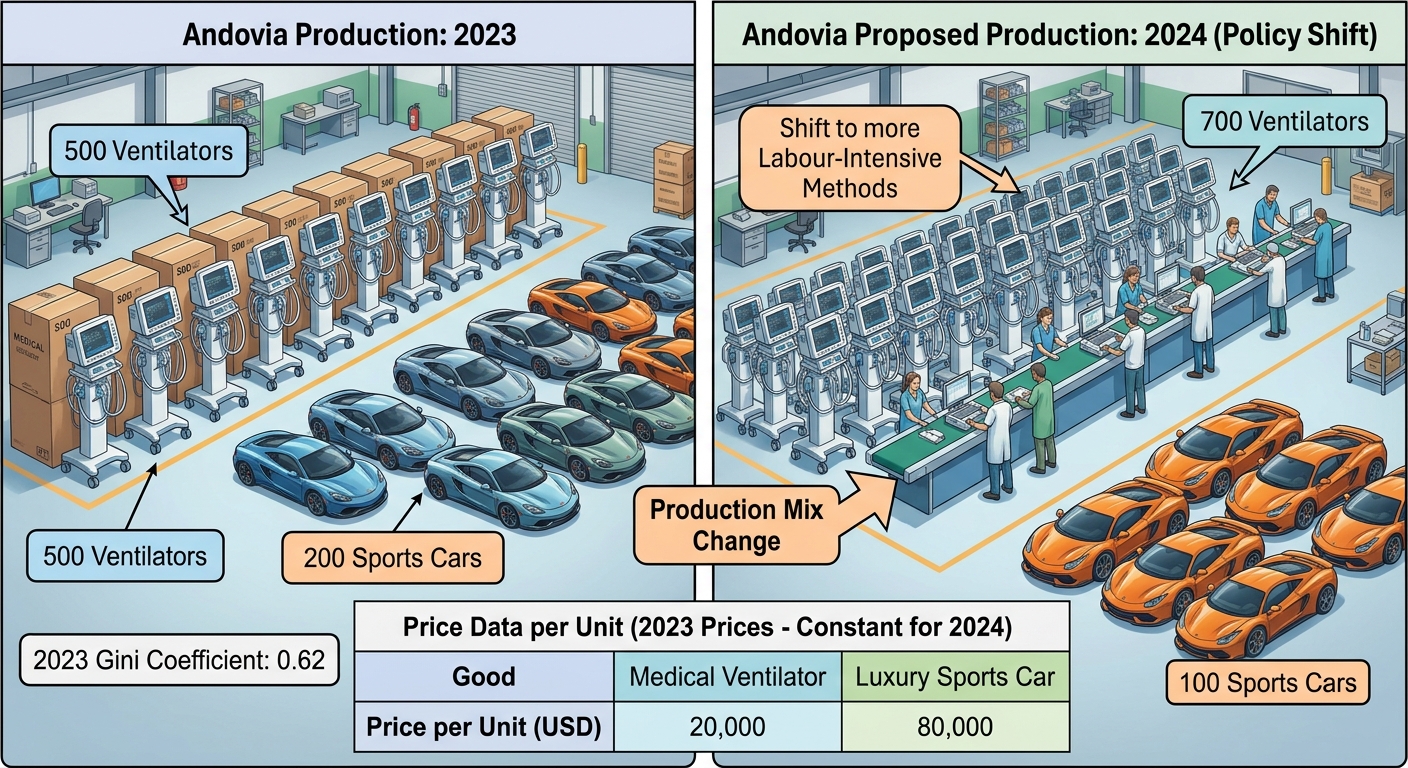
The economy of Andovia produces only two goods: medical ventilators and luxury sports cars. In 2023, Andovia produced 500 ventilators at a price of USD 20,000 each, and 200 sports cars at a price of USD 80,000 each. The Gini coefficient for Andovia is . The government is considering a policy shift: in 2024, Andovia would produce 700 ventilators and 100 sports cars, using more labour-intensive assembly methods for ventilators. Prices remain unchanged.
(a)
Calculate the percentage change in nominal GDP from 2023 to 2024 if the proposed production plan is adopted. [3 marks]
(b)
Explain how the change in the production mix between 2023 and 2024 addresses the basic economic question 'What to produce?' [2 marks]
(c)
Evaluate the likely impact of the proposed production change on the basic economic question 'For whom to produce?', using the Gini coefficient and the concept of equity. [2 marks]
Solutions
12ChallengeSAQ-LBasic economic questions: What, how and for whom?7 marksPaper 3~11 min
The government of Agraria is deciding how to allocate hectares of fertile land among three crops. The table below shows output, price, and labour data for each crop.
Crop — Output (tonnes/hectare) — Price (USD/tonne) — Labour (workers/hectare)
Rice — — —
Cotton — — —
Sugarcane — — —
Agraria has a total agricultural workforce of workers, each earning a wage of USD per day. The government aims to maximise the total value of agricultural output while also considering labour use and income distribution.
(a)
Calculate the total value of output (in USD) if the government allocates hectares to rice, hectares to cotton, and hectares to sugarcane. [3 marks]
(b)
Determine whether this allocation is feasible given the labour constraint, showing your working. [2 marks]
(c)
Explain how a shift toward more labour-intensive production techniques affects the distribution of income between workers and landowners in Agraria. [2 marks]
Solutions