You're viewing 2 free preview questions for Economics HL — subscribe to unlock 154 more, plus the Full Question Bank, Mock Papers & Worksheets.Upgrade
Elasticity of Supply · Paper 2 — Free Economics HL Practice Questions
1MasteryLAQPrice elasticity of supply (PES)10 marksPaper 2~15 min

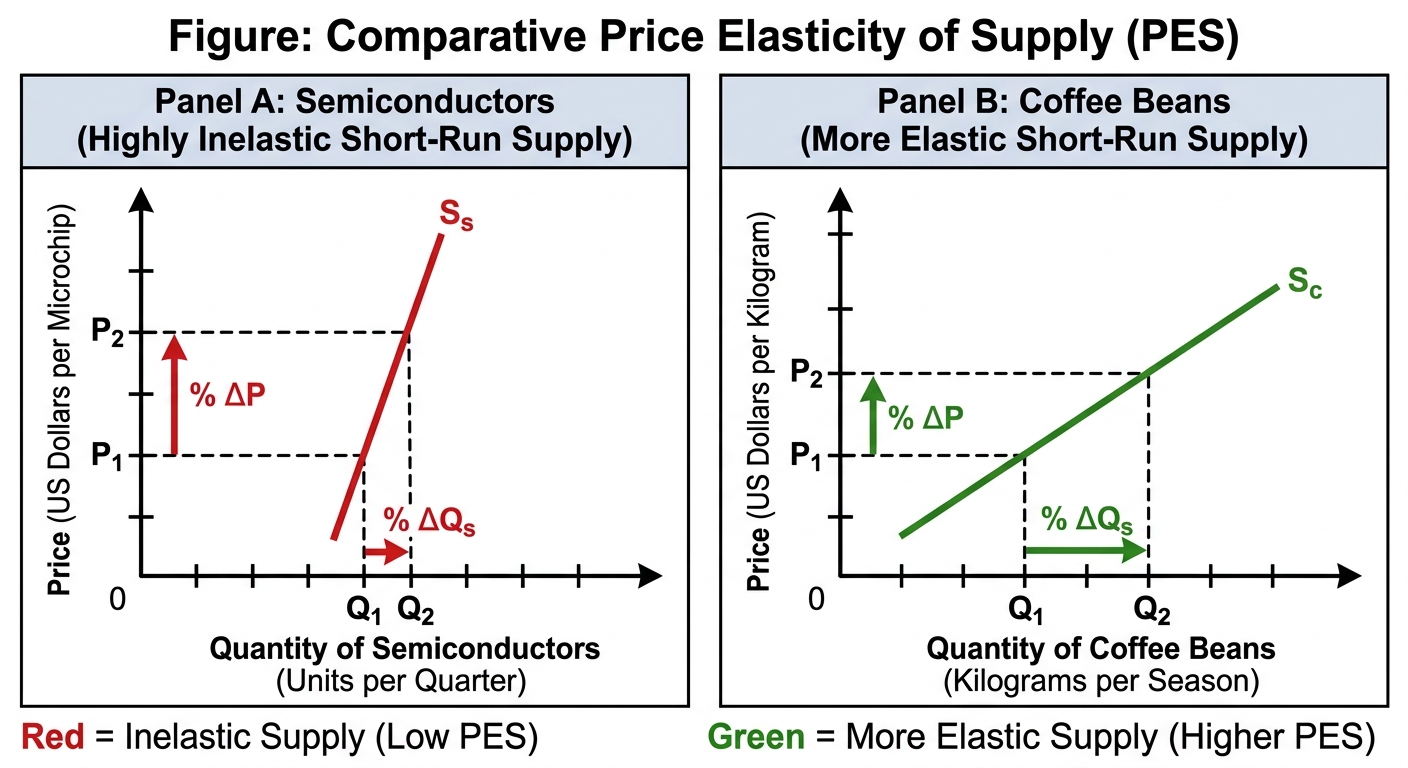
The global supply of semiconductors (microchips) is dominated by a few large firms, such as TSMC (Taiwan) and Samsung (South Korea). In 2021, a surge in demand for electronics during the COVID-19 pandemic led to a global semiconductor shortage. Manufacturers struggled to increase output quickly because building new fabrication plants ("fabs") requires 2–3 years and costs over USD 10 billion. In contrast, the supply of freshly harvested coffee beans is more responsive to price changes in the short term, as farmers can allocate more land or labour within a single growing season.
(a)
State the formula for price elasticity of supply (PES). [1 mark]
(b)
Using the data provided, explain two determinants of PES that made the supply of semiconductors highly inelastic during the 2021 shortage. [4 marks]
(c)
Using a supply and demand , explain the short-run impact of a low PES for semiconductors on consumers and producers following the 2021 demand surge. [3 marks]
(d)
Evaluate whether producers or consumers are more adversely affected by a low PES in the short run. Refer to a real-world example in your answer. [2 marks]

Solutions
2MasteryLAQPrice elasticity of supply (PES)10 marksPaper 2~15 min
The global market for semiconductors experienced severe supply chain disruptions between 2020 and 2023. A sudden surge in demand for consumer electronics coincided with factory shutdowns in key producing countries.
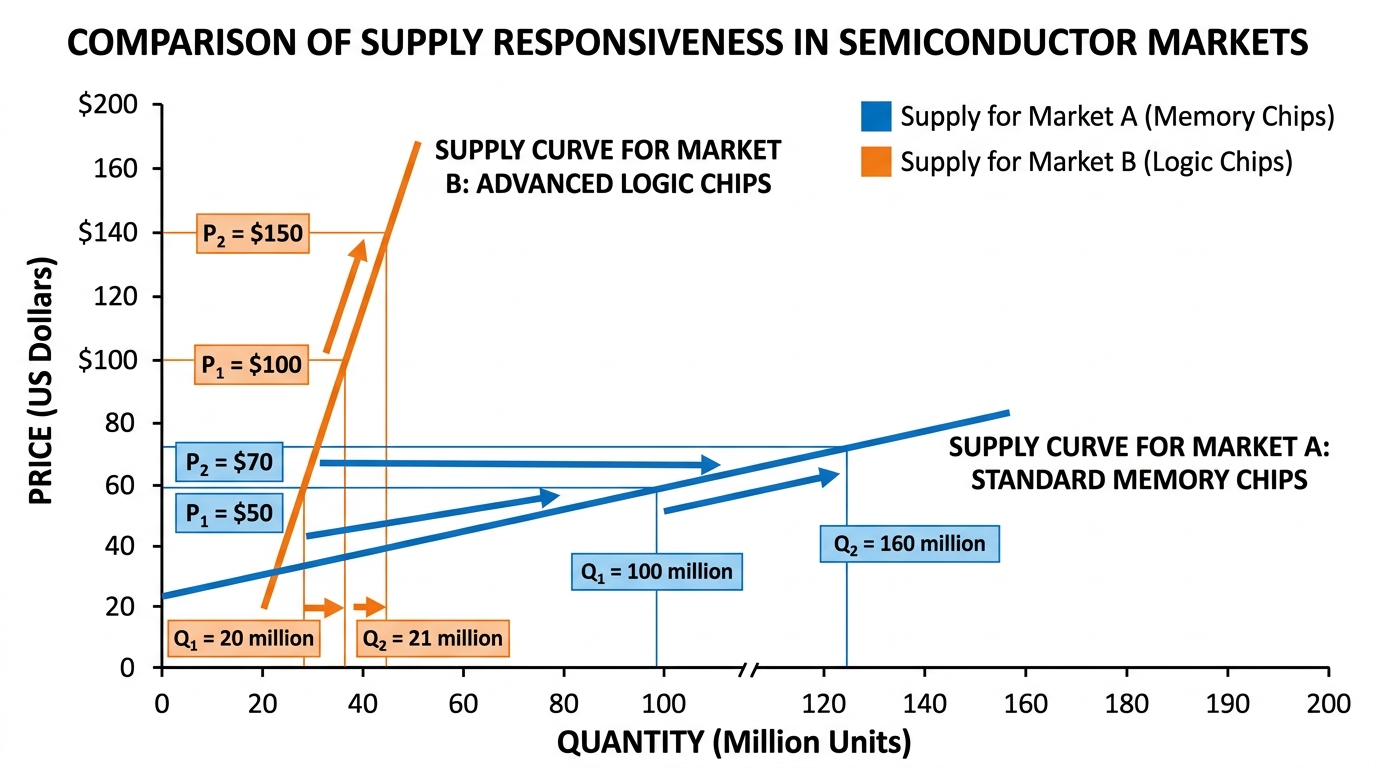
Consider two markets within the semiconductor industry:
- Market A — Standard memory chips (DRAM): produced using highly automated, standardised processes that can be scaled up or down relatively quickly; spare production capacity exists in several countries.
- Market B — Advanced logic chips (3-nanometer processors): require extremely specialised fabrication plants (fabs) that take 3–5 years to build and operate near maximum capacity 24/7.
In 2022, the price of standard memory chips rose by and the quantity supplied increased by . For advanced logic chips, the price rose by but the quantity supplied increased by only .
(a)
Calculate the Price Elasticity of Supply (PES) for standard memory chips. [2 marks]
(b)
Using one determinant of PES identified in the scenario, explain why the PES for advanced logic chips is lower than for standard memory chips. [3 marks]
(c)
Evaluate the implications of the difference in PES between the two markets for producers facing a sudden increase in demand. Your answer must include a justified conclusion about which producers are better positioned in the long run. [5 marks]
Solutions
That's every free question here — 2 of 156.
+154 more questions, plus Mock Papers & Worksheets, are waiting in Premium.