You're viewing 3 free preview questions for Economics SL — subscribe to unlock 51 more, plus the Full Question Bank, Mock Papers & Worksheets.Upgrade
Measuring Development · Paper 2 — Free Economics SL Practice Questions
1MasteryLAQChallenges in measuring development10 marksPaper 2~15 min

Data
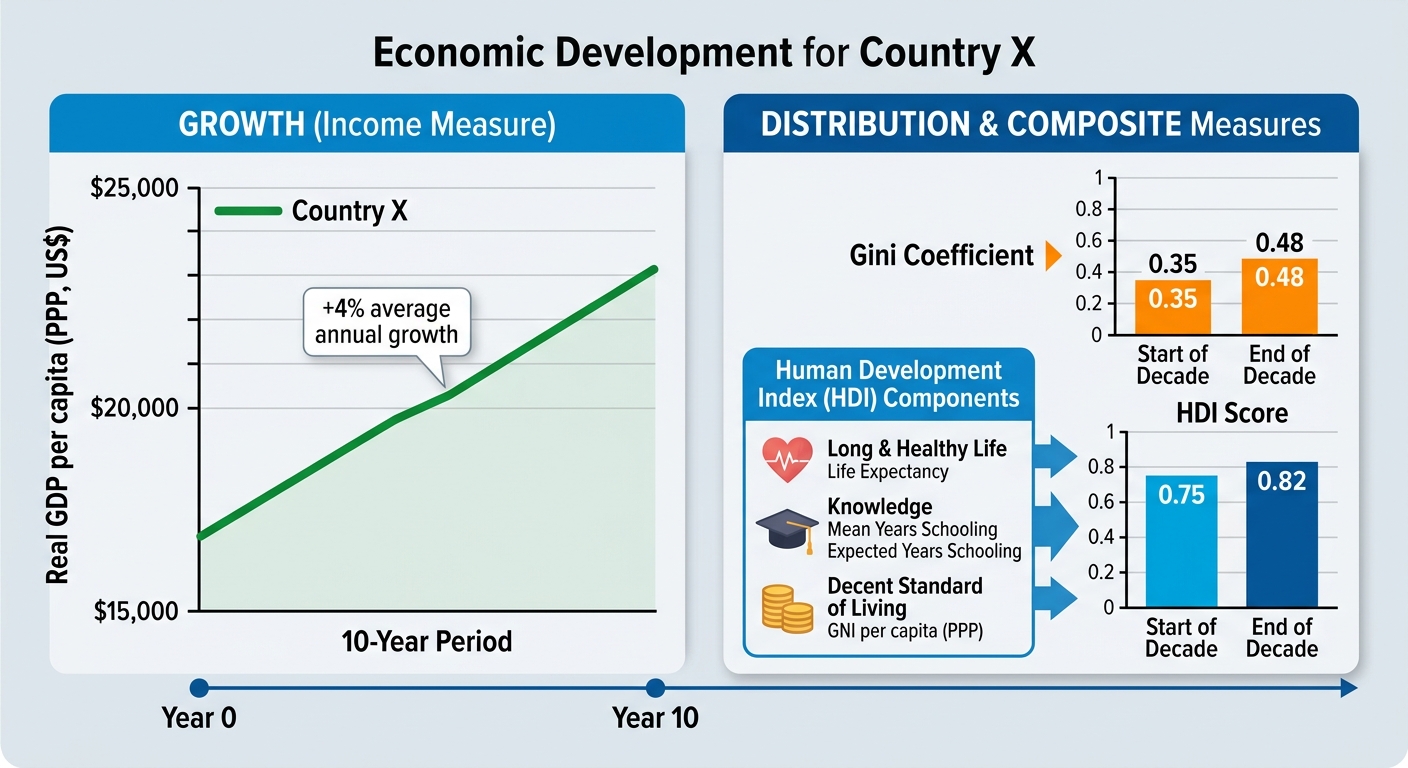
The Human Development Index (HDI) is a composite index comprising: (1) life expectancy at birth, (2) mean and expected years of schooling, and (3) GNI per capita (PPP). The Gini coefficient measures income inequality, where = perfect equality and = perfect inequality.*
Country X has experienced steady growth in its real GDP per capita (PPP) of per year for the past decade. Over the same period, the country's Gini coefficient has risen from to . The government of Country X claims its development strategy has been highly successful, citing rising GDP per capita as evidence.
*
(a)
Using the data provided, explain why the rise in the Gini coefficient from to suggests that GDP per capita growth alone is an insufficient indicator of development in Country X. [4 marks]
(b)
Discuss the extent to which the HDI provides a more comprehensive measure of development than GDP per capita, with reference to the situation in Country X. [6 marks]

Solutions
2MasteryLAQChallenges in measuring development10 marksPaper 2~15 min
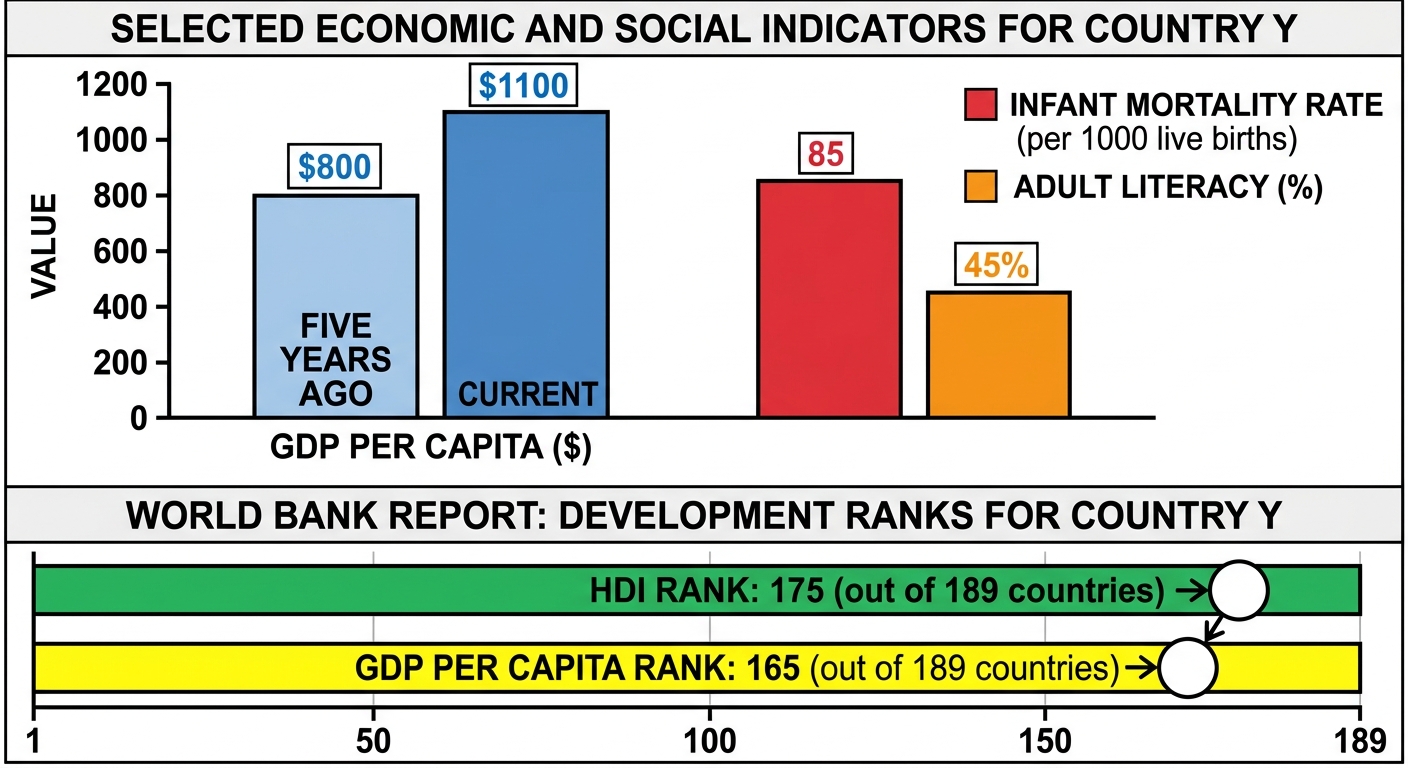
Country Y is a low-income country in Sub-Saharan Africa. Its GDP per capita has risen from USD 800 to USD 1,100 over the last five years. However, the country has an infant mortality rate of per live births, an adult literacy rate of , and frequent power outages that disrupt economic activity. A recent World Bank report notes that Country Y's HDI rank is out of countries, while its GDP per capita rank is .
- GDP per capita Gross Domestic Product total population.
- The Human Development Index (HDI) is a composite index based on: (i) life expectancy at birth, (ii) mean and expected years of schooling, and (iii) GNI per capita (PPP).
- Infant mortality rate number of deaths of infants under one year old per live births.
(a)
Using the data provided, explain why GDP per capita is an insufficient measure of development for Country Y. [4 marks]
(b)
With reference to at least two development indicators evident in Country Y's situation, evaluate which indicator(s) provide the most complete picture of development for a country in Country Y's position, and explain the limitations that remain even with those indicators. [6 marks]
Solutions
3ChallengeLAQEconomic, social and environmental factors in development10 marksPaper 2~15 min
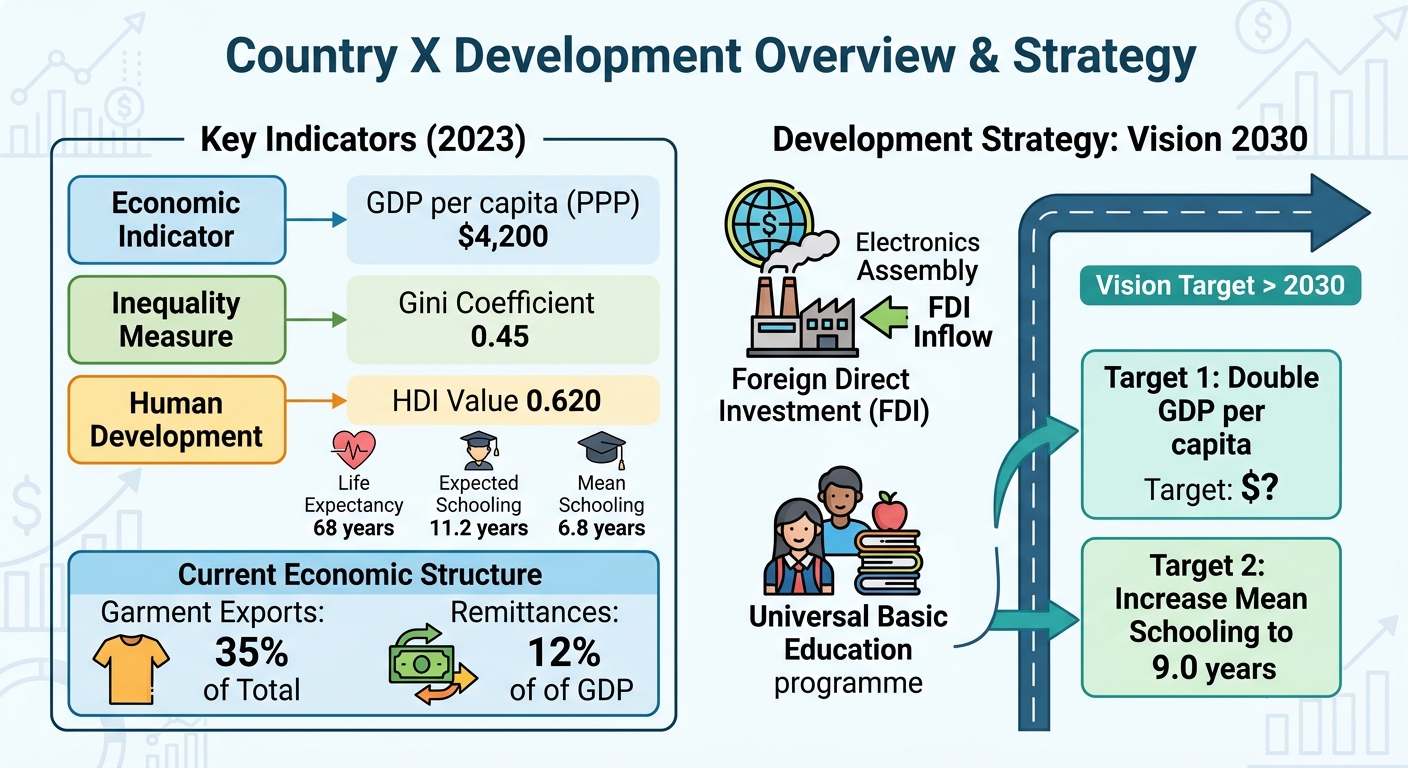
Country X is a lower-middle-income nation in Southeast Asia. In 2023, its GDP per capita was USD 4,200 (PPP). Its Human Development Index (HDI) value was 0.620, with life expectancy at birth of 68 years, expected years of schooling of 11.2, and mean years of schooling of 6.8. The Gini coefficient was 0.45. The economy relies heavily on garment manufacturing ( of exports) and remittances from overseas workers ( of GDP). The government has announced 'Vision 2030', which aims to double GDP per capita by attracting foreign direct investment (FDI) into electronics assembly, while simultaneously introducing a universal basic education programme to raise mean years of schooling to 9.0.
(a)
Using the data provided, explain two limitations of using GDP per capita alone as a measure of development in Country X. [4 marks]
(b)
Evaluate whether 'Vision 2030' is likely to result in balanced and sustainable development for Country X. In your answer, refer to economic, social, and environmental factors. [6 marks]
Solutions
That's every free question here — 3 of 54.
+51 more questions, plus Mock Papers & Worksheets, are waiting in Premium.