You're viewing free preview questions. Upgrade to access more Economics SL questions.Upgrade
What is Economics? · Paper 1 — Free Economics SL Practice Questions
1FoundationSAQ-SDefinition of economics4 marksPaper 1~6 min

A student has 2 hours of free time after school. They can either work at a part-time job earning USD 15 per hour, or study for an economics test. The student chooses to study.
(a)
Define the term opportunity cost. [2 marks]
(b)
Using the information above, calculate the opportunity cost of the student's decision to study, and explain why scarcity made this choice necessary. [2 marks]
Solutions

2FoundationSAQ-SDefinition of economics4 marksPaper 1~6 min
A farmer in Kenya has a fixed plot of land that can be used to grow either maize or coffee. The farmer chooses to grow coffee, which generates a higher market price per kilogram but requires the entire plot.
-
(a)
Define the term opportunity cost.
- [2 marks]
(b)
Explain the opportunity cost of the farmer's decision to grow coffee rather than maize. [2 marks]
Solutions
3FoundationSAQ-SDefinition of economics8 marksPaper 1~12 min
A government has a limited budget of USD 10 million. It must choose between building a new hospital or a new school, but cannot afford both. The government decides to build the hospital.
(a)
Define the term scarcity. [2 marks]
(b)
Explain the opportunity cost of the government's decision. [2 marks]
(c)
Evaluate whether the government made the correct decision in choosing to build the hospital rather than the school. [4 marks]
Solutions
4FoundationSAQ-SThe problem of scarcity4 marksPaper 1~6 min
In a rural village in Nepal, a single water source must be allocated between drinking water and crop irrigation. The villagers cannot use it for both purposes simultaneously.
(a)
Define the concept of scarcity. [1 mark]
(b)
Explain the opportunity cost for the villagers if they choose to use the water for drinking rather than irrigation. [3 marks]
Solutions
5FoundationSAQ-SThe problem of scarcity4 marksPaper 1~6 min
A student in Brazil has 2 hours of free time after school. They can either study for an upcoming economics test or work at a part-time job earning USD 15 per hour. They choose to study.
(a)
Define the term 'opportunity cost'. [1 mark]
(b)
Calculate the opportunity cost of the student's decision to study. [1 mark]
(c)
Evaluate whether the student's decision to study rather than work is rational. [2 marks]
Solutions
6FoundationSAQ-SDefinition of economics4 marksPaper 1~6 min
A student is deciding how to spend Saturday afternoon. They have two options: (i) work a -hour shift a local café earning USD 60, or (ii) attend a free economics lecture to prepare for upcoming IB exams. The student chooses to attend the lecture.
(a)
Define the term "opportunity cost". [2 marks]
(b)
Using the information above, identify and explain the opportunity cost of the student's decision to attend the lecture. [2 marks]
Solutions
7FoundationSAQ-SBasic economic questions: What, how, and for whom?4 marksPaper 1~6 min
A city council in a wealthy country must decide how to use a single vacant plot of land. Three proposals are under consideration: a public park, a shopping mall, or affordable housing apartments. Only one proposal can be approved.
(a)
Define the economic concept of opportunity cost and identify the opportunity cost if the council approves the public park. [2 marks]
(b)
Using the context above, explain why scarcity forces the council to make a choice. [2 marks]
Solutions
8FoundationSAQ-SThe problem of scarcity4 marksPaper 1~6 min
A small island nation has a limited supply of land labour. Its government must choose between building a new hospital or a new school. It cannot build both.
(a)
Define the concept of scarcity. [1 mark]
(b)
Explain the opportunity cost of the government's decision to build the hospital. [3 marks]
Solutions
9FoundationSAQ-SThe problem of scarcity6 marksPaper 1~9 min
A farmer in Kenya has a fixed piece of land. She can use it to grow either maize or coffee. Maize provides food for her family, while coffee can be sold for cash in the local market.
(a)
Define the term "opportunity cost". [1 mark]
(b)
Explain the opportunity cost the farmer faces if she chooses to grow coffee on her land. [2 marks]
(c)
Evaluate whether the farmer should choose to grow coffee rather than maize, given that she faces both food security and income objectives. [3 marks]
Solutions
10FoundationSAQ-SThe problem of scarcity4 marksPaper 1~6 min
A city government has a budget of USD 10 million. It must decide between building a new park or repairing existing roads. The roads are in poor condition and are causing accidents, while the park would improve residents' quality of life.
(a)
Define the term "scarcity". [1 mark]
(b)
Explain the opportunity cost of choosing to repair the roads, and assess which forgone benefit of the park is likely to be most significant for the city's residents. [3 marks]
Solutions
11FoundationSAQ-SBasic economic questions: What, how, and for whom?4 marksPaper 1~6 min
A local government in a developing country must allocate its limited budget between two projects: building a hospital to improve public health, or building a factory to create jobs and generate export revenue. Whichever project is chosen, the government must also decide whether to use labour-intensive or capital-intensive construction methods.
(a)
State one of the three basic economic questions that all economies must answer. [1 mark]
(b)
Using the context above, explain how the government's choice between the hospital and the factory illustrates the basic economic question of what to produce. [3 marks]
Solutions
12FoundationSAQ-SDefinition of economics4 marksPaper 1~6 min
A city has a fixed budget of USD 1 million for public projects. It can either build a new park or repair a deteriorating bridge. The city chooses to repair the bridge.
(a)
Define the term opportunity cost. [2 marks]
(b)
Explain why repairing the bridge involves an opportunity cost for the city. [2 marks]
Solutions
13FoundationSAQ-SBasic economic questions: What, how, and for whom?4 marksPaper 1~6 min
A furniture factory in Vietnam produces chairs using skilled carpenters (labour) and power tools (capital). The factory manager is considering two methods to increase output: Method A hires additional carpenters; Method B invests in automated wood-cutting machines.
(a)
Define the basic economic question of "how to produce." [2 marks]
(b)
Explain one economic reason why the manager might choose Method B over Method A. [2 marks]
Solutions
14FoundationSAQ-SBasic economic questions: What, how, and for whom?4 marksPaper 1~6 min
A government in a developing country builds an irrigation system on a large farm, significantly increasing the farm's rice harvest. The extra rice is sold in local markets and also distributed free of charge to low-income families.
(a)
Define the basic economic question of 'for whom to produce'. [1 mark]
(b)
Explain how the price system would have answered the 'for whom' question differently without government intervention, and evaluate whether the market outcome would have been more or less equitable than the government's decision. [3 marks]
Solutions
15FoundationSAQ-SBasic economic questions: What, how, and for whom?8 marksPaper 1~12 min
A remote village currently grows food and builds shelters using manual labour. A development agency offers modern farming tools (tractors) and construction equipment (cement mixers). The village elders must decide how to allocate these new resources.
(a)
Define the basic economic question of how to produce. [2 marks]
(b)
Explain one disadvantage the village might face if it adopts the capital-intensive method of production instead of its current labour-intensive method. [2 marks]
(c)
Using the concepts of factor endowments and opportunity cost, evaluate whether the village should adopt the capital-intensive method of production. [4 marks]
Solutions
16FoundationSAQ-SThe problem of scarcity8 marksPaper 1~12 min
A farmer in a low-income country has a fixed plot of land. She must choose between growing wheat or cotton. Wheat provides food for her family, while cotton can be sold for cash to pay for her children's school fees.
(a)
Define the concept of scarcity, referring to the farmer's situation. [2 marks]
(b)
Explain the opportunity cost the farmer faces when she chooses to grow cotton. [2 marks]
(c)
The government introduces a food subsidy that reduces the cost of buying wheat in local markets. Evaluate how this change affects the farmer's opportunity cost of growing cotton. [4 marks]
Solutions
17FoundationSAQ-SBasic economic questions: What, how, and for whom?7 marksPaper 1~11 min
Isla Verde is a small island nation with a fixed amount of fertile land a growing population. Its government must decide whether to use the land to grow staple crops (rice) for domestic consumption or high-value export crops (coffee) to earn foreign currency.
(a)
Define the term "opportunity cost". [1 mark]
(b)
Explain one opportunity cost that Isla Verde faces if it chooses to grow more staple crops rather than coffee. [2 marks]
(c)
Using the concept of opportunity cost, evaluate whether Isla Verde should prioritise staple crop production over coffee exports. [4 marks]
Solutions
18FoundationSAQ-SDefinition of economics6 marksPaper 1~9 min
A small island nation can produce either tons of fish or tons of coconuts per month using all its resources. The nation decides to produce tons of fish and tons of coconuts per month.
(a)
Define the term opportunity cost and identify the opportunity cost of the nation's decision to produce tons of fish. [2 marks]
(b)
Using the information above, explain how the nation's production decision illustrates the basic economic problem of scarcity and choice. [4 marks]
Solutions
19MasterySAQ-SThe problem of scarcity4 marksPaper 1~6 min
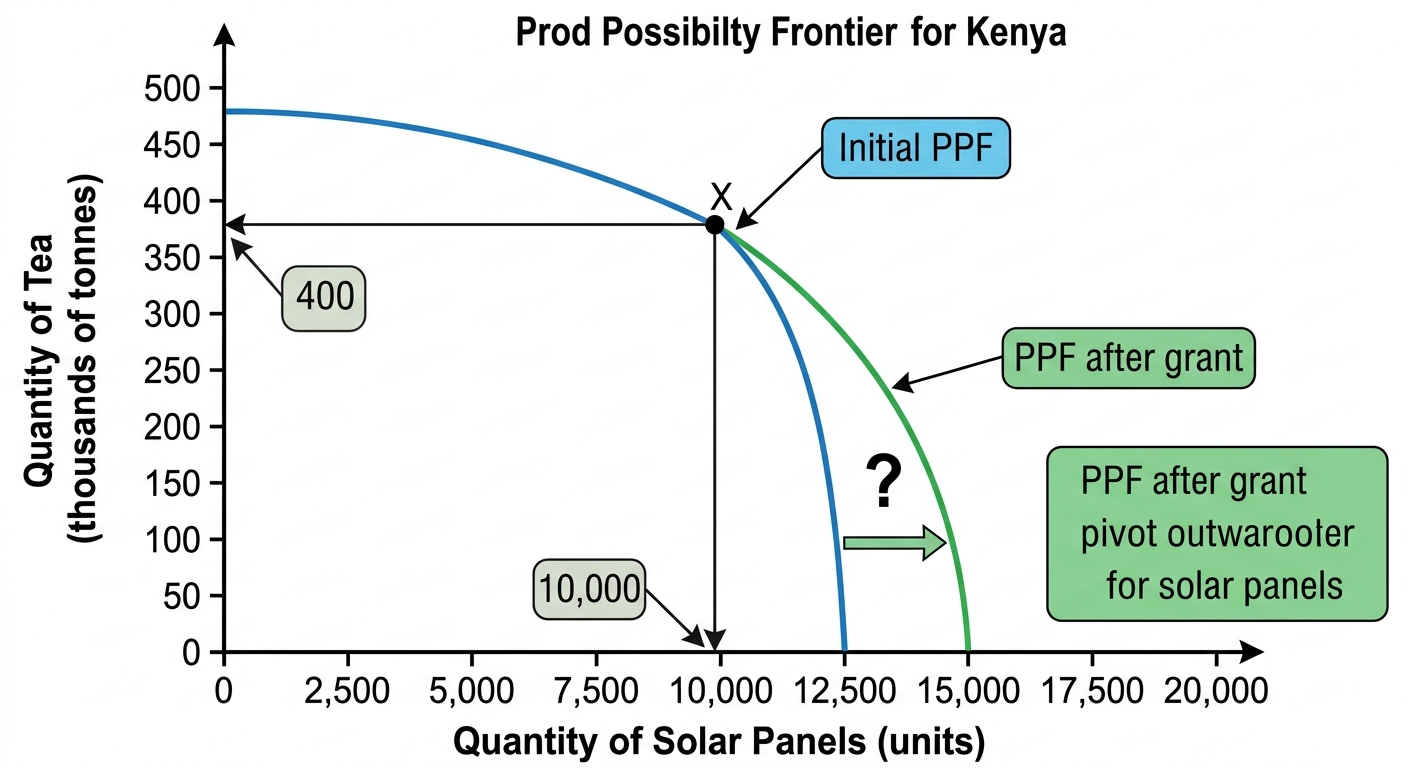
Kenya is a developing nation that allocates its limited resources between the production of two goods: tea (a major export crop) and solar panels (a capital good for renewable energy). Currently, Kenya produces at point X on its Production Possibility Frontier (PPF), where it makes tonnes of tea and solar panels per year. A new international climate fund offers Kenya a grant to invest exclusively in solar panel technology, causing the PPF to pivot outward along the solar panel axis only.
(a)
State what happens to the tea-axis intercept of Kenya's PPF as a result of the grant. [1 mark]
(b)
Calculate the opportunity cost of increasing solar panel production from to units after the grant, given that tea production falls from to tonnes. [1 mark]
(c)
Using the concept of the PPF, explain why the opportunity cost per solar panel is lower after the grant than before. [2 marks]
Solutions
20MasterySAQ-SThe problem of scarcity5 marksPaper 1~8 min
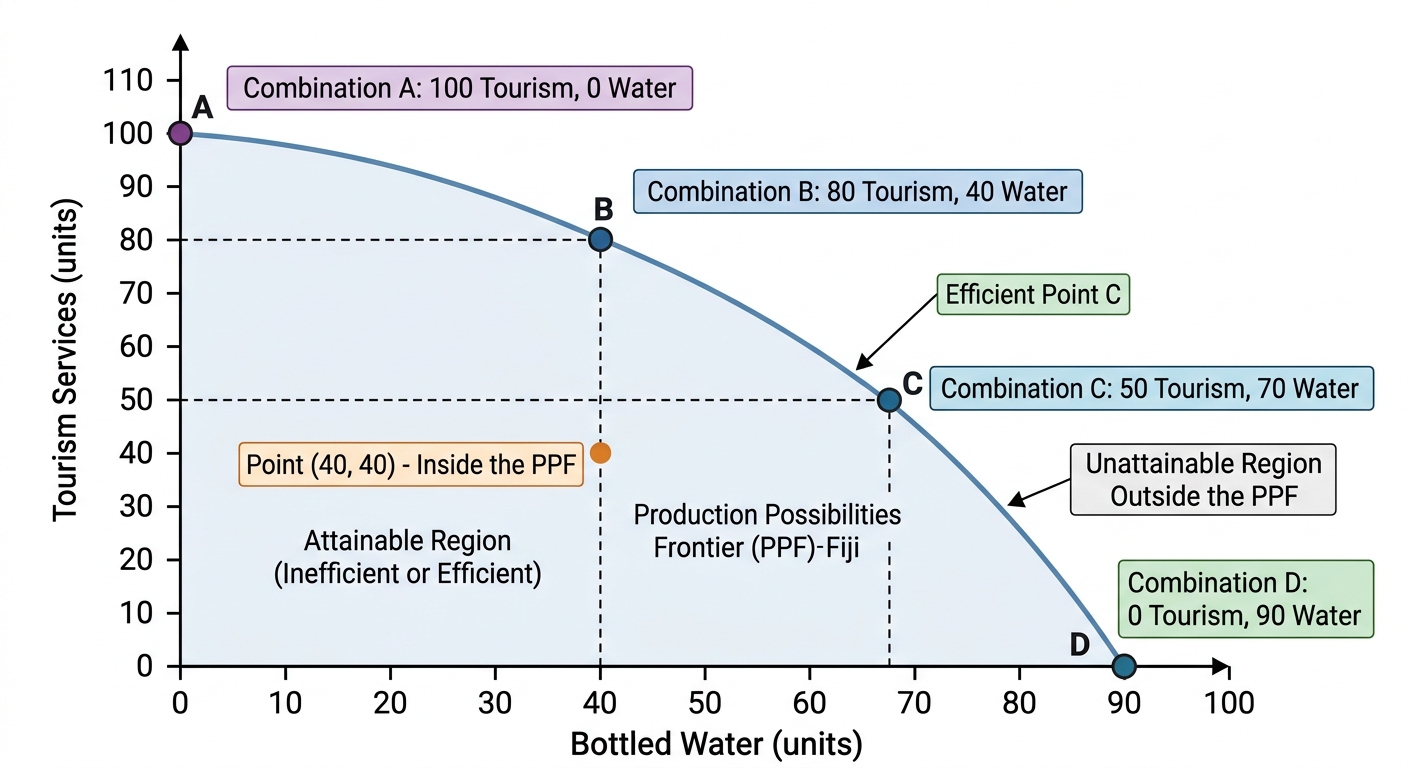
The island nation of Fiji has limited land, labour, and capital. It currently uses all its resources to produce two goods: tourism services and bottled water. The table below shows alternative production combinations for Fiji in 2023.
Combination — Tourism (units) — Bottled water (units)
A — 100
B — 80 — 40
C — 50 — 70
D — 0 — 90
(a)
State the opportunity cost to Fiji of moving from combination A to combination B. [1 mark]
(b)
Calculate the opportunity cost of increasing bottled water production from 40 units to 70 units. Show your working. [2 marks]
(c)
Explain why combination C is productively efficient while the combination of 40 units of tourism and 40 units of bottled water is not, and state one implication of this inefficiency for Fiji's economy. [2 marks]
Solutions
Showing 20 of 36 free questions