You're viewing free preview questions. Upgrade to access more Economics SL questions.Upgrade
What is Economics? · Paper 2 — Free Economics SL Practice Questions
1MasteryLAQDefinition of economics10 marksPaper 2~15 min

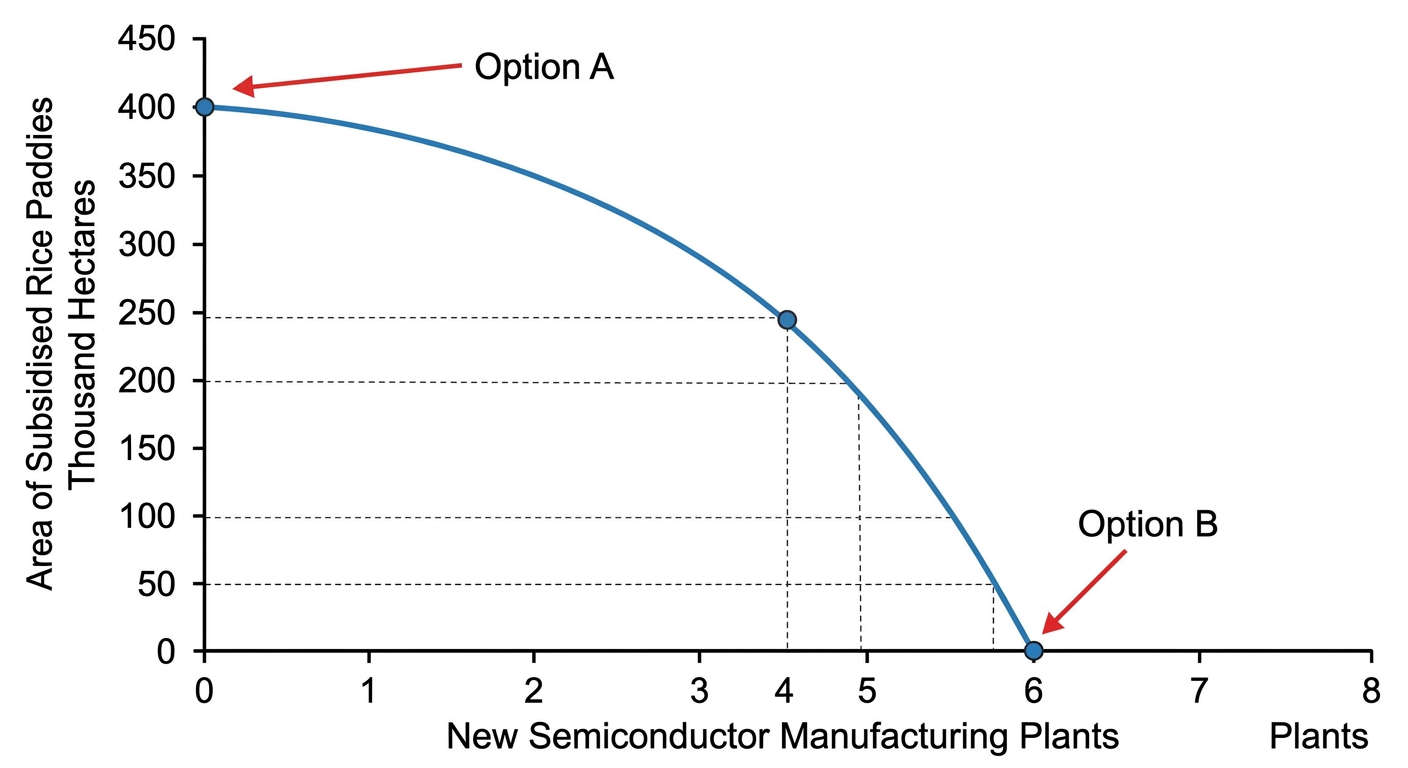
The government of Vietnam faced a policy dilemma in 2023 due to a severe drought in the Mekong Delta region. The drought destroyed hectares of rice paddies and reduced aquaculture output by . The government must allocate its entire limited budget of 2.5 trillion Vietnamese Dong between two mutually exclusive options:
- Option A: Subsidise farmers and invest in drought-resistant irrigation infrastructure.
- Option B: Invest in new semiconductor manufacturing plants and worker training for the electronics sector.
(a)
State the fundamental economic problem illustrated by this policy dilemma. [1 mark]
(b)
Explain the opportunity cost to the Vietnamese government of choosing Option A. [2 marks]
(c)
Analyse how the opportunity cost of the government choosing Option B differs for rural farming communities compared to urban electronics workers. [3 marks]
(d)
Using the concept of scarcity, discuss whether the Vietnamese government should prioritise Option A or Option B. Your answer must reach a justified conclusion. [4 marks]

Solutions
2MasteryLAQThe problem of scarcity14 marksPaper 2~21 min
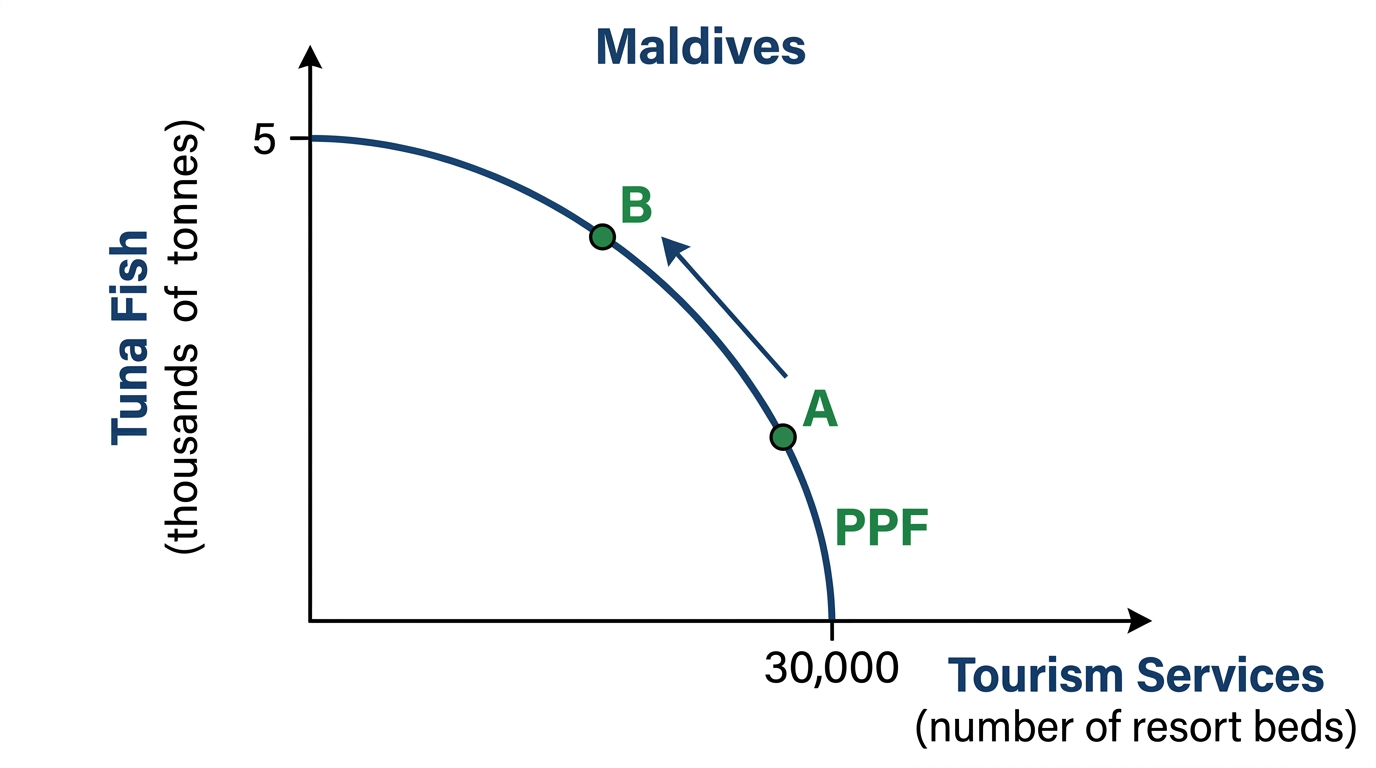
The island nation of Maldives has a land area of approximately . Its economy relies on two main activities: tourism (luxury resorts) and tuna fishing. In 2023, of the labour force and capital were allocated tourism, generating of GDP, while of resources were used in fishing. The President has proposed reallocating of resources from tourism to fishing to improve food security.
(a)
Explain why the Maldives cannot produce unlimited amounts of both tourism services and tuna fish. Refer to the types of resources in your answer. [4 marks]
(b)
Using a correctly labelled Production Possibility Frontier (PPF) , explain the opportunity cost of the President's proposed reallocation of resources. [4 marks]
(c)
Evaluate whether the President's proposed reallocation of resources is likely to benefit the Maldivian economy. [6 marks]
Solutions
3MasteryLAQThe problem of scarcity22 marksPaper 2~33 min
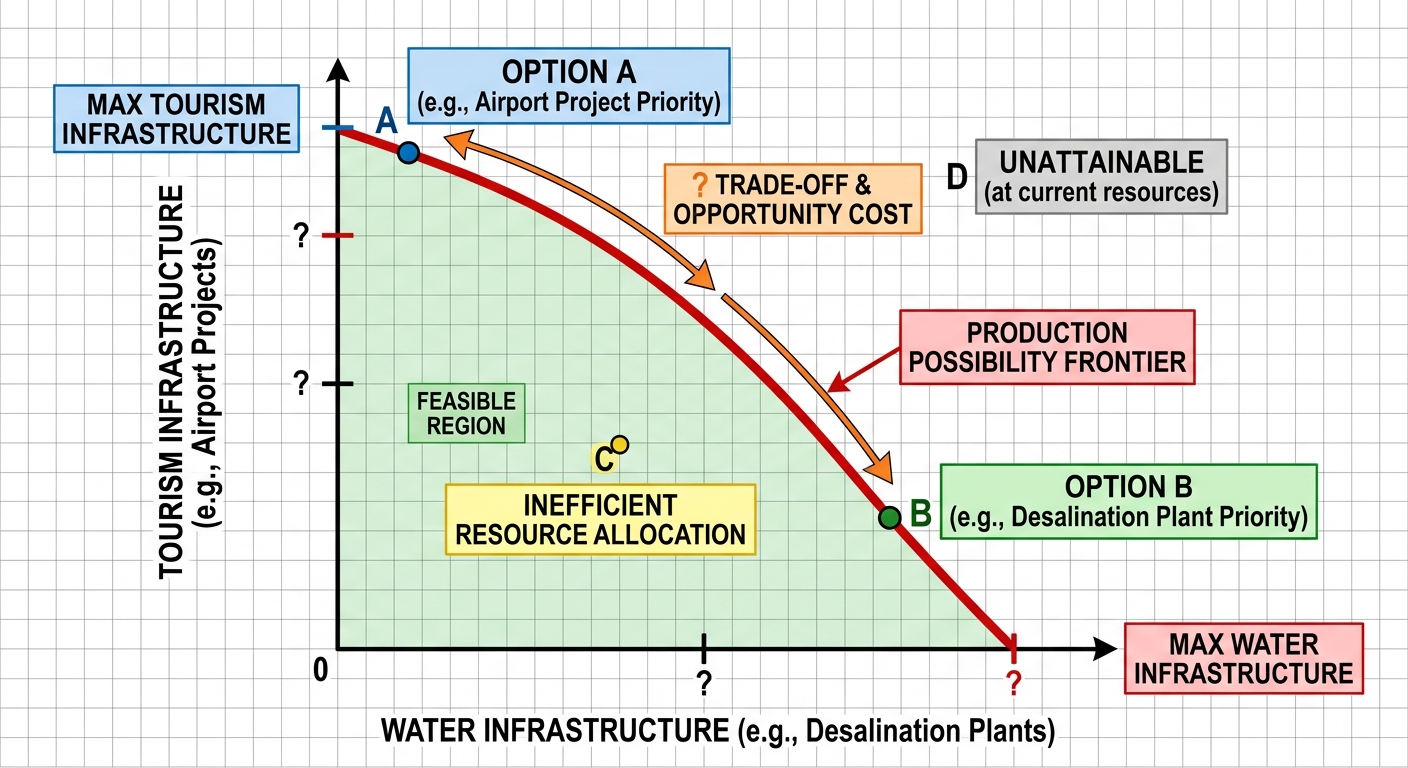
The island nation of Maldives has a total land area of approximately and a population of 540,000. Its economy relies heavily on tourism (28 percent of GDP) and fishing (12 percent of GDP). In 2023, the Maldivian government faced a choice between two projects: (i) building a new international airport on an uninhabited island at a cost of USD 500 million, or (ii) constructing a desalination plant to provide fresh water to the capital, Malé, at a cost of USD 300 million. Due to limited financial resources, the government could only fund one project.
(a)
Using the data provided, explain the concept of scarcity. [3 marks]
(b)
Draw a Production Possibility Frontier (PPF) for the Maldives with tourism infrastructure capacity on the horizontal axis and water infrastructure capacity on the vertical axis. On your , label:
- a point of productive efficiency on the PPF
- a point of productive inefficiency
- an unattainable point [4 marks]
(c)
Evaluate the opportunity cost of choosing the airport project. In your answer, consider the perspectives of at least two different stakeholder groups and reach a reasoned conclusion about which stakeholder group bears the greatest opportunity cost. [8 marks]
Total: [15 marks]
Solutions
4MasteryLAQThe problem of scarcity10 marksPaper 2~15 min
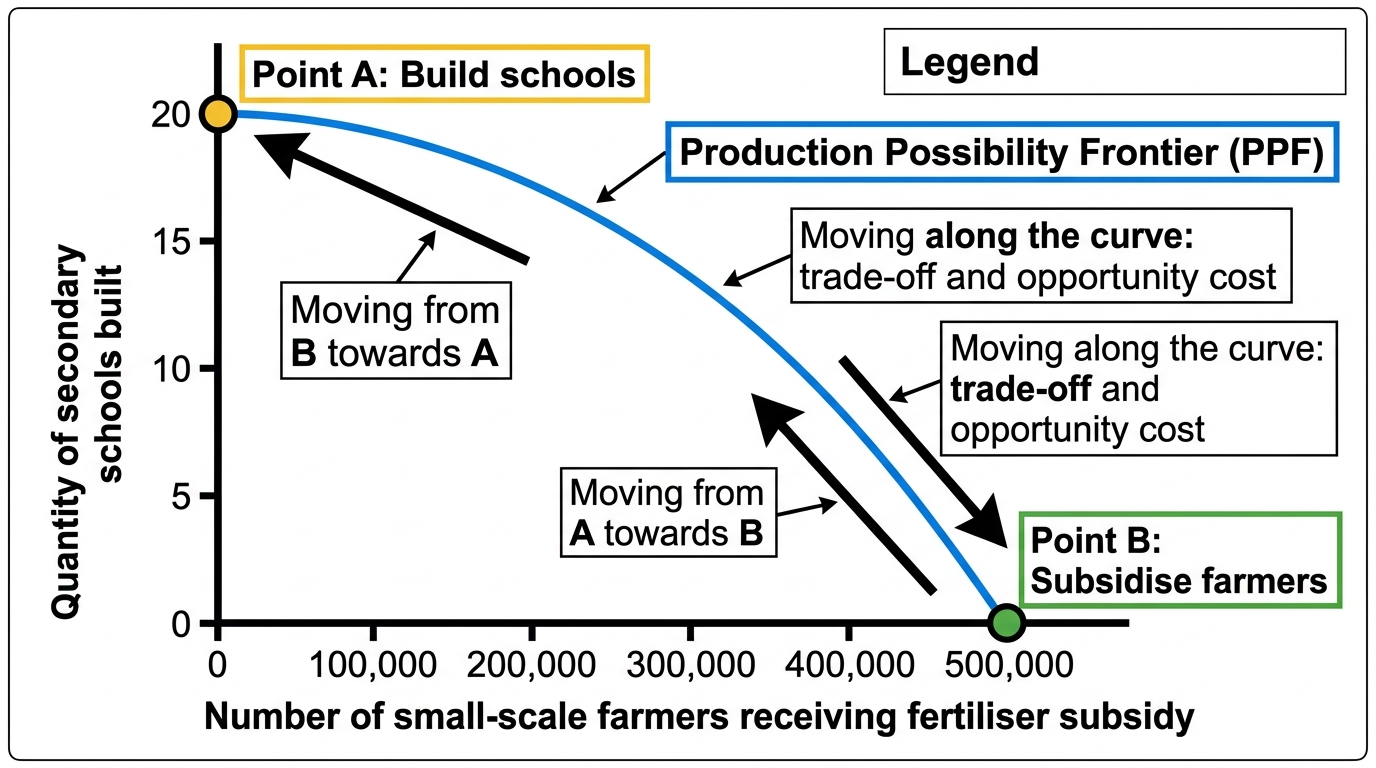
Ghana's government allocated billion cedis in 2022 to one of two projects: (A) subsidising fertiliser for small-scale cocoa farmers, or (B) building new secondary schools in rural areas. Both projects were considered urgent. Ghana's land labour resources are fully employed in the short run. The Minister of Finance stated: "We cannot do both because our resources are not enough."
(a)
Using the data, explain the concept of scarcity. [3 marks]
(b)
Explain the opportunity cost to Ghana of choosing the fertiliser subsidy project. [2 marks]
(c)
Evaluate whether the fertiliser subsidy or the school-building programme is more likely to promote sustainable economic growth and equity in Ghana in the long run. [5 marks]
Solutions
5MasteryLAQThe problem of scarcity10 marksPaper 2~15 min
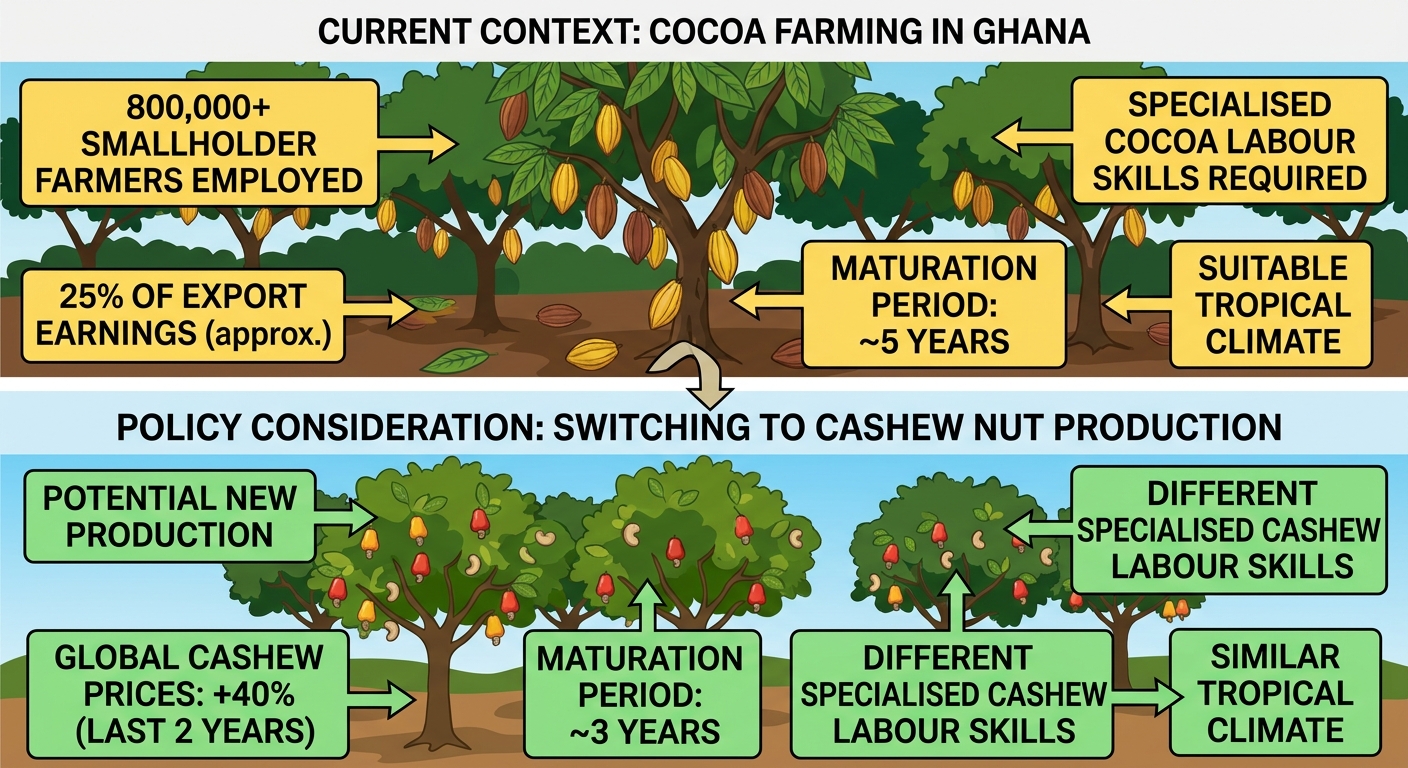
In Ghana, cocoa farming employs over 800,000 smallholder farmers and contributes approximately of the country's export earnings. The government is considering a policy to encourage farmers to switch from cocoa to cashew nut production, as cashew prices have risen by in global markets over the past two years. Cocoa trees take 5 years to mature; cashew trees take 3 years to mature. Both crops require similar tropical climate conditions but different specialised labour skills.
(a)
Explain how scarcity influences the choice between producing cocoa and cashew nuts in Ghana. Refer to the types of resources involved. [4 marks]
(b)
Calculate the opportunity cost for a Ghanaian farmer who decides to switch from cocoa to cashew nut production in the short run (years 0–3). [3 marks]
(c)
Evaluate whether the opportunity cost of switching from cocoa to cashew production is likely to decrease or increase over time. [3 marks]
Solutions
6MasteryLAQThe problem of scarcity10 marksPaper 2~15 min
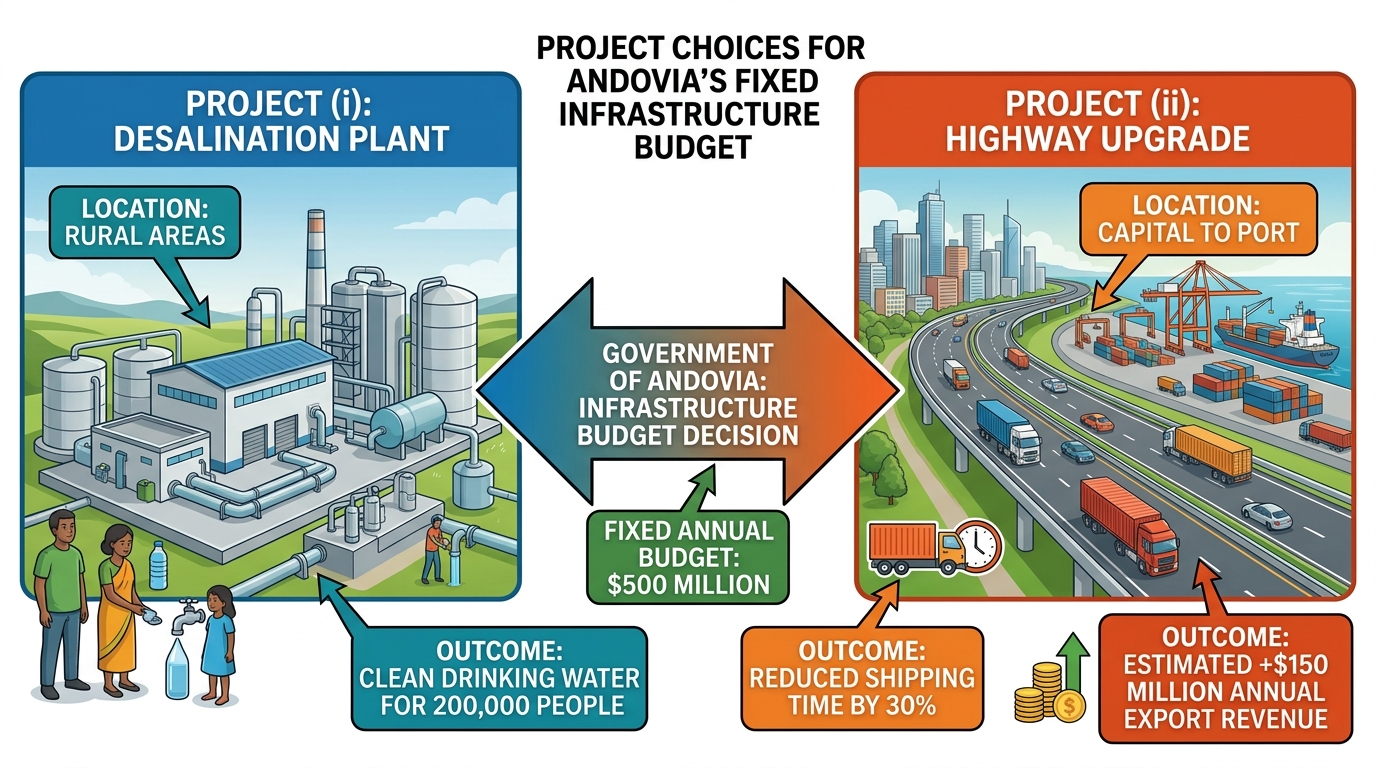
The country of Andovia is a small, developing nation. Its government has a fixed budget of USD 500 million for infrastructure spending this year. Engineers have identified two urgent projects: (i) building a new desalination plant to address chronic water shortages in rural areas, and (ii) upgrading the main highway connecting the capital to the largest port to reduce transport costs for exporters. Due to technical constraints, only one project can be fully funded. The desalination plant would provide clean drinking water to 200,000 rural citizens. The highway upgrade would reduce shipping time by , boosting export revenue by an estimated USD 150 million annually.
(a)
State the fundamental economic problem illustrated by the Andovian government's situation. [1 mark]
(b)
Explain the opportunity cost to Andovia of choosing to build the desalination plant. [3 marks]
(c)
Evaluate the usefulness of the concept of opportunity cost as a decision-making tool for the Andovian government when choosing between these two projects. [6 marks]
Solutions
7MasteryLAQDefinition of economics13 marksPaper 2~20 min
Data
Total marks = 13. If your paper requires exactly 10 marks, allocate as: (a) [1], (b) [2], (c) [3], (d) [4] — see Examiner Insights for guidance on trimming (c)/(d).
(Revised to 10 marks below as per brief)
(a) State the economic concept illustrated by the government of Country Gamma being unable to fund both projects simultaneously. [1]
(b) Identify the next-best alternative foregone and calculate the opportunity cost person benefited, in USD, if the government chooses to build the hospital. [2]
(c) Explain how the government's choice to fund the hospital rather than the irrigation system affects two different stakeholders. For each stakeholder, link your explanation to specific data from the passage. [3]
(d) Evaluate whether Country Gamma's government should prioritise the hospital or the irrigation system. Your answer must weigh equity against productive efficiency and provide a justified conclusion. [4]
Country Gamma is a small, low-income nation in Sub-Saharan Africa. Its government has a limited annual budget of USD 500 million. The Ministry of Health proposes building a new hospital in the capital city, costing USD 200 million and providing modern healthcare to 500,000 urban residents. The Ministry of Agriculture proposes investing in drought-resistant irrigation systems in rural areas, costing USD 200 million and increasing food security for 2 million subsistence farmers. The government cannot fund both projects in the same year due to other fixed expenditures totalling USD 300 million.
(a)
State the economic concept illustrated by the government of Country Gamma being unable to fund both projects simultaneously. [1 mark]
(b)
Identify the next-best alternative foregone and calculate the opportunity cost, expressed in USD person benefited, if the government chooses to build the hospital. [2 marks]
(c)
Explain how the government's choice to fund the hospital rather than the irrigation system affects two different stakeholders, linking each to a specific outcome from the data. [4 marks]
(d)
Evaluate whether Country Gamma's government should prioritise the hospital or the irrigation system. In your answer, consider both equity and productive efficiency, and provide a justified conclusion. [6 marks]
Solutions
8MasteryLAQDefinition of economics10 marksPaper 2~15 min
Country X is a developing nation in sub-Saharan Africa. Its government has a limited annual budget of USD 500 million. The Ministry of Health proposes a vaccination programme costing USD 500 million that would save an estimated 15,000 lives per year. The Ministry of Infrastructure proposes building a new port, also costing USD 500 million, that would increase annual export revenue by USD 120 million and create 8,000 permanent jobs. The government cannot fund both projects.
(a)
Define scarcity and explain how it applies to the government of Country X. [2 marks]
(b)
Calculate the annual opportunity cost, in dollars, if the government chooses the vaccination programme. [2 marks]
(c)
Evaluate the opportunity costs faced by healthcare workers, port construction workers, and the citizens of Country X if the vaccination programme is chosen over the port. [6 marks]
Solutions
9MasteryLAQBasic economic questions: What, how, and for whom?10 marksPaper 2~15 min
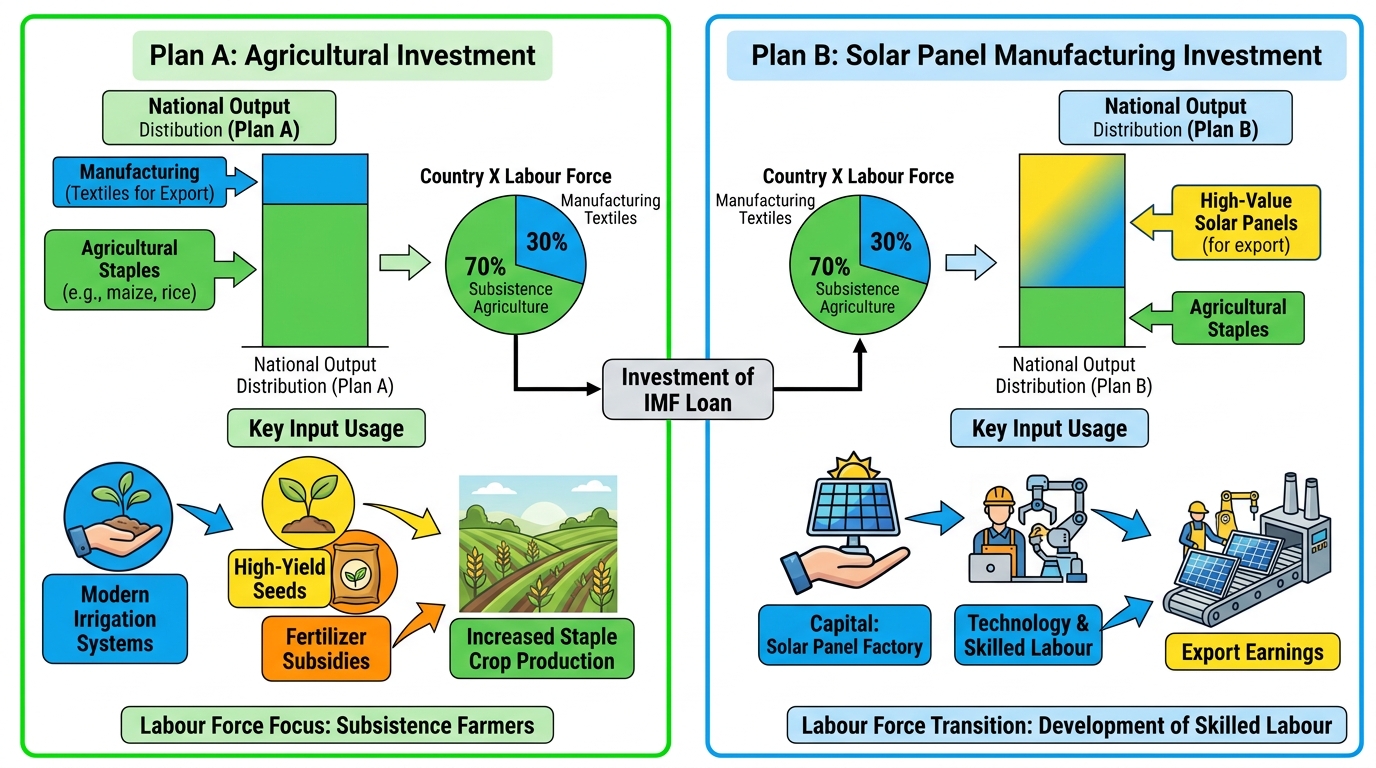
Country X is a low-income developing nation with a rapidly growing population. Currently, of its labour force is employed in subsistence agriculture producing staple crops (maize and rice). The remaining work in a small manufacturing sector producing low-cost textiles for export. The government has received a significant IMF loan that must be used to increase export earnings. Two mutually exclusive investment plans are under consideration:
- Plan A: Invest the entire loan in modern irrigation systems, high-yield seeds, and fertiliser subsidies for the agricultural sector.
- Plan B: Invest the entire loan in building a new factory to produce solar panels for export to high-income countries.
(a)
Explain how the choice between Plan A and Plan B represents a different answer to the fundamental economic question of 'what to produce' in Country X. [2 marks]
(b)
Deduce how choosing Plan B over Plan A would alter the factor intensity of production in Country X, and explain one likely consequence for employment in the agricultural sector. [2 marks]
(c)
Evaluate whether the government of Country X should choose Plan B over Plan A, considering the potential economic consequences for at least two different stakeholders. [6 marks]
Solutions
10MasteryLAQBasic economic questions: What, how, and for whom?10 marksPaper 2~15 min
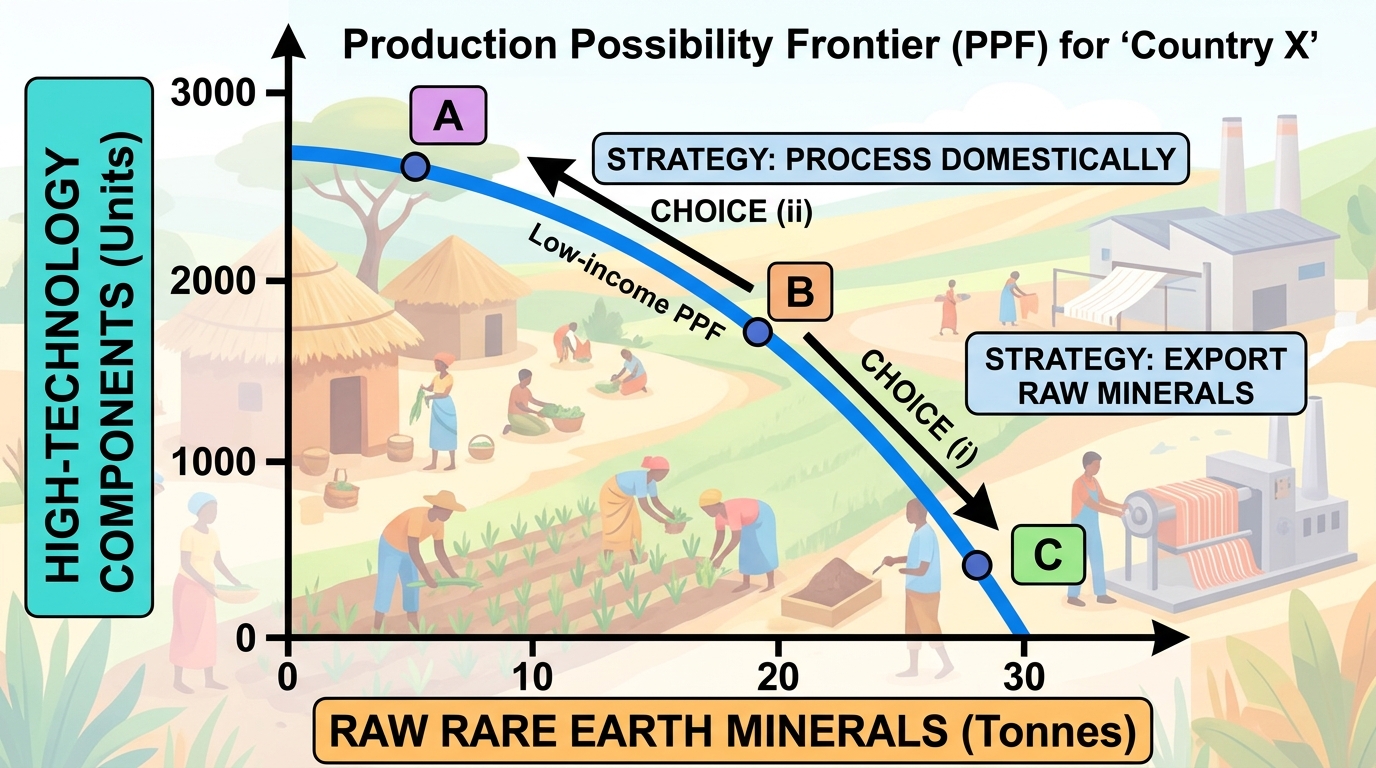
Country X is a low-income developing nation that has recently discovered significant deposits of rare earth minerals used in high-technology products such as smartphones and electric vehicle batteries. The economy currently relies on subsistence agriculture and a small textile manufacturing sector. The government is considering two strategies:
- Strategy A: Invest in mining infrastructure and export raw minerals immediately.
- Strategy B: Invest in education and technology to process minerals domestically, producing higher-value components for export.
Country X has an abundant unskilled labour force, very limited domestic capital, and negligible existing technical expertise.
(a)
Explain how the economic concept of opportunity cost applies to Country X's choice between Strategy A and Strategy B. [2 marks]
(b)
Using Country X's factor endowments, deduce which production method — capital-intensive or labour-intensive — is more appropriate for each strategy, and explain why. [2 marks]
(c)
Discuss the trade-offs Country X faces when choosing between Strategy A and Strategy B. In your answer, consider the perspectives of at least two different stakeholder groups and reach a justified recommendation. [6 marks]
Solutions
11MasteryLAQBasic economic questions: What, how, and for whom?10 marksPaper 2~15 min
The government of a low-income country, Agraria, is deciding on its national production plan for the next five years. Currently, of its workforce is employed in subsistence agriculture, producing staple crops (maize and rice) for local consumption. A large multinational corporation (MNC) has offered to invest in a new factory producing smartphones for export, employing of the workforce at wages higher than agricultural incomes. However, this would require shifting land water resources away from agriculture, reducing staple crop output by . The remaining of the workforce is unemployed or underemployed in the informal sector.
(a)
Define opportunity cost and identify the opportunity cost faced by Agraria's government in this decision. [2 marks]
(b)
Using the concept of resource allocation, explain how shifting of the workforce into smartphone manufacturing affects what and for whom goods are produced in Agraria. [3 marks]
(c)
Discuss the extent to which prioritising smartphone production for export is likely to promote long-term economic development in Agraria. [5 marks]
Solutions
12MasteryLAQBasic economic questions: What, how, and for whom?10 marksPaper 2~15 min
A local government planning committee in Mumbai, India is deciding how to use a vacant -hectare plot of land. Proposal A is to build a public hospital providing free healthcare to low-income residents annually. Proposal B is to build a luxury apartment complex generating million rupees in tax revenue per year and creating construction jobs. Local farmers have been informally cultivating the land, earning approximately million rupees per year in total.
(a)
State the opportunity cost to the committee of choosing Proposal A. [1 mark]
(b)
Explain, using the concept of the "how to produce" question, why the factor combinations required by Proposal A and Proposal B differ, and identify one economic consequence of this difference. [3 marks]
(c)
Using the data provided, discuss whether the committee should prioritise equity or efficiency in its decision. Your answer must reach a justified conclusion. [6 marks]
Solutions
13MasteryLAQThe problem of scarcity10 marksPaper 2~15 min
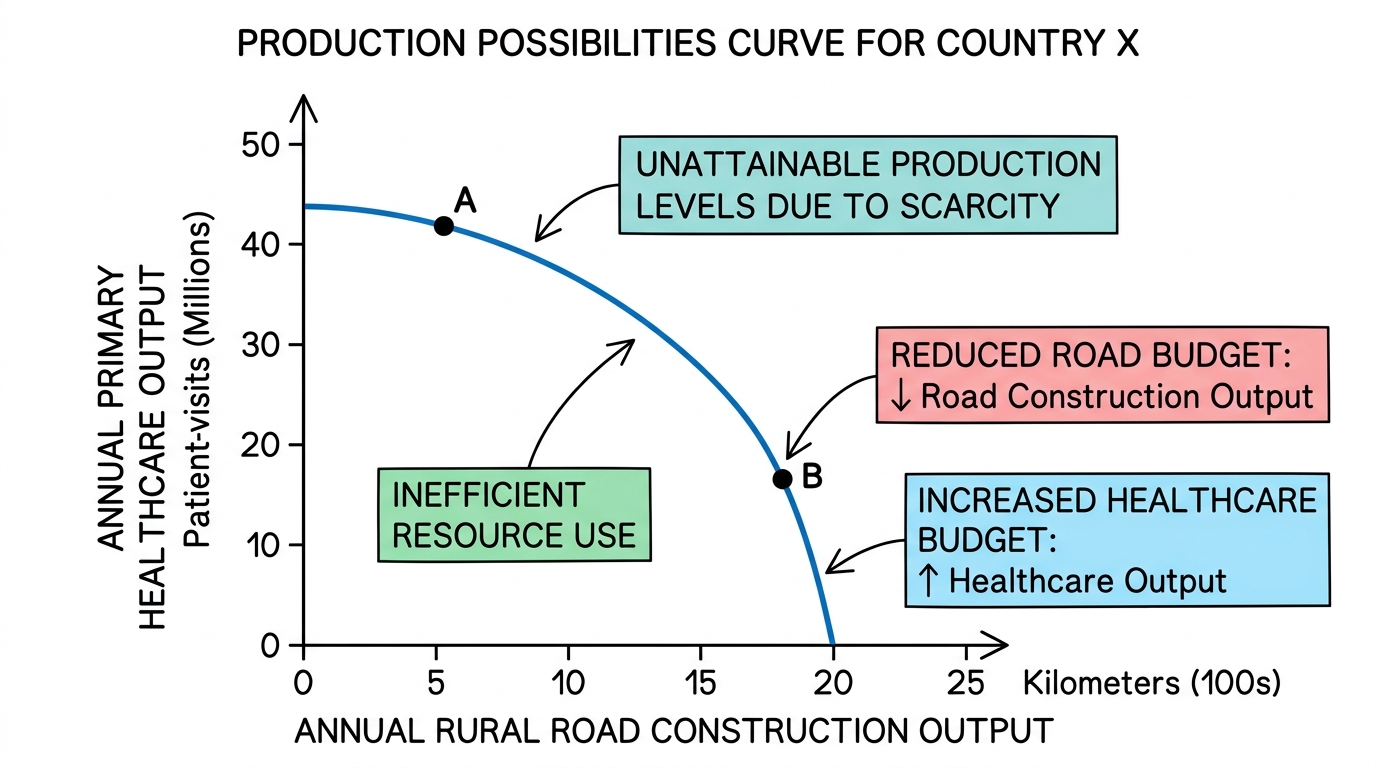
The government of Country X, a low-income nation in sub-Saharan Africa, has recently announced a significant increase in its annual budget allocation for primary healthcare. The Minister of Finance stated that the funds will come from a reduction in the budget for the construction of new rural roads. The Minister argued that the opportunity cost of better health outcomes is a justified sacrifice for the nation's long-term development. A local economist countered that the decision ignores the scarcity of both physical capital and skilled labour, and that road construction would have created more immediate employment and improved market access for rural communities.
(a)
Explain how the concept of scarcity forces the government of Country X to make a trade-off between primary healthcare and rural road construction. [4 marks]
(b)
Evaluate the view that the government's decision to prioritise primary healthcare represents an efficient allocation of Country X's scarce resources. [6 marks]
Solutions
14MasteryLAQDefinition of economics10 marksPaper 2~15 min
Vietnam's government has a total energy investment budget of trillion dong for 2023. It must choose between building coal-fired power plants or solar energy farms. Each coal plant costs trillion dong and generates of electricity but produces significant carbon emissions. Each solar farm costs trillion dong, generates , and produces zero emissions.
(a)
Explain the concept of scarcity in the context of Vietnam's energy investment decision. [2 marks]
(b)
Using the data provided, explain the trade-off Vietnam faces when allocating its trillion dong budget between coal plants and solar farms. [2 marks]
(c)
Using the concept of opportunity cost, evaluate the advantages and disadvantages to Vietnam of choosing to build solar farms rather than coal plants. [6 marks]
Solutions
15MasteryLAQDefinition of economics10 marksPaper 2~15 min
In July 2023, a severe drought in Vietnam destroyed of the country's rice crop. Vietnam is one of the world's largest rice exporters. The Vietnamese government must decide how to allocate the remaining rice supply between domestic consumption and exports.
A farmer, Ms. Lan, had planned to sell her entire harvest of tonnes to an overseas exporter at USD per tonne. After the drought, she can only harvest tonnes. The government offers to buy her entire remaining harvest at USD per tonne for domestic food aid. Ms. Lan accepts the government's offer.
(a)
Define the concept of scarcity and apply it to Vietnam's rice situation after the drought. [2 marks]
(b)
Calculate the opportunity cost, in USD, for Ms. Lan of selling all tonnes to the government rather than to the overseas exporter. [2 marks]
(c)
Evaluate the opportunity costs faced by Vietnamese consumers and foreign buyers if the government prioritises domestic consumption over exports. In your answer, make a justified judgement about which stakeholder bears the greater opportunity cost. [6 marks]
Solutions
16MasteryLAQDefinition of economics10 marksPaper 2~15 min
The government of Landia, a developed country, has USD 12 billion available for new spending. It must choose between two mutually exclusive proposals:
- Proposal X: Subsidise electric vehicle (EV) purchases for households at a cost of USD 12 billion, projected to reduce national carbon emissions by over ten years.
- Proposal Y: Build new public housing for low-income families at a cost of USD 8 billion, projected to house 40 000 homeless families within three years.
Landia's Minister of Finance stated: "We cannot do everything we want because our resources are finite. Every choice has a cost."
(a)
State the economic term for the value of the next best alternative foregone when a choice is made. [1 mark]
(b)
Calculate the opportunity cost, in USD billions, if the government chooses Proposal X. [2 marks]
(c)
Explain how choosing Proposal X affects two different groups in Landia. [3 marks]
(d)
Using the concept of opportunity cost, evaluate whether the government of Landia should choose Proposal X or Proposal Y. [4 marks]
Solutions
17MasteryLAQThe problem of scarcity10 marksPaper 2~15 min
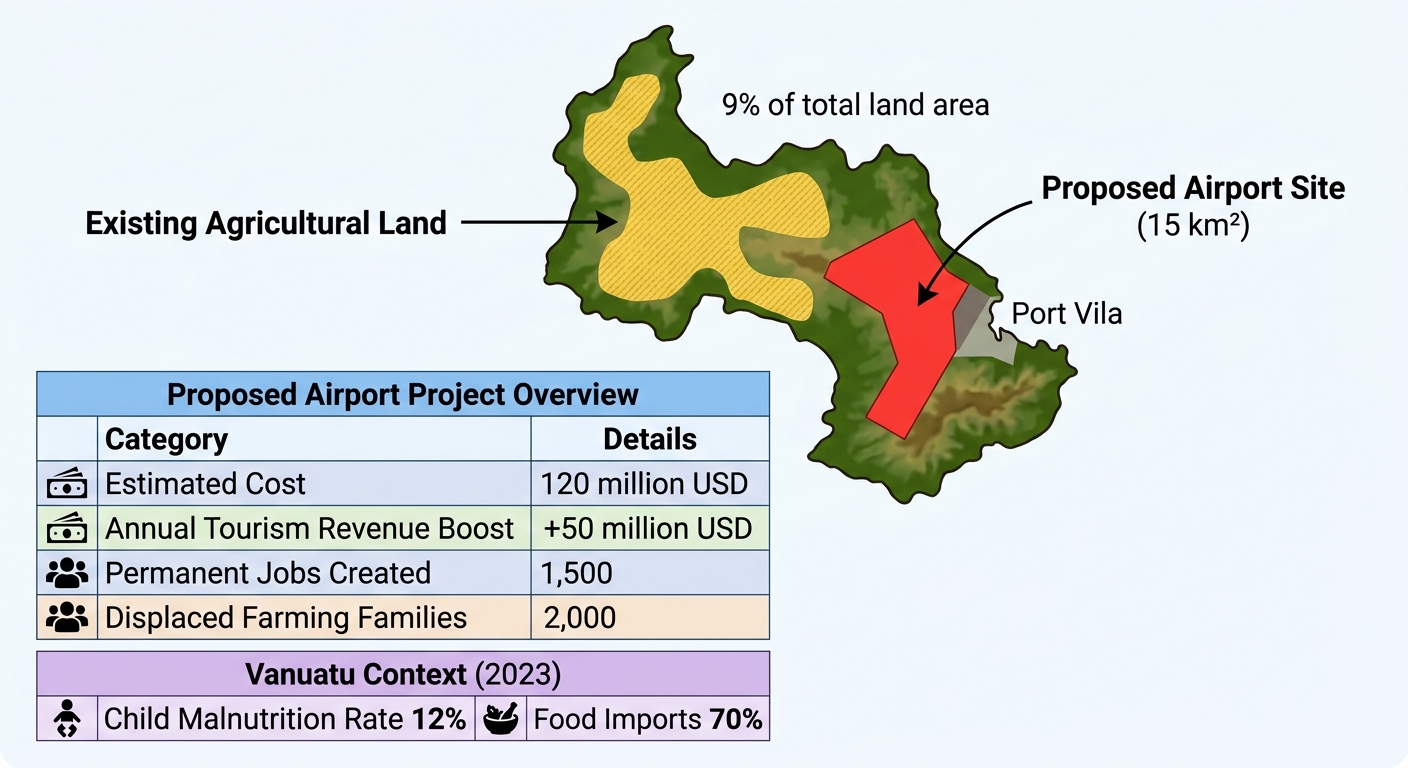
The Pacific island nation of Vanuatu has a total land area of , of which only is suitable for agriculture. In 2023, Vanuatu's population was approximately , with a GDP per capita of USD 3,200. The country relies heavily on subsistence farming, tourism, and foreign aid. A proposed new airport on the main island of Efate would cost USD 120 million and require of agricultural land, displacing 2,000 farming families. Supporters argue the airport will boost tourism revenue by USD 50 million annually and create 1,500 permanent jobs. Opponents note that Vanuatu already imports of its food and has a child malnutrition rate of .
(a)
Define scarcity and, using two pieces of data from the passage, explain how scarcity forces Vanuatu to make choices between competing uses of its resources. [4 marks]
(b)
Using the concept of opportunity cost, evaluate whether Vanuatu should build the new airport. [6 marks]
Solutions
18MasteryLAQBasic economic questions: What, how, and for whom?10 marksPaper 2~15 min
Data
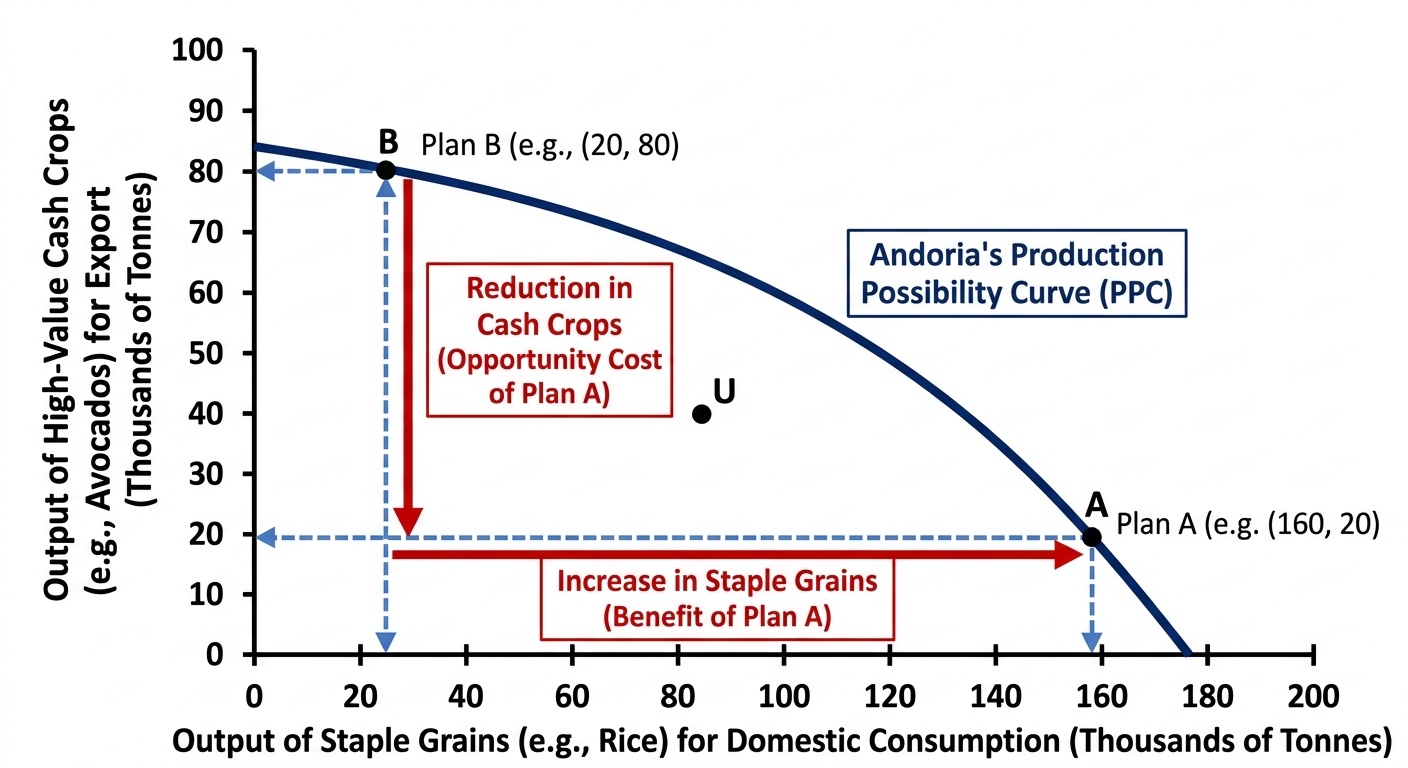
In the fictional country of Andoria, the government is planning its annual budget for the agricultural sector. Andoria has a large, fertile land area but a limited supply of skilled farm labour. The government must decide between two main production plans:
- Plan A: Subsidise the production of staple grains (e.g., rice) using labour-intensive, traditional farming methods. This would employ many low-skilled rural workers and provide cheap food for the urban poor.
- Plan B: Subsidise the production of high-value cash crops (e.g., avocados for export) using capital-intensive, automated irrigation and harvesting technology. This would require importing expensive machinery and employing fewer, high-skilled workers, but would generate significant export revenue.
(a)
Explain how the government of Andoria is addressing the "what to produce?" and "how to produce?" questions of resource allocation. [4 marks]
(b)
Using a Production Possibility Curve (PPC) , analyse the opportunity cost implications of choosing Plan A over Plan B. [3 marks]
(c)
Discuss which plan is likely to produce a more favourable outcome for Andoria, considering the impacts on workers, consumers, and the government's budget. [3 marks]
Solutions
19MasteryLAQBasic economic questions: What, how, and for whom?10 marksPaper 2~15 min
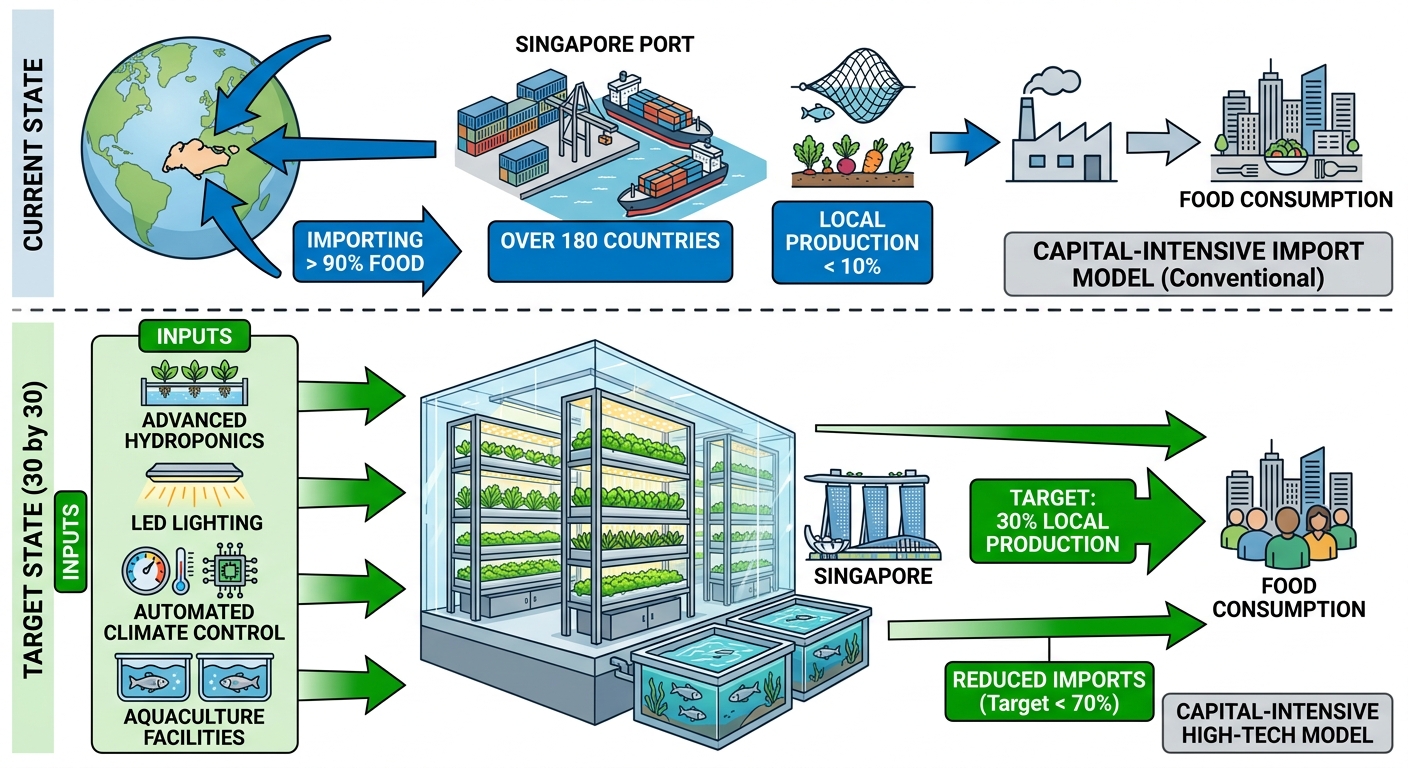
The city-state of Singapore announced a national strategy called "30 by 30," aiming to produce of its nutritional needs locally by 2030. Currently, Singapore imports over of its food from more than 180 countries. The strategy involves building high-tech vertical farms, aquaculture facilities, and indoor plant factories using advanced hydroponics, automated climate control, and LED lighting — all highly capital-intensive methods. The Singaporean government provides subsidies and grants to agri-tech firms to encourage this shift.
(a)
Explain how the "30 by 30" strategy addresses the fundamental economic question of how to produce in Singapore's food sector. [3 marks]
(b)
Evaluate the economic implications of the "30 by 30" strategy for the question of for whom to produce, with reference to Singaporean consumers, foreign food-exporting countries, and local agri-tech firms. [7 marks]
Solutions
20MasteryLAQDefinition of economics10 marksPaper 2~15 min
The government of Kenya is considering a policy to provide free insecticide-treated mosquito nets to all households in malaria-prone regions. Currently, families purchase nets from private suppliers at a market price of KES 500 each. A health economist estimates that for every 100 nets distributed, 15 malaria cases are prevented, reducing both public healthcare expenditure and lost workdays. The government's total annual health budget is KES 2 billion, and it must choose between funding free nets, a national vaccination programme, or rural clean-water infrastructure.
(a)
Using the data provided, explain why scarcity forces the Kenyan government to make a choice between the three healthcare interventions. [2 marks]
(b)
Explain how the concept of opportunity cost applies to the Kenyan government's decision to fund free mosquito nets rather than the next best alternative intervention. [2 marks]
(c)
Evaluate the trade-offs the Kenyan government faces when allocating its health budget to free mosquito nets instead of vaccinations or clean-water projects. [6 marks]
Solutions
Showing 20 of 48 free questions