You're viewing 3 free preview questions for Economics SL — subscribe to unlock 151 more, plus the Full Question Bank, Mock Papers & Worksheets.Upgrade
Economics of Inequality and Poverty · Paper 2 — Free Economics SL Practice Questions
1MasteryLAQCauses and consequences of income inequality10 marksPaper 2~15 min

Data
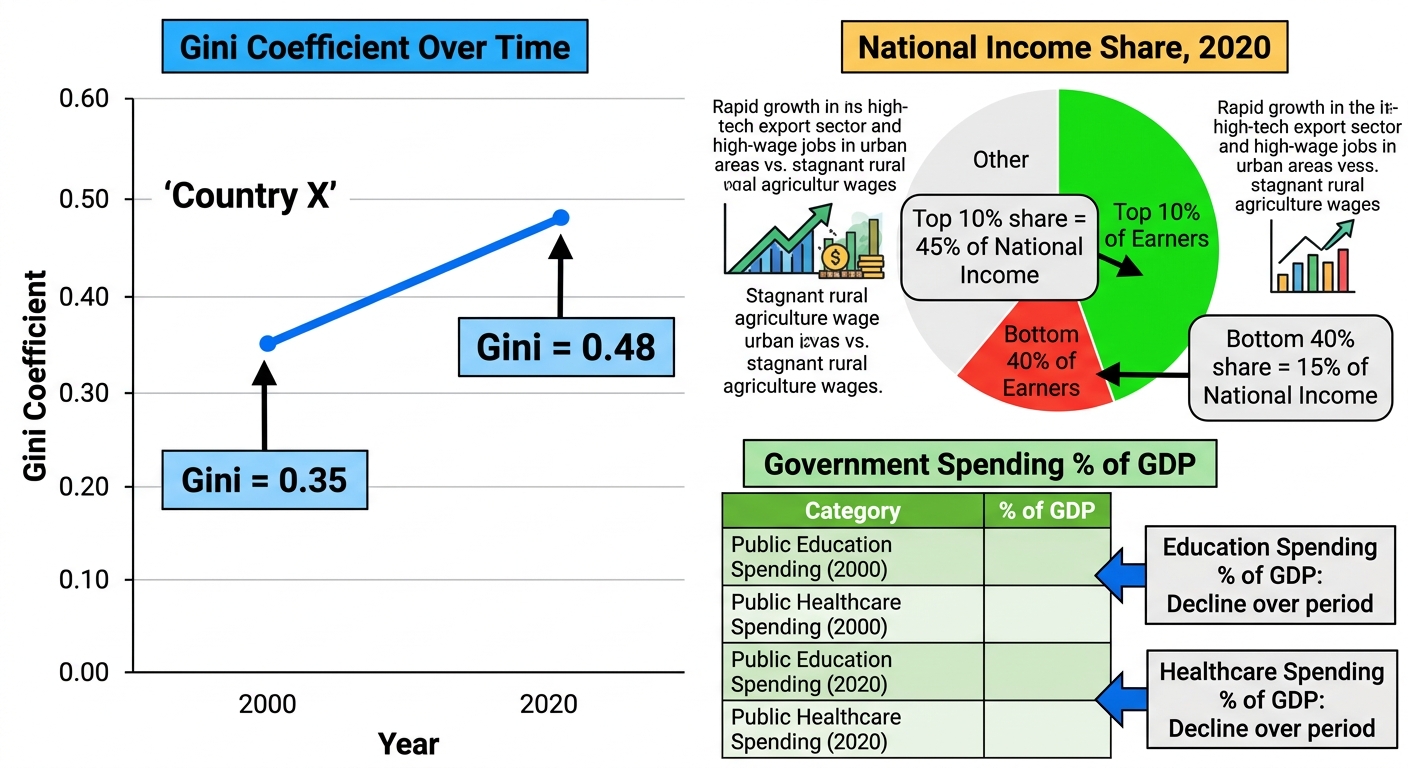
In Country X, a developing nation in Southeast Asia, the Gini coefficient has risen from in 2000 to in 2020. Over the same period, rapid economic growth has been driven by a boom in the technology export sector, creating high-skilled, high-wage jobs concentrated in urban areas. Rural agricultural workers have experienced stagnant wages. Government spending on public education and healthcare has declined as a percentage of GDP. The top of earners now capture of national income, while the bottom capture only .
(a)
Using the data, explain how skill-biased technological change has contributed to rising income inequality in Country X. [3 marks]
(b)
Using a factor market , explain how declining government spending on education has contributed to rising income inequality in Country X. [3 marks]
(c)
Evaluate the consequences of rising income inequality for Country X's long-run economic growth, considering the perspectives of at least two different stakeholders. Justify an overall judgement on whether inequality is likely to sustain or undermine growth. [4 marks]

Solutions
2MasteryLAQCauses and consequences of income inequality10 marksPaper 2~15 min
Data
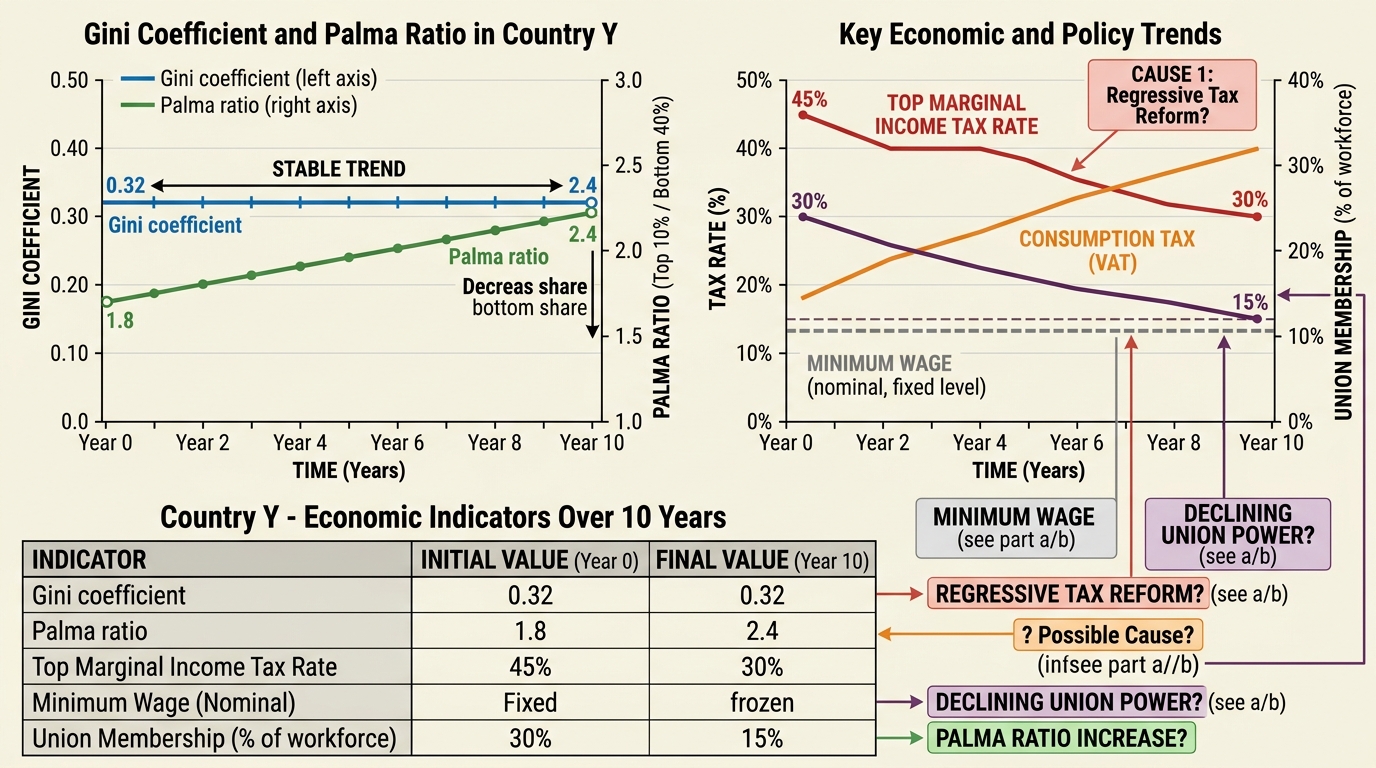
In Country Y, a high-income OECD member, the Gini coefficient has remained stable at over the past decade. However, the Palma ratio (the income share of the top divided by the income share of the bottom ) has risen from to . The government has cut the top marginal income tax rate from to and simultaneously raised a flat-rate consumption tax (VAT). The minimum wage has been frozen in nominal terms for five years, and union membership has fallen from to of the workforce.
(a)
Using the data, explain one reason why the Palma ratio has risen despite the stable Gini coefficient. [3 marks]
(b)
Using a different piece of data, explain one labour-market reason for the widening gap between the top and the bottom of income earners in Country Y. [3 marks]
(c)
Using at least two different theoretical perspectives on inequality, evaluate whether the rising Palma ratio is likely to harm Country Y's long-run economic performance. [4 marks]
Solutions
3ChallengeLAQCauses and consequences of income inequality10 marksPaper 2~15 min
Country X is a rapidly industrialising lower-middle-income economy in Southeast Asia.
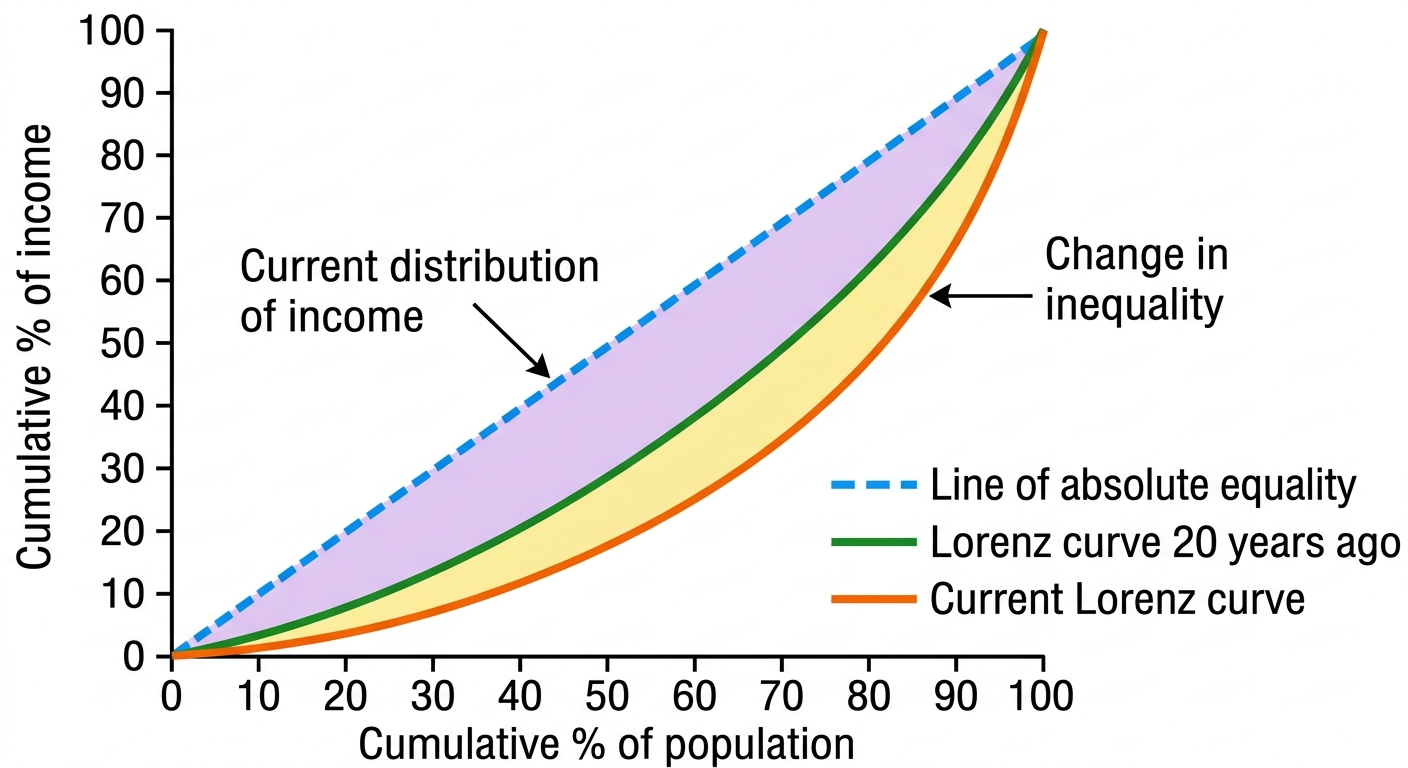
- The Gini coefficient has risen from to over the past 20 years.
- The top of income earners now capture of national income, up from two decades ago.
- The government has maintained a flat corporate tax rate of for the past 15 years.
- Foreign direct investment (FDI) has flowed heavily into capital-intensive manufacturing (robotics and electronics assembly), creating few low-skill jobs.
- Tertiary enrolment remains at of the relevant age cohort.
- A recent World Bank report notes that social mobility in Country X has fallen significantly.
(a)
Explain how a Lorenz curve can be used to illustrate the change income inequality in Country X over the past 20 years. Use the data provided. [2 marks]
(b)
Explain how skill-biased technological change (SBTC) could contribute to rising income inequality in Country X. [2 marks]
(c)
Evaluate the view that the primary cause of rising income inequality in Country X is technological change, rather than government policy choices or globalisation. Use economic theory, the data provided, and your answers to (a) and (b). [6 marks]
Solutions
That's every free question here — 3 of 154.
+151 more questions, plus Mock Papers & Worksheets, are waiting in Premium.