You're viewing 3 free preview questions for Economics SL — subscribe to unlock 207 more, plus the Full Question Bank, Mock Papers & Worksheets.Upgrade
Macroeconomic Objectives · Paper 2 — Free Economics SL Practice Questions
1MasteryLAQEconomic growth15 marksPaper 2~23 min

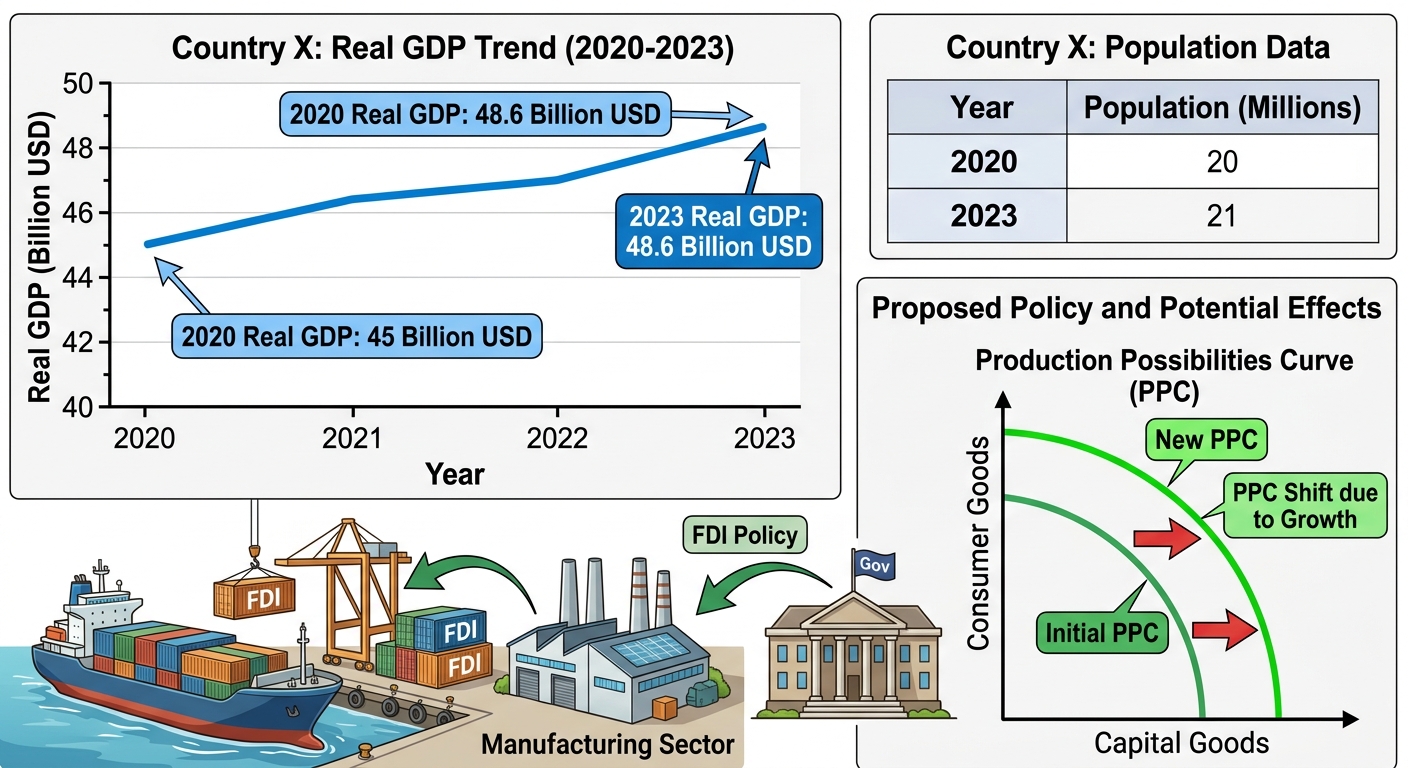
Country X is a low-income developing nation in sub-Saharan Africa. In 2020, its real GDP was USD 45 billion and its population was 20 million. By 2023, real GDP had grown to USD 48.6 billion and population had grown to 21 million.
The government of Country X has announced a policy to attract foreign direct investment (FDI) into its manufacturing sector, aiming to increase capital stock and create employment. Economists have warned that rapid growth could lead to environmental degradation and increased income inequality.
(a)
(i) Calculate the percentage change in real GDP for Country X between 2020 and 2023. [2]
(ii) Calculate the GDP per capita for Country X in 2020 and in 2023. [2 marks]
(ii) Calculate the GDP per capita for Country X in 2020 and in 2023. [2 marks]
(b)
Explain how the FDI policy could stimulate economic growth in Country X. Use the concept of the production possibilities curve (PPC) in your answer. [3 marks]
(c)
Using the data and referring to specific stakeholder groups, evaluate whether the benefits of economic growth for Country X are likely to outweigh its costs.
Total: 17 marks
> Note: Part (c) is marked using the Paper 2 markband descriptors for a 10-mark evaluate response. [10 marks]

Solutions
2MasteryLAQEconomic growth10 marksPaper 2~15 min
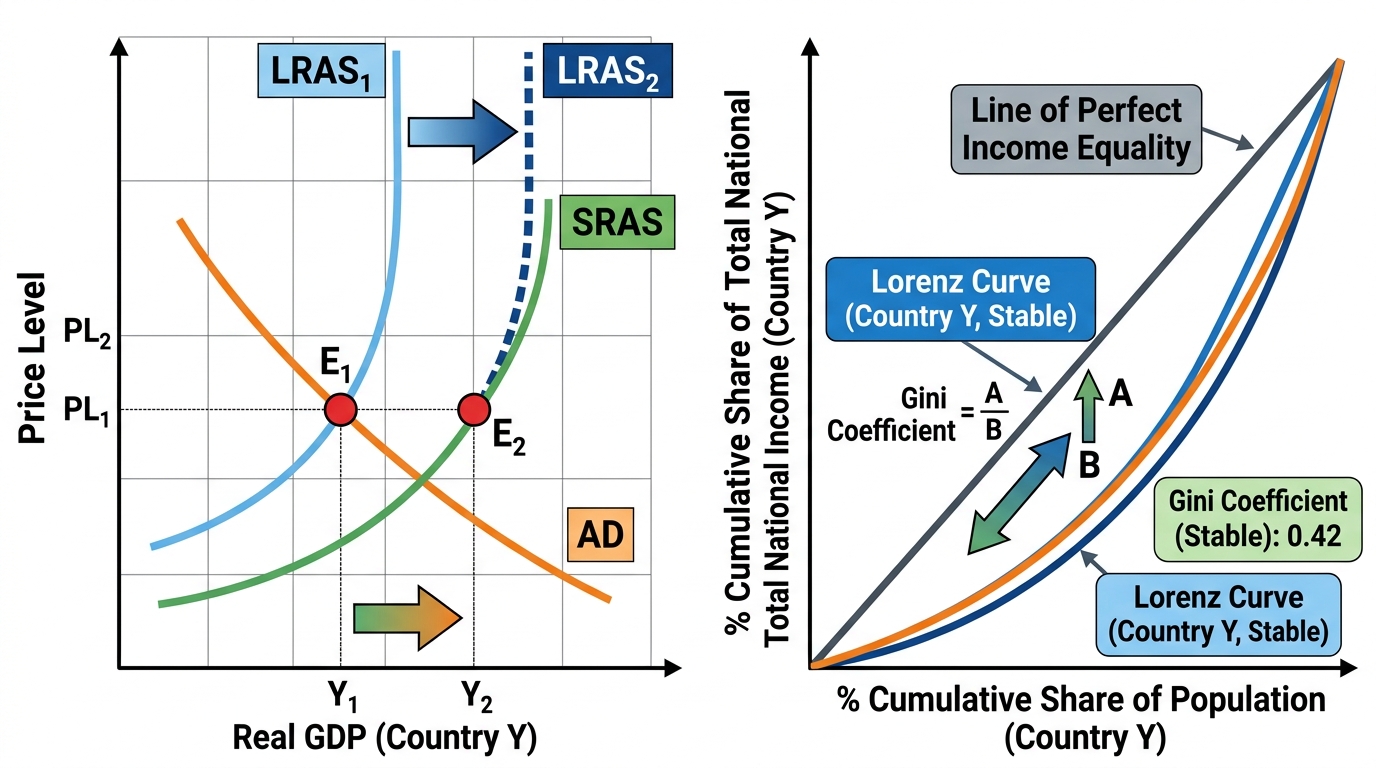
Country Y is a high-income oil-exporting nation. In 2022, its real GDP growth rate was , driven by high global oil prices. The government has launched a 'Vision 2030' plan to diversify the economy by investing heavily in tourism, technology, and renewable energy. In 2023, despite a fall in oil prices, real GDP growth was , partly due to expansion in non-oil sectors. The country's Gini coefficient has remained stable at over the past five years.
(a)
Distinguish between actual economic growth and potential economic growth. Use Country Y's data to illustrate each concept. [2 marks]
(b)
Using an AD/AS , explain how the 'Vision 2030' diversification strategy could lead to long-run economic growth in Country Y. [4 marks]
(c)
Evaluate whether the 'Vision 2030' strategy is likely to improve the standard of living for all citizens of Country Y. In your answer, refer to the data and to at least one economic indicator other than real GDP. [4 marks]
Solutions
3ChallengeLAQEconomic growth10 marksPaper 2~15 min
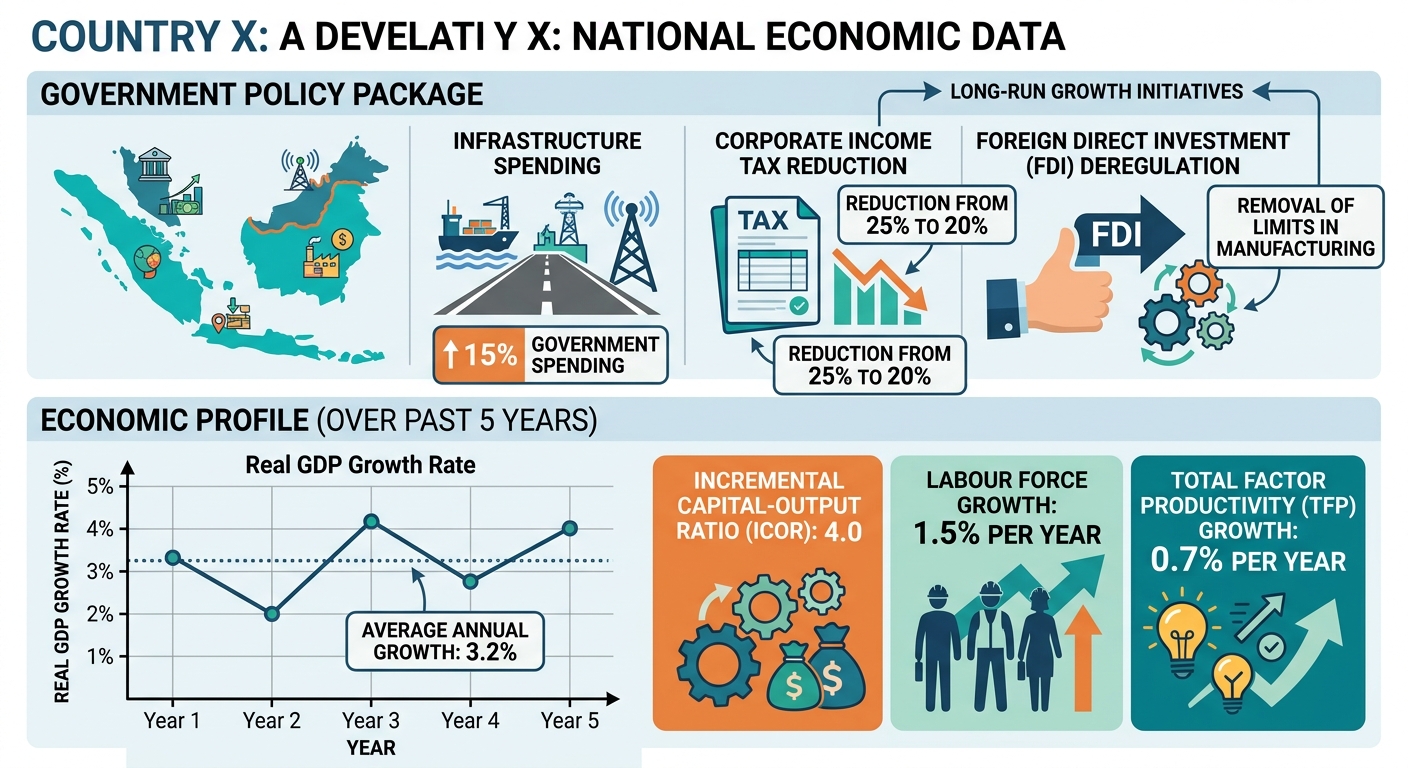
The government of Country X, a middle-income developing nation in Southeast Asia, has announced a policy package to boost economic growth. The package includes: (i) a increase in government spending on infrastructure (roads, ports, and digital networks); (ii) a reduction in corporate income tax from to ; and (iii) deregulation of foreign direct investment (FDI) limits in the manufacturing sector.
Over the past five years, Country X has experienced an average real GDP growth rate of per year, with an incremental capital-to-output ratio (ICOR) of . The labour force is growing at per year and total factor productivity (TFP) growth has been estimated at per year.
(a)
Using the production function , explain how each of the three policy components could contribute to increasing Country X's long-run potential output. [4 marks]
(b)
Evaluate the likely effectiveness of this policy package in achieving sustained economic growth for Country X. In your answer, consider potential trade-offs and limitations, and refer to real-world evidence from at least one named developing economy. [6 marks]
Solutions
That's every free question here — 3 of 210.
+207 more questions, plus Mock Papers & Worksheets, are waiting in Premium.