Differentiation Rules · Paper 1 — Free Maths AA HL Practice Questions
Free questions
Open in full, with answers, mark scheme and examiner insights.
Derivatives of standard functions; chain, product and quotient rules
The diagram shows a cone of base radius cm and height cm, with volume . For a family of these cones, , where .
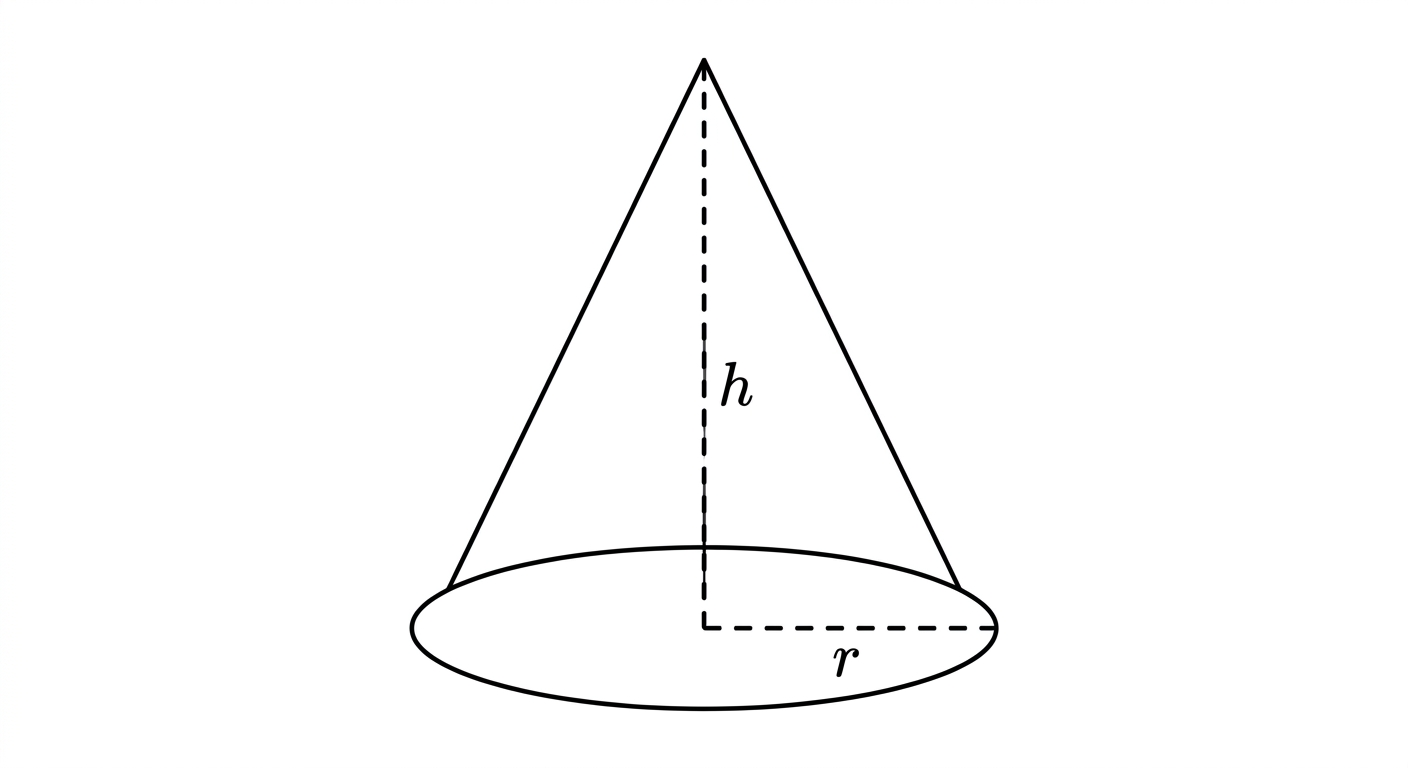
Show that .
Find .
Find the value of that maximises , justifying that it gives a maximum.
Find the maximum volume.
revisionprep.com
Summary Answer
Not available for this question.
Model Answer
Not available for this question.
Marking Scheme
Not available for this question.
Examiner Insights
Not available for this question.
Derivatives of tan, sec, cosec, cot, aˣ, logₐx and inverse trig functions
Differentiate with respect to :
;
.
revisionprep.com
Summary Answer
Not available for this question.
Model Answer
Not available for this question.
Marking Scheme
Not available for this question.
Examiner Insights
Not available for this question.
Derivatives of standard functions; chain, product and quotient rules
The diagram shows a closed cylindrical container with base radius cm, height cm and volume . The curved surface costs USD 1 per and each circular end costs USD 2 per .
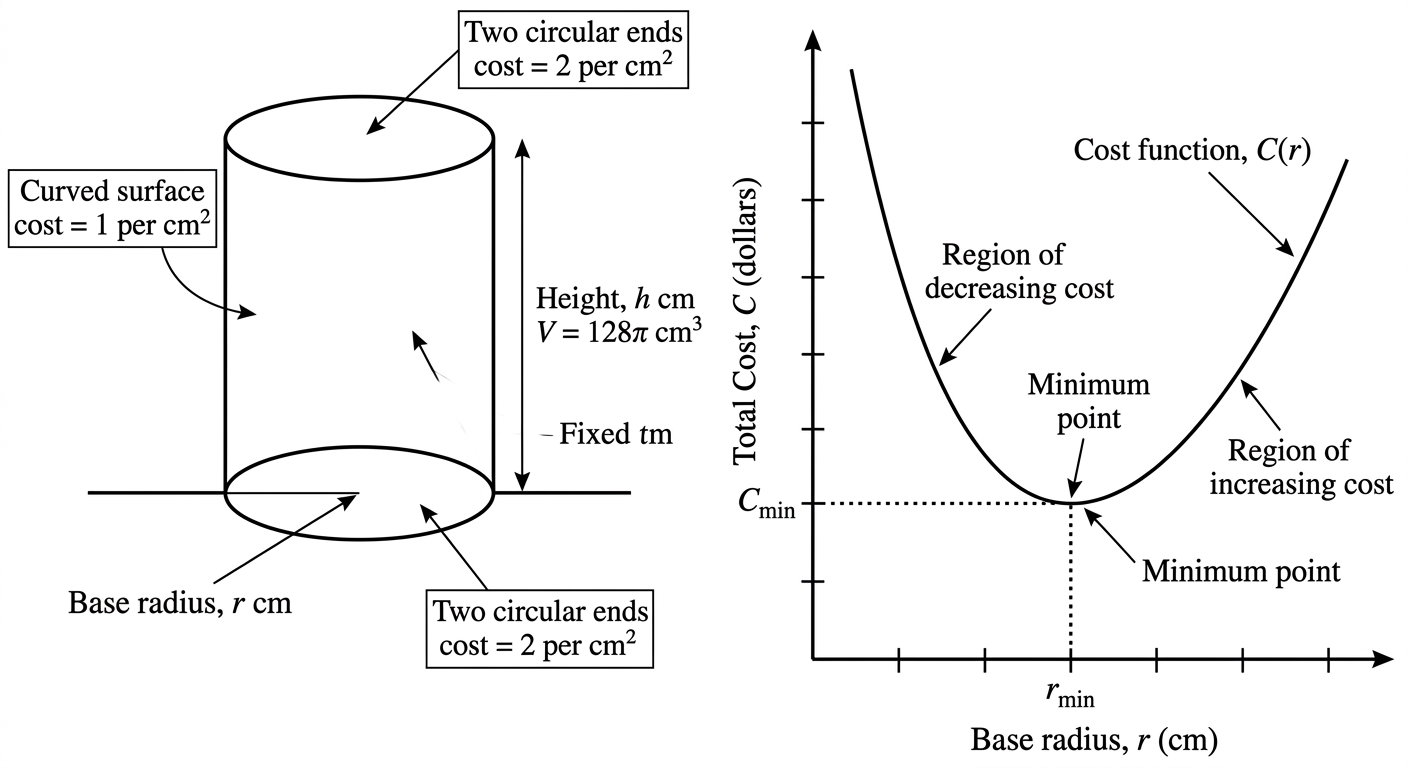
Show that the total cost dollars of the material is .
Find and hence find the exact value of at the stationary point of .
Use the second derivative to show that this stationary point is a local minimum.
Justify that this local minimum is the global minimum of for .
revisionprep.com
Summary Answer
Not available for this question.
Model Answer
Not available for this question.
Marking Scheme
Not available for this question.
Examiner Insights
Not available for this question.
The second derivative
The diagram shows the graph of , the derivative of a function , for . The graph of passes through the origin O and has turning points at and .
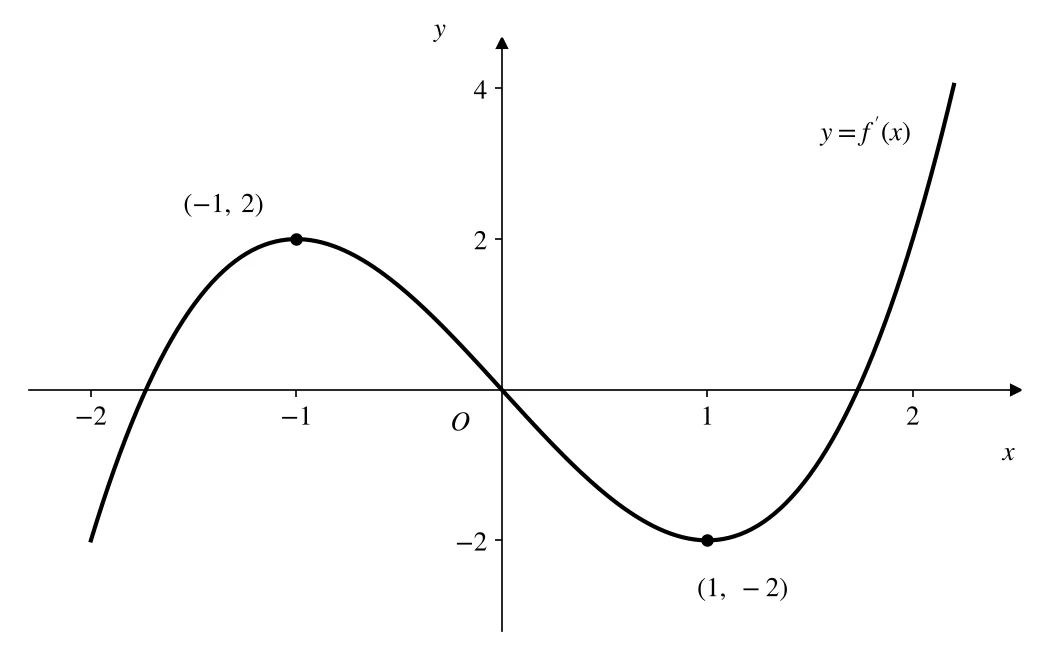
Write down the -coordinates of the points of inflexion of the graph of . Justify your answer.
Write down the set of values of for which the graph of is concave down.
Determine whether has a local maximum, a local minimum or neither at . Justify your answer.
Sketch the graph of for , showing clearly where it meets the -axis.
revisionprep.com
Summary Answer
Not available for this question.
Model Answer
Not available for this question.
Marking Scheme
Not available for this question.
Examiner Insights
Not available for this question.
The second derivative
Let , for . The diagram shows part of the graph of .
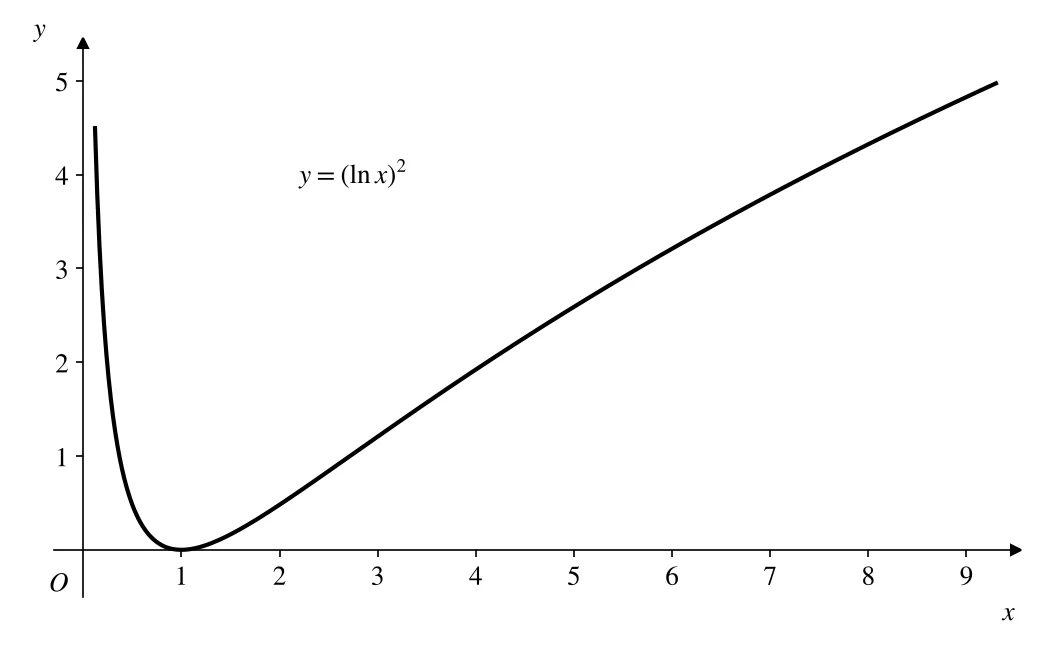
Find .
Find the coordinates of the stationary point of the graph of .
Show that .
Use to determine the nature of the stationary point.
Find the coordinates of the point of inflexion of the graph of .
Show that the tangent to the graph of at the point of inflexion passes through the point .
revisionprep.com
Summary Answer
Not available for this question.
Model Answer
Not available for this question.
Marking Scheme
Not available for this question.
Examiner Insights
Not available for this question.
Implicit differentiation and related rates
The diagram shows the curve with equation .
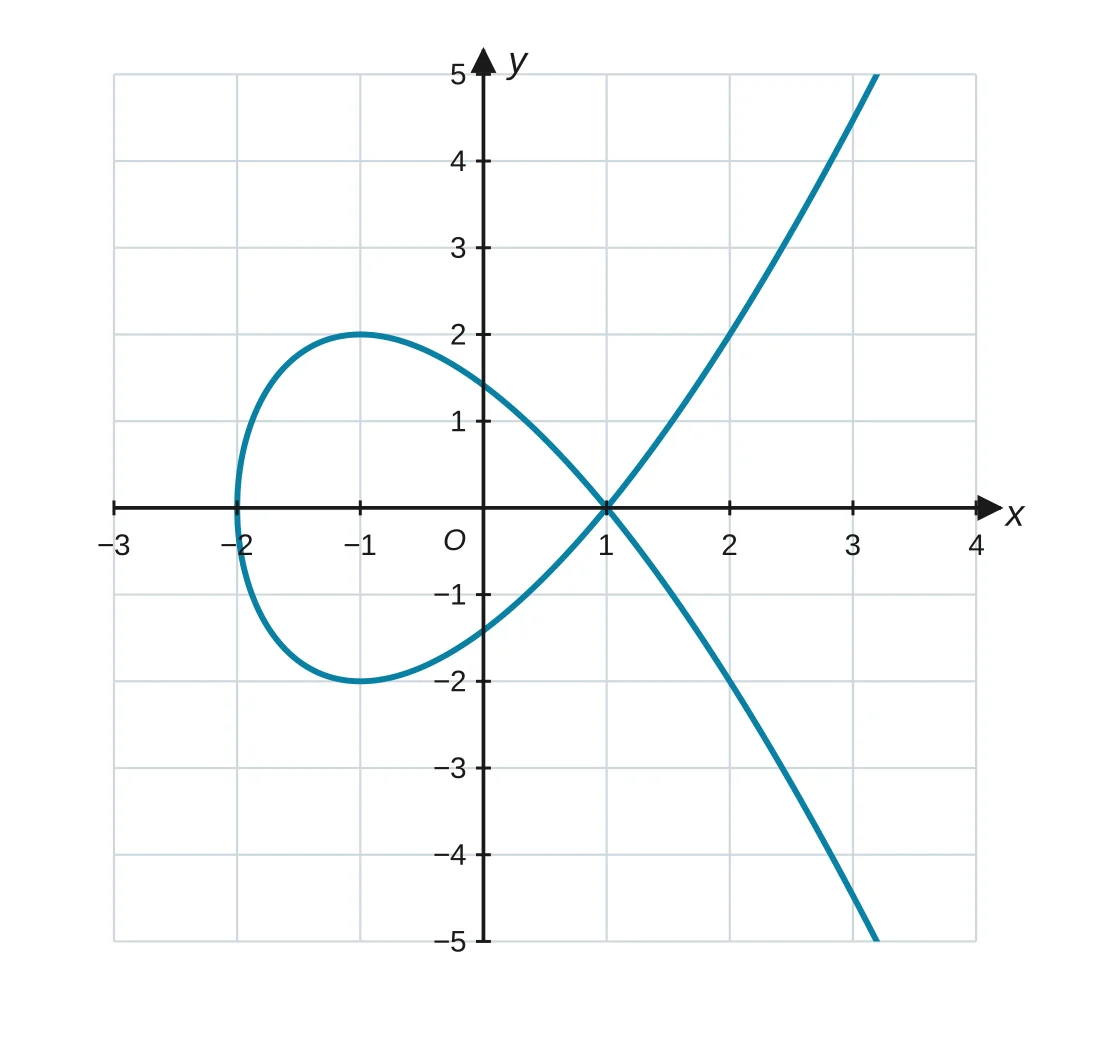
Find in terms of and .
Find the coordinates of the point on the curve at which the tangent is vertical.
The curve also meets the -axis at . Explain why the expression for cannot be used to describe the tangent at this point.
revisionprep.com
Summary Answer
Not available for this question.
Model Answer
Not available for this question.
Marking Scheme
Not available for this question.
Examiner Insights
Not available for this question.
That's every free question here — 6 of 223.
+217 more questions, plus Mock Papers & Worksheets, are waiting in Premium.