Differential Equations and Maclaurin Series · Paper 2 — Free Maths AA HL Practice Questions
Free questions
Open in full, with answers, mark scheme and examiner insights.
First-order differential equations: separable, homogeneous, integrating factor
In a chemical reaction the concentration mol L of a reactant at time seconds satisfies , where is a positive constant. The graph shows and the measured point .
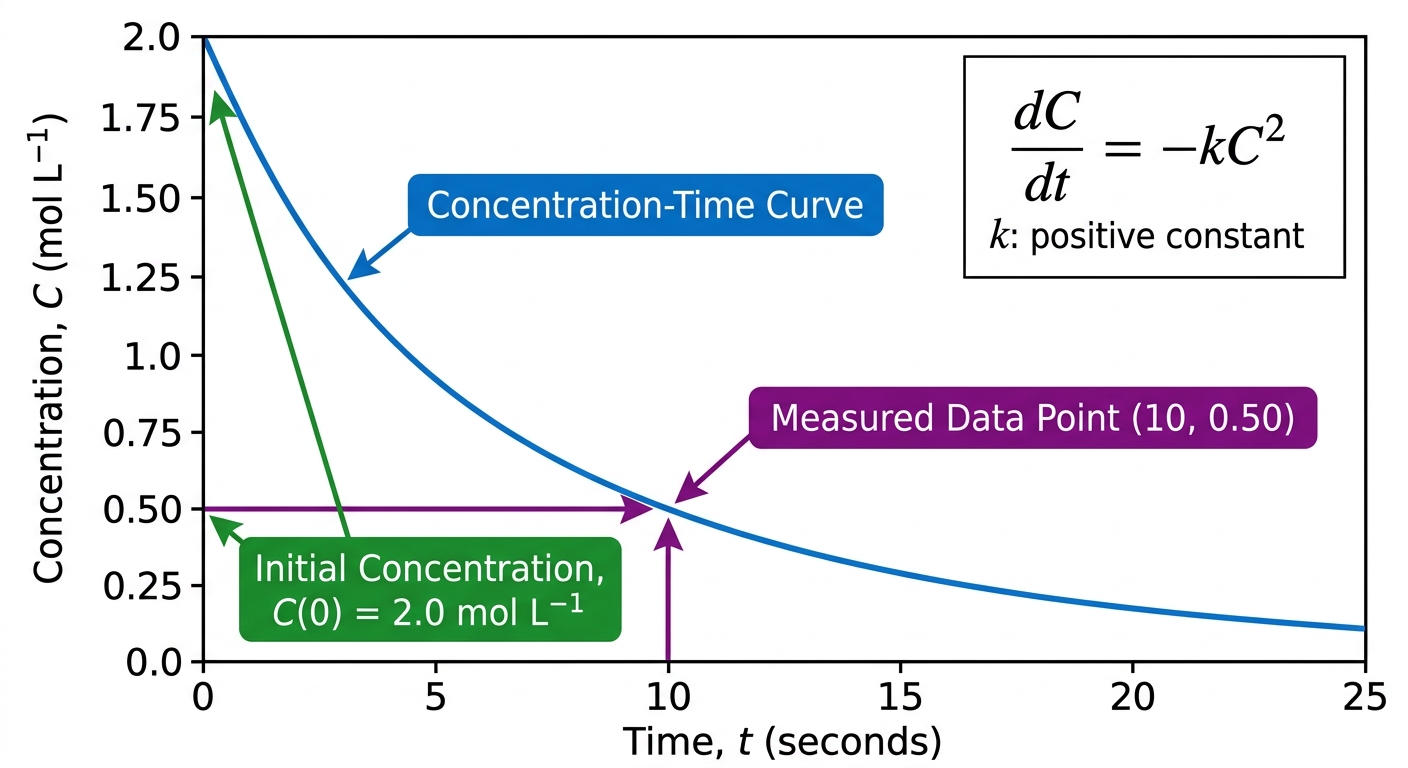
By separating the variables, show that .
Find the value of .
Find the time at which the concentration reaches 0.10 mol L.
revisionprep.com
Summary Answer
Not available for this question.
Model Answer
Not available for this question.
Marking Scheme
Not available for this question.
Examiner Insights
Not available for this question.
Euler's method
Consider the differential equation , with when .
Euler's method with step length is used to approximate the solution, as shown in the table.
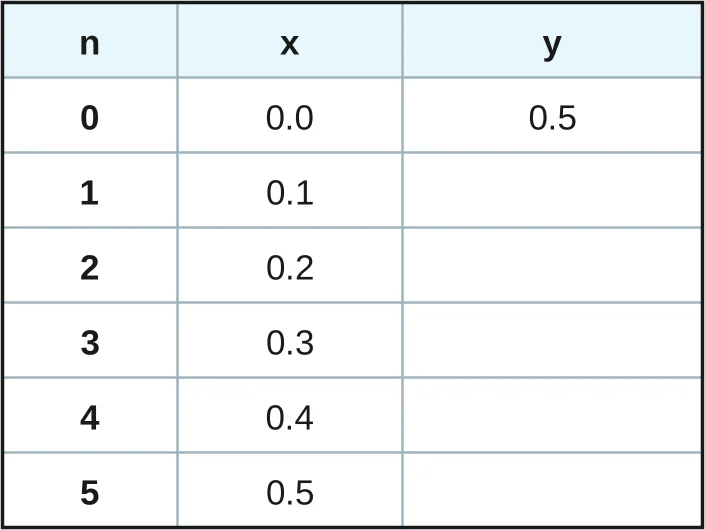
Copy and complete the table, giving values of correct to four significant figures.
Write down an approximation for when .
revisionprep.com
Summary Answer
Not available for this question.
Model Answer
Not available for this question.
Marking Scheme
Not available for this question.
Examiner Insights
Not available for this question.
First-order differential equations: separable, homogeneous, integrating factor
The function satisfies , with . The diagram shows the graph of and the two steps to and to of Euler's method with step length 0.5, starting at .
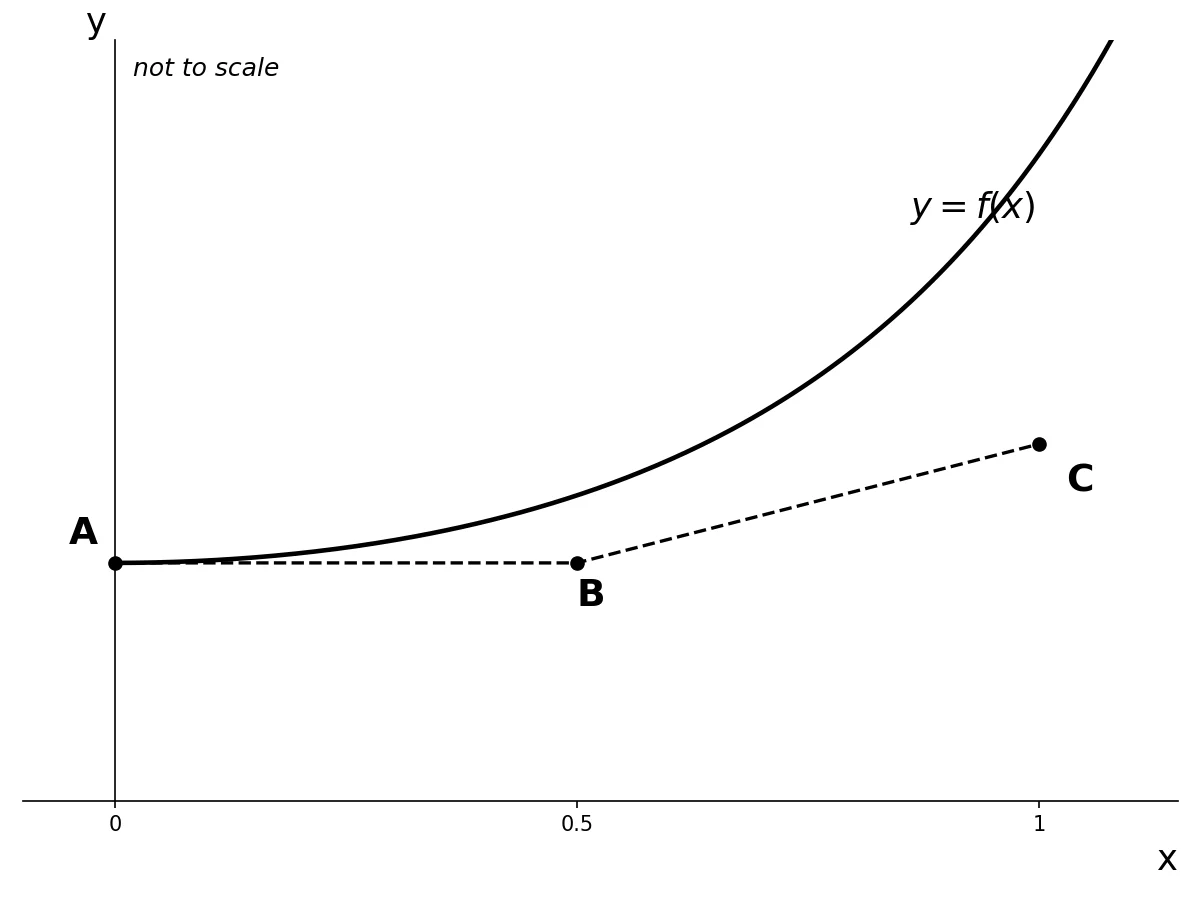
Use Euler's method with step length 0.5 to find an approximate value of .
Solve the differential equation and hence find the exact value of .
With reference to the diagram, explain why the approximation in (a) is less than the exact value.
Suggest one change to the method that would give a more accurate approximation.
revisionprep.com
Summary Answer
Not available for this question.
Model Answer
Not available for this question.
Marking Scheme
Not available for this question.
Examiner Insights
Not available for this question.
First-order differential equations: separable, homogeneous, integrating factor
The diagram shows a tank holding 100 litres of brine. Initially the concentration is 0.2 kg of salt per litre. Brine of concentration 0.5 kg per litre flows in at 4 litres per minute, and the well-stirred mixture flows out at 4 litres per minute. Let kg be the mass of salt in the tank after minutes.
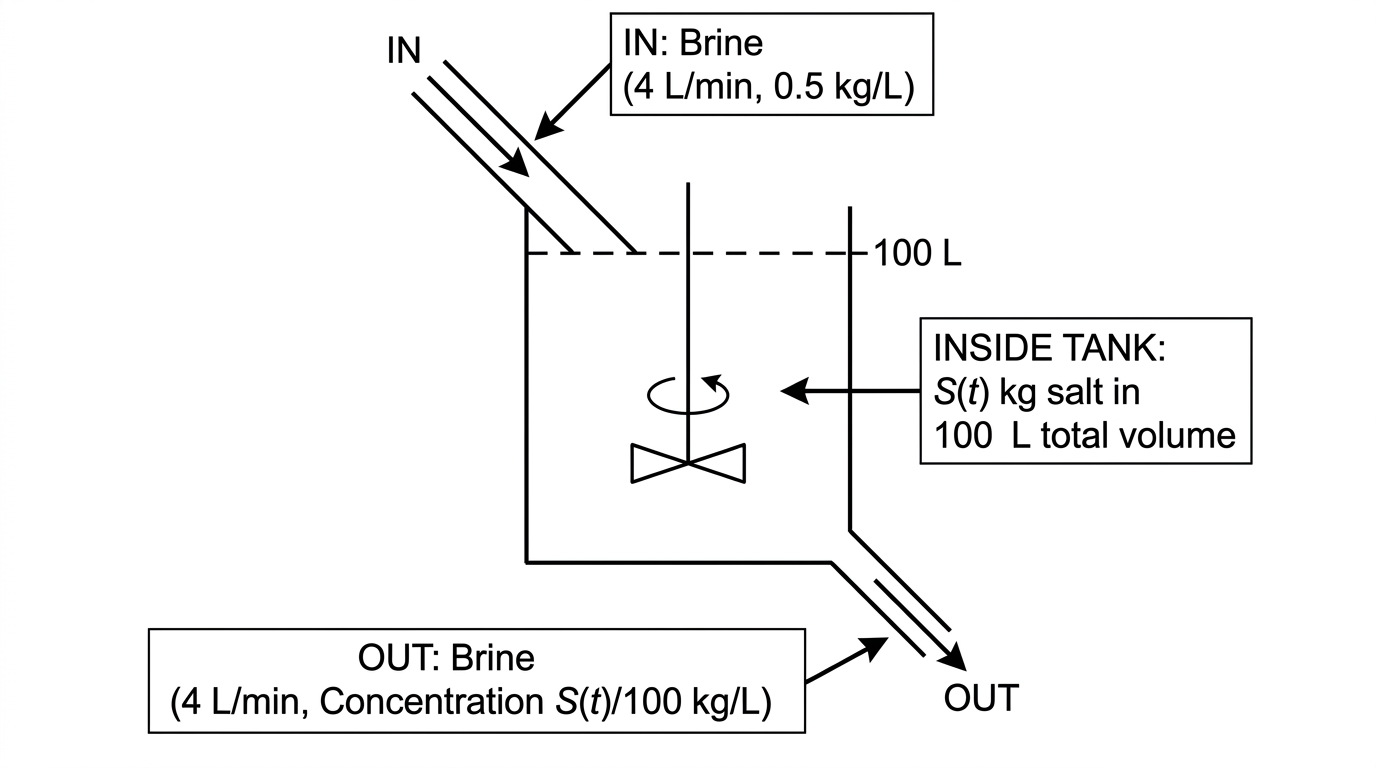
Show that .
Show that .
Find the exact time at which the concentration in the tank is 0.4 kg per litre.
The inflow concentration is changed to kg per litre, with all flow rates and the initial state unchanged. Show that the concentration in the tank at time is .
Determine the set of values of for which the concentration never exceeds 0.4 kg per litre.
revisionprep.com
Summary Answer
Not available for this question.
Model Answer
Not available for this question.
Marking Scheme
Not available for this question.
Examiner Insights
Not available for this question.
First-order differential equations: separable, homogeneous, integrating factor
The diagram shows two tanks, A and B, each holding 100 litres of liquid. At tank A contains 20 kg of dissolved salt and tank B contains pure water. Pure water flows into tank A at 10 litres per minute, the stirred mixture flows from A into B at 10 litres per minute, and the stirred mixture leaves B at 10 litres per minute. Let kg and kg be the masses of salt in A and B after minutes.
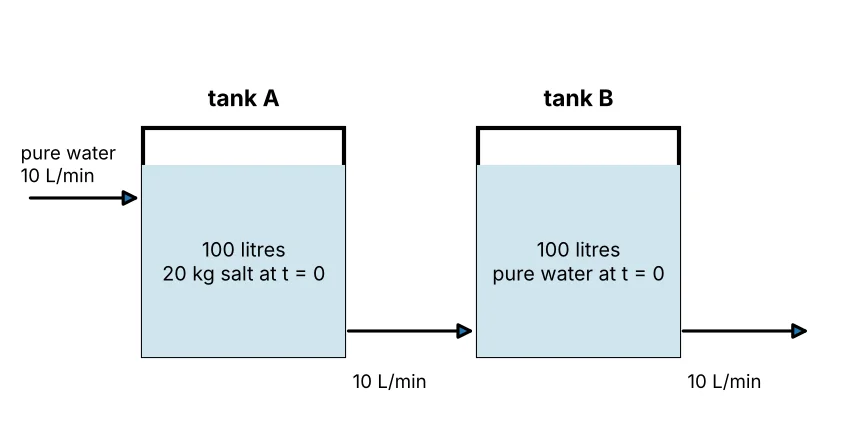
Show that .
Show that .
Use an integrating factor to find in terms of .
Find the greatest mass of salt in tank B and the time at which it occurs.
Show that the two tanks contain equal masses of salt at the time found in part (d), and explain why this must happen.
Find the time after which tank B contains less than 1 kg of salt.
revisionprep.com
Summary Answer
Not available for this question.
Model Answer
Not available for this question.
Marking Scheme
Not available for this question.
Examiner Insights
Not available for this question.
Maclaurin series
Consider the equation , where .
Use the Maclaurin series for , up to and including the term in , to show that an approximate solution is .
Use your graphic display calculator to find the solution of , and find the percentage error in the approximation .
By considering the next non-zero term in the series for , explain why is less than the exact solution.
revisionprep.com
Summary Answer
Not available for this question.
Model Answer
Not available for this question.
Marking Scheme
Not available for this question.
Examiner Insights
Not available for this question.
That's every free question here — 6 of 171.
+165 more questions, plus Mock Papers & Worksheets, are waiting in Premium.