You're viewing 1 free preview question for Maths AA HL — subscribe to unlock 16 more, plus the Full Question Bank, Mock Papers & Worksheets.Upgrade
Limits and Continuity · Paper 3 — Free Maths AA HL Practice Questions
1ChallengeLAQDefinition and calculation of limits10 marksPaper 3~15 min

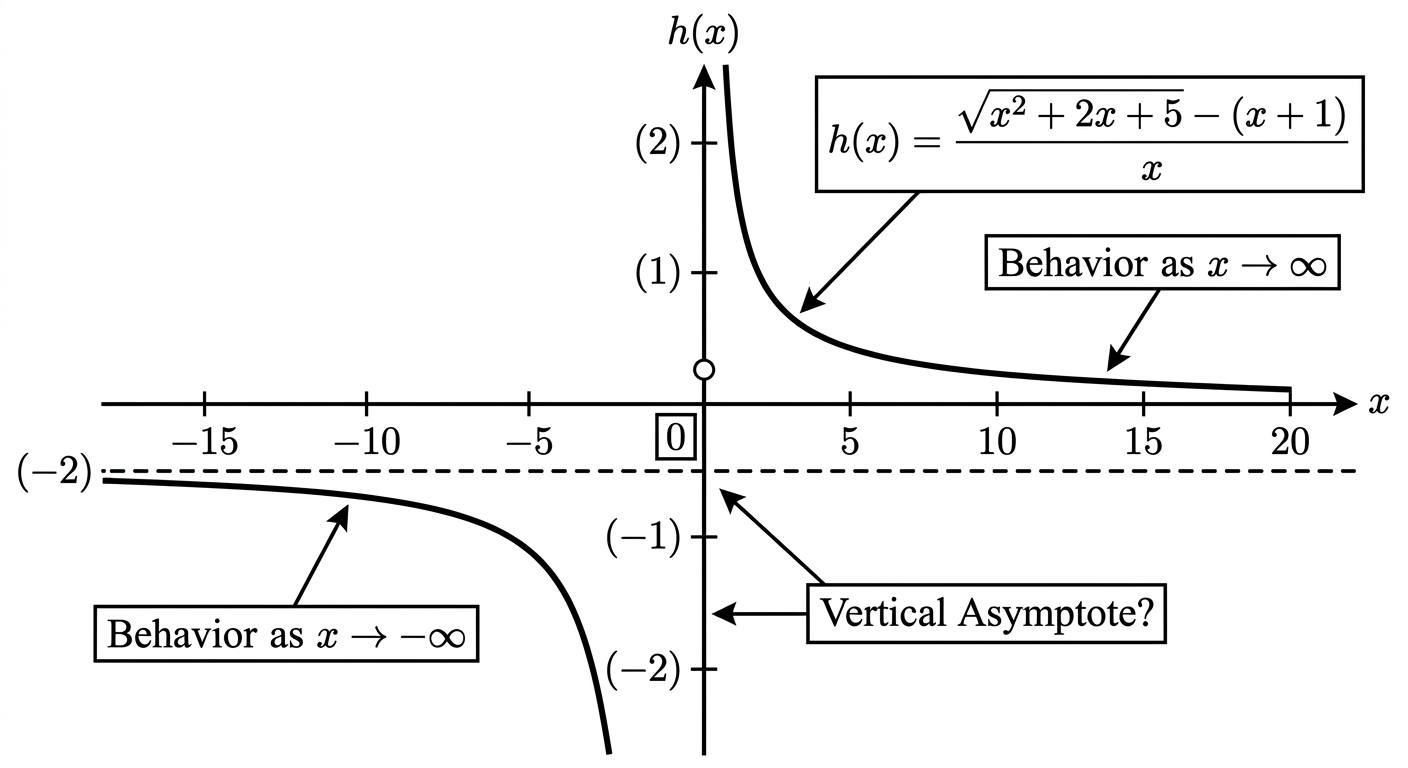
A function is defined by for .
(a)
Show that can be written in the form for , and hence prove that . [4 marks]
(b)
Show that for ,
Hence determine . [3 marks]
(c)
The graph of has two distinct horizontal asymptotes. State both asymptotes and explain why the asymptote as differs from the asymptote as , with reference to the role of in the simplification of . [3 marks]

Solutions
That's every free question here — 1 of 17.
+16 more questions, plus Mock Papers & Worksheets, are waiting in Premium.