You're viewing 1 free preview question for Maths AA HL — subscribe to unlock 7 more, plus the Full Question Bank, Mock Papers & Worksheets.Upgrade
Modeling with Functions · Paper 3 — Free Maths AA HL Practice Questions
1ChallengeLAQReal-world applications of functions (e.g. growth models)s11 marksPaper 3~17 min

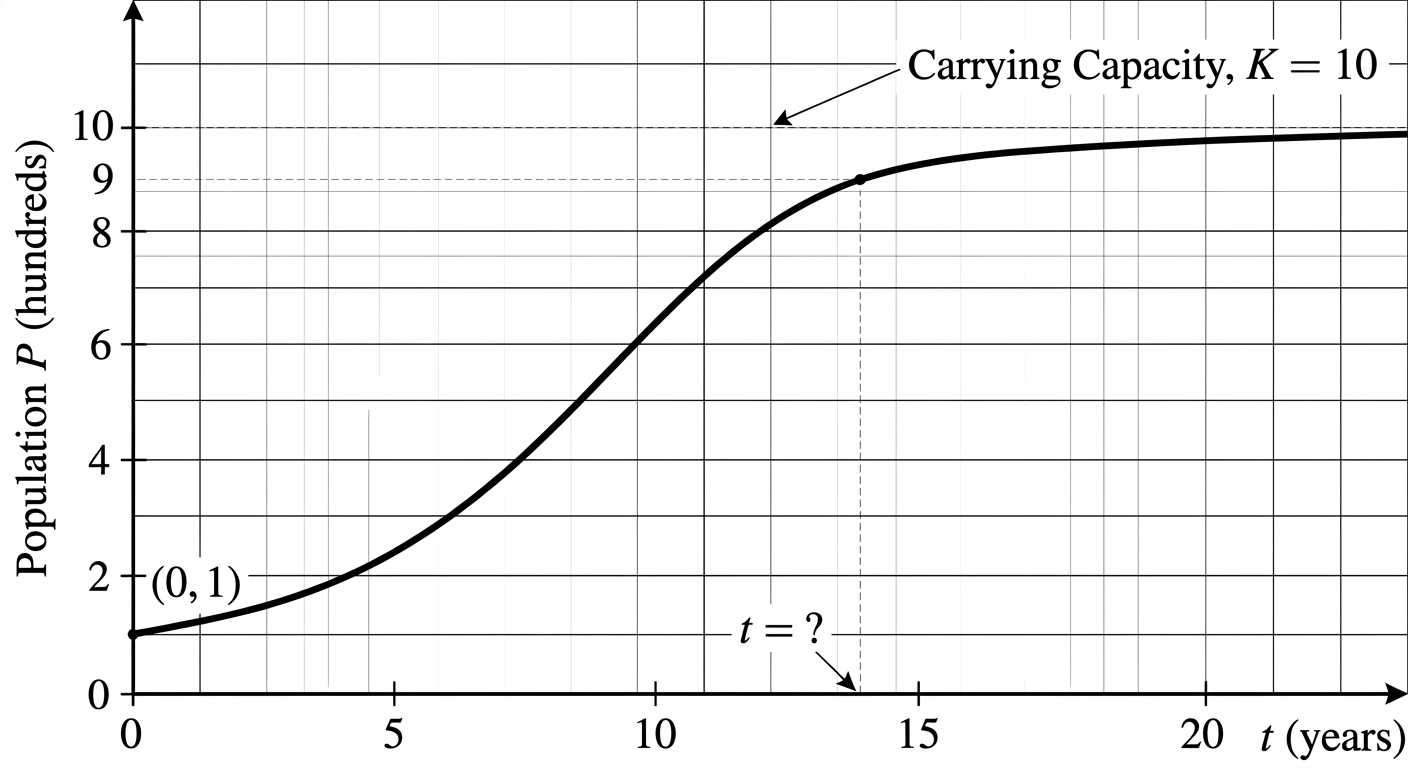
A biologist studies the population growth of a rare bird species on an isolated island. The population (in hundreds) at time (in years) satisfies the logistic differential equation
where is the carrying capacity (in hundreds) and .
(a)
Show that the general solution satisfying is
[5 marks]
(b)
Given , calculate the time at which the population reaches of the carrying capacity. [3 marks]
(c)
For the model with , the growth rate is a function of .
(i) Determine the value of at which is maximised. [1 mark]
(ii) Hence analyse how the rate of population growth changes as increases from to , and explain what this implies about the time taken for the population to grow from to of compared to the time taken to grow from to of . Total: 12 marks [3 marks]
(ii) Hence analyse how the rate of population growth changes as increases from to , and explain what this implies about the time taken for the population to grow from to of compared to the time taken to grow from to of . Total: 12 marks [3 marks]

Solutions
That's every free question here — 1 of 8.
+7 more questions, plus Mock Papers & Worksheets, are waiting in Premium.