You're viewing free preview questions. Upgrade to access more Maths AA HL questions.Upgrade
Arithmetic and Geometric Sequences · Paper 2 — Free Maths AA HL Practice Questions
1MasterySAQ-SDefinition and general term of arithmetic sequencess7 marksPaper 2~11 min

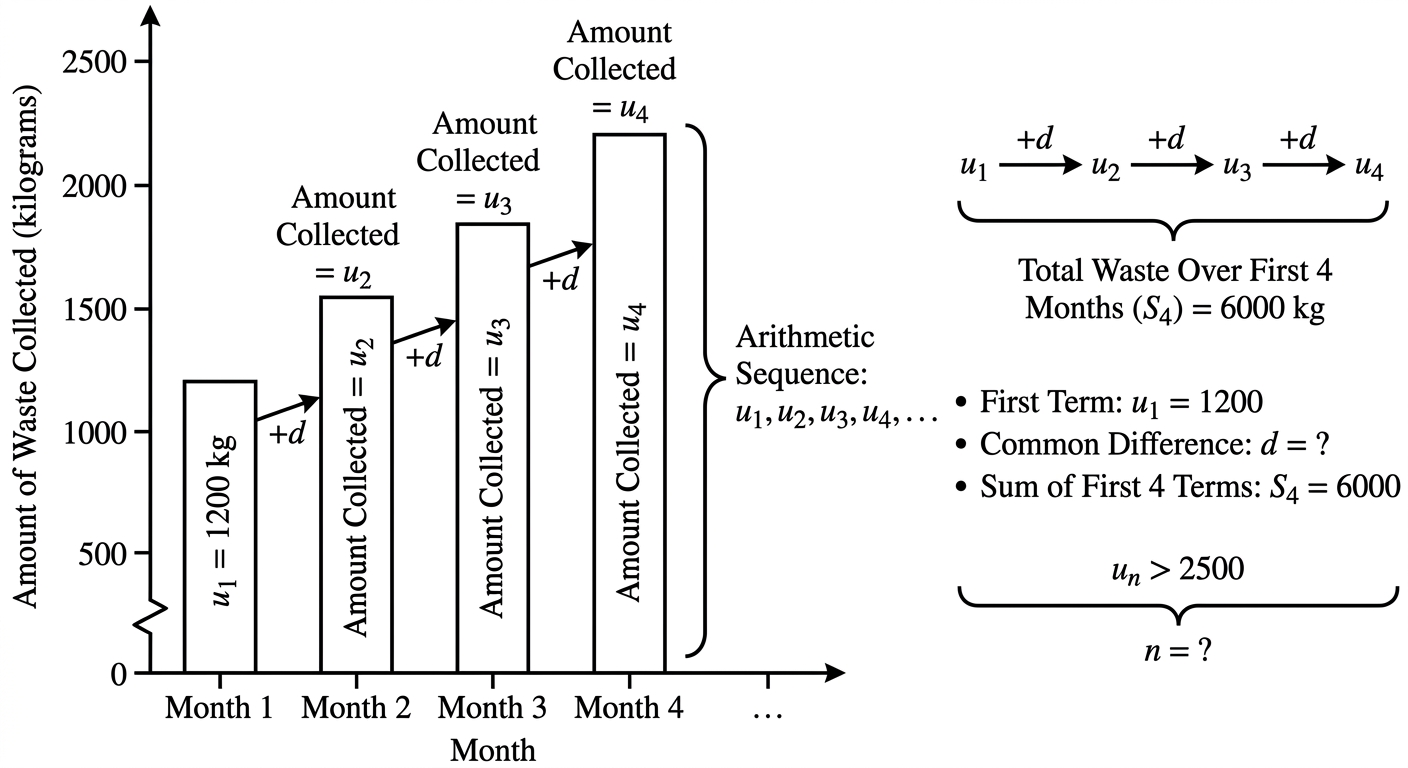
A company is developing a new recycling program. In the first month, of waste are collected. The monthly amounts collected form an arithmetic sequence. The company collects a total of over the first four months.
(a)
Calculate the common difference of the sequence. [3 marks]
(b)
Calculate the total waste collected over the first three months. [2 marks]
(c)
Determine the month in which the amount of waste collected first exceeds . [2 marks]

Solutions
2MasterySAQ-SDefinition and general term of arithmetic sequencess7 marksPaper 2~11 min
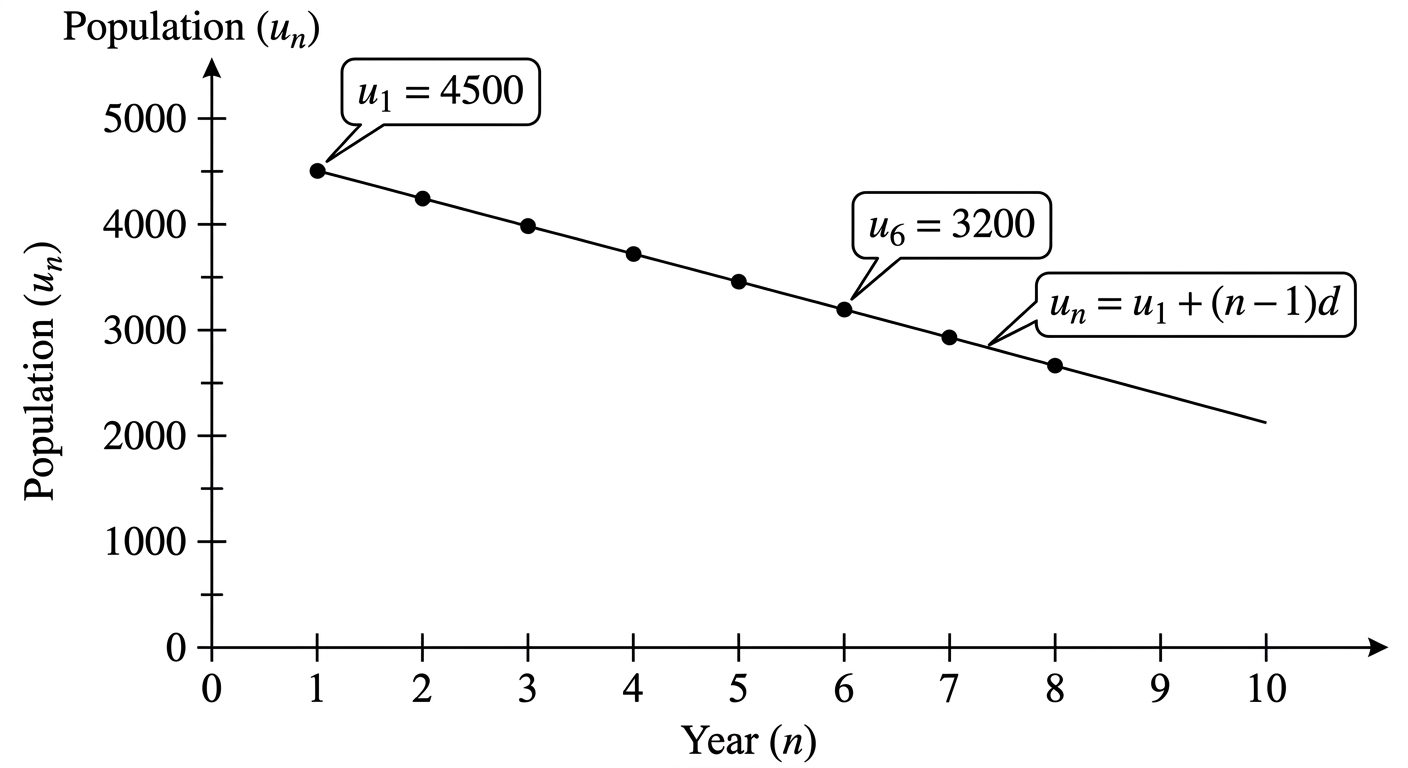
A biologist studies the population of a fish species in a lake. The population in the first year of observation is fish. The population decreases each year by a constant amount, forming an arithmetic sequence. In the sixth year, the population is fish.
(a)
Calculate the common difference of the sequence. [2 marks]
(b)
Determine the population in the tenth year. [2 marks]
(c)
The biologist estimates that the population will fall below fish in year . Calculate the value of . [3 marks]
Solutions
3MasterySAQ-SDefinition and general term of arithmetic sequencess10 marksPaper 2~15 min
Data
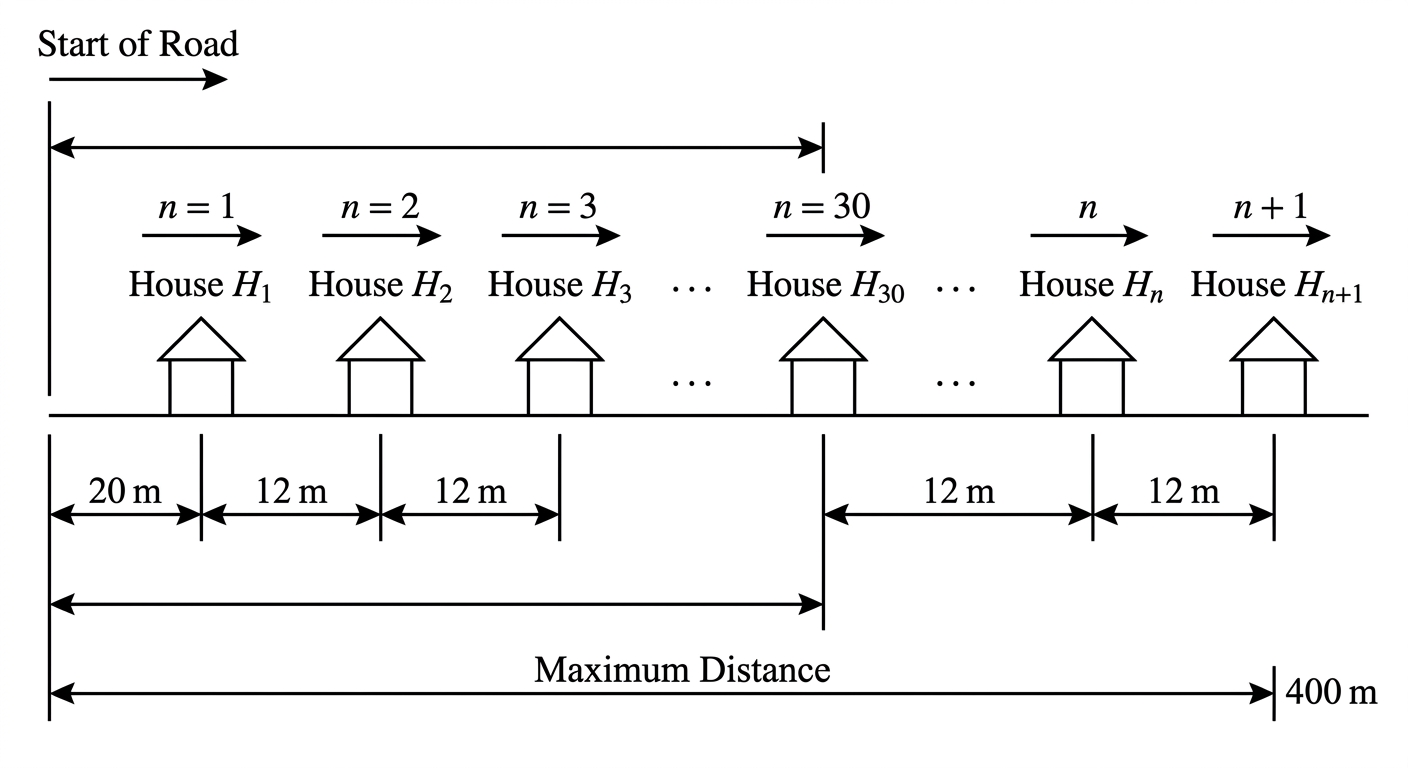
A construction company is building a series of houses along a straight road. The first house is located from the start of the road. Each subsequent house is placed further from the start of the road than the previous house.
(a)
Write down the values of and for this arithmetic sequence. [2 marks]
(b)
Calculate the distance from the start of the road to the th house. [2 marks]
(c)
The local council requires that no house may be placed more than from the start of the road. Determine the maximum number of houses that can be built. [3 marks]
(d)
The company also requires that the total distance covered by all houses (i.e. the sum of all individual house distances from the start of the road) must not exceed . Determine whether the constraint in part (c) or this new constraint is more restrictive, justifying your answer. [3 marks]
Solutions
4MasterySAQ-SSum of an arithmetic sequences6 marksPaper 2~9 min
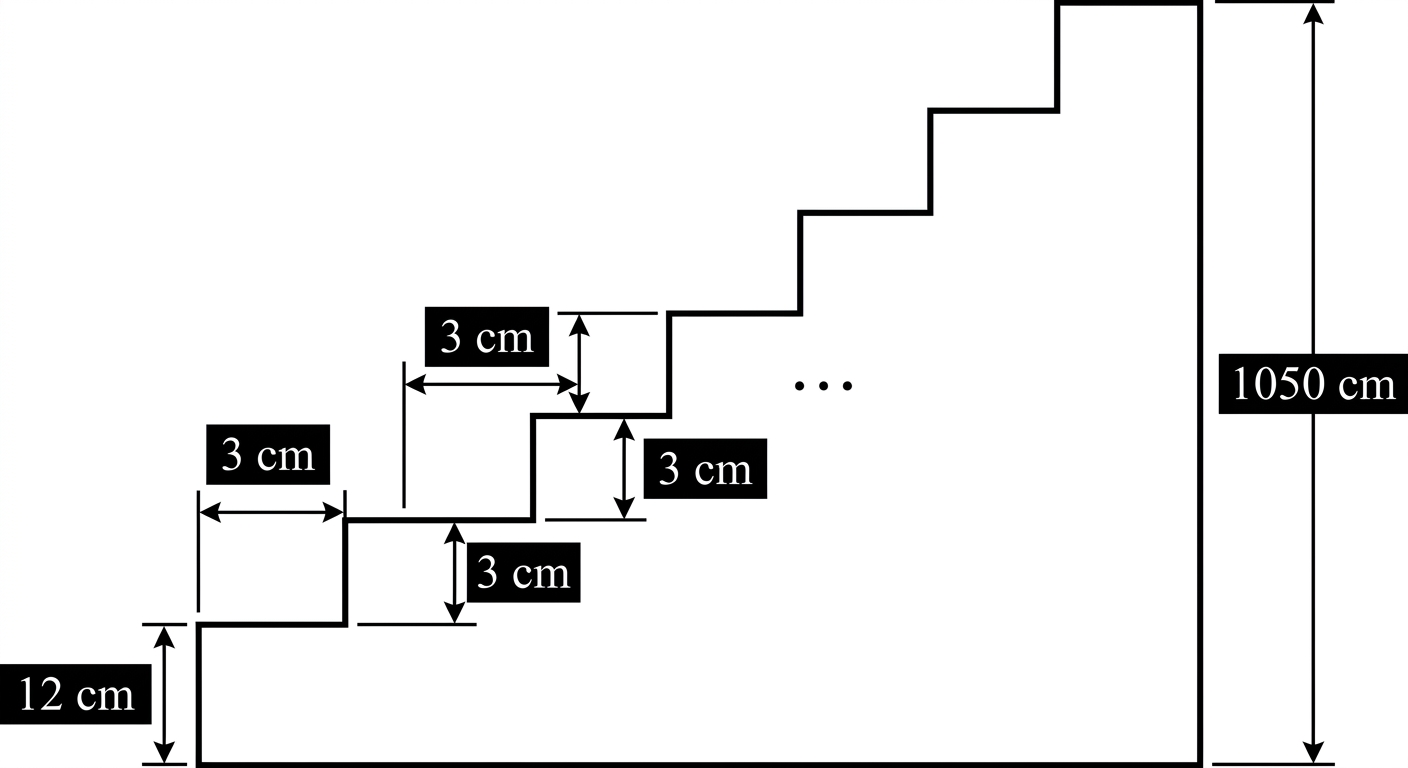
A construction company is building a staircase. The first step has a height of . Each subsequent step is taller than the previous step. The total height of the staircase is .
(a)
Calculate the number of steps in the staircase. [3 marks]
(b)
Building regulations require that no single step in a staircase may exceed in height. Determine whether this staircase complies with the regulation. [3 marks]
Solutions
5MasterySAQ-SSum of an arithmetic sequences6 marksPaper 2~9 min
Data
$
$
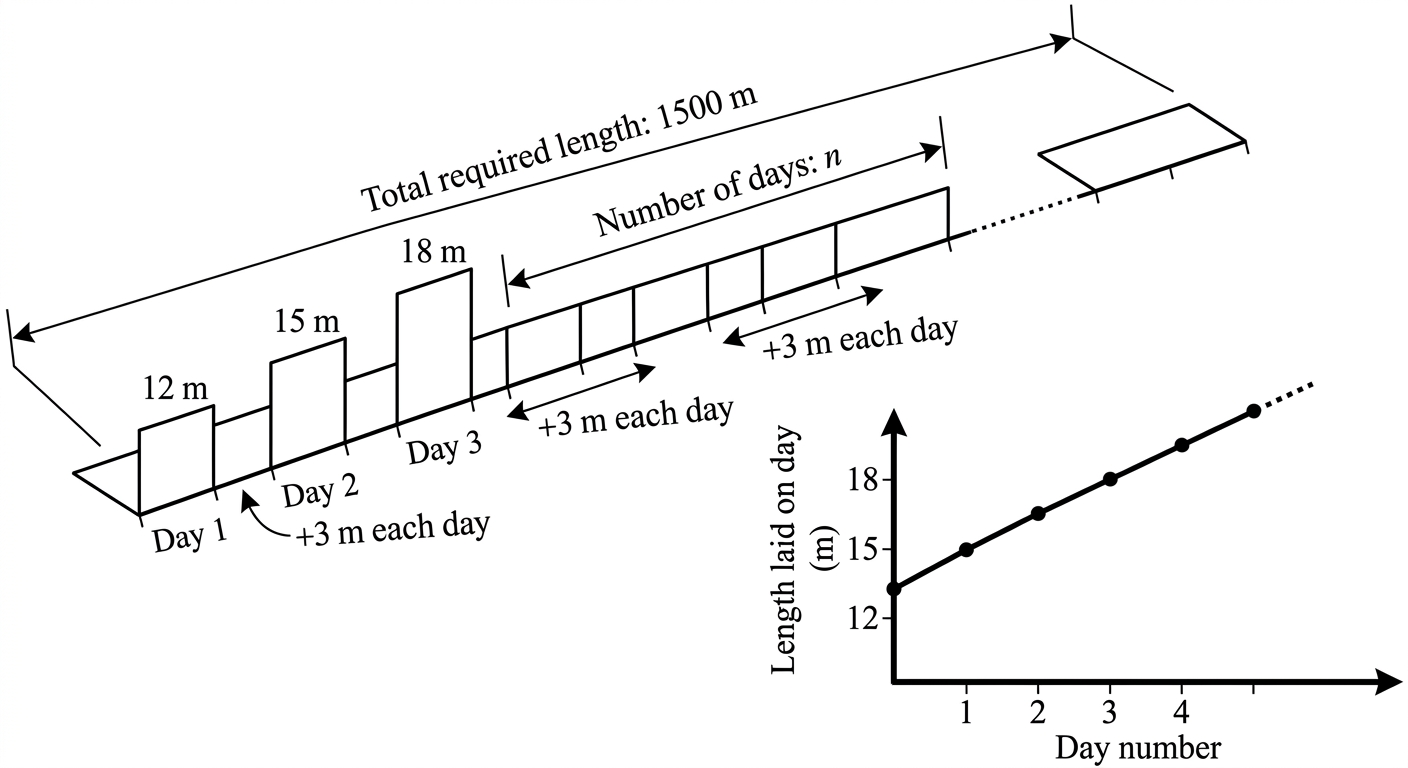
A construction company is building a straight section of road. On the first day, they lay metres of road. Each subsequent day, they lay metres more than the previous day. The project requires a total of metres of road to be laid.
(a)
Show that the number of days, , required to complete the road satisfies the equation
$$3n^2 + 21n - 2436 = 0. \quad [2 marks]
(b)
Hence, calculate the number of days required to complete the road. $ [2 marks]
(c)
Determine the length of road laid on the final day. $ [2 marks]
Solutions
6MasterySAQ-SSum of an arithmetic sequences6 marksPaper 2~9 min
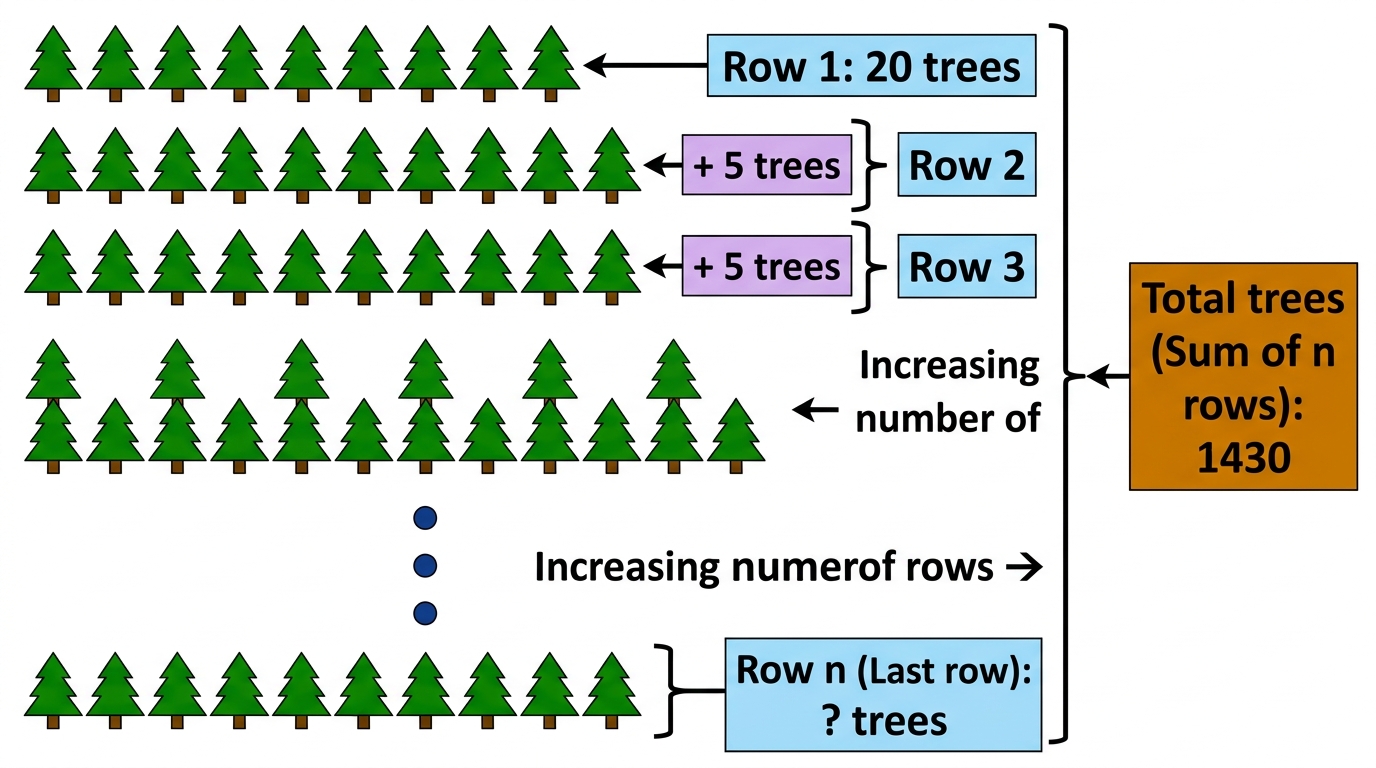
A farmer plants trees in rows. The first row contains trees. Each subsequent row contains more trees than the previous row. The total number of trees planted is .
(a)
Show that the number of rows planted is . [3 marks]
(b)
The farmer wishes to plant at least trees using the same pattern (first row of trees, each subsequent row increasing by ). Determine the minimum number of complete rows required. [3 marks]
Solutions
7MasterySAQ-SGeometric sequences and their general terms6 marksPaper 2~9 min
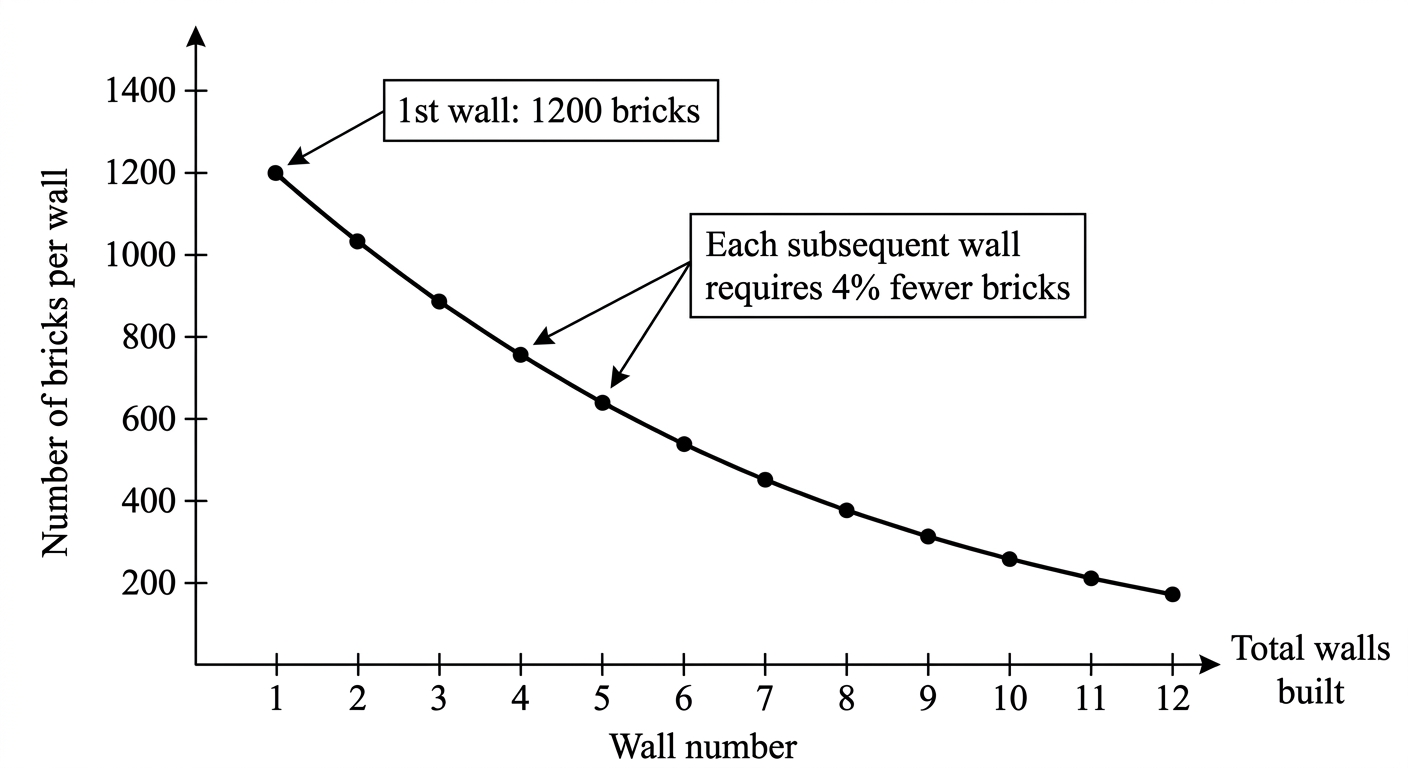
A construction company is building a series of retaining walls. The first wall requires bricks. Each subsequent wall requires fewer bricks than the previous wall.
(a)
Calculate the number of bricks required for the th wall, giving your answer to the nearest whole brick. [2 marks]
(b)
Calculate the total number of bricks required for the first walls, giving your answer to the nearest whole brick. [2 marks]
(c)
The company has a total stock of bricks. Determine the maximum number of complete walls they can build, and find the number of bricks remaining in stock after those walls are built. [2 marks]
Solutions
8MasterySAQ-SGeometric sequences and their general terms6 marksPaper 2~9 min
Data
, ,
A geometric sequence has first term and common ratio .
(a)
State the value of . [1 mark]
(b)
Calculate the sum of the first 8 terms. Give your answer as an exact fraction. [2 marks]
(c)
Show that the sum of the first terms can be written in the form for some constant , and hence determine the value of for which . [3 marks]
Solutions
9MasterySAQ-SGeometric sequences and their general terms8 marksPaper 2~12 min
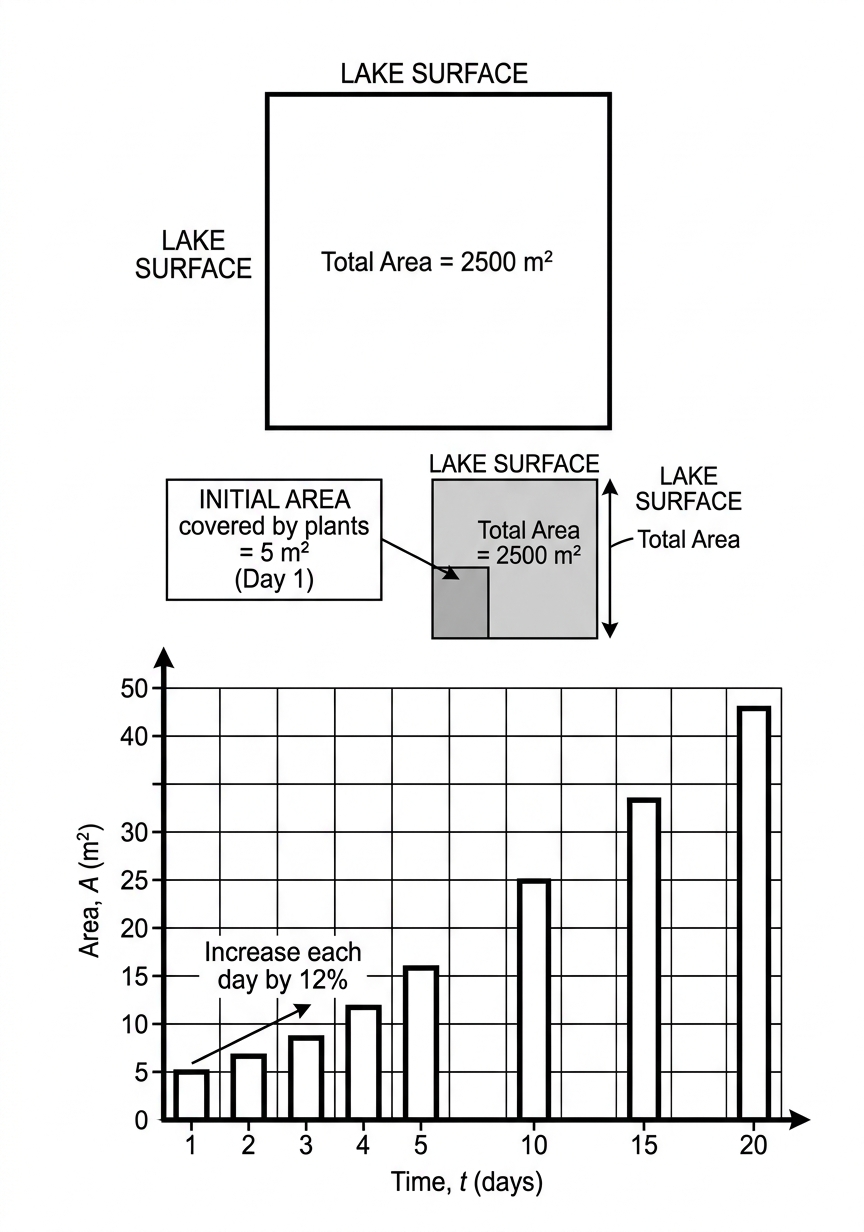
A biologist is studying the spread of a plant species in a lake. The area covered by the plants on the first day is . Each day, the area covered increases by of the previous day's area.
(a)
Calculate the area covered on the 15th day. Give your answer correct to 3 significant figures. [2 marks]
(b)
Calculate the total area covered from day 1 to day 20 inclusive. Give your answer correct to 3 significant figures. [2 marks]
(c)
The lake has a total surface area of . Determine the day on which the plants first cover more than of the lake's surface area. [2 marks]
(d)
Using your answer to part (c), determine the day on which the model predicts the plants would first cover the entire lake. Hence comment on whether the geometric model remains valid beyond the day found in part (c). [2 marks]
Solutions
10MasterySAQ-SDefinition and general term of arithmetic sequencess10 marksPaper 2~15 min
A concert hall has seats arranged in rows. The number of seats in each row forms an arithmetic sequence. The first row has seats and the sixth row has seats.
(a)
Find the common difference of the sequence. [2 marks]
(b)
Calculate the number of seats in the fifteenth row. [2 marks]
(c)
The total number of seats in the first rows is . Find the value of . [2 marks]
(d)
The concert hall has exactly rows. A second concert hall also has rows of seats. Its first row has seats and its last row has seats, with the number of seats in each row also forming an arithmetic sequence. Determine which concert hall has more total seats, showing your reasoning clearly. [4 marks]
Solutions
11MasterySAQ-SDefinition and general term of arithmetic sequencess6 marksPaper 2~9 min
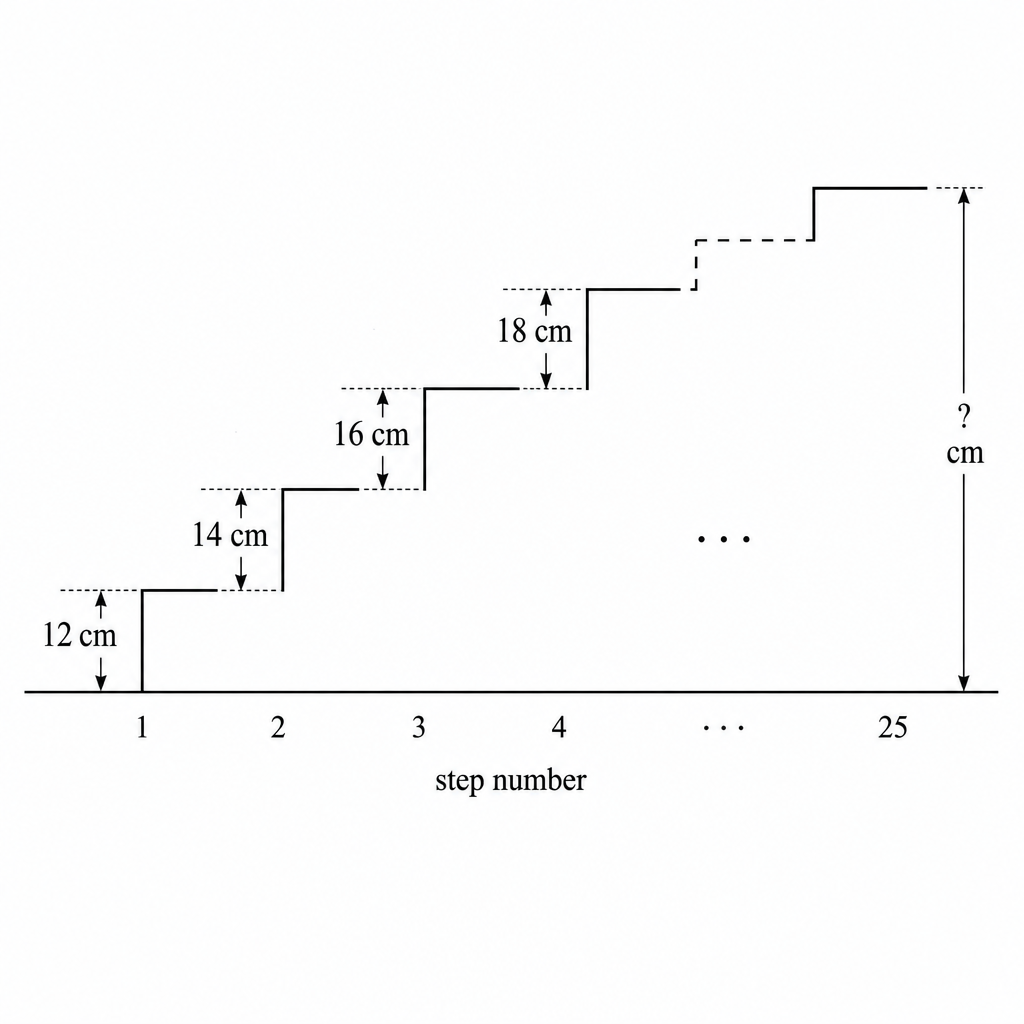
A construction company is building a staircase. The first step has a height of . Each subsequent step has a height greater than the previous step.
(a)
Calculate the height of the 25th step. [2 marks]
(b)
Show that the total vertical height of a staircase with 25 steps is exactly . [2 marks]
(c)
The company needs the total vertical height to exceed . Determine the minimum number of steps required. [2 marks]
Solutions
12MasterySAQ-SDefinition and general term of arithmetic sequencess6 marksPaper 2~9 min
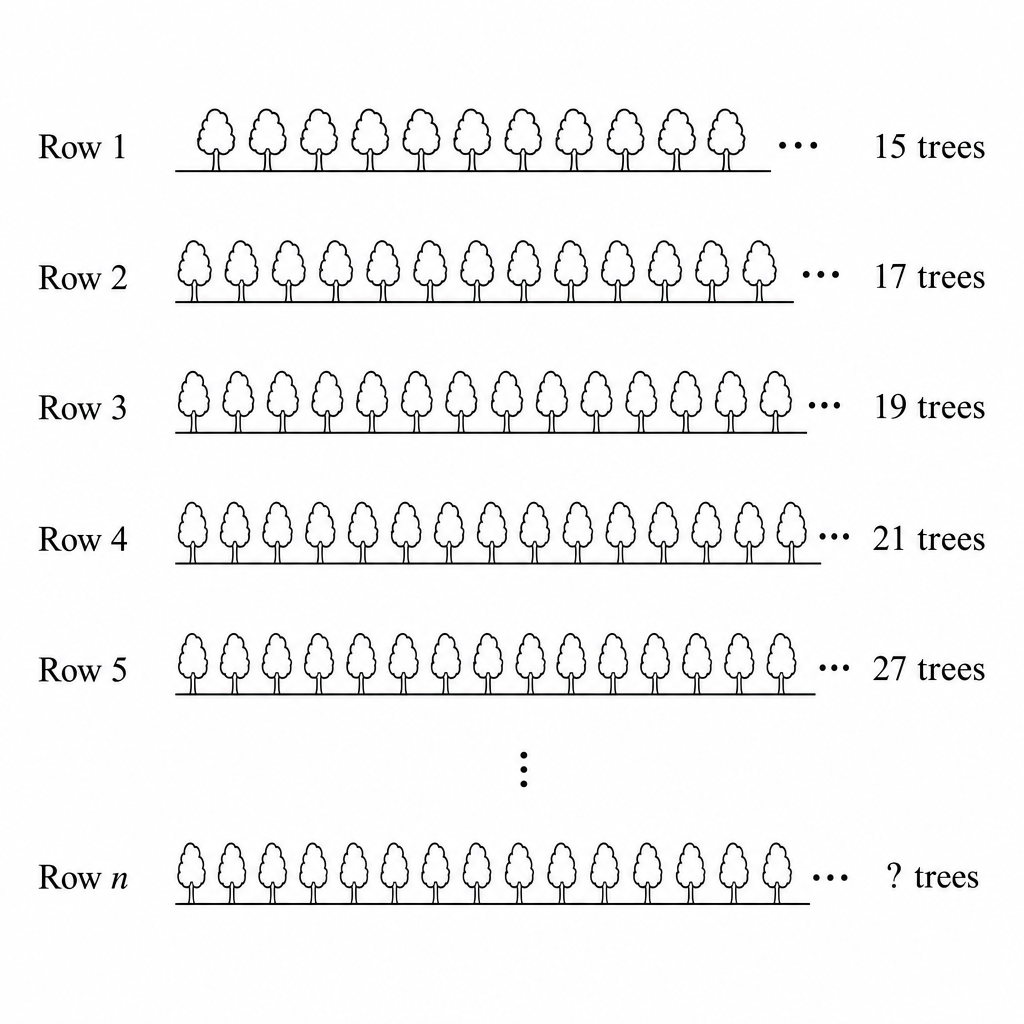
A farmer is planting trees in rows. The number of trees in each row forms an arithmetic sequence. The first row has trees. The fifth row has trees.
(a)
Show that the common difference of the sequence is . [2 marks]
(b)
Calculate the number of trees in the twelfth row. [2 marks]
(c)
The total number of trees planted in the first rows is . Calculate the value of . [2 marks]
Solutions
13MasterySAQ-SDefinition and general term of arithmetic sequencess8 marksPaper 2~12 min
A theatre has seats arranged in rows. The first row has seats. Each subsequent row has more seats than the previous row. The last row has seats.
(a)
Calculate the number of rows in theatre. [3 marks]
(b)
The theatre charges USD 12 per seat. A production company rents the entire theatre for a performance. Calculate the maximum possible revenue from ticket sales. [2 marks]
(c)
The production company sells all seats except those in the last three rows. Determine the revenue lost compared to a full house. [3 marks]
Solutions
14MasterySAQ-SDefinition and general term of arithmetic sequencess8 marksPaper 2~12 min
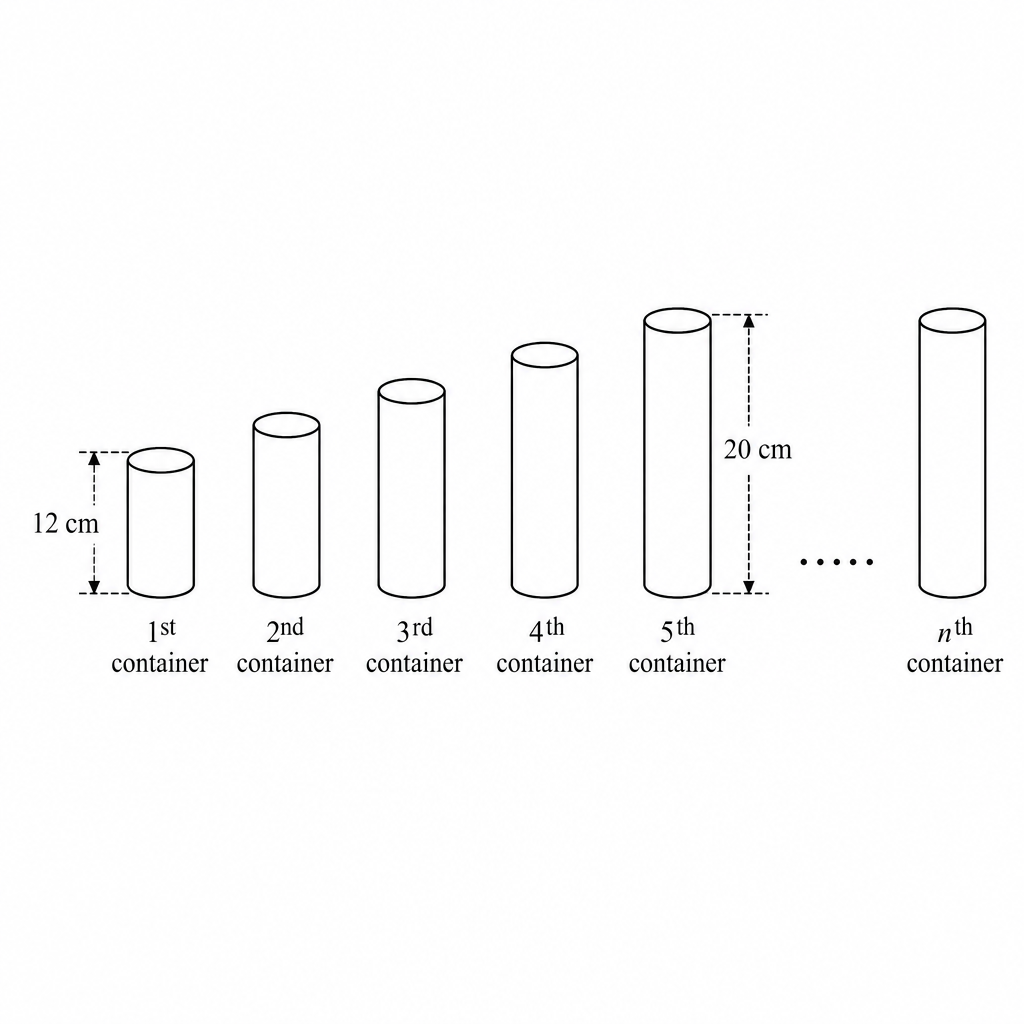
A company manufactures cylindrical containers. The heights of the containers, measured in centimetres, form an arithmetic sequence. The third container has a height of and the seventh container has a height of .
(a)
Find the common difference and the height of the first container. [3 marks]
(b)
Find the height of the twelfth container. [2 marks]
(c)
The company needs the total height of the first containers to reach at least . Find the minimum value of . [3 marks]
Solutions
15MasterySAQ-SDefinition and general term of arithmetic sequencess6 marksPaper 2~9 min
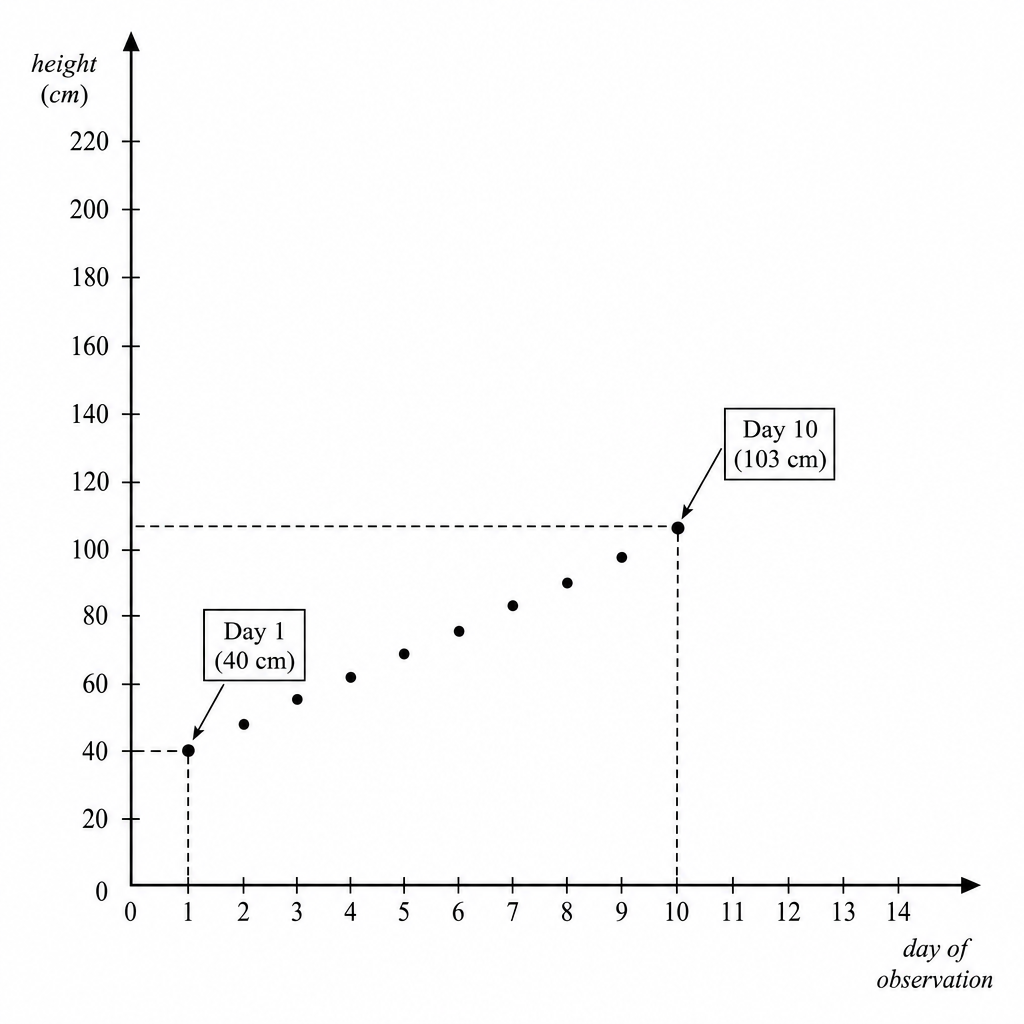
A biologist monitors the growth of a bamboo plant. On the first day of observation, the plant has a height of . The plant grows by a constant amount each day. On the th day of observation, the plant has a height of .
(a)
Calculate the daily growth rate of the bamboo plant. [2 marks]
(b)
Determine on which day the height of the plant first exceeds . [2 marks]
(c)
The biologist claims that the plant will reach a height of exactly on a particular day of observation. Determine whether this claim is correct, justifying your answer. [2 marks]
Solutions
16MasterySAQ-SDefinition and general term of arithmetic sequencess6 marksPaper 2~9 min
A student saves money over 12 weeks. She saves USD 200 in the first week and increases her savings by a fixed amount each week. After 12 weeks her total savings are USD 4200.
(a)
Write down the value of and state what represents in this context. [1 mark]
(b)
Calculate the common difference of the arithmetic sequence representing her weekly savings. [2 marks]
(c)
The student claims that by week 15 her weekly savings will exceed USD 400. Determine whether this claim is correct, justifying your answer. [3 marks]
Solutions
17MasterySAQ-SDefinition and general term of arithmetic sequencess6 marksPaper 2~9 min
The number of books on the shelves of a library forms an arithmetic sequence. The first shelf has books and the fourth shelf has books.
(a)
Find the common difference of the sequence. [2 marks]
(b)
Calculate the number of books on the twelfth shelf. [2 marks]
(c)
The total number of books on the first shelves is . Find the value of , justifying why only one value is valid. [2 marks]
Solutions
18MasterySAQ-SDefinition and general term of arithmetic sequencess8 marksPaper 2~12 min
A small business sells handmade candles. In the first week of operation, they sell 20 candles. Each subsequent week, sales increase by a constant number of candles. In the th week, they sell candles.
(a)
Determine the weekly increase in sales. [2 marks]
(b)
Calculate the week number in which weekly sales will first exceed candles. [2 marks]
(c)
The business needs total cumulative sales to exceed candles before it can break even. Determine the week in which the business first breaks even, and calculate the total sales in that week. [4 marks]
Solutions
19MasterySAQ-SDefinition and general term of arithmetic sequencess6 marksPaper 2~9 min
A cyclist trains for a race. On the first day, she cycles . Each subsequent day, she increases the distance cycled by a constant amount compared to the previous day. On the th day, she cycles .
(a)
Show that the daily increase is . [2 marks]
(b)
Calculate the total distance cycled over the first days. [2 marks]
(c)
The cyclist's target is to cycle a total of at least during her training. Determine the minimum number of days of training required to meet this target. [2 marks]
Solutions
20MasterySAQ-SDefinition and general term of arithmetic sequencess6 marksPaper 2~9 min
A new fitness app tracks a user's daily step count. On the first day of a challenge, a user records steps. Each subsequent day, the user increases their daily step count by a constant amount compared to the previous day. On the th day of the challenge, the user records steps.
(a)
Show that the common difference, , of this arithmetic sequence is steps per day. [2 marks]
(b)
Find the day number on which the user's step count first exceeds steps. [2 marks]
(c)
The challenge lasts days. The app awards a bonus if the user's total step count over the full days exceeds steps. Determine, with justification, whether the user earns the bonus. [2 marks]
Solutions
Showing 20 of 160 free questions