Complex Numbers · Paper 2 — Free Maths AA HL Practice Questions
Free questions
Open in full, with answers, mark scheme and examiner insights.
Complex numbers in Cartesian form; the Argand diagram
The points , and on the Argand diagram represent the complex numbers , and .
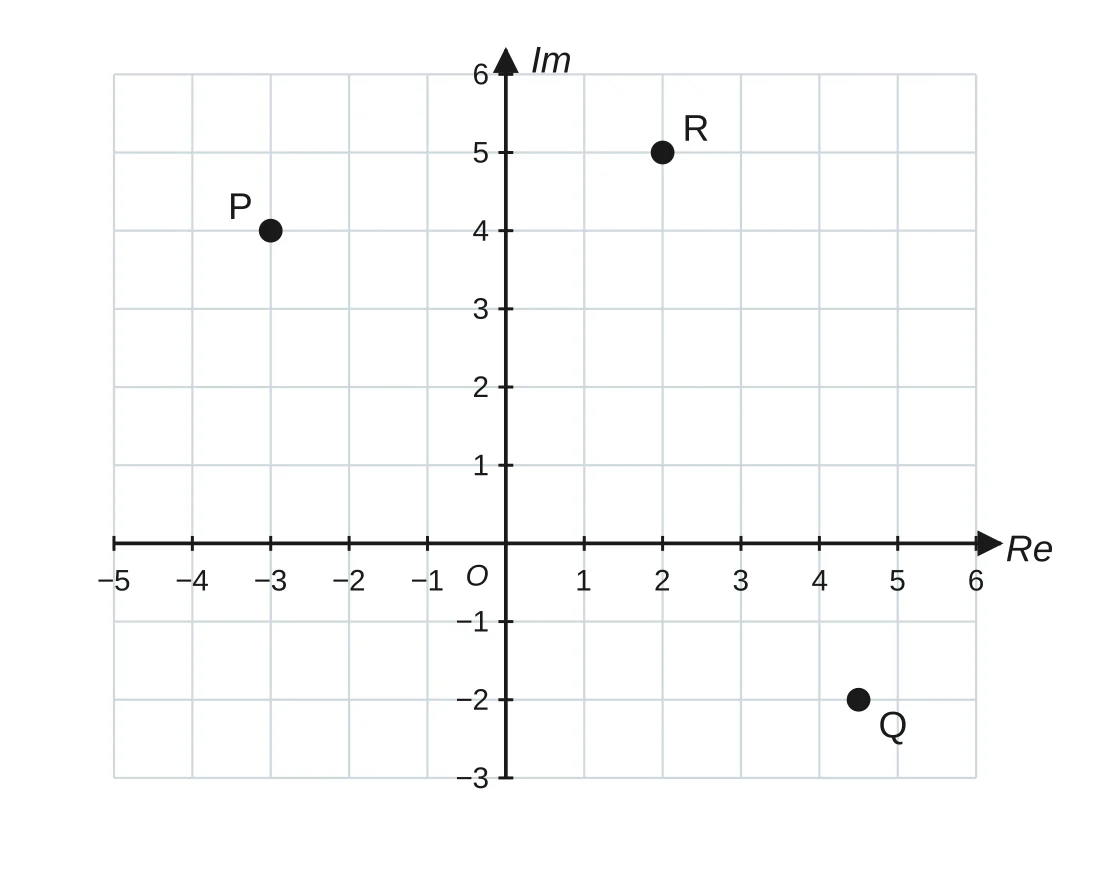
Write down , and in the form .
Find , and .
Determine which point is furthest from the origin.
revisionprep.com
Summary Answer
Not available for this question.
Model Answer
Not available for this question.
Marking Scheme
Not available for this question.
Examiner Insights
Not available for this question.
De Moivre's theorem; powers and roots of complex numbers
The diagram shows the circle .
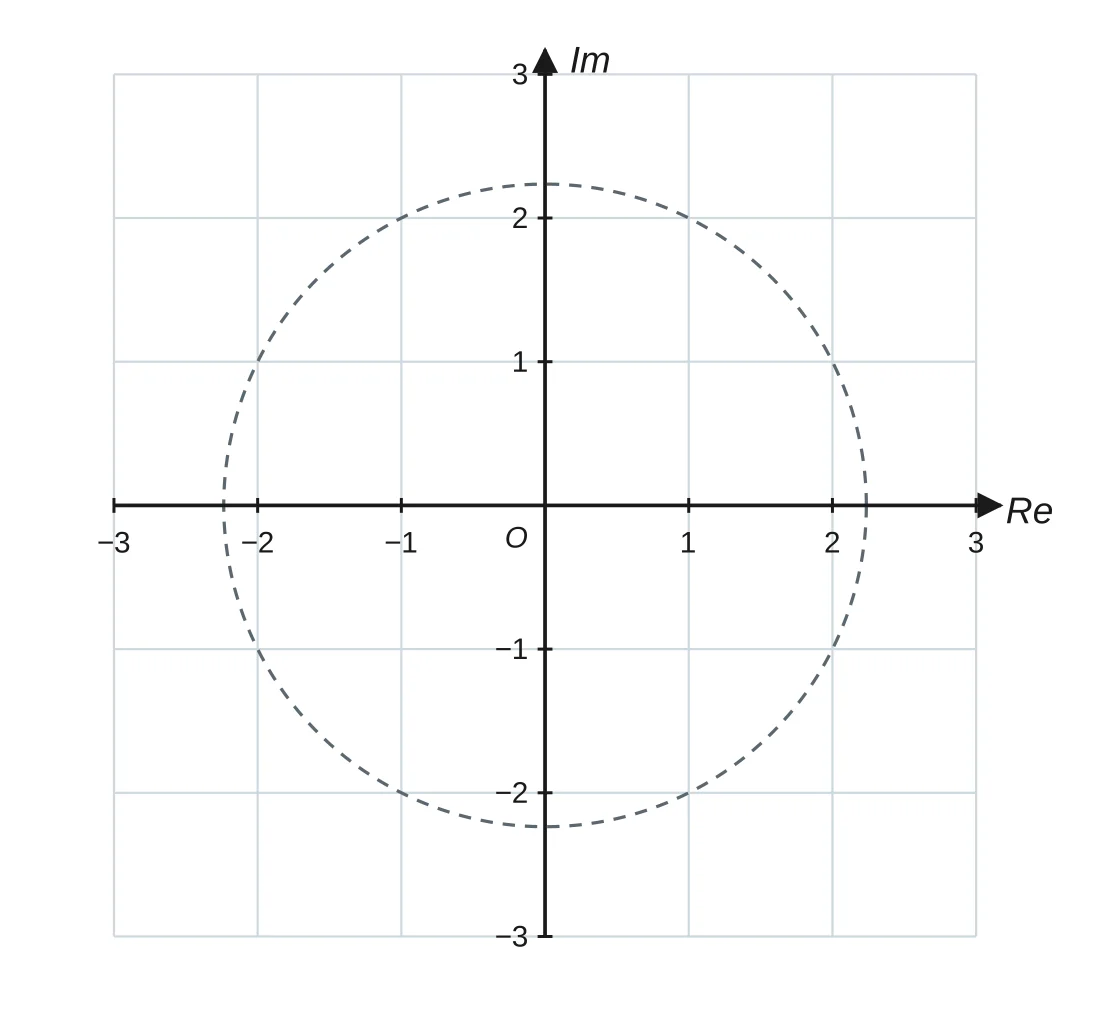
Write in the form , giving correct to four significant figures.
Hence find the four solutions of , giving your answers in the form correct to three significant figures.
revisionprep.com
Summary Answer
Not available for this question.
Model Answer
Not available for this question.
Marking Scheme
Not available for this question.
Examiner Insights
Not available for this question.
Complex numbers in Cartesian form; the Argand diagram
In an alternating-current circuit, impedances are complex numbers. The diagram shows impedances and (in ohms) connected in parallel.
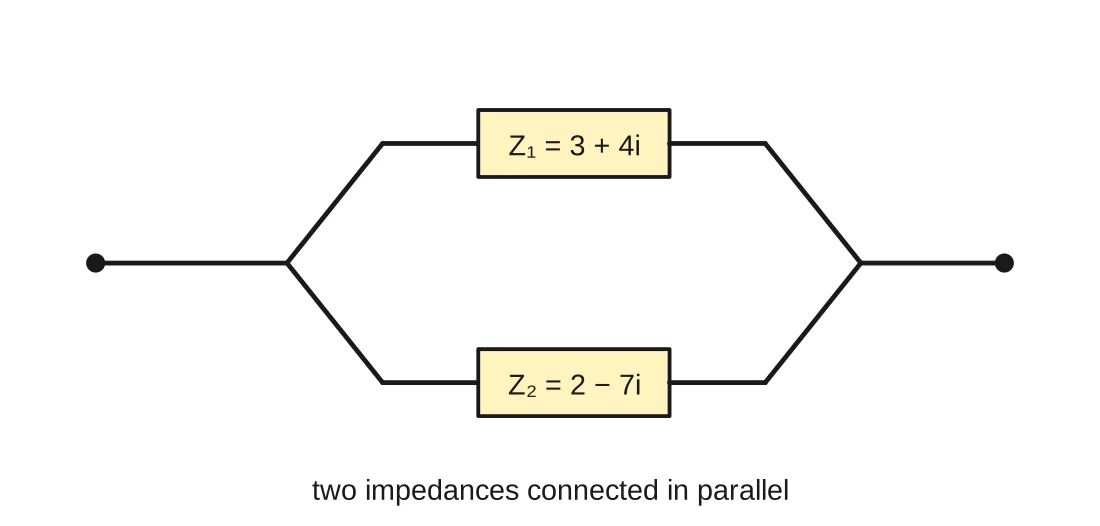
Find the total impedance if instead they were connected in series.
The total impedance in parallel is . Find in the form .
Find .
revisionprep.com
Summary Answer
Not available for this question.
Model Answer
Not available for this question.
Marking Scheme
Not available for this question.
Examiner Insights
Not available for this question.
Modulus-argument (polar) and Euler forms
Let and , shown on the Argand diagram.
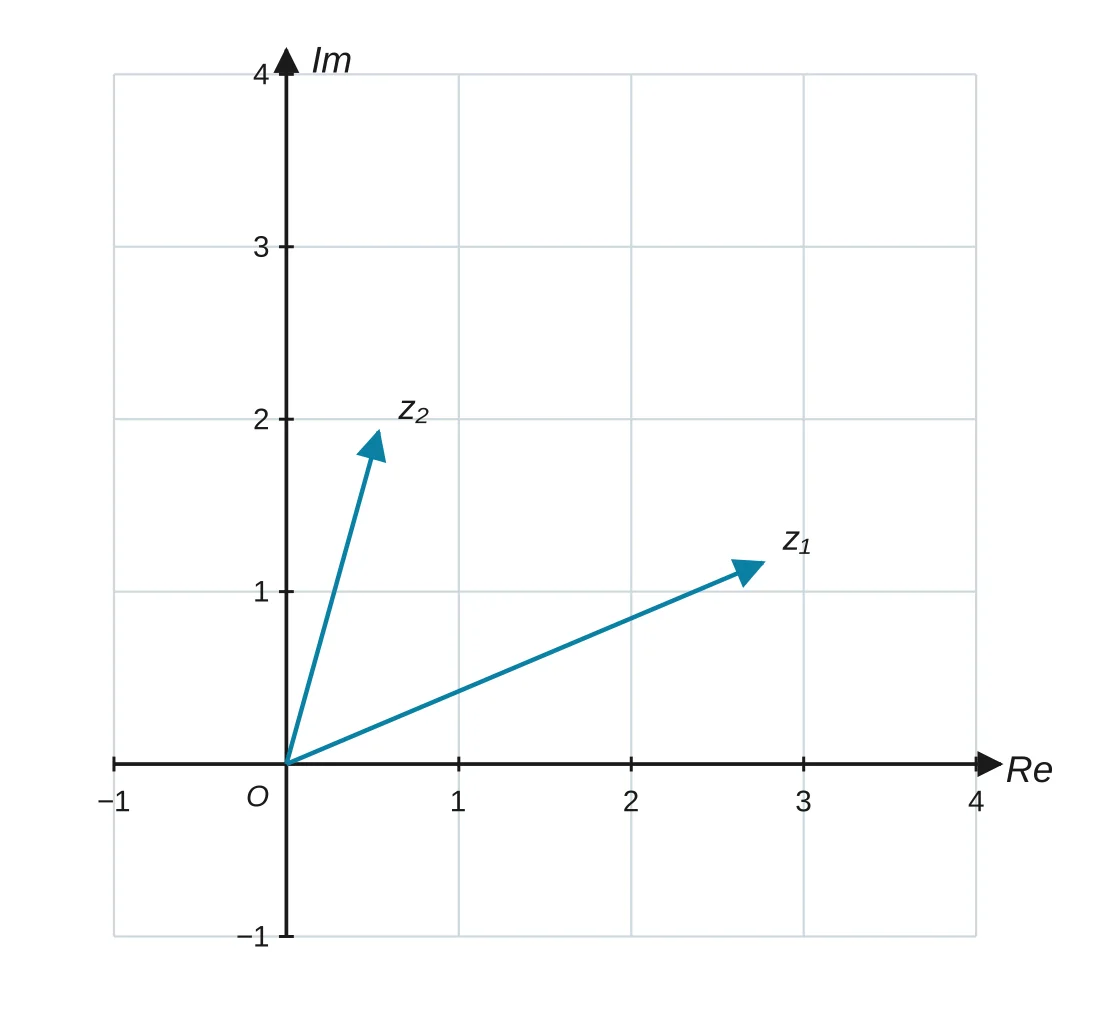
Find and in the form .
Find in the form .
revisionprep.com
Summary Answer
Not available for this question.
Model Answer
Not available for this question.
Marking Scheme
Not available for this question.
Examiner Insights
Not available for this question.
Modulus-argument (polar) and Euler forms
A robot starts at the origin and moves in a sequence of straight steps. The first step has length m due east. Each later step is times as long as the one before and is turned anticlockwise from it. The diagram shows its path.
Let , so that the th step is .
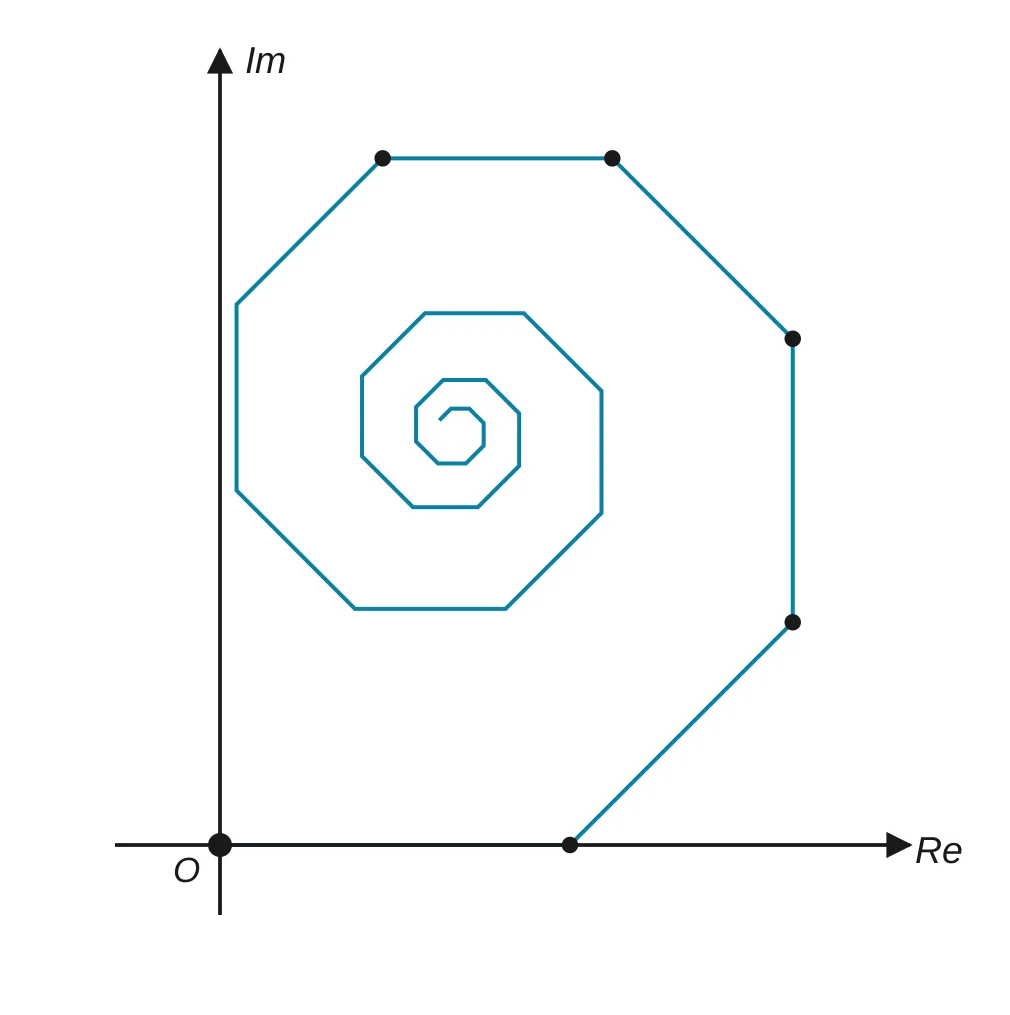
Explain why the position after steps is .
Find the position after steps, in the form .
Find the limiting position , in the form .
Find the distance from to the limiting position.
Explain why the limiting position exists.
Find the total distance travelled by the robot.
revisionprep.com
Summary Answer
Not available for this question.
Model Answer
Not available for this question.
Marking Scheme
Not available for this question.
Examiner Insights
Not available for this question.
Complex conjugate roots of polynomial equations
Show that is a root of .
Write down the other three roots.
Hence factorize into two quadratic factors with real coefficients.
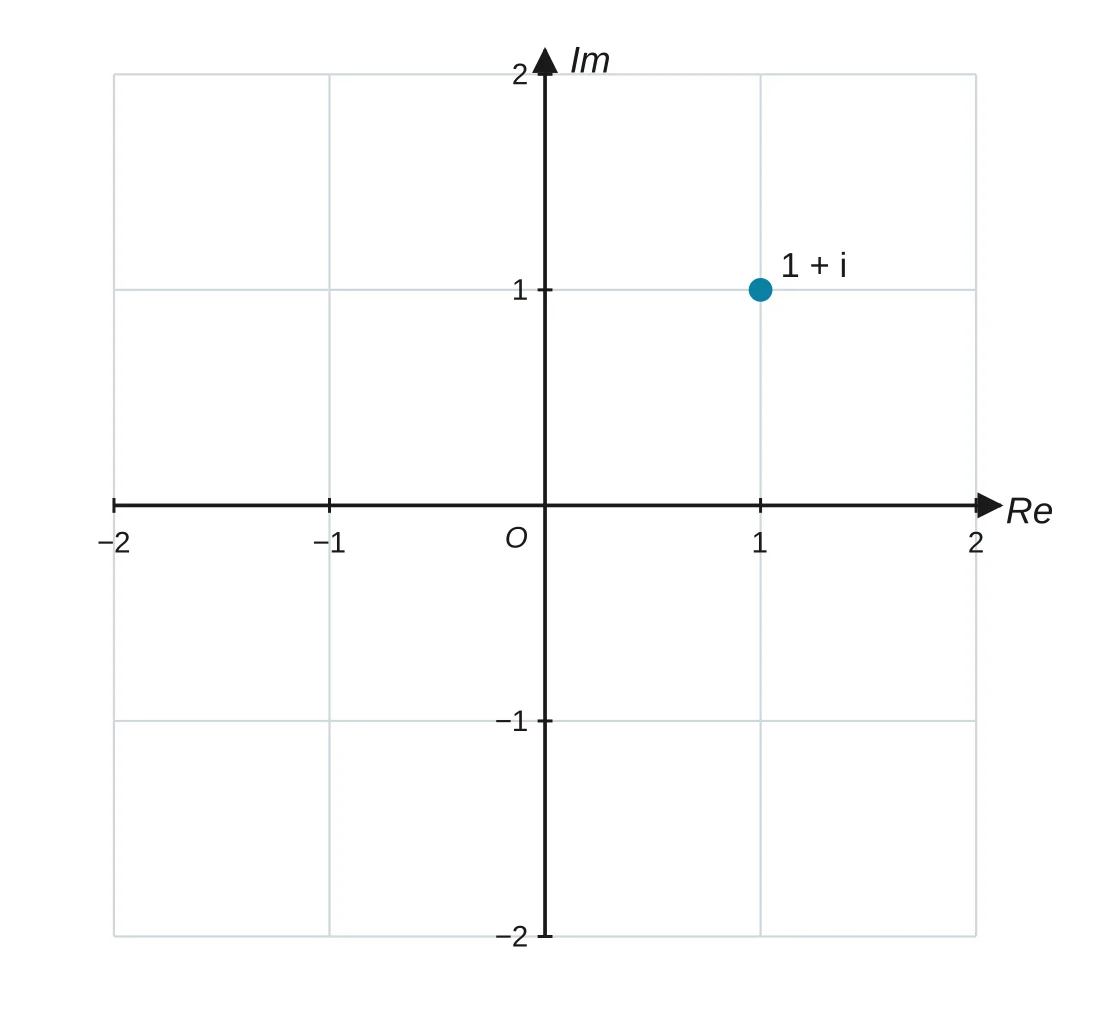
The diagram shows the root . Plot all four roots, describe the shape they form and find its area.
revisionprep.com
Summary Answer
Not available for this question.
Model Answer
Not available for this question.
Marking Scheme
Not available for this question.
Examiner Insights
Not available for this question.
That's every free question here — 6 of 88.
+82 more questions, plus Mock Papers & Worksheets, are waiting in Premium.