Partial Fractions and Systems of Equations · Paper 2 — Free Maths AA HL Practice Questions
Free questions
Open in full, with answers, mark scheme and examiner insights.
Partial fractions
The diagram shows part of the graph of . The shaded region is bounded by the curve, the -axis and the lines and .
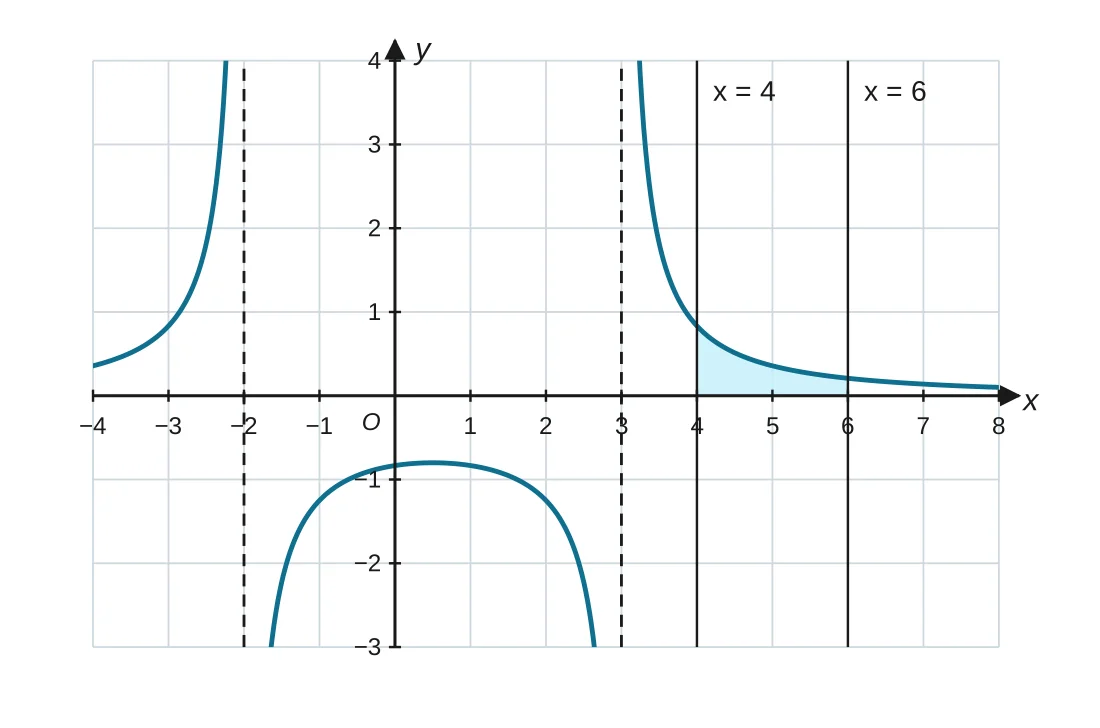
Express in partial fractions.
Find the area of the shaded region.
revisionprep.com
Summary Answer
Not available for this question.
Model Answer
Not available for this question.
Marking Scheme
Not available for this question.
Examiner Insights
Not available for this question.
Systems of linear equations up to three unknowns
A school calculates a final mark as , where , and are fixed weights. The table shows the marks of three students.
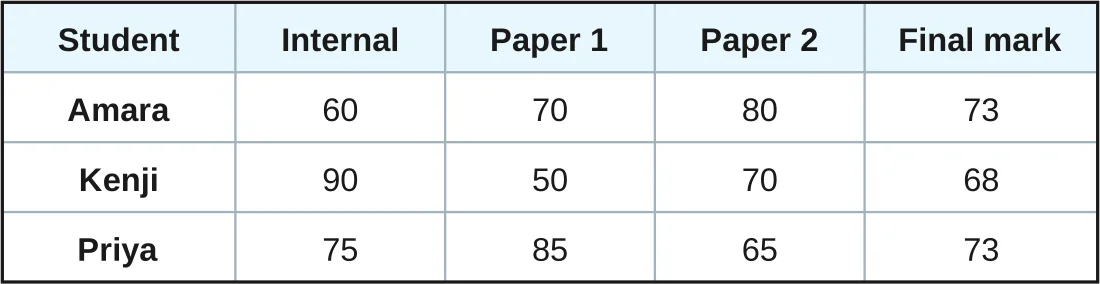
Write down a system of three equations in , and .
Use your GDC to find the weights.
revisionprep.com
Summary Answer
Not available for this question.
Model Answer
Not available for this question.
Marking Scheme
Not available for this question.
Examiner Insights
Not available for this question.
Partial fractions
The diagram shows the graph of , where .
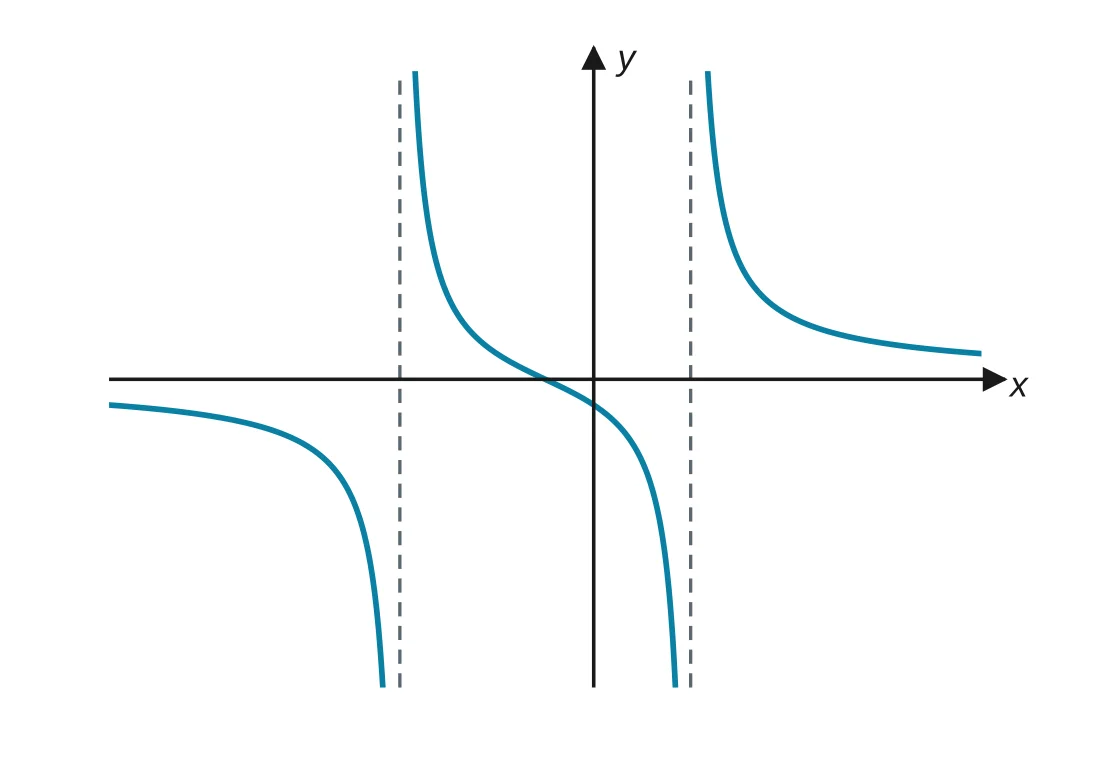
Express in partial fractions.
Hence find .
Explain why the graph of has no stationary points.
revisionprep.com
Summary Answer
Not available for this question.
Model Answer
Not available for this question.
Marking Scheme
Not available for this question.
Examiner Insights
Not available for this question.
Partial fractions
The diagram shows the region bounded by the curve , the -axis, the -axis and the line , where .
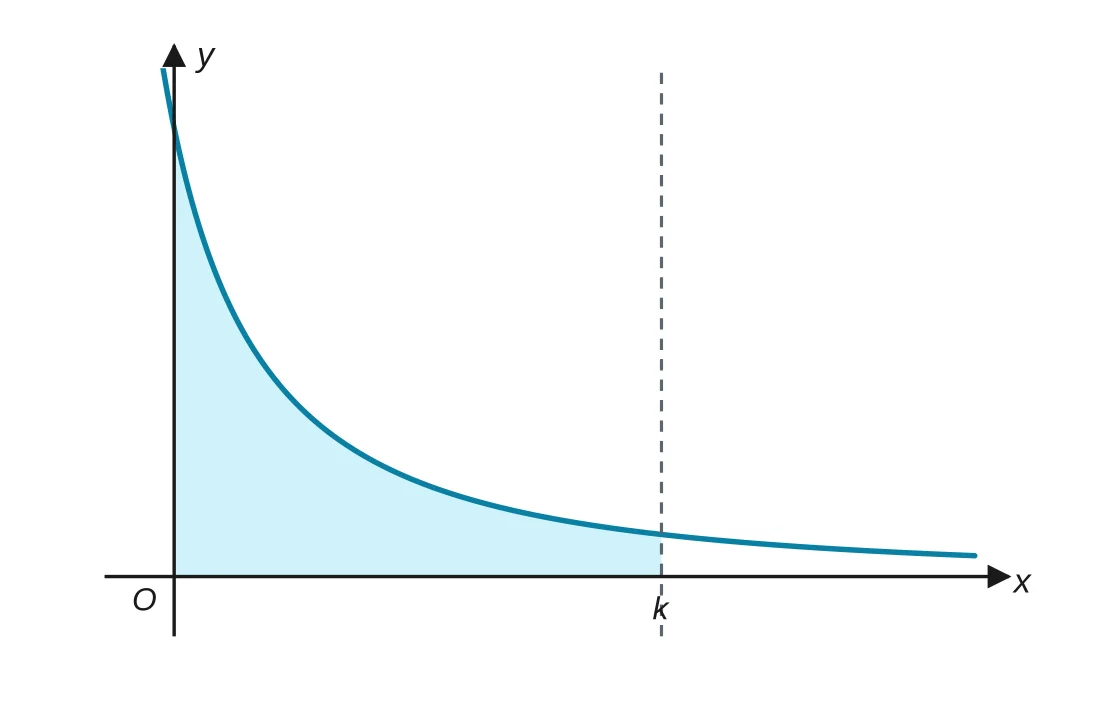
Express in partial fractions.
Show that the area of the region is .
Find the value of for which the area is .
Show that the area can never exceed , however large is.
revisionprep.com
Summary Answer
Not available for this question.
Model Answer
Not available for this question.
Marking Scheme
Not available for this question.
Examiner Insights
Not available for this question.
Systems of linear equations up to three unknowns
A dietitian combines three foods, A, B and C. The table shows the protein, carbohydrate and fat in g of each food. A meal must contain exactly g of protein, g of carbohydrate and g of fat.
Let , and be the numbers of g portions of A, B and C.
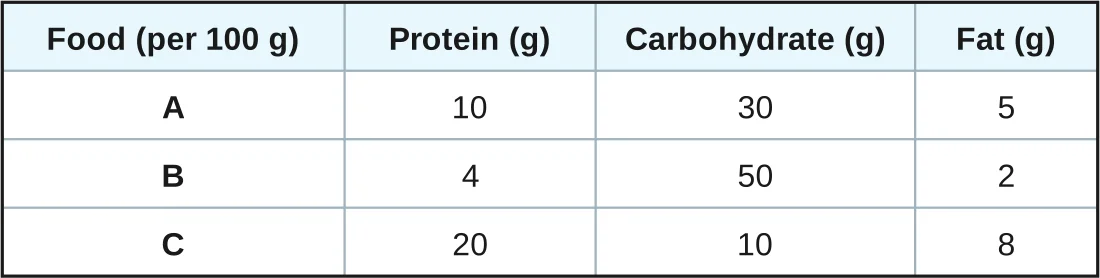
Write down a system of equations for , and .
Find the mass of each food in the meal.
revisionprep.com
Summary Answer
Not available for this question.
Model Answer
Not available for this question.
Marking Scheme
Not available for this question.
Examiner Insights
Not available for this question.
Systems of linear equations up to three unknowns
Consider the system
where .
Show that eliminating gives and .
Find the values of for which the system does not have a unique solution.
Show that for these values of the system has no solution.
revisionprep.com
Summary Answer
Not available for this question.
Model Answer
Not available for this question.
Marking Scheme
Not available for this question.
Examiner Insights
Not available for this question.
That's every free question here — 6 of 47.
+41 more questions, plus Mock Papers & Worksheets, are waiting in Premium.