You're viewing free preview questions. Upgrade to access more Maths AA HL questions.Upgrade
Arithmetic and Geometric Sequences · Paper 3 — Free Maths AA HL Practice Questions
1ChallengeLAQSum of an arithmetic sequences10 marksPaper 3~15 min

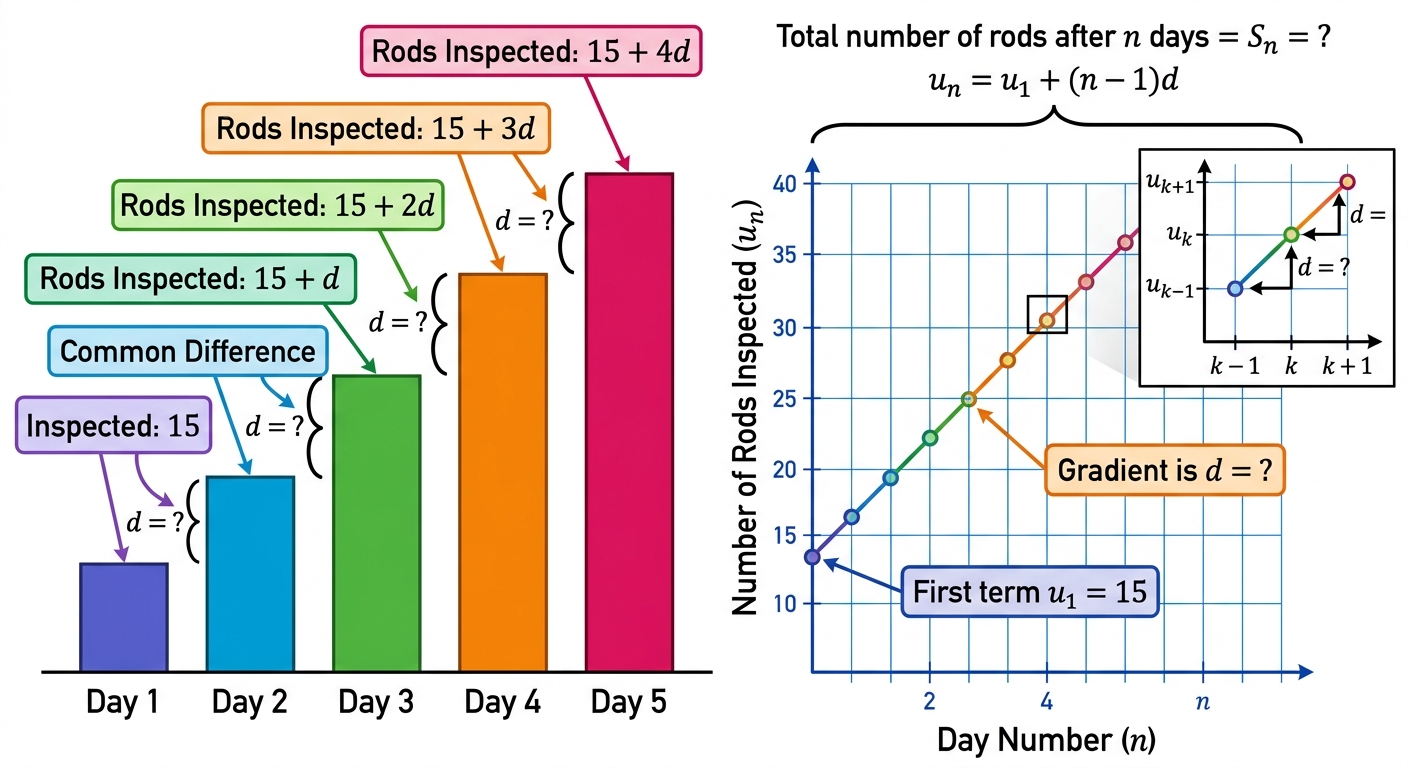
A manufacturing company produces cylindrical metal rods. The rods are produced in batches, and the quality control department inspects them for defects. The number of rods inspected each day forms an arithmetic sequence. On the first day, rods are inspected. On each subsequent day, the number inspected increases by a constant amount , where .
(a)
Starting from the definition of an arithmetic sequence , use the identity and the standard result to prove that
[5 marks]
(b)
After days, the total number of rods inspected is . Calculate the value of . [2 marks]
(c)
The factory's inspection line has a maximum daily capacity of rods. Determine the day on which the number of rods inspected first reaches or exceeds , and hence calculate the total number of rods inspected up to and including that day. [3 marks]

Solutions
2ChallengeLAQSum of an arithmetic sequences8 marksPaper 3~12 min
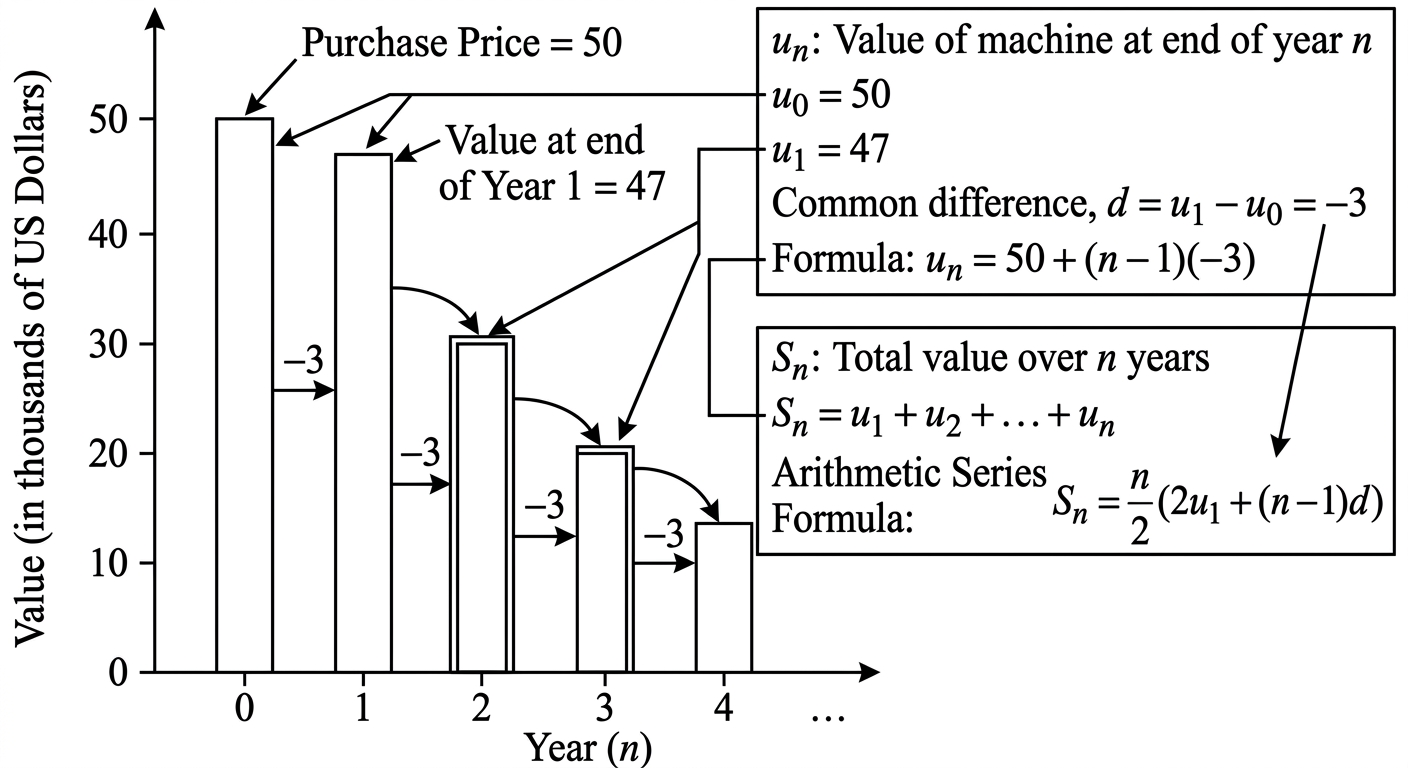
A financial analyst models the depreciation of a specialised machine. The machine is purchased for USD 50000. At the end of the first year its value is USD 47000, and the value decreases by the same fixed amount each year, forming an arithmetic sequence.
(a)
Show that the total value of the machine (the sum of its values at the end of each year) over the first years is given by
[4 marks]
(b)
Calculate , the total value accumulated over the first 10 years. [2 marks]
(c)
The analyst claims the model is only physically valid while the machine retains a non-negative value.
(i) Determine the maximum number of complete years for which the model is valid. [2]
(ii) Hence find the value of that maximises within the valid domain, and state this maximum total value. [2 marks]
(ii) Hence find the value of that maximises within the valid domain, and state this maximum total value. [2 marks]
Solutions
3ChallengeLAQDefinition and general term of arithmetic sequencess8 marksPaper 3~12 min
A sequence is defined by , where , and the recurrence relation for , where is a non-zero real constant.
(a)
Prove by mathematical induction that for all . [3 marks]
(b)
Let . Prove that . [3 marks]
(c)
Consider the sequence defined by for .
- (i) Prove that is an arithmetic sequence, stating its first term and common difference. [2 marks]
-
(ii) Given that and , find the value of such that . [2 marks]
(ii) Given that and , find the value of such that . [2 marks]
Solutions
4ChallengeLAQDefinition and general term of arithmetic sequencess9 marksPaper 3~14 min
A sequence is defined by , where , and , where is a non-zero real constant.
(a)
Prove by mathematical induction that for all . [3 marks]
(b)
Let . Prove that . [2 marks]
(c)
A new sequence is defined by for .
(i) Show that is an arithmetic sequence, stating its first term and common difference. [3 marks]
(ii) Hence find in terms of , , and , and verify your answer is consistent with the result in (b). [4 marks]
(ii) Hence find in terms of , , and , and verify your answer is consistent with the result in (b). [4 marks]
Solutions
5ChallengeLAQDefinition and general term of arithmetic sequencess9 marksPaper 3~14 min
A sequence is defined by , where is a positive integer, and for ,
where is a non-zero constant.
(a)
Prove that is arithmetic, stating its common difference. [2 marks]
(b)
Derive the general term in terms of , , and .
Consider a second sequence defined by . [2 marks]
(c)
Show that
[3 marks]
(d)
Hence prove that is not arithmetic for any non-zero value of . [1]
(e) The sequence of differences is itself arithmetic for particular values of and .
(i) State the common difference of in terms of . [1]
(ii) For the case and , find the least value of such that . [2 marks]
(ii) For the case and , find the least value of such that . [2 marks]
Solutions
6ChallengeLAQDefinition and general term of arithmetic sequencess8 marksPaper 3~12 min
A new type of sequence, called a harmonic-arithmetic sequence, is defined as follows.
For given non-zero real numbers and , the sequence is defined by , and for ,
(a)
Prove that the sequence defined by is arithmetic. State its first term and common difference in terms of and . [2 marks]
(b)
Hence show that the general term of the original sequence is
and state any condition required for to be defined. [3 marks]
(c)
Consider the specific case , .
(i) Calculate , justifying your answer. [2]
(ii) A student claims: "For any non-zero , the limit of as is always , provided ." Analyse this claim. Your answer should consider the effect of the sign of and whether any terms of the sequence may be undefined. [3 marks]
(ii) A student claims: "For any non-zero , the limit of as is always , provided ." Analyse this claim. Your answer should consider the effect of the sign of and whether any terms of the sequence may be undefined. [3 marks]
Solutions
7ChallengeLAQSum of a geometric sequences7 marksPaper 3~11 min
A financial analyst models the growth of an investment fund. The fund's value at the start of each month forms a geometric sequence. At the beginning of month 1 the fund is worth USD 1000. At the beginning of month 2 it is worth USD 1100, and at the beginning of month 3 it is worth USD 1210.
Let represent the value of the fund (in dollars) at the beginning of month , for .
(a)
Show that forms a geometric sequence, and state the values of and . [2 marks]
(b)
Show that the total value accumulated over the first months, , satisfies
[3 marks]
(c)
The analyst claims that the fund's total accumulated value first exceeds USD 21000 during month 12.
(i) Determine the smallest integer such that . [3]
(ii) Hence evaluate whether the analyst's claim is correct. Justify your answer. [2 marks]
(ii) Hence evaluate whether the analyst's claim is correct. Justify your answer. [2 marks]
Solutions
8ChallengeLAQSum of an arithmetic sequences7 marksPaper 3~11 min
Data
$
(ii) Hence find in terms of and , justifying your answer fully.
(iii) Using the result of part (b)(i), determine the value of for which is maximum, giving your answer in terms of . Hence state the maximum value of in terms of and .
Data summary: , , .
An arithmetic sequence has first term and common difference , where and .
denotes the sum of the first terms.
(a)
By writing in two different orders and adding, show that
$$S_n = \frac{n}{2}\bigl(2a + (n-1)d\bigr). \quad [3 marks]
(b)
It is given that for some positive integer .
(i) Show that $2a + d(2k + 4) = 0$. $\quad [4 marks]
Solutions
9ChallengeLAQSum of a geometric sequences10 marksPaper 3~15 min
A geometric sequence has general term for , where is the first term and is the common ratio, .
The sum of the first terms is .
(a)
For the geometric sequence with and , show that . [3 marks]
(b)
For a geometric sequence with first term and common ratio , prove that
[4 marks]
(c)
Consider the sum .
(i) State the values of , , and the number of terms in , identifying as a geometric series. [1]
(ii) Hence show that . [2]
(iii) Determine the least integer value of such that . [3 marks]
(ii) Hence show that . [2]
(iii) Determine the least integer value of such that . [3 marks]
Solutions
10ChallengeLAQSum of a geometric sequences8 marksPaper 3~12 min
A geometric sequence has first term and common ratio .
(a)
Prove that the sum of the first terms is . [3 marks]
(b)
Find the smallest value of such that . [3 marks]
(c)
A different geometric sequence has first term and common ratio , where .
(i) Show that the sum of the first terms is . [2 marks]
(ii) Hence determine all pairs with , , for which the sum formula simplifies to . Justify your answer. [2 marks]
(ii) Hence determine all pairs with , , for which the sum formula simplifies to . Justify your answer. [2 marks]
Solutions
11ChallengeLAQSum of a geometric sequences10 marksPaper 3~15 min
A geometric sequence is defined by and for , where is a non-zero constant.
The sum of the first terms is .
(a)
Prove that for . [4 marks]
(b)
A geometric sequence has first term and common ratio . Calculate , giving your answer as an exact fraction. [2 marks]
(c)
The infinite sum of this sequence is for .
Show that the tail sum , and hence find the least integer such that . [4 marks]
Solutions
12ChallengeLAQSum of an arithmetic sequences10 marksPaper 3~15 min
A company is developing a new type of solar panel. The energy output of the first panel tested is . Each subsequent panel tested produces an energy output that is a constant amount less than the previous panel, due to manufacturing tolerances. The energy outputs of the panels form an arithmetic sequence.
The total energy output of the first panels tested is .
(a)
Prove that the common difference, , of the arithmetic sequence is . [3 marks]
(b)
The company decides that any panel with an energy output of less than is considered defective and will not be sold. Determine the number of non-defective panels among the first panels tested. Justify your answer. [3 marks]
(c)
The company claims that the total energy output of all non-defective panels among the first panels exceeds . Determine whether this claim is correct, showing all working. [4 marks]
Solutions
13ChallengeLAQGeometric sequences and their general terms10 marksPaper 3~15 min
A geometric sequence has first term and common ratio , where and $0 < q < 1$. The sum to infinity exists and equals .
(a)
Prove that . [3 marks]
(b)
Show that the sum of the first terms satisfies
[3 marks]
(c)
Find the least integer such that , giving your answer as an exact value obtained from an inequality involving logarithms. [4 marks]
Solutions
14ChallengeLAQGeometric sequences and their general terms10 marksPaper 3~15 min
A geometric sequence has first term and common ratio . The sum of the first terms is .
(a)
Show that by multiplying by , subtracting, and factorising. [3 marks]
(b)
The sequence satisfies the condition that the sum of the first terms equals the sum of the terms from position to position , for some positive integer . Show that this condition leads to
[4 marks]
(c)
By treating the equation in (b) as a quadratic in , find all solutions for and hence determine the value(s) of that satisfy the original condition. Explain, with justification, why no value can satisfy the condition, and determine the range of values of for which a real solution could exist. [3 marks]
Solutions