You're viewing 1 free preview question for Maths AA HL — subscribe to unlock 9 more, plus the Full Question Bank, Mock Papers & Worksheets.Upgrade
Exponential and Logarithmic Functions · Paper 3 — Free Maths AA HL Practice Questions
1ChallengeLAQExponent laws and propertiess9 marksPaper 3~14 min

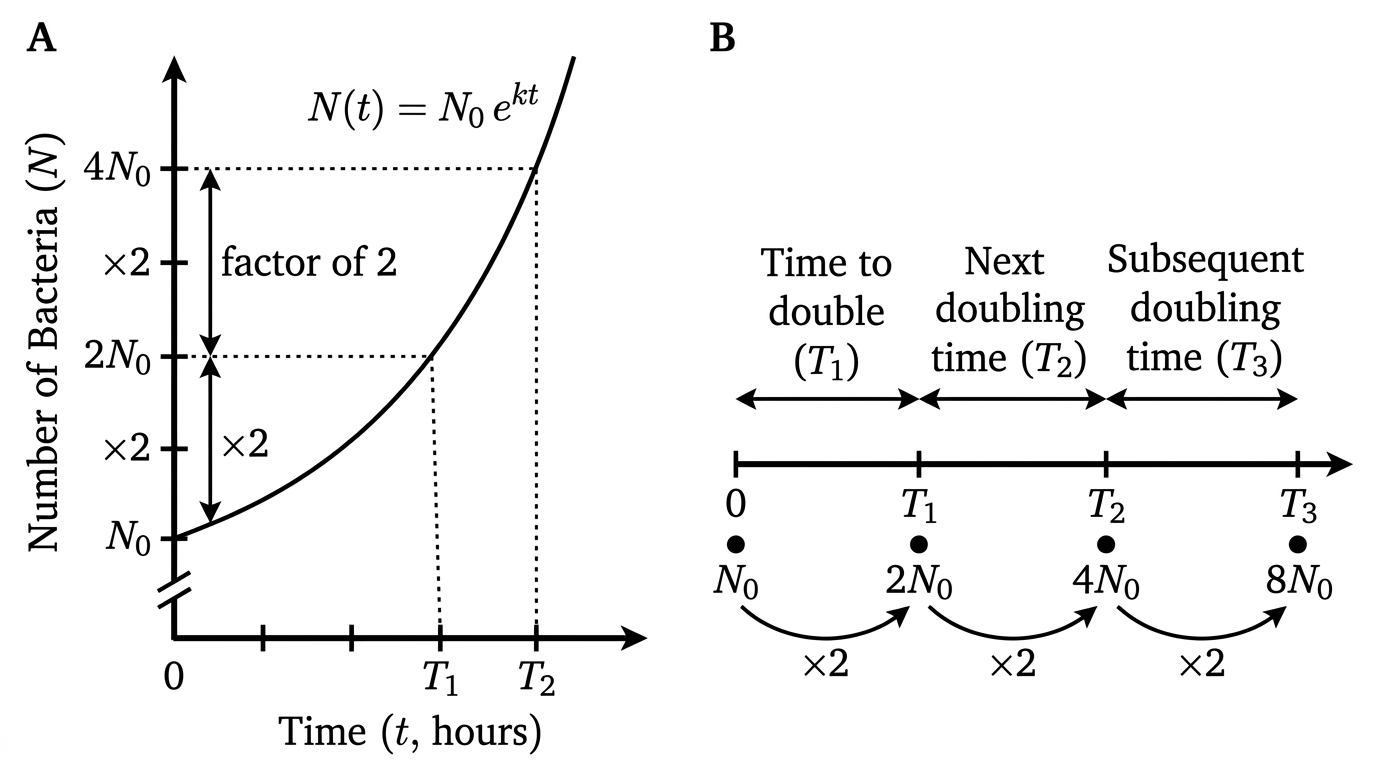
The number of bacteria in a laboratory culture is modelled by , where is the initial population, is time in hours, and .
(a)
Prove that the time for the population to increase by a factor of (where is a positive integer) satisfies
[4 marks]
(b)
A culture has .
(i) Using the result from part (a), find the least positive integer such that hours. [2 marks]
(ii) Show that for any positive integer , and state what this result means in the context of the model. [2 marks]
(ii) Show that for any positive integer , and state what this result means in the context of the model. [2 marks]
(c)
A researcher proposes the modified model , where and are real constants.
(i) Find in terms of , , , and . [2 marks]
(ii) Hence determine the conditions on and for which is strictly increasing for all . Justify your answer. [Total: 13 marks — recalibrated to match independently markable steps] > Recalibrated to 13 marks to match step count; if constrained to 10 marks, remove (b)(ii) and reduce (c)(ii) to 2 marks. [3 marks]
(ii) Hence determine the conditions on and for which is strictly increasing for all . Justify your answer. [Total: 13 marks — recalibrated to match independently markable steps] > Recalibrated to 13 marks to match step count; if constrained to 10 marks, remove (b)(ii) and reduce (c)(ii) to 2 marks. [3 marks]

Solutions
That's every free question here — 1 of 10.
+9 more questions, plus Mock Papers & Worksheets, are waiting in Premium.