Probability · Paper 2 — Free Maths AA HL Practice Questions
Free questions
Open in full, with answers, mark scheme and examiner insights.
Concepts of probability; expected outcomes
A footballer takes penalties. She aims left with probability , right with probability and centre with probability . The goalkeeper saves a penalty aimed left with probability , aimed right with probability and aimed centre with probability . The tree diagram shows this information.
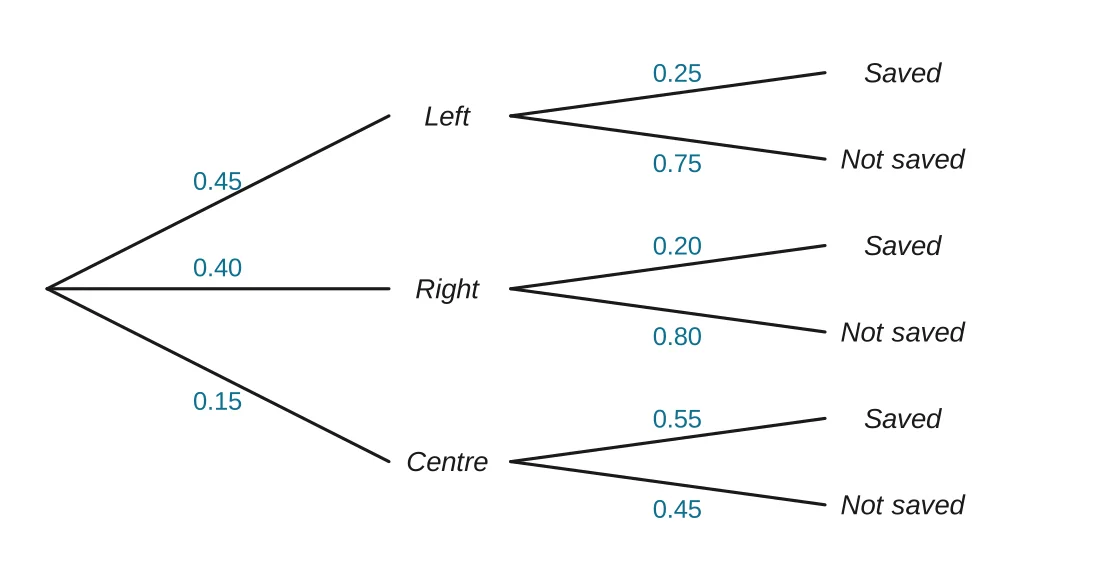
Find the probability that a penalty is saved.
A penalty is saved. Find the probability that it was aimed at the centre.
A penalty is not saved. Find the probability that it was aimed left.
revisionprep.com
Summary Answer
Not available for this question.
Model Answer
Not available for this question.
Marking Scheme
Not available for this question.
Examiner Insights
Not available for this question.
Concepts of probability; expected outcomes
An inspector at a tea-packing plant weighs a random sample of packets from one machine. The results are shown in the table.

Estimate the probability that a packet from this machine is underweight.
Estimate the probability that a packet from this machine is not the correct weight.
The machine fills packets in one shift. Find the expected number of underweight packets in one shift.
Underweight packets are rejected. Each packet costs €0.90 to produce. Find the expected cost of the rejected underweight packets in one shift.
State one reason why the estimate in part (a) might not be reliable for a different machine.
revisionprep.com
Summary Answer
Not available for this question.
Model Answer
Not available for this question.
Marking Scheme
Not available for this question.
Examiner Insights
Not available for this question.
Concepts of probability; expected outcomes
A four-sided spinner has sectors labelled , , and . It is spun times, with the results shown in the table.

Write down an estimate of the probability that a spin gives a score of .
The maker claims that the probability of a score of is . Find the expected frequency of each score in spins if the claim is true.
Comment on whether the results support the maker's claim.
Using the relative frequencies from the experiment, estimate the probability that two spins give a total score of or more.
revisionprep.com
Summary Answer
Not available for this question.
Model Answer
Not available for this question.
Marking Scheme
Not available for this question.
Examiner Insights
Not available for this question.
Venn and tree diagrams; combined and mutually exclusive events
At an international school, students in Grade 11 were asked which of French (), Spanish () and Mandarin () they study. The Venn diagram shows the number of students in each region.
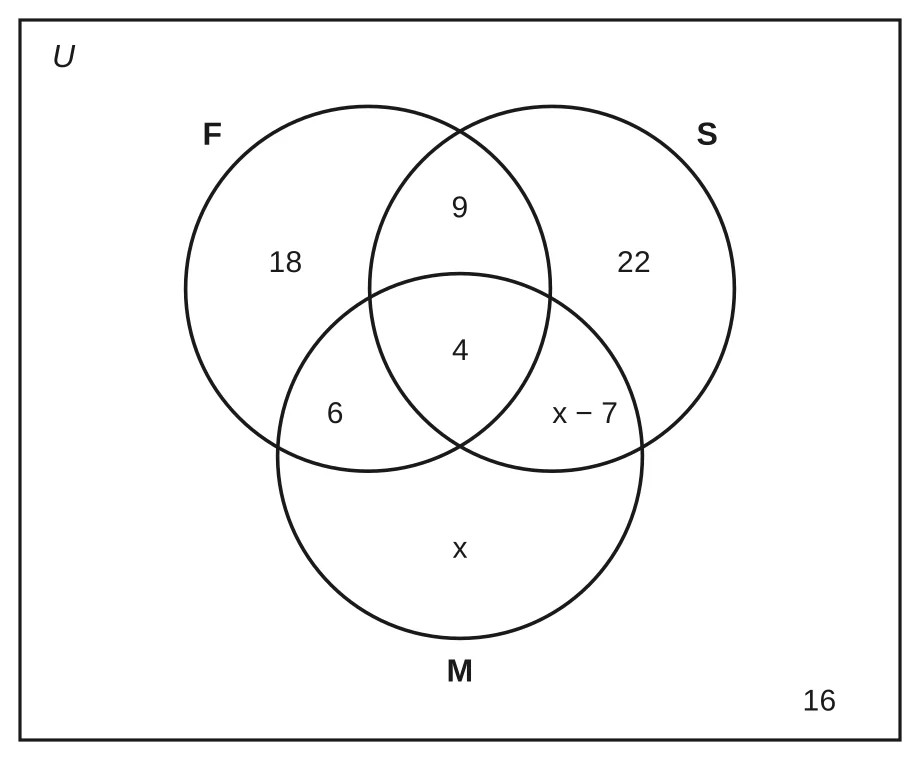
Find the value of .
A student is chosen at random. Find the probability that the student studies exactly two of the three languages.
Write down the probability that the student studies none of the three languages.
Find .
Verify that for these data.
A student who studies Spanish is chosen at random. Find the probability that this student also studies Mandarin.
Three students are chosen at random from the , with replacement. Find the probability that none of the three studies Mandarin.
revisionprep.com
Summary Answer
Not available for this question.
Model Answer
Not available for this question.
Marking Scheme
Not available for this question.
Examiner Insights
Not available for this question.
Venn and tree diagrams; combined and mutually exclusive events
The diagram shows an archery target. An arrow that hits the inner circle scores points, the middle ring scores points and the outer ring scores points. An arrow that misses the target scores points.
For each arrow that Mira shoots, the probabilities of scoring , , and points are , , and respectively, independently of her other arrows. Mira shoots two arrows.
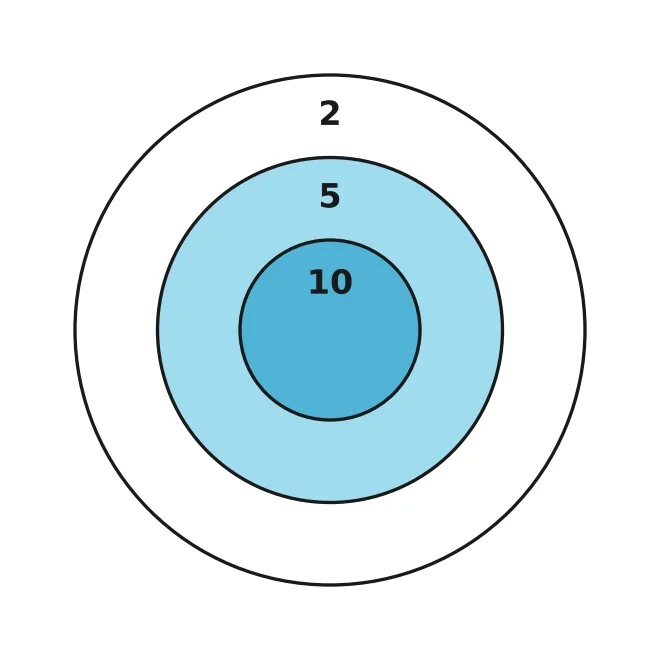
Find the probability that both arrows score points.
Show that the probability that the total score of the two arrows is points is .
Find the probability that the total score is at least points.
Let be the event that the first arrow scores points and let be the event that the total score is points. Find .
State, with a reason, whether and are mutually exclusive.
In a competition, Mira shoots two arrows in each of rounds. Find the expected number of rounds in which her total score is at least points.
revisionprep.com
Summary Answer
Not available for this question.
Model Answer
Not available for this question.
Marking Scheme
Not available for this question.
Examiner Insights
Not available for this question.
Conditional probability and independence
A factory makes components on two machines. The tree diagram shows that Machine makes of the components and Machine makes ; of Machine 's components and of Machine 's components are defective. Let be the event that a component is defective. Two components are chosen at random, independently.
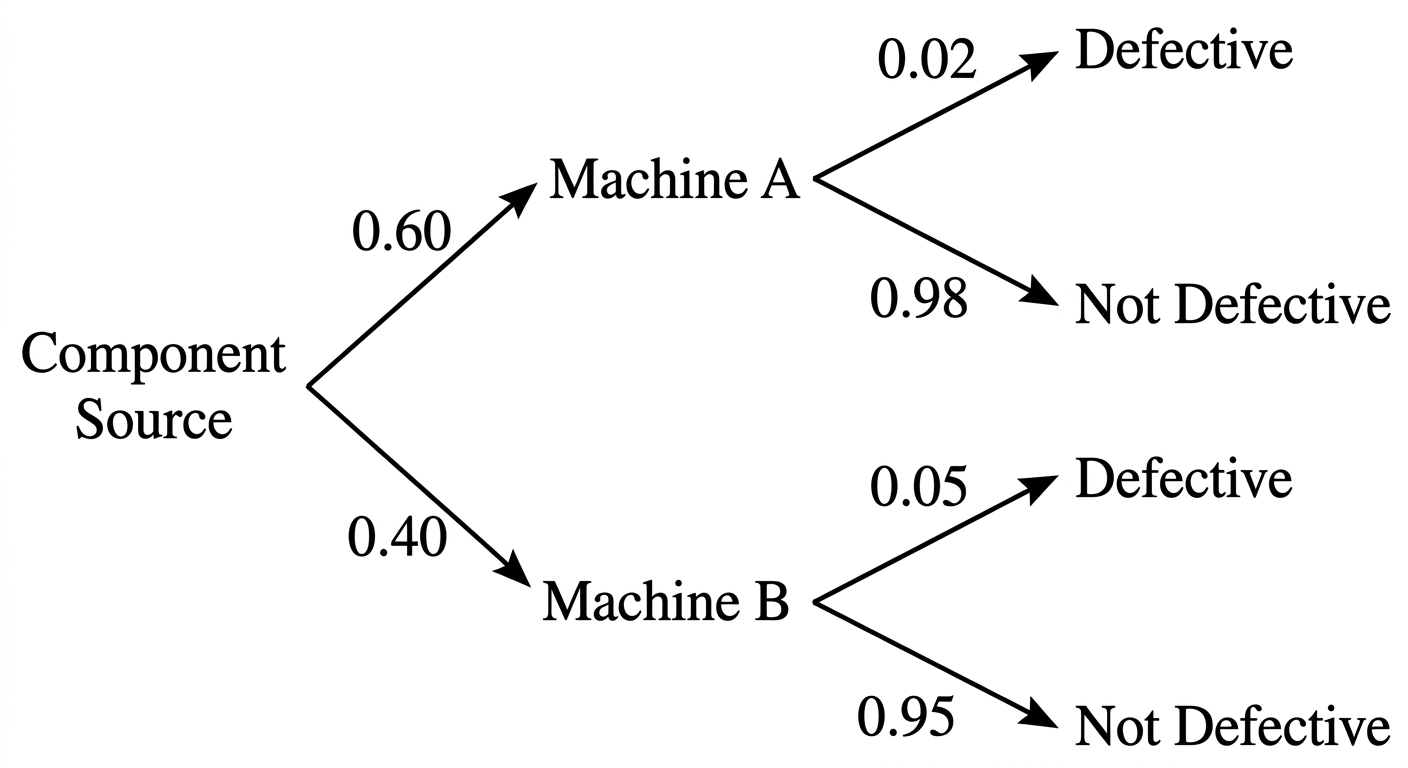
Find the probability that both components are defective.
Find the probability that exactly one of the two components is defective.
Given that both components are defective, find the probability that both were made by Machine .
revisionprep.com
Summary Answer
Not available for this question.
Model Answer
Not available for this question.
Marking Scheme
Not available for this question.
Examiner Insights
Not available for this question.
That's every free question here — 6 of 132.
+126 more questions, plus Mock Papers & Worksheets, are waiting in Premium.