You're viewing 4 free preview questions for Maths AA SL — subscribe to unlock 270 more, plus the Full Question Bank, Mock Papers & Worksheets.Upgrade
Derivatives and Their Applications · Paper 1 — Free Maths AA SL Practice Questions
1FoundationSAQ-SDefinition of a derivative (rate of change)5 marksPaper 1~8 min

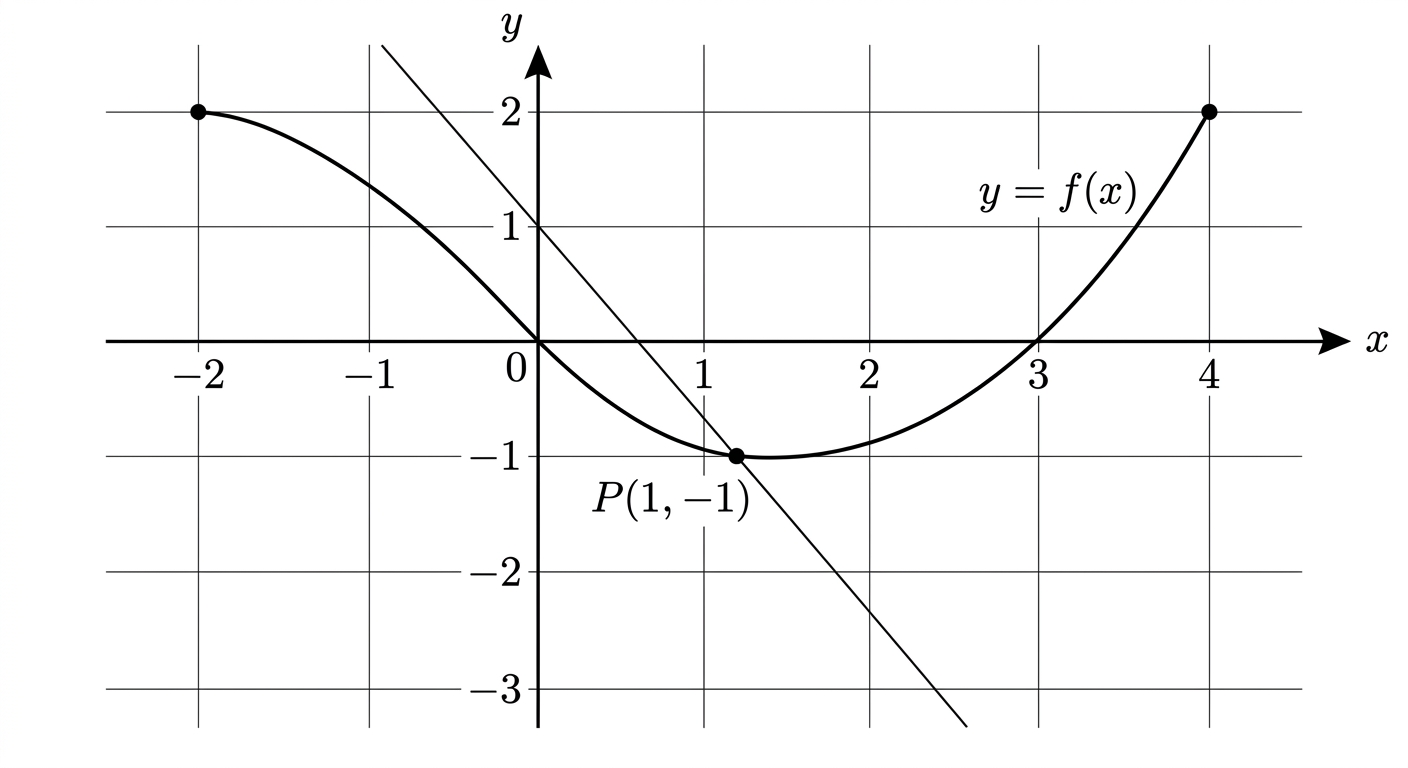
The graph of for is shown below. The tangent to the curve at point , where , is also drawn.
(a)
State the geometric meaning of . [1 mark]
(b)
Find the value of . [2 marks]
(c)
The normal to the curve at intersects the -axis at point . Find the coordinates of . [2 marks]

Solutions
2FoundationSAQ-SRules of differentiation (power, product, quotient, chain rule)s5 marksPaper 1~8 min
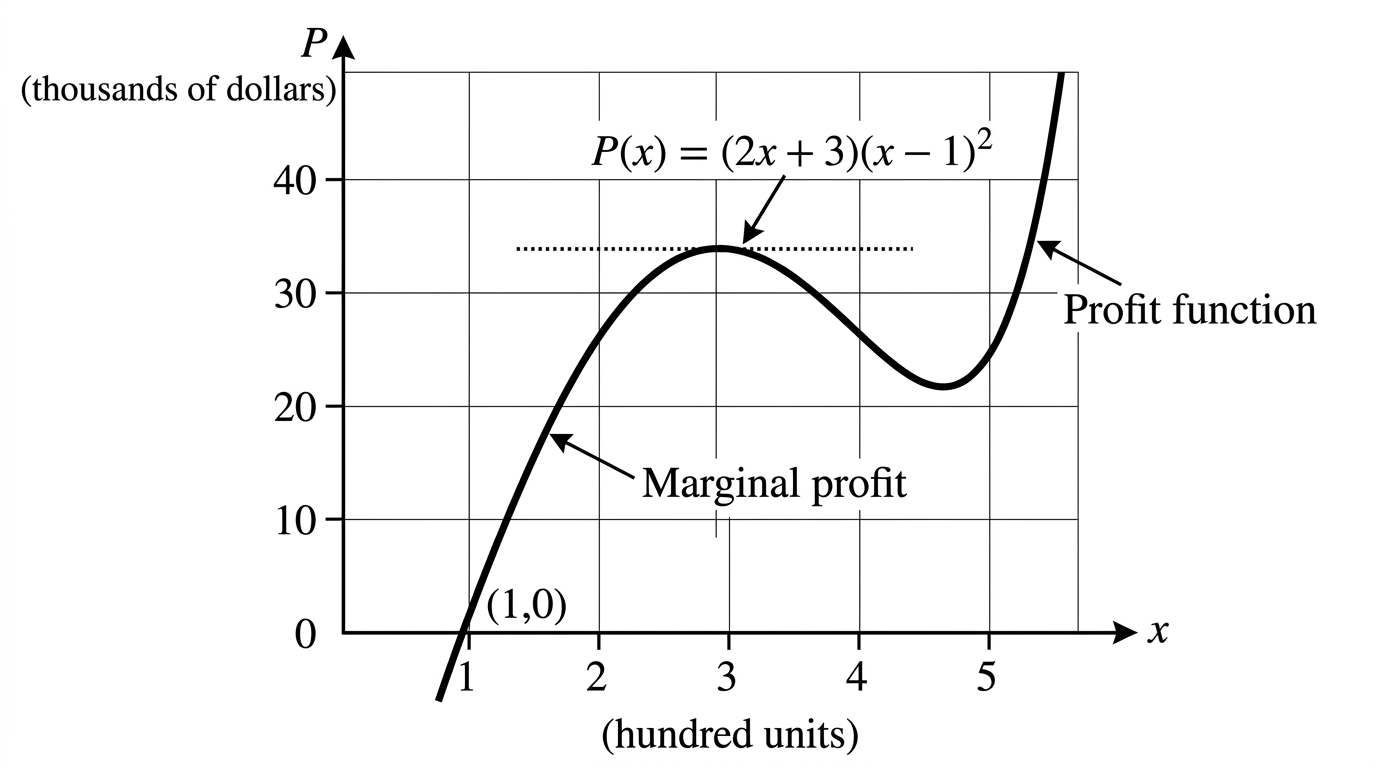
A company models the profit , in thousands of dollars, from selling hundred units of a product as
-
(a)
Find . Write your answer in the form , where and are integers.
- [3 marks]
(b)
Find the value of for which and , or state that no such value exists. Justify your answer.
- [1 mark]
(c)
The company considers increasing production beyond the level found in (b). Using your results from (a) and (b), determine whether profit is increasing or decreasing for , and interpret what this means for the company. [1 mark]
Solutions
3MasterySAQ-SDefinition of a derivative (rate of change)8 marksPaper 1~12 min
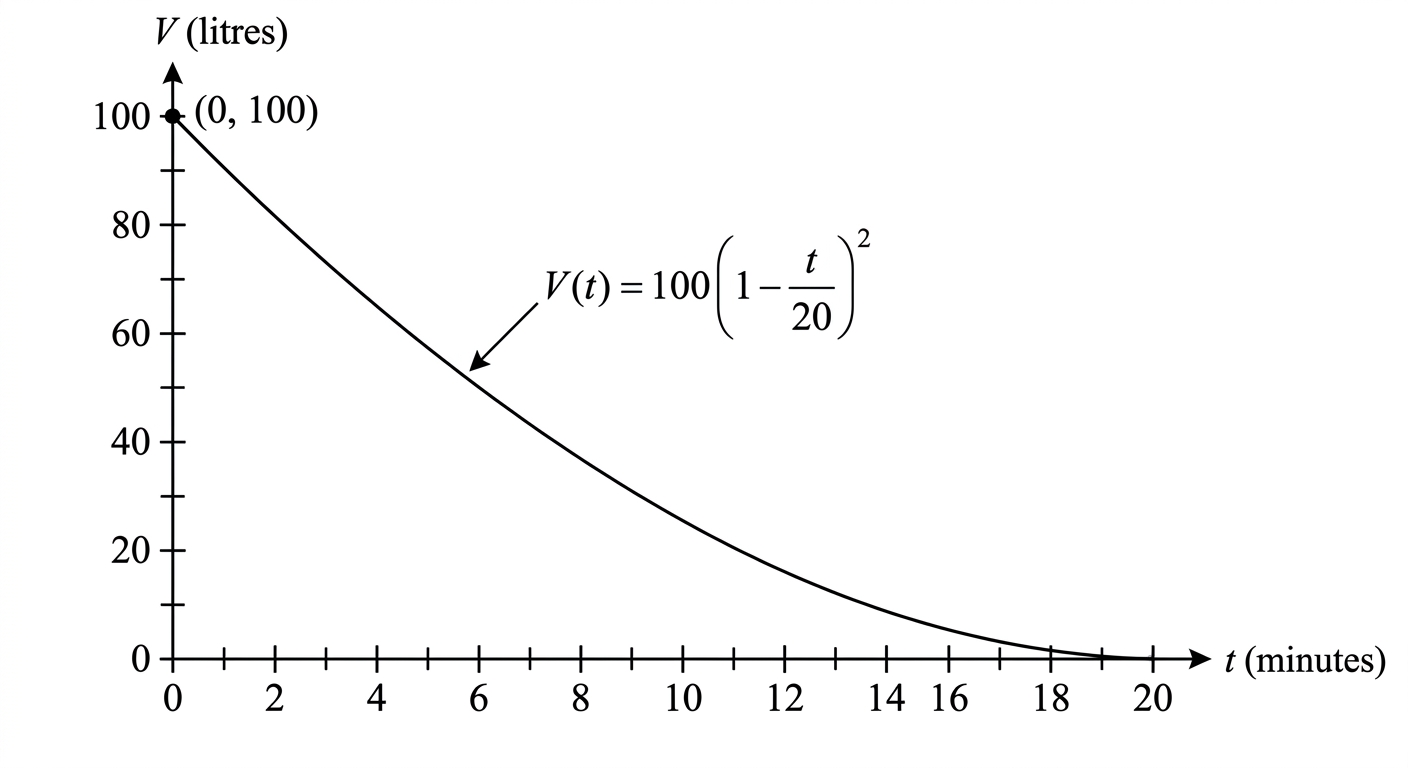
A water tank has a small hole at its base. The volume of water, litres, remaining in the tank minutes after the hole is unplugged is given by
(a)
Show that the rate of change of volume is . [3 marks]
(b)
Find the time at which the water is draining at a rate of litres per minute. [2 marks]
(c)
The average rate of change of volume over the entire interval is compared with the instaneous rate found in part (b). Determine the average rate of change of over and explain why it is consistent with the answer to part (b). [3 marks]
Solutions
4ChallengeSAQ-LDefinition of a derivative (rate of change)8 marksPaper 1~12 min
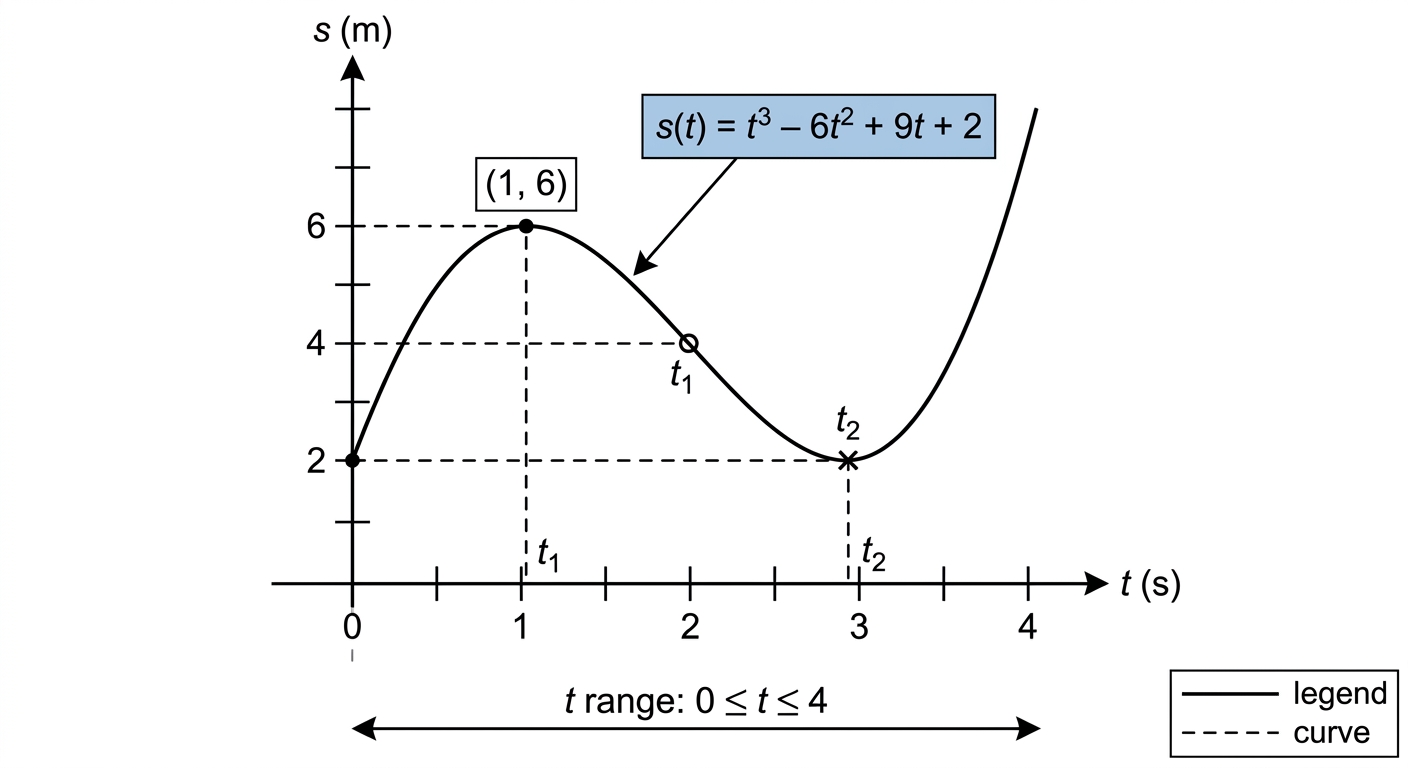
A particle moves along a straight line such that its displacement, metres, from a fixed point at time seconds is given by
(a)
Using the definition of the derivative as a limit,
show that the velocity of the particle is . [4 marks]
(b)
Determine the values of at which the particle is instaneously at rest. [2 marks]
(c)
Determine the intervals within during which the particle moves in the positive direction and the intervals during which it moves in the negative direction. [1 mark]
(d)
Hence determine the total distance travelled by the particle in the first seconds. [1 mark]
Solutions
That's every free question here — 4 of 274.
+270 more questions, plus Mock Papers & Worksheets, are waiting in Premium.