You're viewing 4 free preview questions for Maths AA SL — subscribe to unlock 215 more, plus the Full Question Bank, Mock Papers & Worksheets.Upgrade
Differential Equations · Paper 1 — Free Maths AA SL Practice Questions
1FoundationSAQ-SSolving first-order differential equationss7 marksPaper 1~11 min

The number of bacteria, , in a culture grows at a rate proportional to . This modelled by the differential equation , where is the time in hours and is a positive constant.
(a)
Show that the general solution to is , where is a positive constant. [2 marks]
(b)
Initially there are bacteria. After hours there are bacteria. Find the exact value of . [3 marks]
(c)
A scientist claims the culture will exceed bacteria within hours of the start. Determine whether this claim is correct. [2 marks]


Solutions
2FoundationSAQ-SSolving first-order differential equationss7 marksPaper 1~11 min
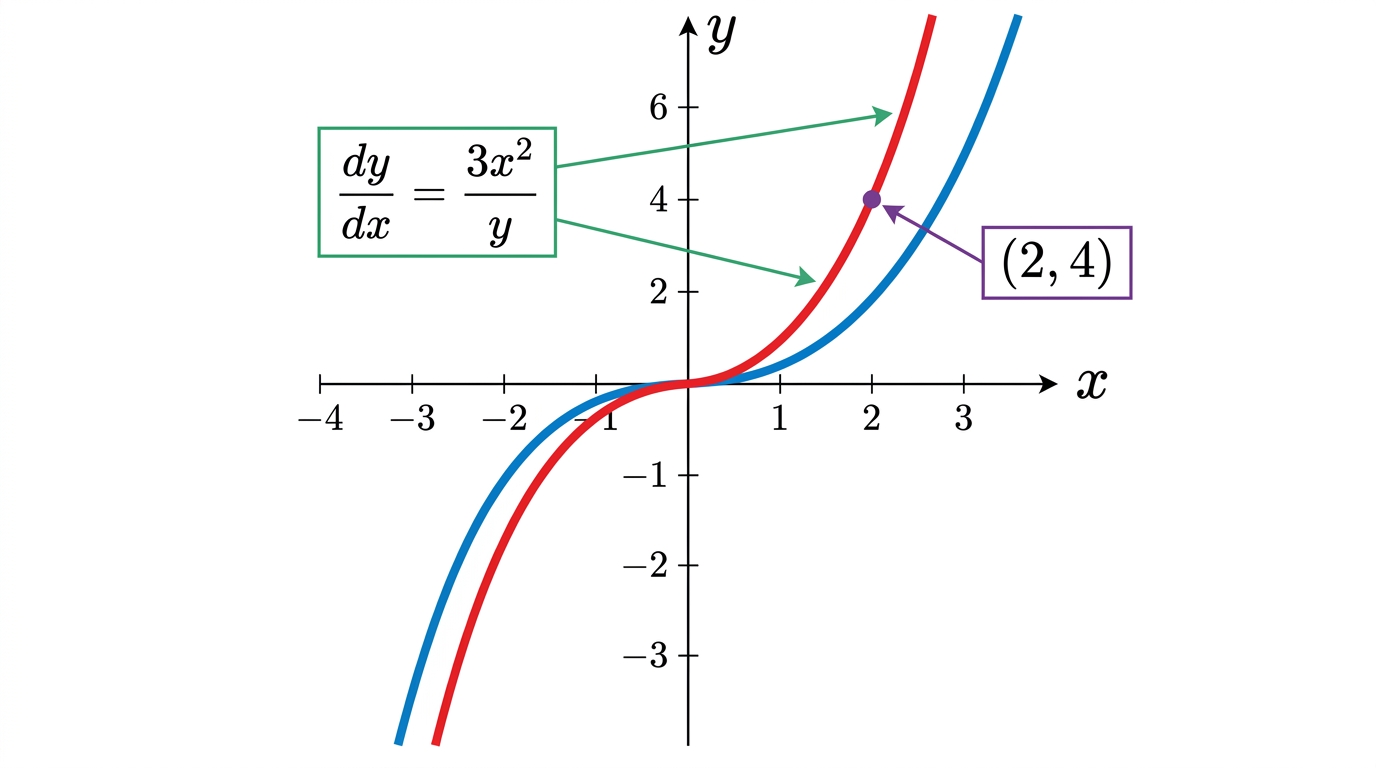
Consider the differential equation , where .
(a)
Show that the general solution can be written as , where is a constant. [3 marks]
(b)
Given that when , find the value of . [1 mark]
(c)
Hence find the value of when , giving your answer correct to 3 significant figures. [3 marks]
Solutions
3MasterySAQ-SSolving first-order differential equationss5 marksPaper 1~8 min
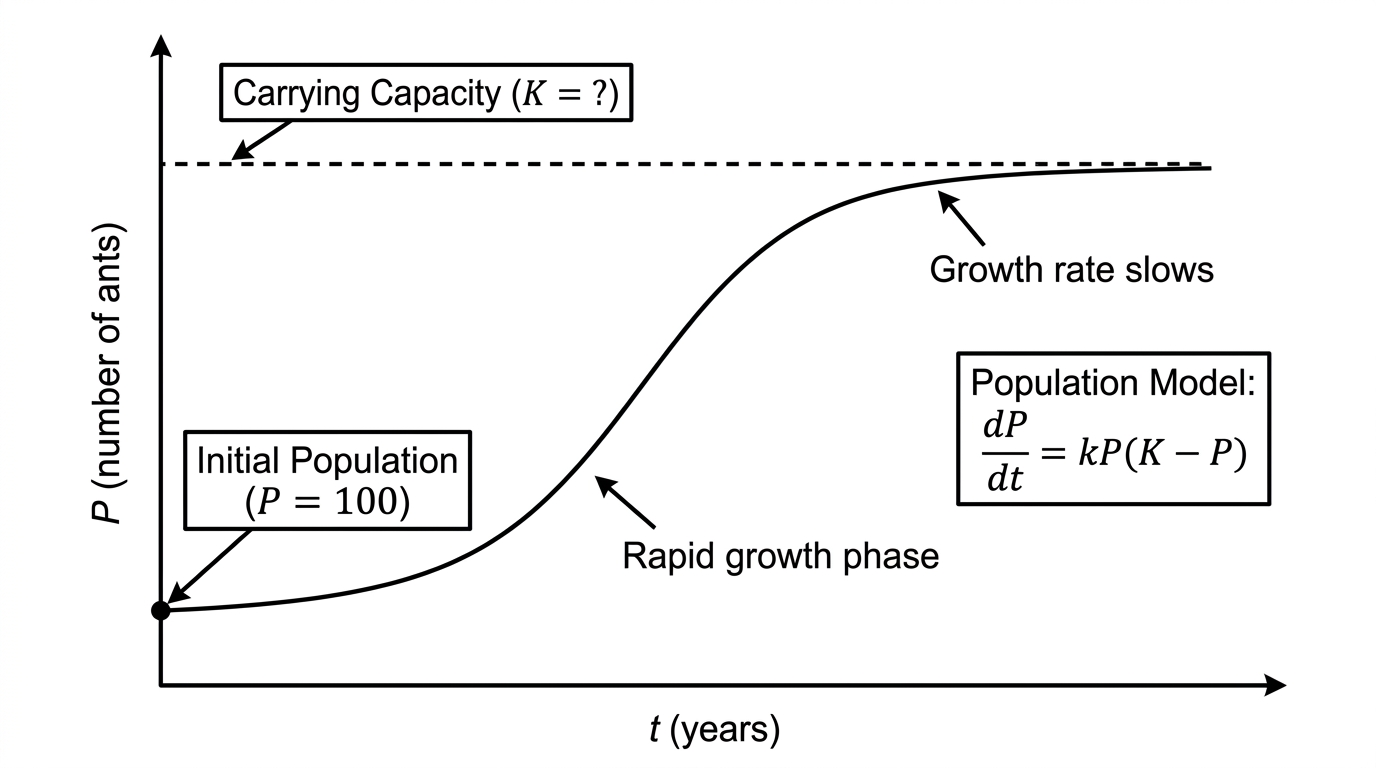
The population of a colony of ants is modelled by the differential equation
where is the population at time years, . Initially, the population is ants.
(a)
Show that
[2 marks]
(b)
Hence solve the differential equation, giving your answer in the form
where , , are integers. [3 marks]
Solutions
4ChallengeSAQ-LSolving first-order differential equationss8 marksPaper 1~12 min
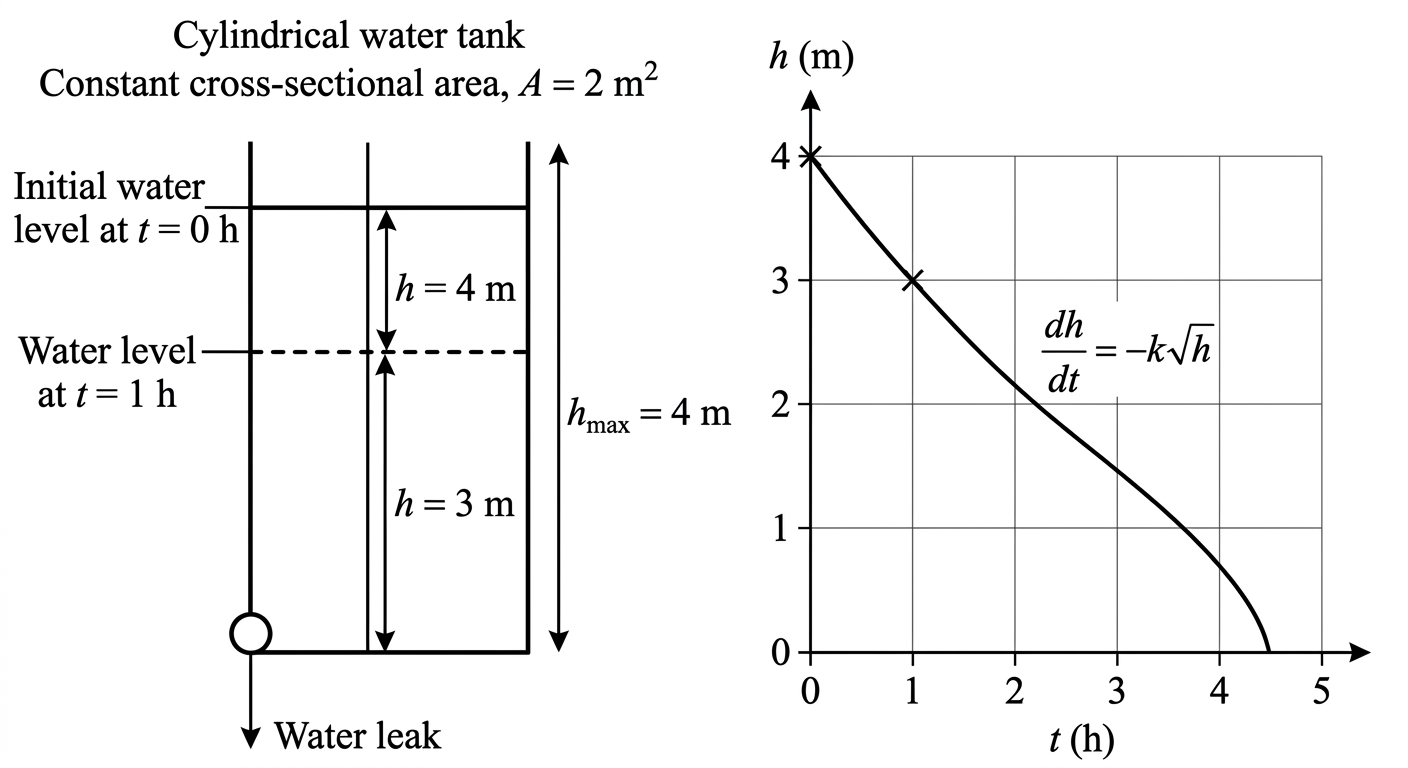
A cylindrical water tank has a constant cross-sectional area of and a small hole at its base. Water leaks such that the rate of change of volume (in ) at time (in hours) is proportional to the square root of the depth (in metres). The tank is initially full with depth . After hour, the depth has decreased to .
Using , the differential equation for the depth is
(a)
Show that . [4 marks]
(b)
Determine the time at which the depth reaches . Give your answer in exact form. [2 marks]
(c)
Determine whether the tank empties completely according to this model. Justify your answer mathematically. [2 marks]
Solutions
That's every free question here — 4 of 219.
+215 more questions, plus Mock Papers & Worksheets, are waiting in Premium.