Differential Equations and Maclaurin Series · Paper 1 — Free Maths AA SL Practice Questions
Free questions
Open in full, with answers, mark scheme and examiner insights.
First-order differential equations: separable, homogeneous, integrating factor
In a reaction the concentration of product mol L at time seconds satisfies with when . The left-hand graph shows against .
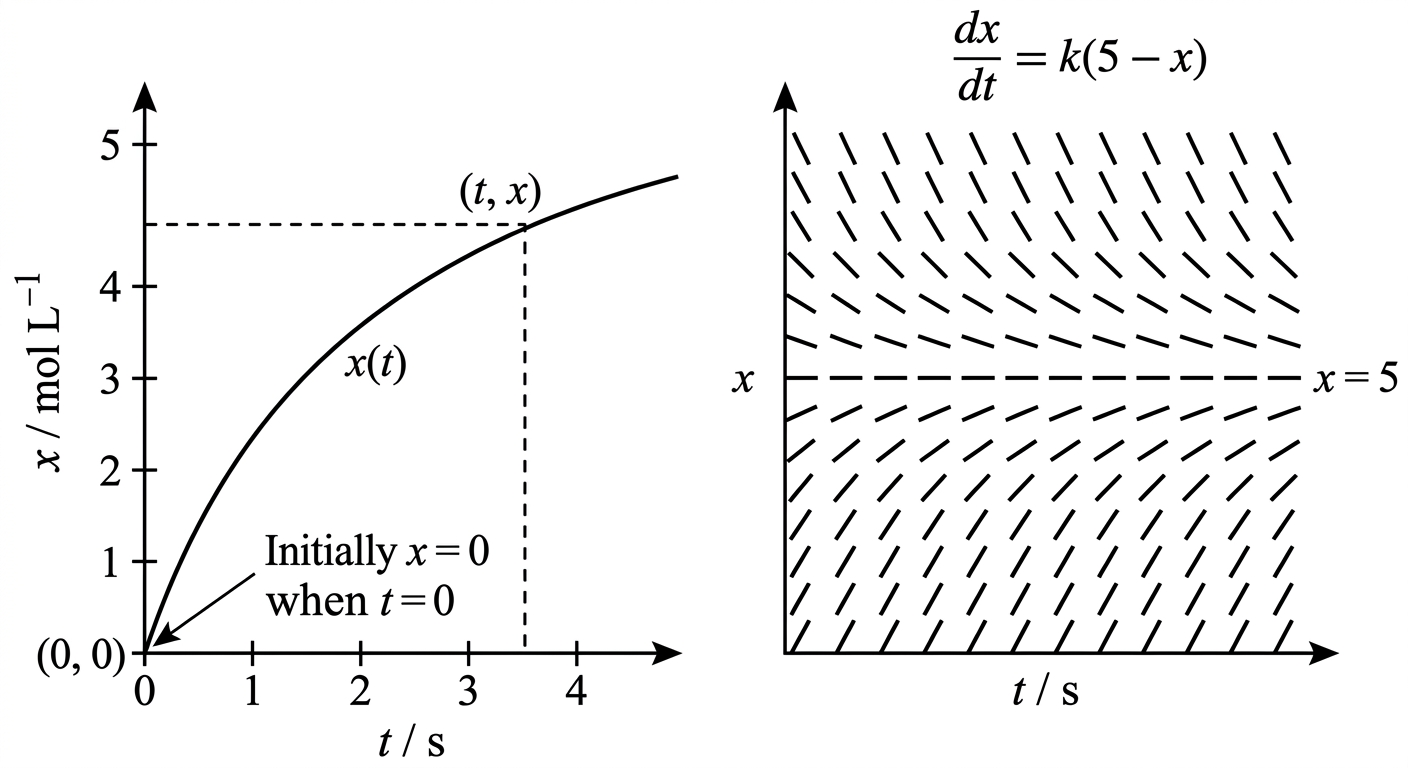
Show that satisfies the differential equation and the initial condition.
Write down the value that approaches as increases.
Given that when , find the exact value of .
revisionprep.com
Summary Answer
Not available for this question.
Model Answer
Not available for this question.
Marking Scheme
Not available for this question.
Examiner Insights
Not available for this question.
First-order differential equations: separable, homogeneous, integrating factor
The diagram shows a culture of bacteria. The number of bacteria at time hours satisfies and is modelled by . Use the counts given in the diagram.
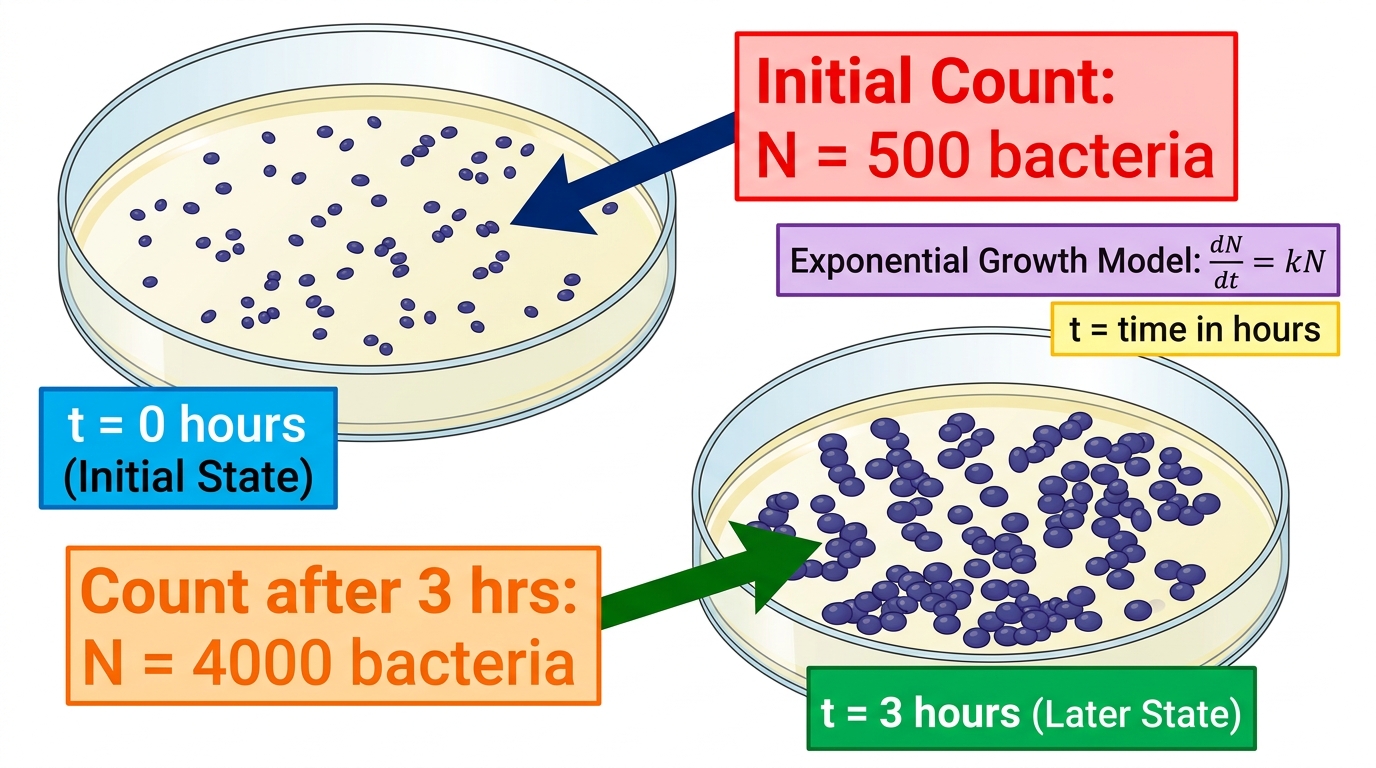
Show that .
Hence state how long it takes the number of bacteria to double, giving a reason.
Find the value of at which the bacteria are increasing at a rate of per hour.
revisionprep.com
Summary Answer
Not available for this question.
Model Answer
Not available for this question.
Marking Scheme
Not available for this question.
Examiner Insights
Not available for this question.
First-order differential equations: separable, homogeneous, integrating factor
The population of an island, thousand, years after 1 January 2000, is modelled by , which satisfies , as shown in the diagram.
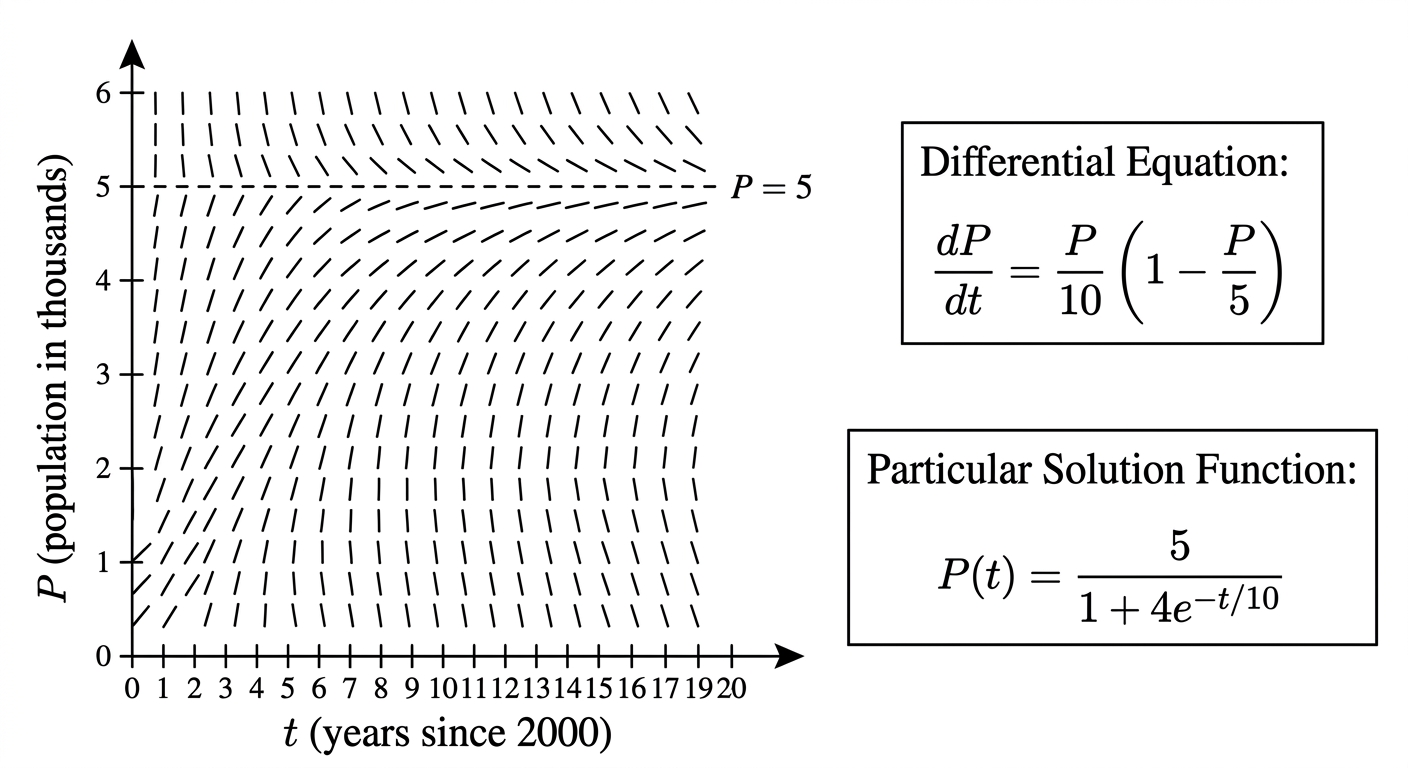
Write down the population in 2000 and the value that the population approaches.
Find the exact value of at which the population reaches 4 thousand.
Find the rate of growth when the population is 2.5 thousand.
revisionprep.com
Summary Answer
Not available for this question.
Model Answer
Not available for this question.
Marking Scheme
Not available for this question.
Examiner Insights
Not available for this question.
First-order differential equations: separable, homogeneous, integrating factor
The population of an island, thousand, is modelled by , where is in years. The diagram shows the graph of against .
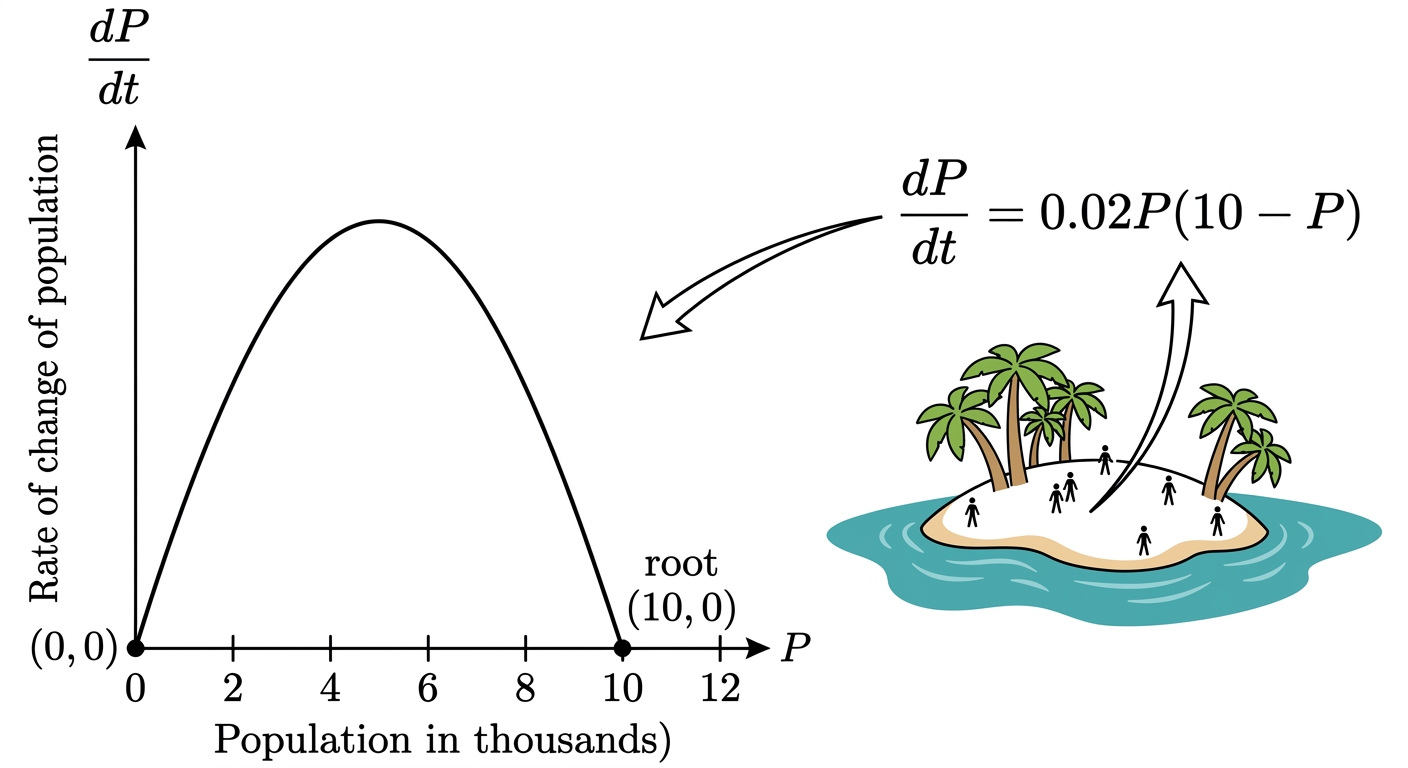
Write down the two values of for which the population does not change.
Find the population at which it grows fastest, and this greatest rate of growth.
The population is . Explain what the model predicts will happen to it.
revisionprep.com
Summary Answer
Not available for this question.
Model Answer
Not available for this question.
Marking Scheme
Not available for this question.
Examiner Insights
Not available for this question.
First-order differential equations: separable, homogeneous, integrating factor
A colony of rabbits, shown in the picture, starts with 80 rabbits. Its population after years is modelled by .
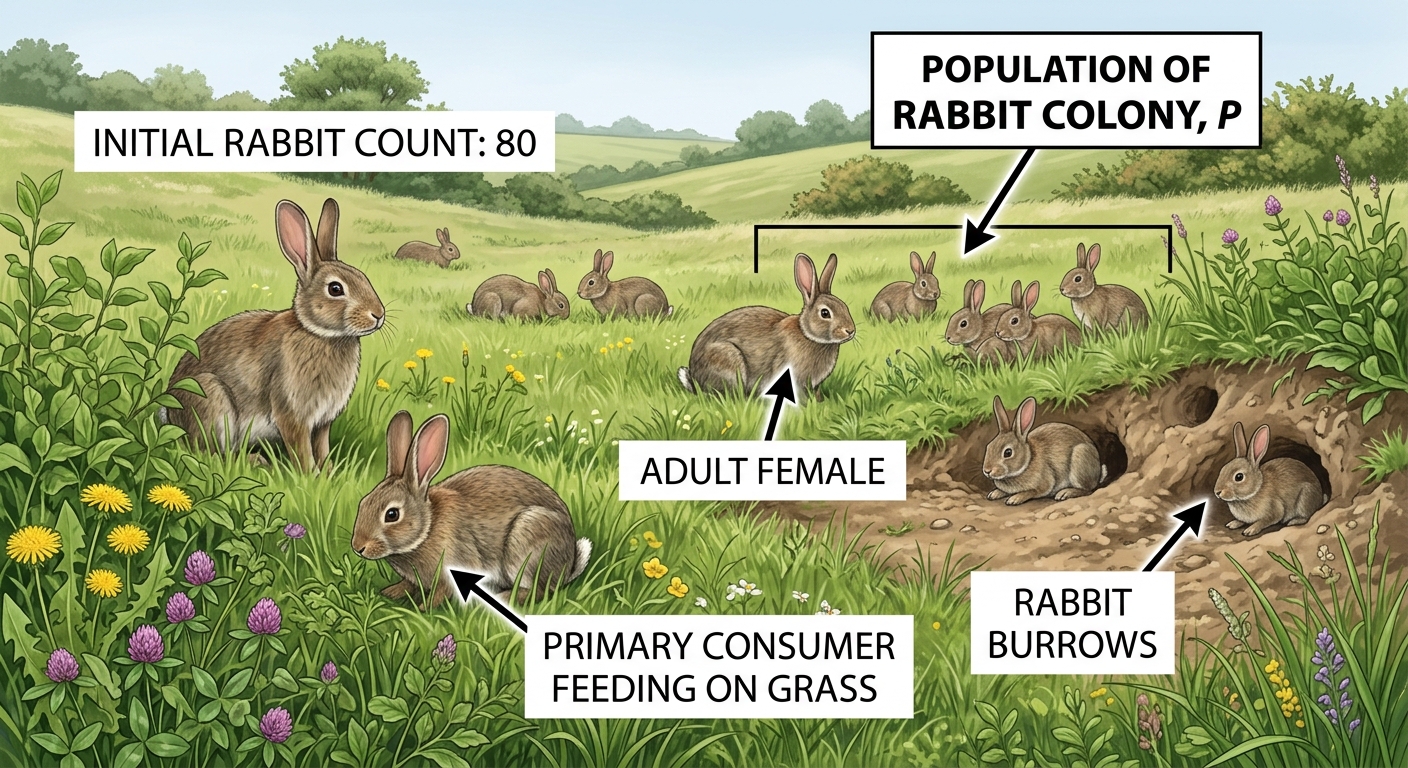
Verify that satisfies the differential equation and the initial population.
Find the exact population predicted after 2 years.
A second colony starts with 40 rabbits and follows the same differential equation, with . Find the exact time at which this model predicts the colony dies out, and explain why the two colonies behave so differently.
revisionprep.com
Summary Answer
Not available for this question.
Model Answer
Not available for this question.
Marking Scheme
Not available for this question.
Examiner Insights
Not available for this question.
First-order differential equations: separable, homogeneous, integrating factor
The diagram shows a tank that initially contains 100 litres of pure water. Brine containing 2 g of salt per litre flows into the tank at 3 litres per minute. The mixture is kept stirred and flows out at 2 litres per minute. The tank can hold 200 litres. Let grams be the mass of salt in the tank minutes after the brine starts to flow.
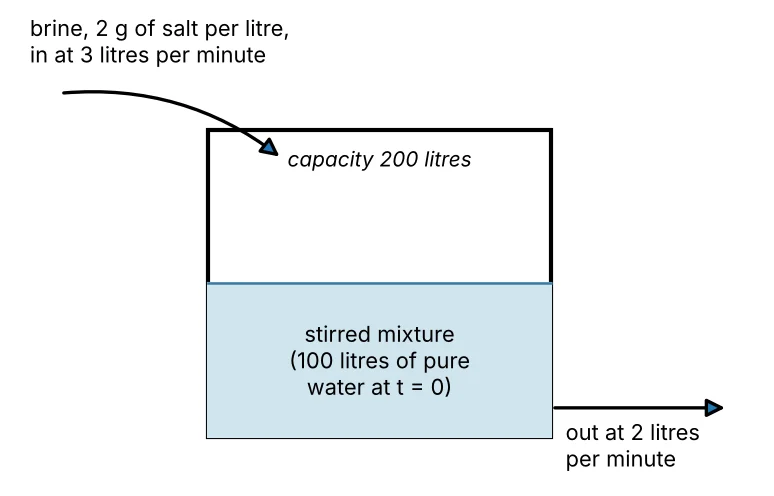
Show that .
Show that is an integrating factor for this differential equation.
Hence show that .
Find the mass of salt in the tank and the concentration of salt at the moment the tank becomes full.
Show that the concentration of salt in the tank is always less than 2 g per litre, and explain why this is to be expected.
revisionprep.com
Summary Answer
Not available for this question.
Model Answer
Not available for this question.
Marking Scheme
Not available for this question.
Examiner Insights
Not available for this question.
That's every free question here — 6 of 178.
+172 more questions, plus Mock Papers & Worksheets, are waiting in Premium.