Introduction to Differentiation and Limits · Paper 2 — Free Maths AA SL Practice Questions
Free questions
Open in full, with answers, mark scheme and examiner insights.
Derivative of axⁿ
The diagram shows the graphs of and for .
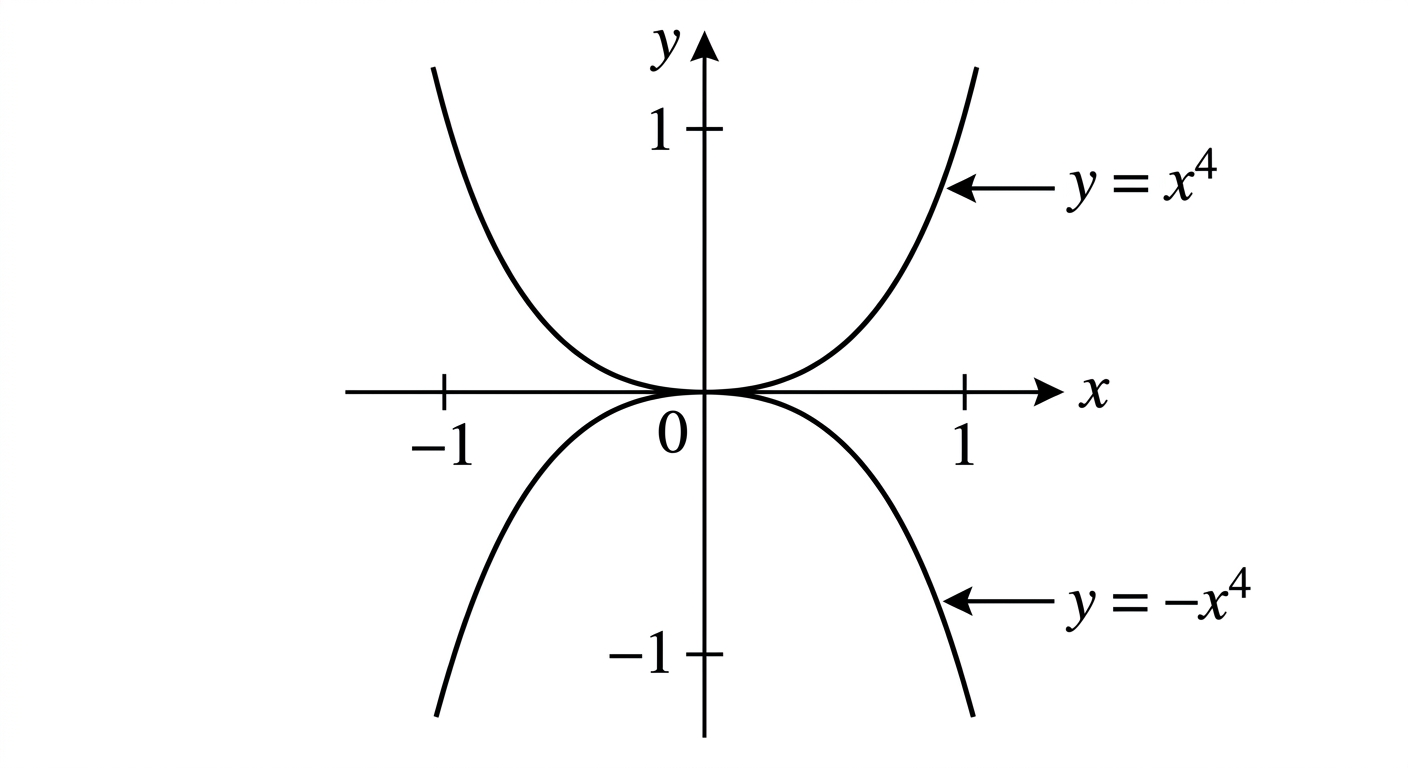
Find for each curve.
Find the gradient of each curve at and at .
Write down the gradient of each curve at the origin, and describe the tangent there.
revisionprep.com
Summary Answer
Not available for this question.
Model Answer
Not available for this question.
Marking Scheme
Not available for this question.
Examiner Insights
Not available for this question.
Continuity, differentiability and differentiation from first principles
A car park charges dollars for each hour or part of an hour, up to a maximum of dollars. The graph shows the charge dollars for a stay of hours, . An open circle shows a point that is not on the graph; a filled circle shows a point that is on the graph.
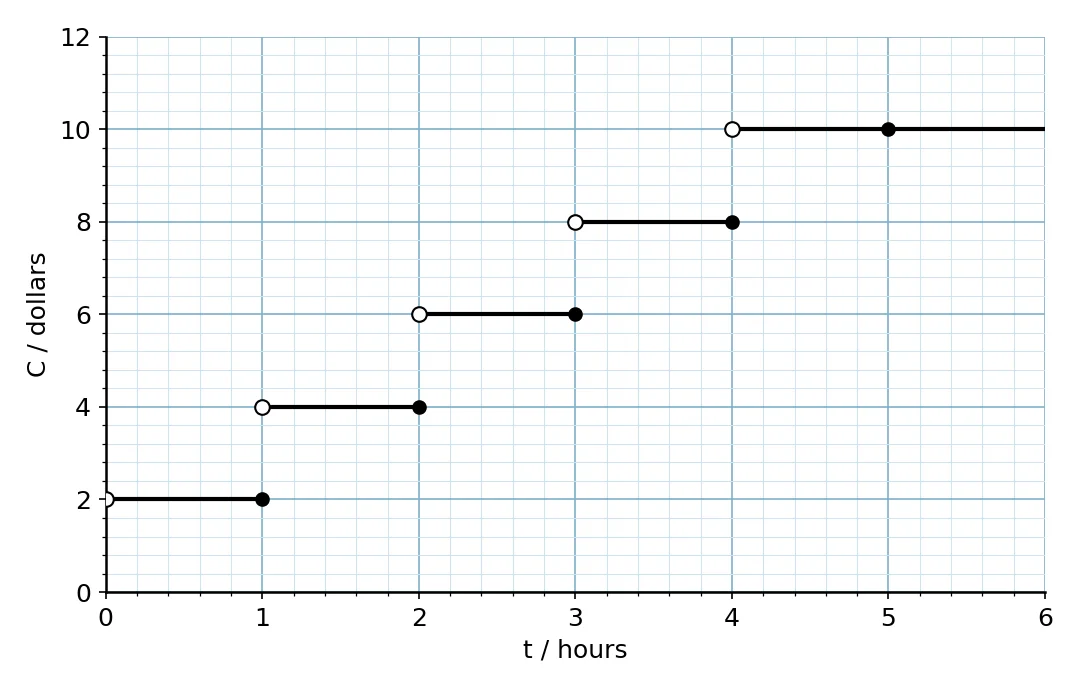
Write down the charge for a stay of hours and for a stay of hours.
Write down the value that approaches as and as .
Hence explain whether exists, and write down .
revisionprep.com
Summary Answer
Not available for this question.
Model Answer
Not available for this question.
Marking Scheme
Not available for this question.
Examiner Insights
Not available for this question.
Introduction to the derivative; limits and rates of change
The volume of water in a cylindrical tank, measured in litres, is given by , where is the time in minutes after a valve is opened.
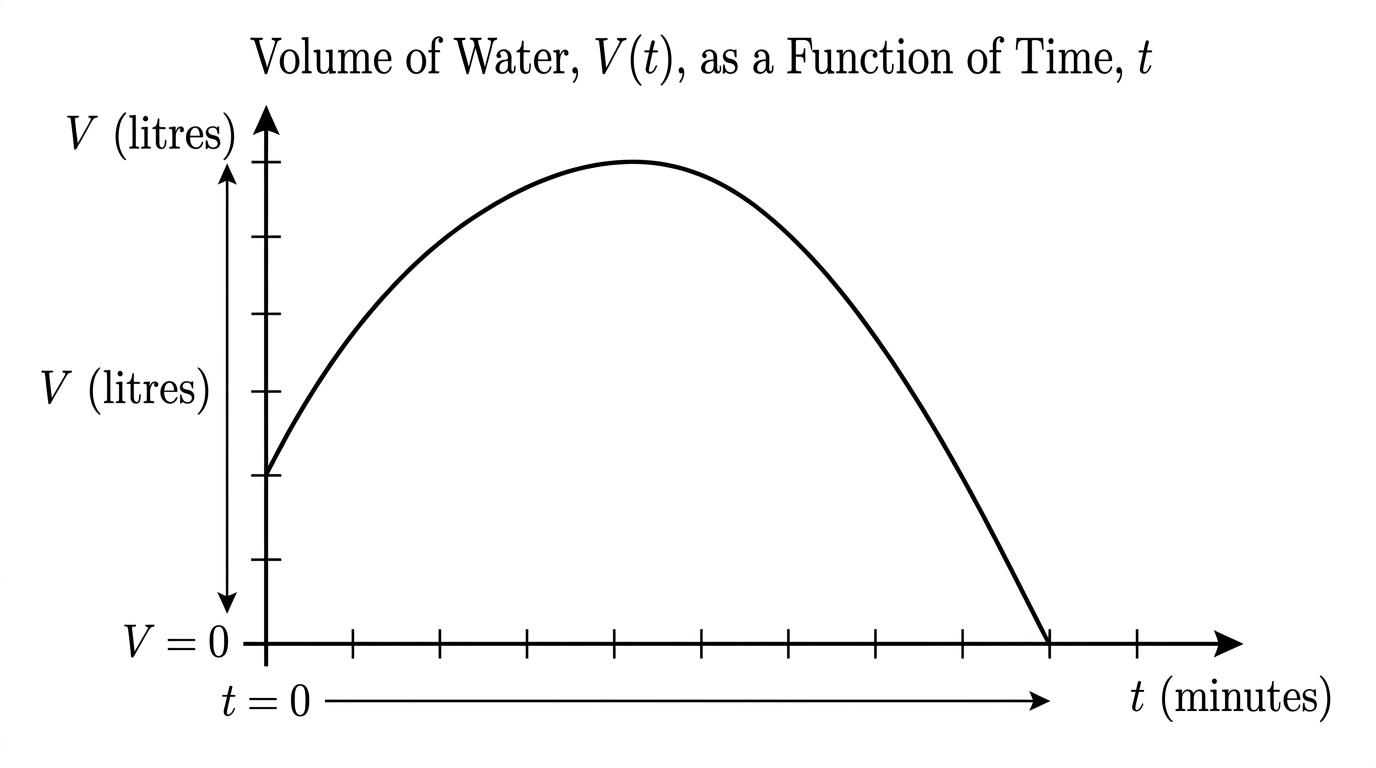
Calculate the rate at which the volume of water is changing at minutes.
Determine the time at which the volume of water is at its maximum.
Calculate the maximum volume of water in the tank and explain what happens to the volume for .
revisionprep.com
Summary Answer
Not available for this question.
Model Answer
Not available for this question.
Marking Scheme
Not available for this question.
Examiner Insights
Not available for this question.
Introduction to the derivative; limits and rates of change
The graph shows a model for the population, thousand, of a city years after 2020, for . The tangent to the curve at the point , where , is also shown.
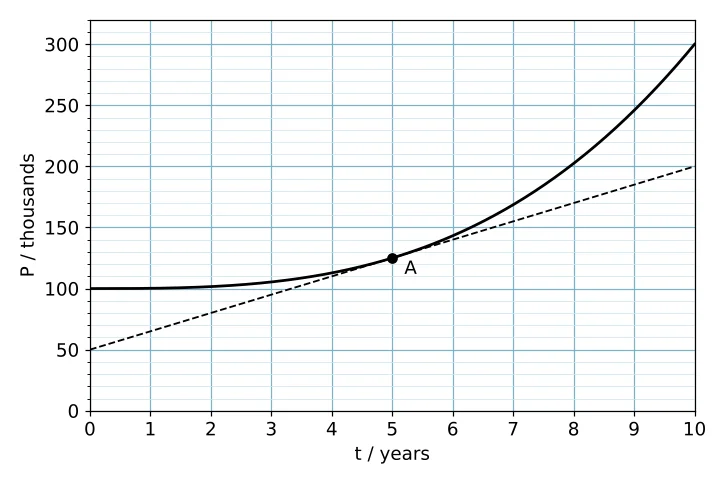
Use the tangent to find the rate of growth of the population at .
Find the average rate of growth over the ten years.
Explain why the answers to (a) and (b) are different.
The rate of growth at time is thousand per year. Find the time at which the rate of growth equals the average rate in (b).
revisionprep.com
Summary Answer
Not available for this question.
Model Answer
Not available for this question.
Marking Scheme
Not available for this question.
Examiner Insights
Not available for this question.
Introduction to the derivative; limits and rates of change
Let , .
Find , , and , giving each answer to four significant figures.
Hence estimate to three significant figures.
By considering the chord joining and on the curve , explain why is the gradient of at .
Given that , use differentiation to find the exact value of this limit.
revisionprep.com
Summary Answer
Not available for this question.
Model Answer
Not available for this question.
Marking Scheme
Not available for this question.
Examiner Insights
Not available for this question.
Derivative of axⁿ
Priya models the height, cm, of a bamboo shoot days after it appears by , where is a positive constant. The diagram shows the graph of this model. When , the shoot is growing at a rate of 1.2 cm per day.
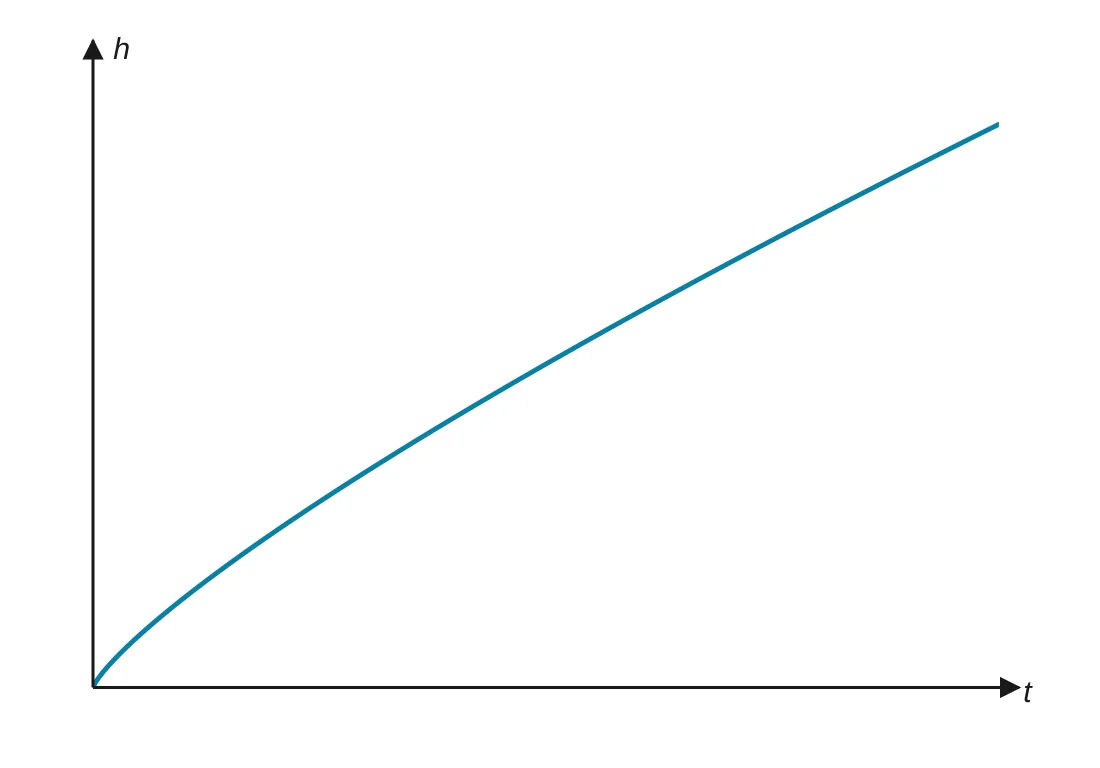
Find in terms of and .
Find the value of .
Find the height of the shoot when .
Show that when is multiplied by , the growth rate is halved. Hence find the value of at which the shoot grows at a rate of 0.6 cm per day.
Comment on the suitability of the model for large values of .
revisionprep.com
Summary Answer
Not available for this question.
Model Answer
Not available for this question.
Marking Scheme
Not available for this question.
Examiner Insights
Not available for this question.
That's every free question here — 6 of 145.
+139 more questions, plus Mock Papers & Worksheets, are waiting in Premium.