Rational, Exponential, Logarithmic and Polynomial Functions · Paper 2 — Free Maths AA SL Practice Questions
Free questions
Open in full, with answers, mark scheme and examiner insights.
The reciprocal function and simple rational functions
At a constant temperature, the pressure kPa of a fixed mass of gas and its volume litres are related by . When the pressure is kPa.
Find the value of .
Find the pressure when .
Find the volume when the pressure is kPa.
The volume is reduced by . Find the percentage increase in the pressure.
Sketch a graph of against for .
A second sample of gas satisfies . Explain why the graphs for the two samples never meet.
Show that doubling the volume halves the pressure.
revisionprep.com
Summary Answer
Not available for this question.
Model Answer
Not available for this question.
Marking Scheme
Not available for this question.
Examiner Insights
Not available for this question.
Exponential and logarithmic functions and models
A cup of tea is left to cool in a room. Its temperature, degrees Celsius, minutes after it is poured is modelled by , for .
Write down the temperature of the tea when it is poured.
Find the temperature of the tea after minutes.
Find the time taken for the tea to cool to degrees Celsius.
Write down the temperature of the room, and explain how the model shows this.
revisionprep.com
Summary Answer
Not available for this question.
Model Answer
Not available for this question.
Marking Scheme
Not available for this question.
Examiner Insights
Not available for this question.
The reciprocal function and simple rational functions
The concentration of a chemical in a solution, parts per million, is modelled by
where is the time in hours after the experiment starts.
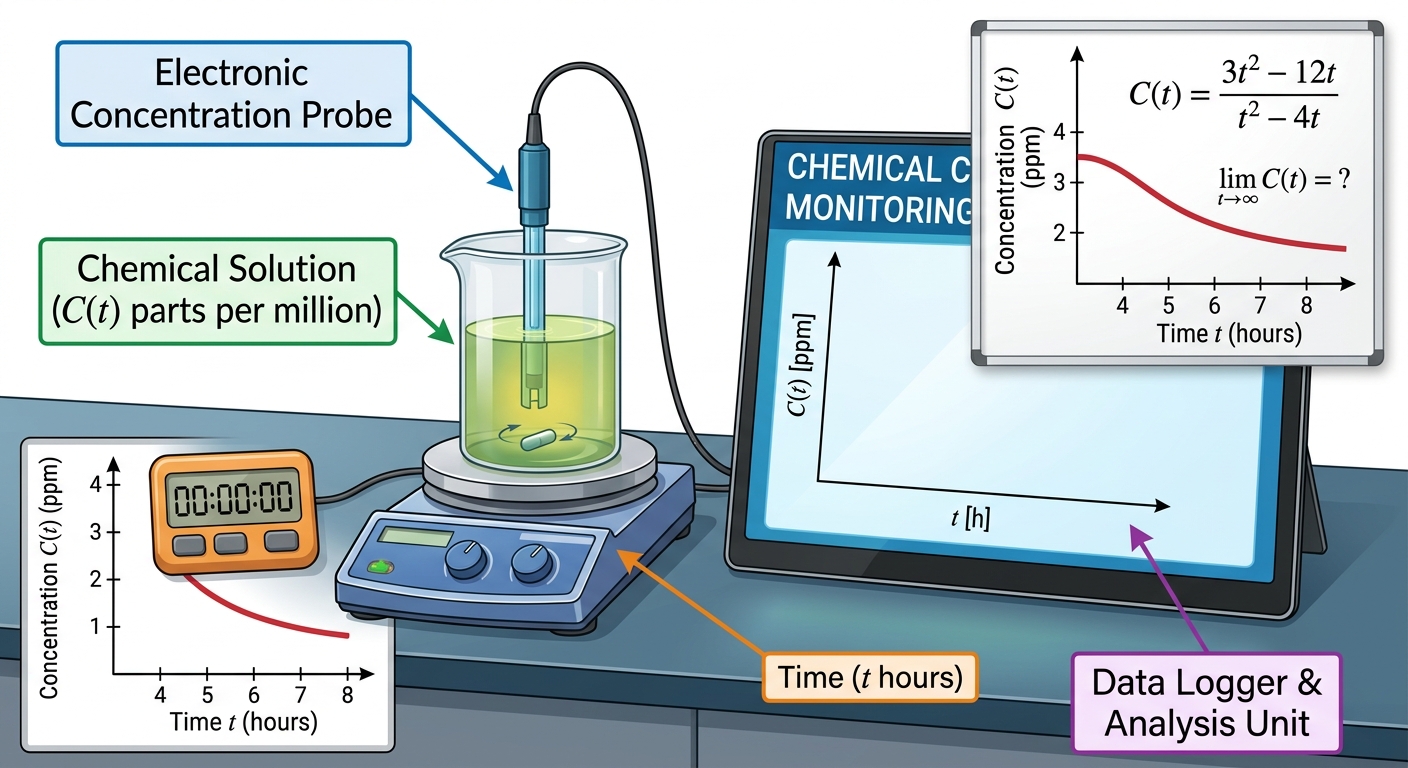
Show that can be written in the form , where and are integers to be determined.
State the value of for which is undefined, and explain why this value is excluded from the domain.
Determine the time at which the concentration is parts per million.
revisionprep.com
Summary Answer
Not available for this question.
Model Answer
Not available for this question.
Marking Scheme
Not available for this question.
Examiner Insights
Not available for this question.
Exponential and logarithmic functions and models
The table shows the number of users of a new study app months after launch, rounded to the nearest whole number.

Use the table to explain why an exponential model is more suitable than a linear model.
Write down an exponential model for in the form .
Find the first month in which the model predicts more than users.
Give one reason why this model should not be used to predict the number of users after years.
revisionprep.com
Summary Answer
Not available for this question.
Model Answer
Not available for this question.
Marking Scheme
Not available for this question.
Examiner Insights
Not available for this question.
Polynomial functions; factor and remainder theorems
Car A starts at a crossroads and drives north at km per hour. At the same time car B, km east of the crossroads, drives west towards it at km per hour.
Show that the square of the distance between them after hours is .
Find the least distance between them and when it occurs.
Find when they are again km apart.
revisionprep.com
Summary Answer
Not available for this question.
Model Answer
Not available for this question.
Marking Scheme
Not available for this question.
Examiner Insights
Not available for this question.
Polynomial functions; factor and remainder theorems
The number of bacteria, , in a culture hours after it is set up is modelled by , for . At an antibiotic is added, and for the number is modelled by .
Find the number of bacteria at .
Given that the model is continuous at , explain why .
Find the value of , , at which the number of bacteria returns to .
Find the total length of time for which there are more than bacteria.
Sketch a graph of against for , showing the coordinates of the maximum point and of the end points.
revisionprep.com
Summary Answer
Not available for this question.
Model Answer
Not available for this question.
Marking Scheme
Not available for this question.
Examiner Insights
Not available for this question.
That's every free question here — 6 of 89.
+83 more questions, plus Mock Papers & Worksheets, are waiting in Premium.