Sequences, Series and Financial Mathematics · Paper 2 — Free Maths AA SL Practice Questions
Free questions
Open in full, with answers, mark scheme and examiner insights.
Easy8 questions
Arithmetic sequences and series
Chen invests €5000 and wants it to grow to €8000 in exactly years. He makes no further deposits or withdrawals.
Find the annual interest rate, compounded annually, that he needs.
Find the nominal annual interest rate, compounded monthly, that he needs.
State why your answer to (b) is lower than your answer to (a).
revisionprep.com
Summary Answer
Not available for this question.
Model Answer
Not available for this question.
Marking Scheme
Not available for this question.
Examiner Insights
Not available for this question.
Arithmetic sequences and series
Mei invests NZD 5000 in an account that pays simple interest of of the original amount at the end of each year.
Show that the values of the account at the end of each year form an arithmetic sequence, and state its common difference.
Find the value of the account at the end of year .
Find the first year at the end of which the value is more than NZD 7000.
A second account pays compound interest per year. Find how much more this account would hold after years.
revisionprep.com
Summary Answer
Not available for this question.
Model Answer
Not available for this question.
Marking Scheme
Not available for this question.
Examiner Insights
Not available for this question.
Geometric sequences and series
A ball is dropped from a height of . On each bounce, it rebounds to of the height from which it fell.
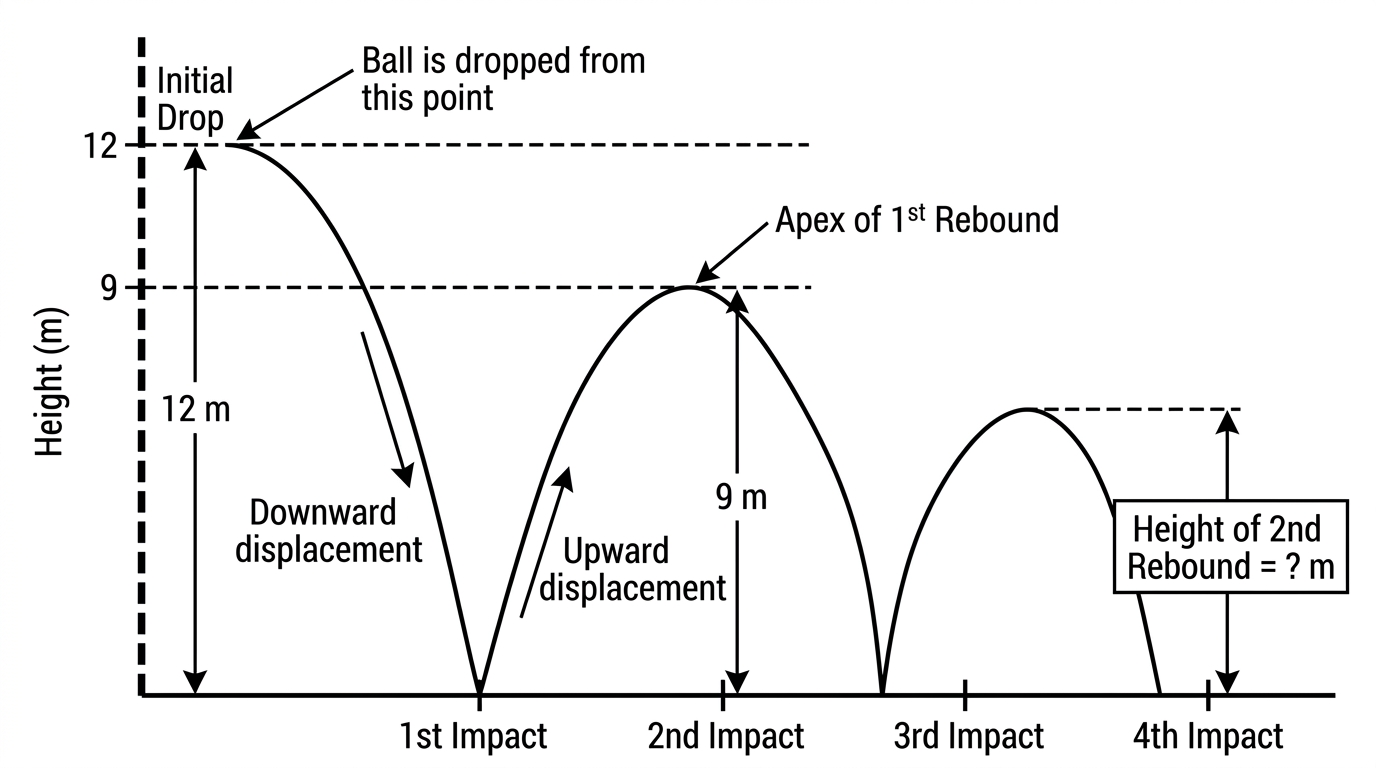
State the common ratio of the geometric sequence formed by the rebound heights.
Find the total vertical distance travelled by the ball from the moment is dropped until it hits the ground for the sixth time. Give your answer correct to 3 significant figures.
revisionprep.com
Summary Answer
Not available for this question.
Model Answer
Not available for this question.
Marking Scheme
Not available for this question.
Examiner Insights
Not available for this question.
Geometric sequences and series
A city has a population of at the start of 2020. Each year, the population increases by of the population at the start of that year.
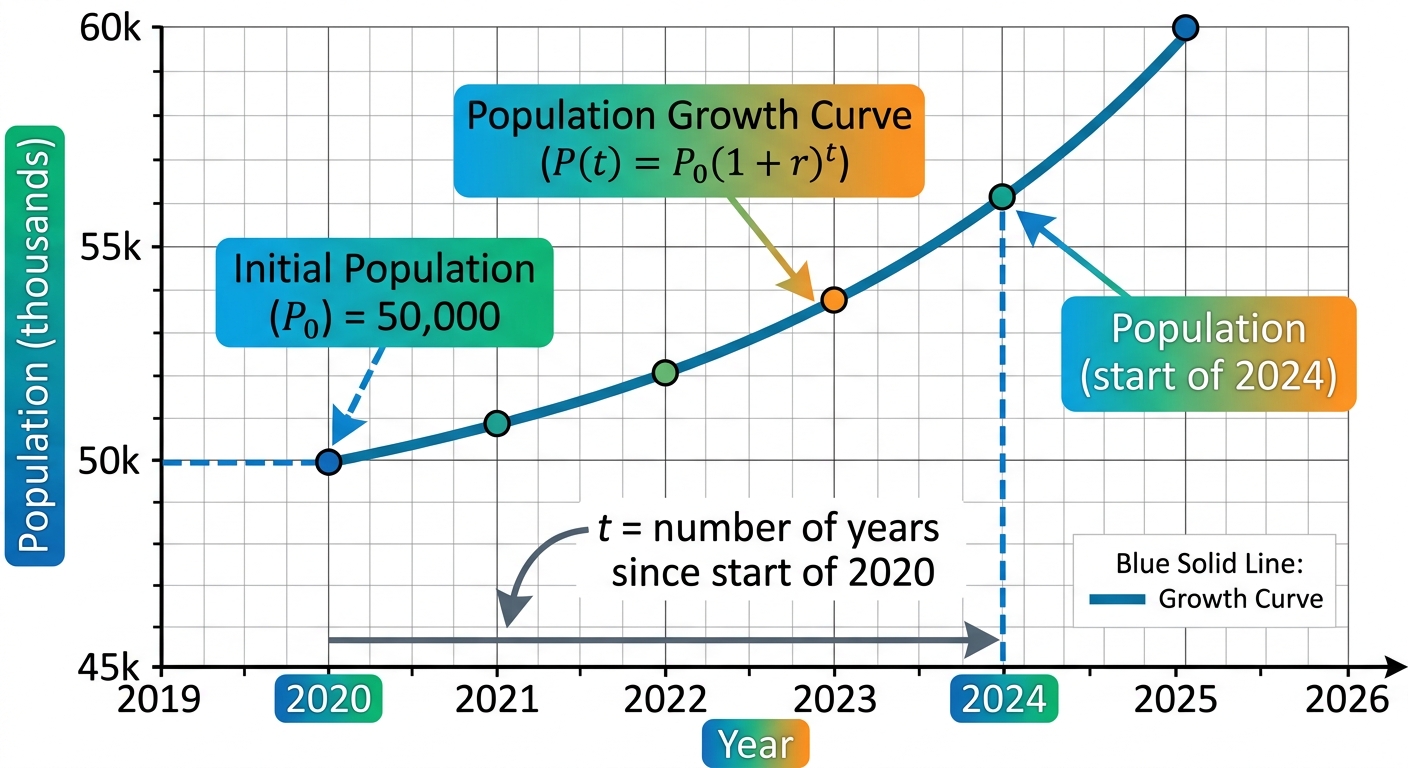
Write down an expression for the population at the start of year , where corresponds to the start of 2020. Hence show that the population at the start of 2024 is approximately .
Find the total number of people added to the city's population during the five-year period from the start of 2020 to the start of 2025. Give your answer correct to the nearest hundred.
revisionprep.com
Summary Answer
Not available for this question.
Model Answer
Not available for this question.
Marking Scheme
Not available for this question.
Examiner Insights
Not available for this question.
Geometric sequences and series
A new smartphone is released. In the first week, units are sold. Each subsequent week, sales fall by compared to the previous week.
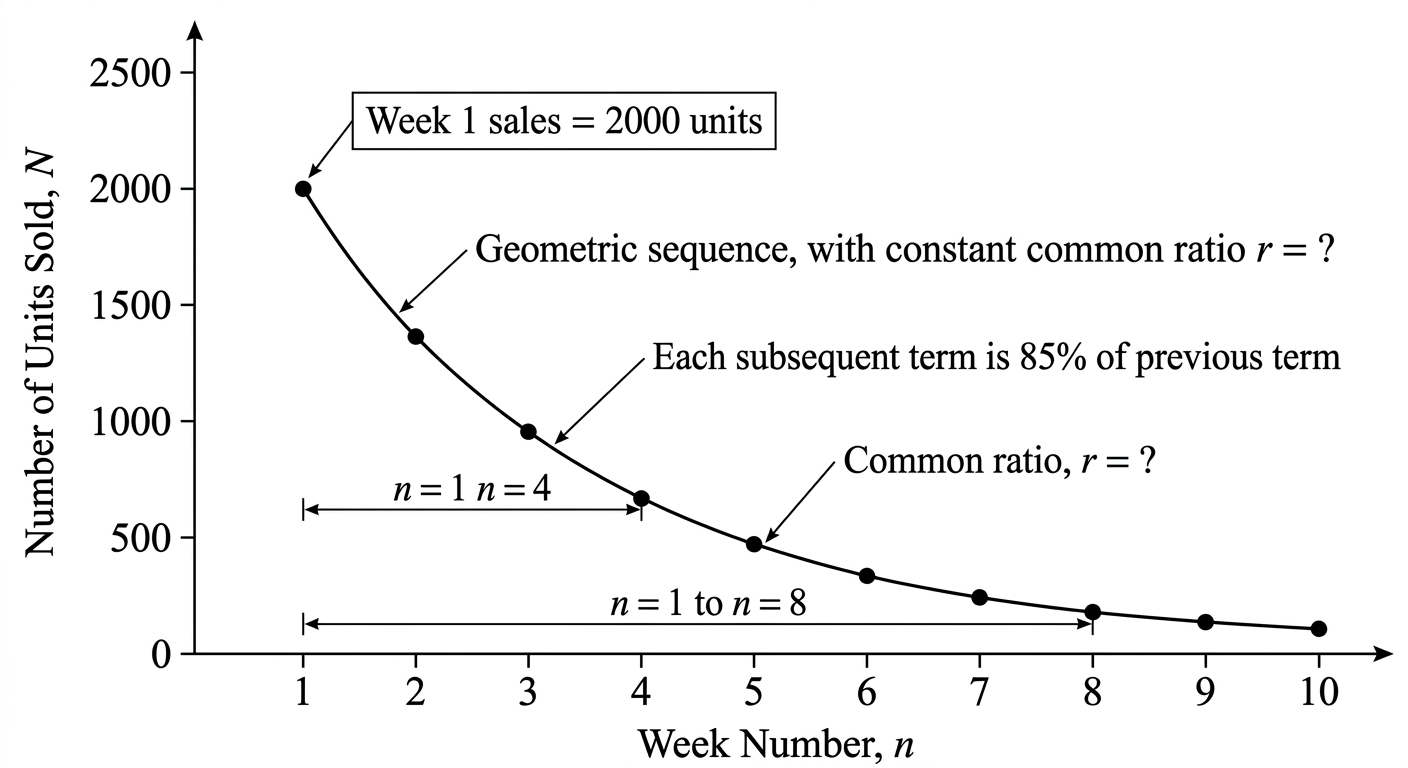
Write down the common ratio of the geometric sequence formed by the weekly sales figures.
Calculate the number of units sold in the 4th week. Give your answer to the nearest integer.
Find the total number of units sold over the first 8 weeks. Give your answer to the nearest integer.
The manufacturer considers the product commercially viable as long as total cumulative sales have not yet reached units. Determine the week in which cumulative sales first exceed units, and hence state whether the product is still commercially viable at the start of that week.
revisionprep.com
Summary Answer
Not available for this question.
Model Answer
Not available for this question.
Marking Scheme
Not available for this question.
Examiner Insights
Not available for this question.
Financial applications: compound interest and depreciation
A farmer buys a tractor. The table shows its value at the end of the first two years. The value depreciates by the same percentage each year.

Show that the annual rate of depreciation is .
Find the value of the tractor at the end of year .
Write down the total depreciation in the first two years.
revisionprep.com
Summary Answer
Not available for this question.
Model Answer
Not available for this question.
Marking Scheme
Not available for this question.
Examiner Insights
Not available for this question.
Sum of infinite convergent geometric sequences
After an appeal, a charity receives donations each month. The table shows the donations in the first three months. The donations form a geometric sequence.

Find the donation in month .
Assuming the pattern continues indefinitely, find the total amount the charity will receive.
revisionprep.com
Summary Answer
Not available for this question.
Model Answer
Not available for this question.
Marking Scheme
Not available for this question.
Examiner Insights
Not available for this question.
Sum of infinite convergent geometric sequences
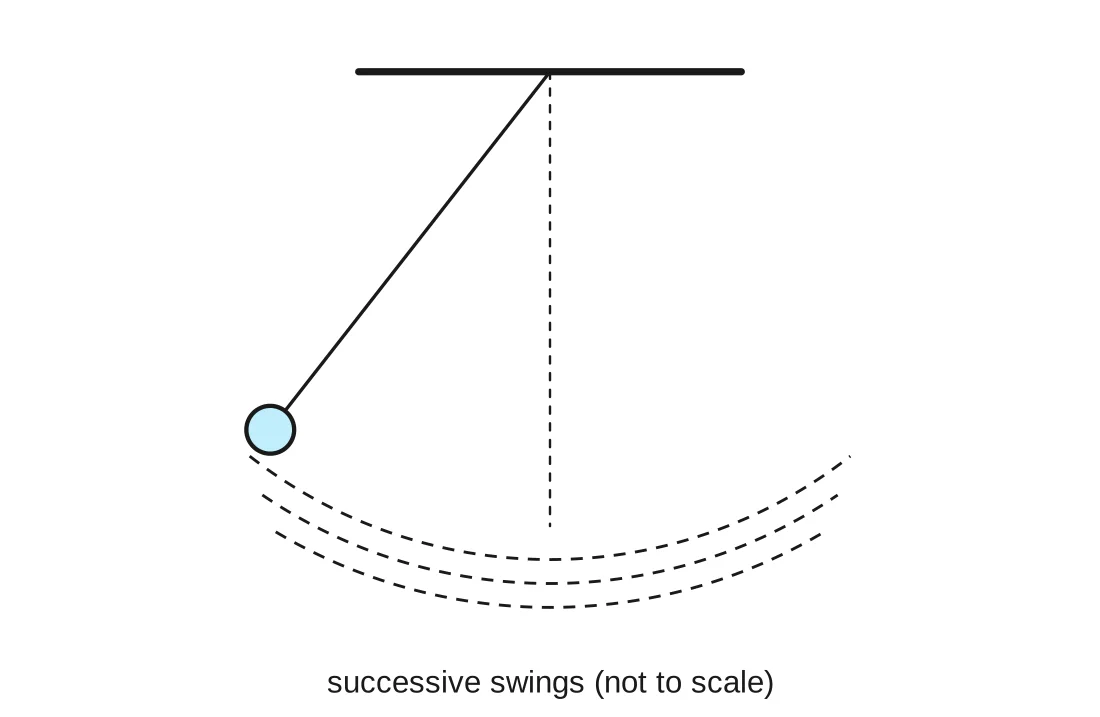
A pendulum is released and swings to and fro, as shown in the diagram. The bob travels cm along its arc on the first swing. On each later swing it travels of the distance of the swing before.
Find the distance travelled on the fifth swing.
Find the total distance travelled in the first swings.
Find the total distance the bob would travel if it continued to swing indefinitely.
revisionprep.com
Summary Answer
Not available for this question.
Model Answer
Not available for this question.
Marking Scheme
Not available for this question.
Examiner Insights
Not available for this question.
Medium9 questions
Arithmetic sequences and series
A construction company is building a staircase. The first step has a height of . Each subsequent step has a height greater than the previous step.
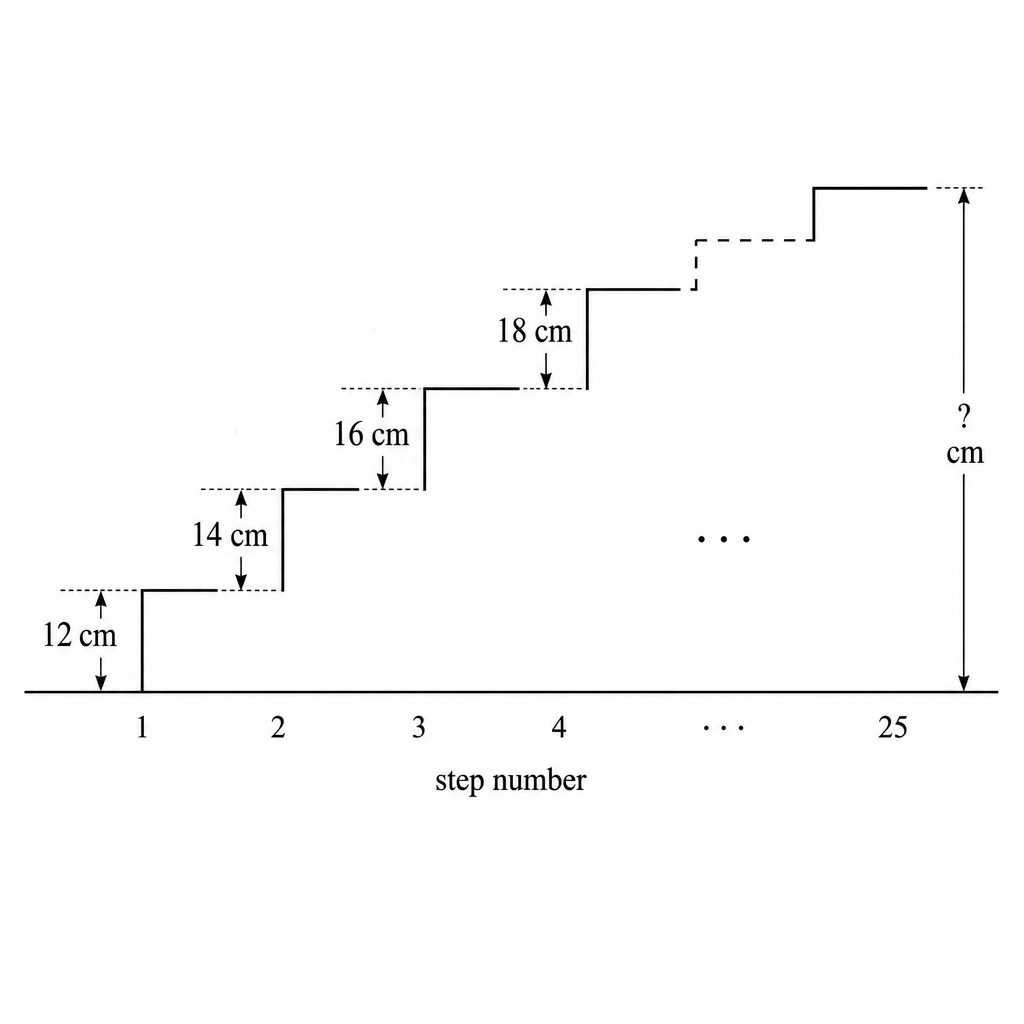
Calculate the height of the 25th step.
Show that the total vertical height of a staircase with 25 steps is exactly .
The company needs the total vertical height to exceed . Determine the minimum number of steps required.
revisionprep.com
Summary Answer
Not available for this question.
Model Answer
Not available for this question.
Marking Scheme
Not available for this question.
Examiner Insights
Not available for this question.
Arithmetic sequences and series
The diagram shows cylindrical containers whose heights form an arithmetic sequence. The rd container is high and the th is high.
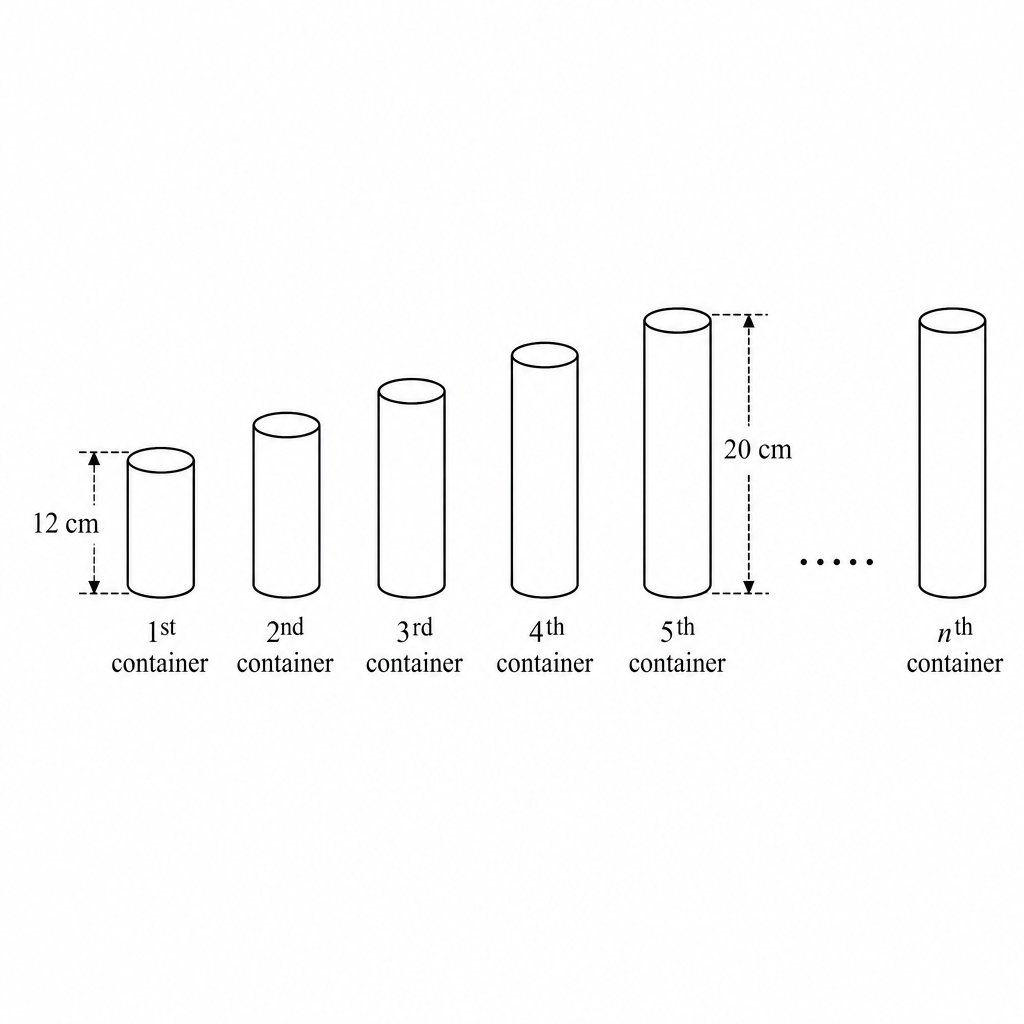
Find the common difference and the height of the first container.
Find the height of the th container.
Find the least number of containers whose total height is at least .
revisionprep.com
Summary Answer
Not available for this question.
Model Answer
Not available for this question.
Marking Scheme
Not available for this question.
Examiner Insights
Not available for this question.
Arithmetic sequences and series
Two investments are made on the same day. Investment A is €4000 at per year, compounded annually. Investment B is €6000 at per year, compounded annually. The graph shows the value , in thousands of euros, of each investment years after it was made.
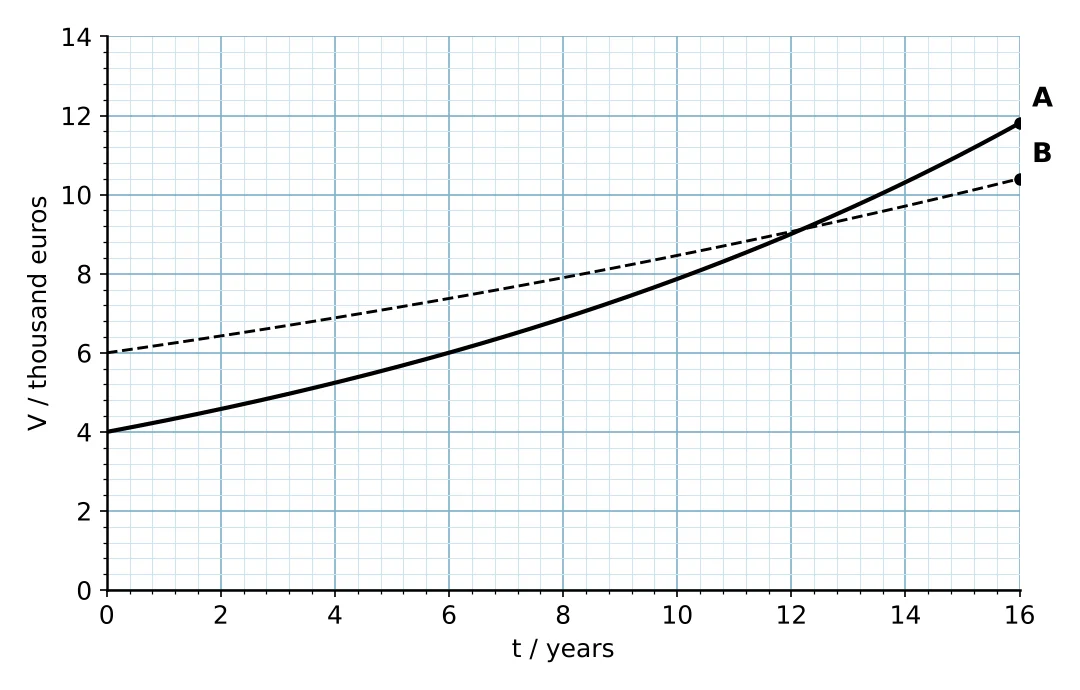
Write down an expression for the value of each investment after years.
Find the value of at which the two investments are worth the same.
Interest is added at the end of each year. Write down the first year at the end of which investment A is worth more than investment B.
Find the difference between the values of the two investments after years.
revisionprep.com
Summary Answer
Not available for this question.
Model Answer
Not available for this question.
Marking Scheme
Not available for this question.
Examiner Insights
Not available for this question.
Arithmetic sequences and series
The graph shows the value , in thousands of dollars, of a delivery truck years after it was bought. The value decreases by the same percentage each year. The graph passes through the points and .
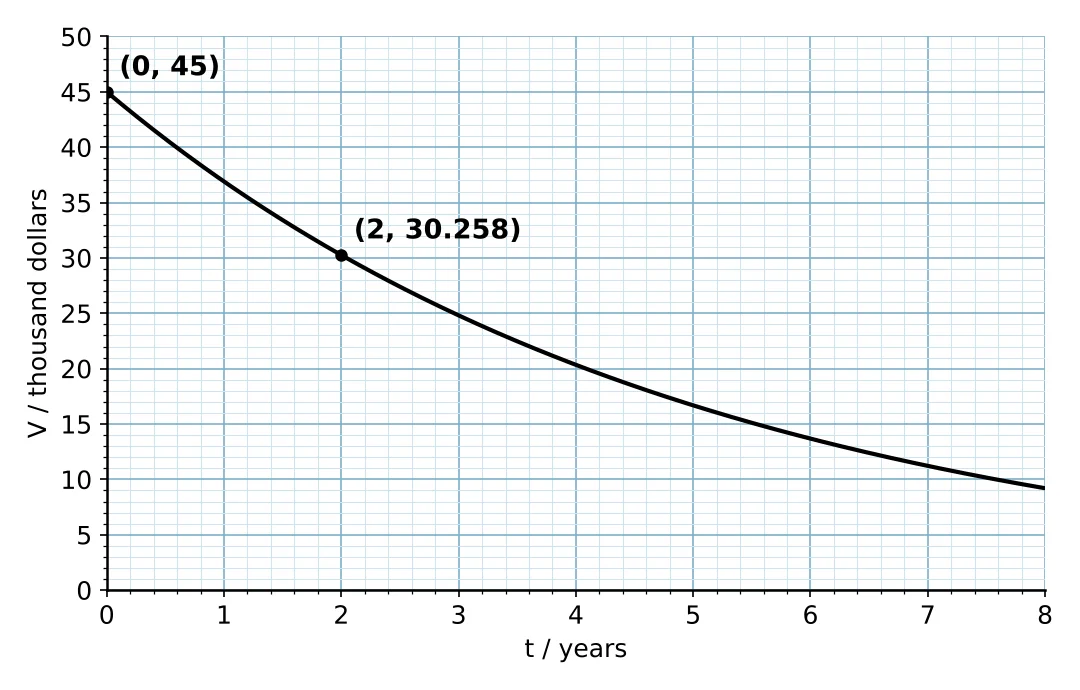
Write down the price paid for the truck.
Find the annual rate of depreciation.
Find the value of the truck after years.
Find the first year at the end of which the value of the truck is less than USD 10 000.
revisionprep.com
Summary Answer
Not available for this question.
Model Answer
Not available for this question.
Marking Scheme
Not available for this question.
Examiner Insights
Not available for this question.
Arithmetic sequences and series
The diagram shows a ladder with rungs. The rungs decrease in length by the same amount from the bottom rung, of length cm, to the top rung, of length cm.
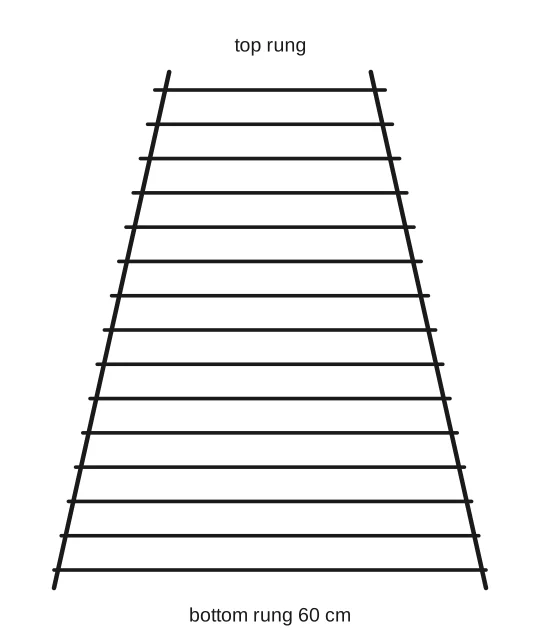
Find the common difference of the lengths.
Find the total length of the rungs.
A taller ladder of the same design has rungs, with the bottom rung cm and each rung cm shorter than the one below. Show that the total length of its rungs is cm.
The total length of rungs in this ladder is cm. Find the possible values of .
Explain which value of is possible.
revisionprep.com
Summary Answer
Not available for this question.
Model Answer
Not available for this question.
Marking Scheme
Not available for this question.
Examiner Insights
Not available for this question.
Geometric sequences and series
The first three terms of a geometric sequence are .
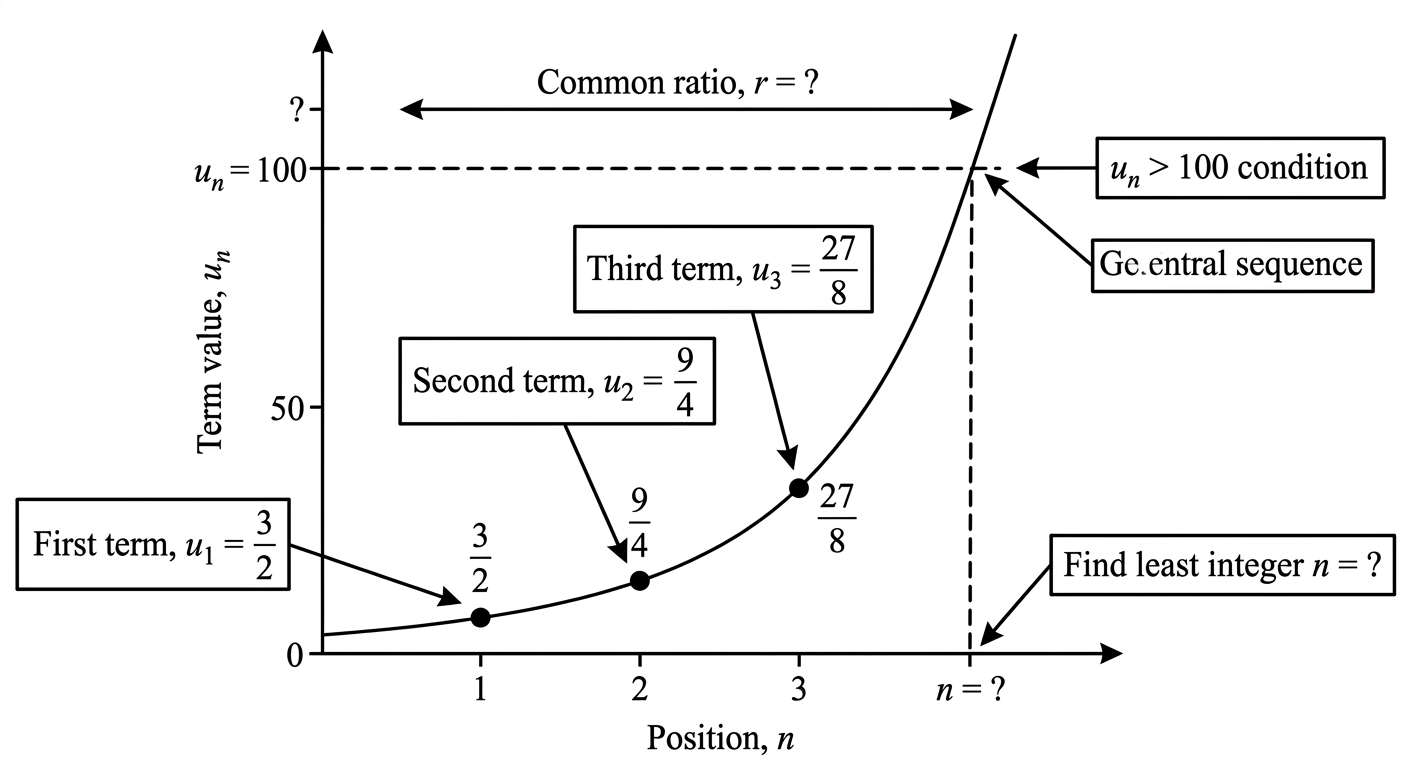
Show that the th term of the sequence is given by .
Hence find the least value of such that .
revisionprep.com
Summary Answer
Not available for this question.
Model Answer
Not available for this question.
Marking Scheme
Not available for this question.
Examiner Insights
Not available for this question.
Geometric sequences and series
A bacteria culture is modelled by a geometric sequence: on day 1 and on day 4.
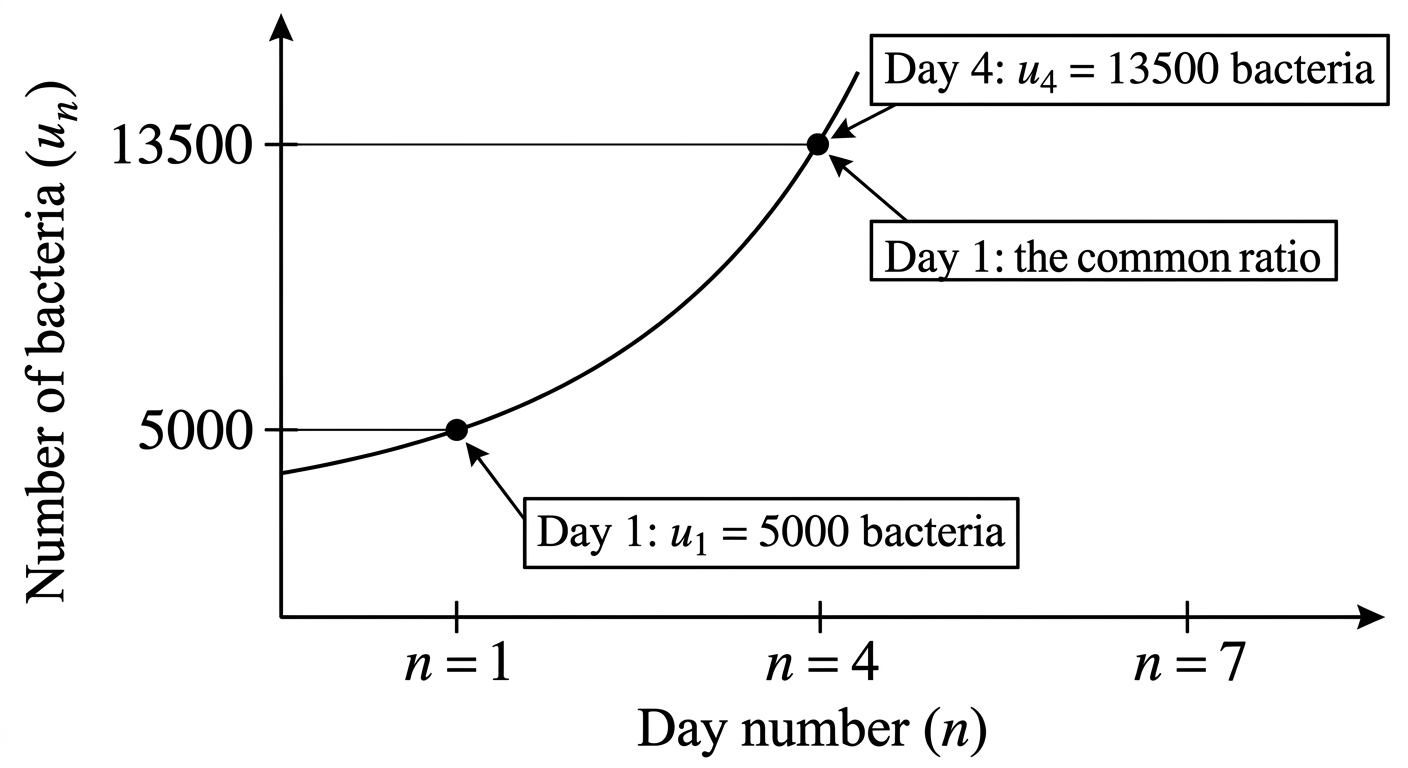
Find the common ratio, to 3 significant figures.
Show that the model gives on day 7.
Find the first day on which the culture exceeds .
revisionprep.com
Summary Answer
Not available for this question.
Model Answer
Not available for this question.
Marking Scheme
Not available for this question.
Examiner Insights
Not available for this question.
Sum of infinite convergent geometric sequences
A geometric series has first term and common ratio . The graph shows the partial sums for and the line .
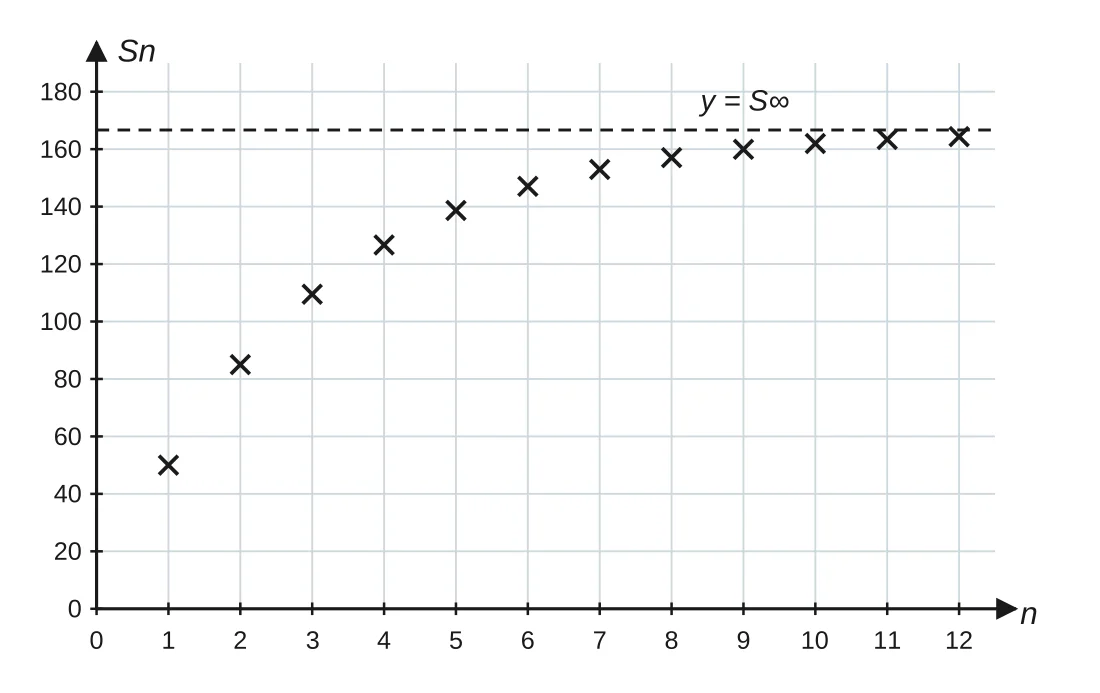
Find the value of .
Find the least value of for which .
revisionprep.com
Summary Answer
Not available for this question.
Model Answer
Not available for this question.
Marking Scheme
Not available for this question.
Examiner Insights
Not available for this question.
Sum of infinite convergent geometric sequences
A patient takes a mg dose of a medicine every hours. By the time the next dose is taken, of the amount in the body from earlier doses remains. The graph shows the amount mg of medicine in the body hours after the first dose, for .
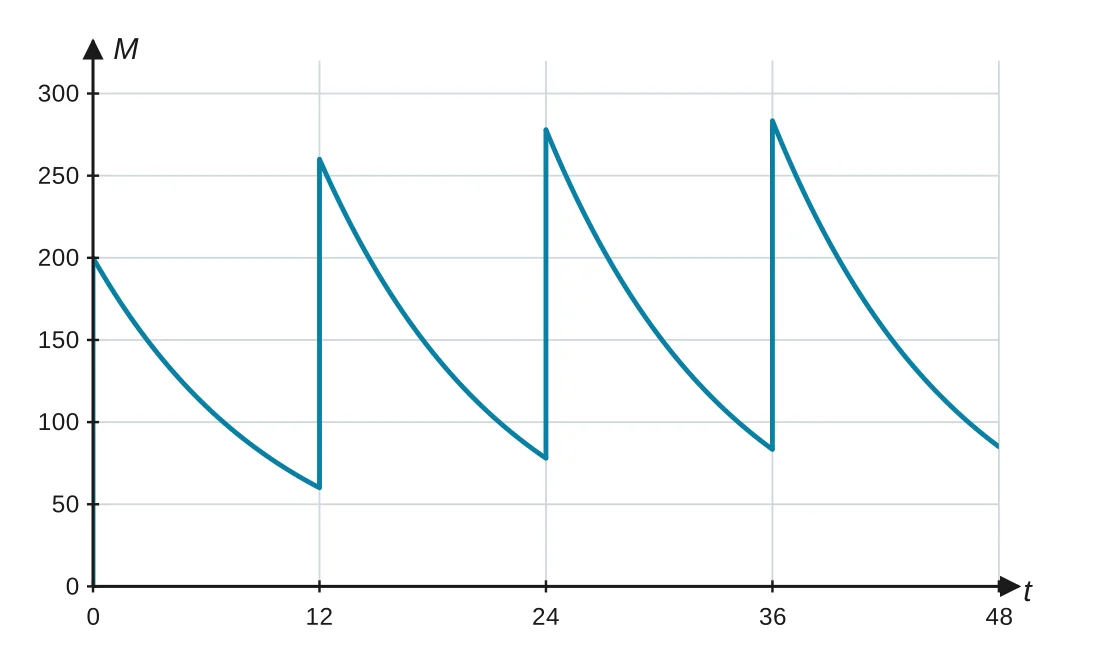
Show that the amount in the body just after the second dose is mg.
Show that the amount in the body just after the th dose is mg.
Find the amount in the body just after the third dose.
Find the amount that the amount just after each dose approaches in the long term.
Find the least number of doses after which the amount just after a dose is within mg of the long-term amount.
revisionprep.com
Summary Answer
Not available for this question.
Model Answer
Not available for this question.
Marking Scheme
Not available for this question.
Examiner Insights
Not available for this question.
Challenge8 questions
Arithmetic sequences and series
Sam invests USD at simple interest per year. Ana invests USD at per year compounded annually.
Show that Sam's investment after years forms an arithmetic sequence, and write down its common difference.
Find the value of each investment after years.
Find the first whole number of years after which Ana's investment is worth more than Sam's.
revisionprep.com
Summary Answer
Not available for this question.
Model Answer
Not available for this question.
Marking Scheme
Not available for this question.
Examiner Insights
Not available for this question.
Arithmetic sequences and series
Noor borrows USD from a family member, interest-free. She repays USD in month , and each month she repays USD less than the month before.
Find her repayment in month .
Show that the total repaid after months is dollars.
Find the number of months needed to repay the loan.
Explain why the other solution of the equation in part (c) is not valid.
Find the total she repays in the last months.
revisionprep.com
Summary Answer
Not available for this question.
Model Answer
Not available for this question.
Marking Scheme
Not available for this question.
Examiner Insights
Not available for this question.
Geometric sequences and series
A ball is dropped from a height of . The time taken to fall from height metres is given by seconds, where . After each bounce, the ball rebounds to of its previous height.
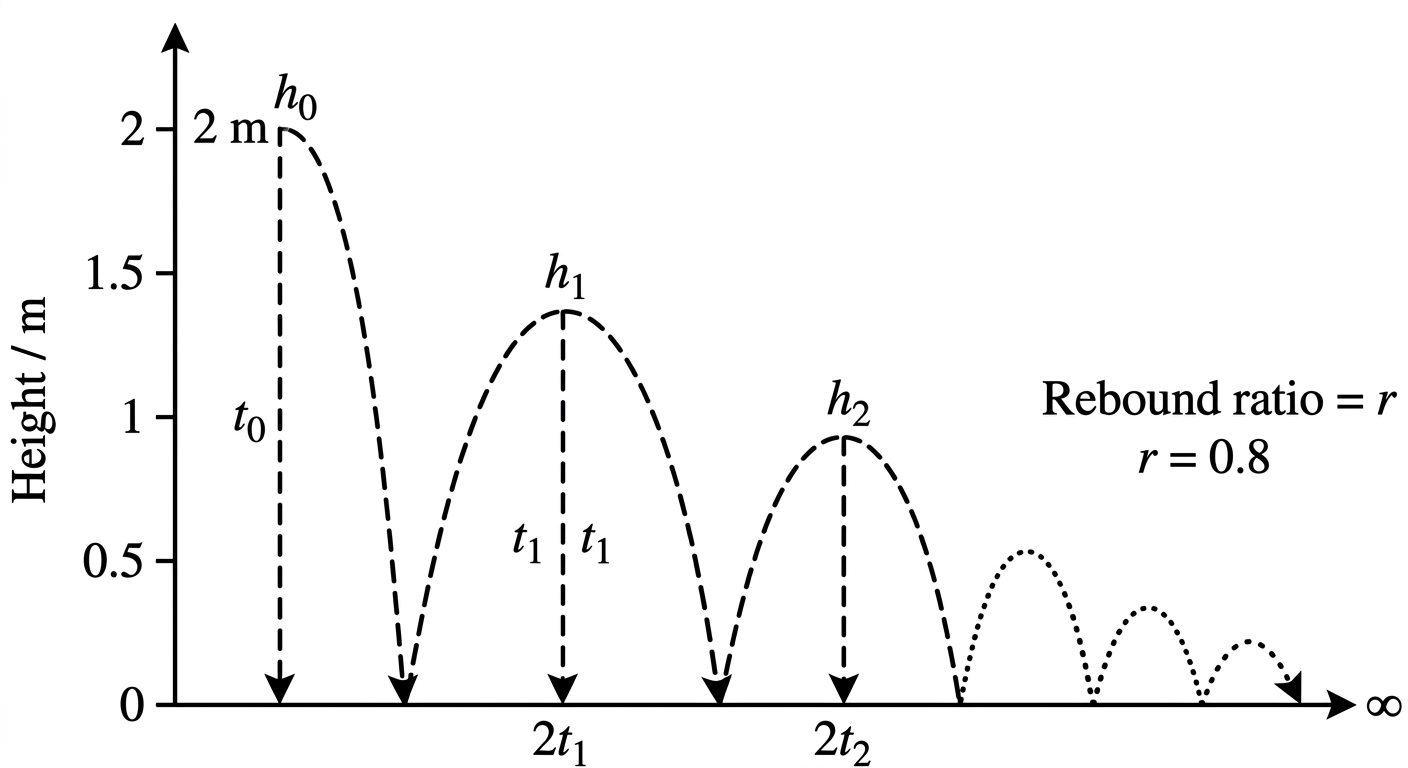
Show that the time for the ball to fall the initial is seconds.
Determine the total time, in seconds, that the ball is in motion from the moment is dropped until it comes to rest. Give your answer correct to 3 significant figures.
revisionprep.com
Summary Answer
Not available for this question.
Model Answer
Not available for this question.
Marking Scheme
Not available for this question.
Examiner Insights
Not available for this question.
Geometric sequences and series
A ball is dropped from a height of . On each bounce, it rebounds to of the height from which it fell.
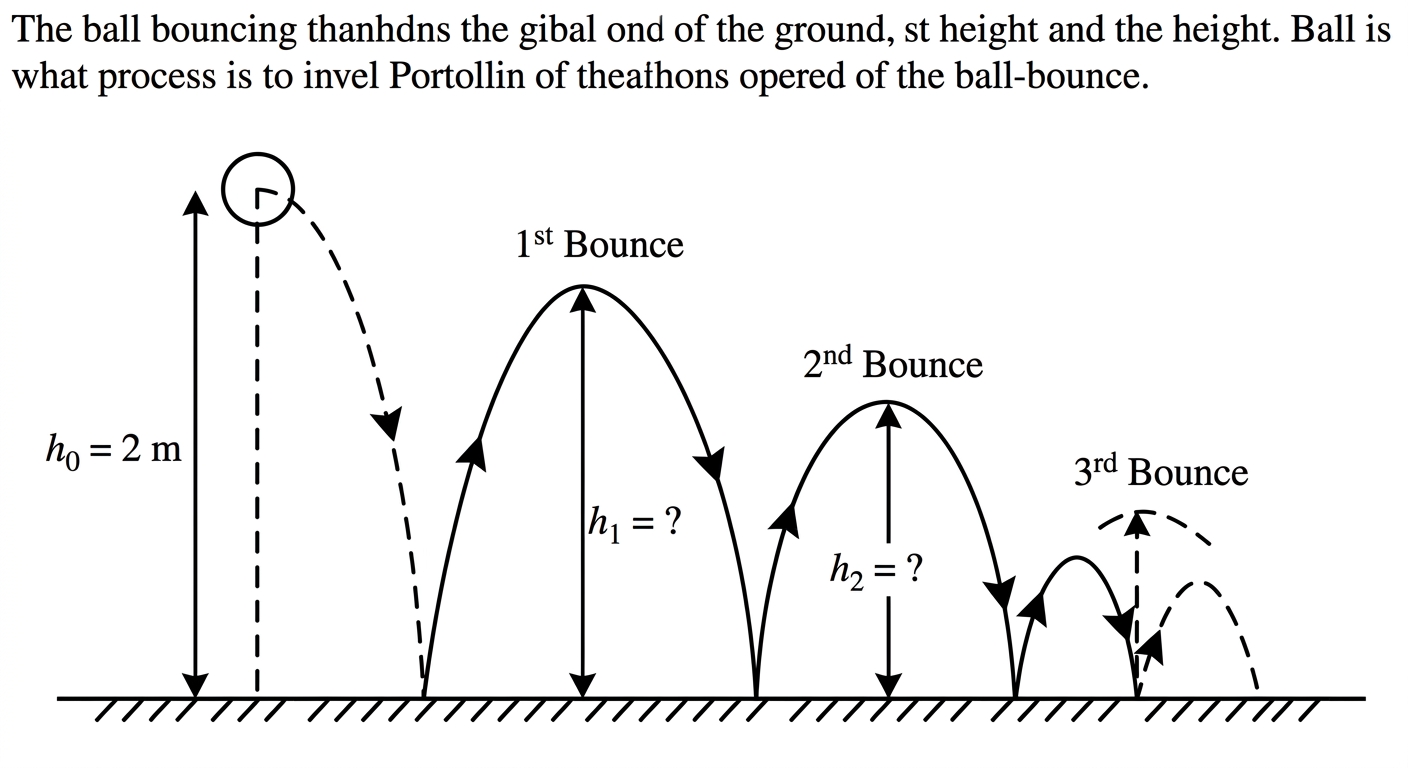
Determine the total vertical distance travelled by the ball from the moment is dropped until it hits the ground for the 8th time. Give your answer in metres correct to 3 significant figures.
A bounce is defined as one complete up-and-down movement after a ground contact. The ball is considered to have stopped bouncing when the vertical distance of a single bounce is less than . Determine the number of complete bounces that occur before the ball stops.
revisionprep.com
Summary Answer
Not available for this question.
Model Answer
Not available for this question.
Marking Scheme
Not available for this question.
Examiner Insights
Not available for this question.
Geometric sequences and series
A sculptor stacks solid cubes, as shown in the diagram. The bottom cube has side cm, and each cube has sides of the length of the sides of the cube below it.
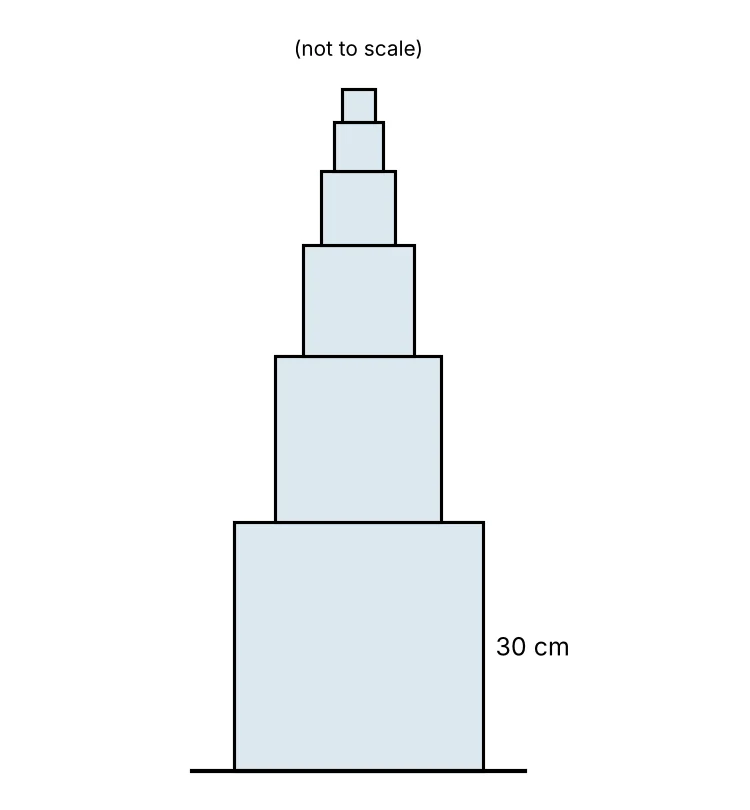
Find the side lengths of the second and third cubes.
Find the height of a stack of cubes.
Find the height the stack would approach if cubes could be added without end.
Find the total volume of all the cubes in the stack in (c).
The stack must fit under a shelf cm above the floor. Find the greatest number of cubes the sculptor can use.
revisionprep.com
Summary Answer
Not available for this question.
Model Answer
Not available for this question.
Marking Scheme
Not available for this question.
Examiner Insights
Not available for this question.
Financial applications: compound interest and depreciation
Two savings accounts are offered as shown in the table. An amount of dollars is invested in account A and dollars in account B, at the same time. After years the two accounts have the same value.

Show that .
Find the value of .
Show that after years the value of account B is exactly times the value of account A.
Explain why account B is worth more than account A at the end of every year after year .
revisionprep.com
Summary Answer
Not available for this question.
Model Answer
Not available for this question.
Marking Scheme
Not available for this question.
Examiner Insights
Not available for this question.
Financial applications: compound interest and depreciation
A printing machine is bought for USD 75 000. For the first years its value decreases by per year. The graph shows its value dollars for , where is the time in years. At , .
From the end of year , the value decreases by per year.
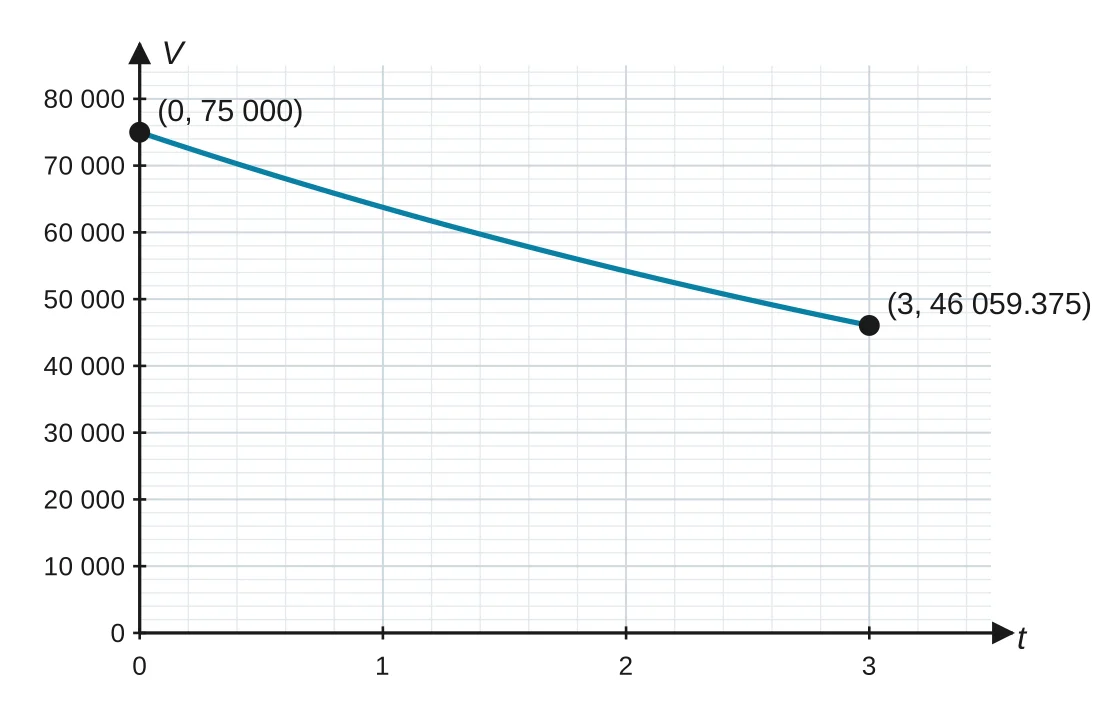
Find the value of .
Find the value of the machine at the end of year .
Find the first year at the end of which the value of the machine is less than of the price paid.
An accountant wants to use one constant rate of depreciation, per year, that gives the same value at the end of year . Find .
revisionprep.com
Summary Answer
Not available for this question.
Model Answer
Not available for this question.
Marking Scheme
Not available for this question.
Examiner Insights
Not available for this question.
Sum of infinite convergent geometric sequences
Square has sides of length cm. Points are marked on each side, a quarter of the way along it, as shown in the diagram, so that cm and cm. These points are joined to form a second square. The process is repeated without end, each time a quarter of the way along each side of the latest square.
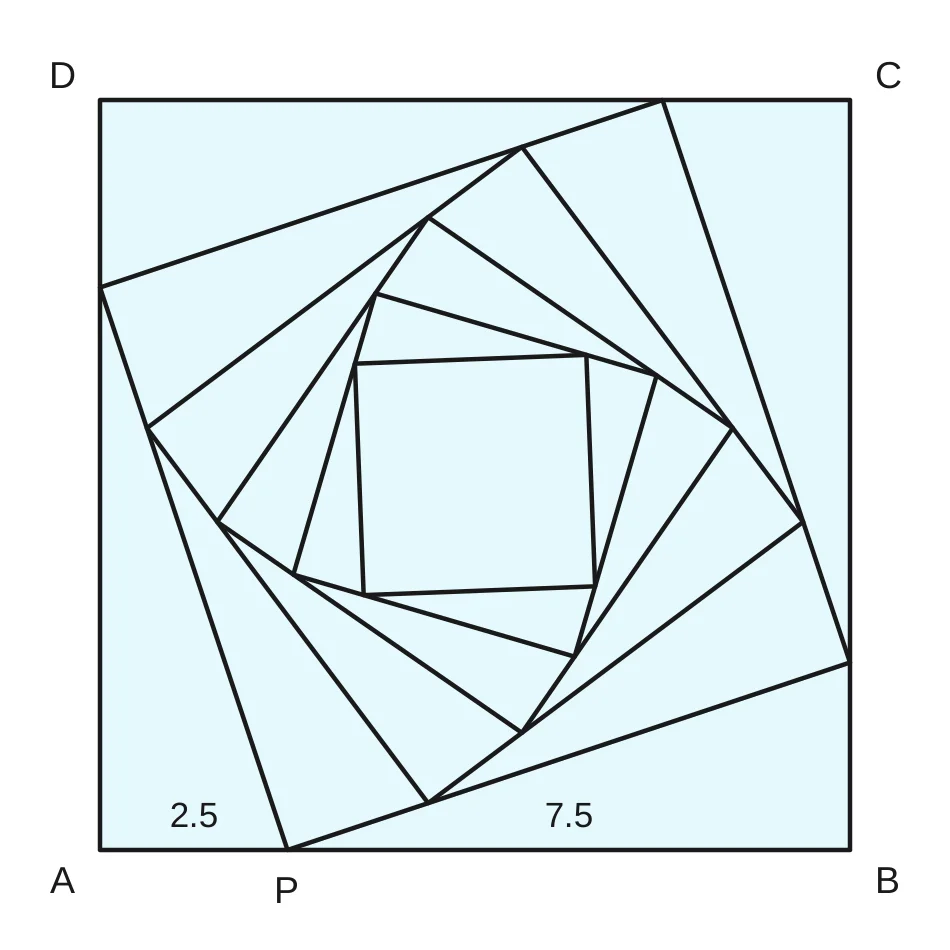
Show that the second square has side cm.
Write down the common ratio of the areas of the squares.
Find the total area of all the squares, including .
Find the total perimeter of all the squares.
The points are instead marked a fraction of the way along each side, where . Find the values of for which the total area of all the squares is cm.
revisionprep.com
Summary Answer
Not available for this question.
Model Answer
Not available for this question.
Marking Scheme
Not available for this question.
Examiner Insights
Not available for this question.
That's every free question here — 25 of 214.
+189 more questions, plus Mock Papers & Worksheets, are waiting in Premium.