You're viewing 3 free preview questions for Maths AI HL — subscribe to unlock 269 more, plus the Full Question Bank, Mock Papers & Worksheets.Upgrade
Integration and Its Applications · Paper 1 — Free Maths AI HL Practice Questions
1FoundationSAQ-SIndefinite integrals and their properties8 marksPaper 1~12 min

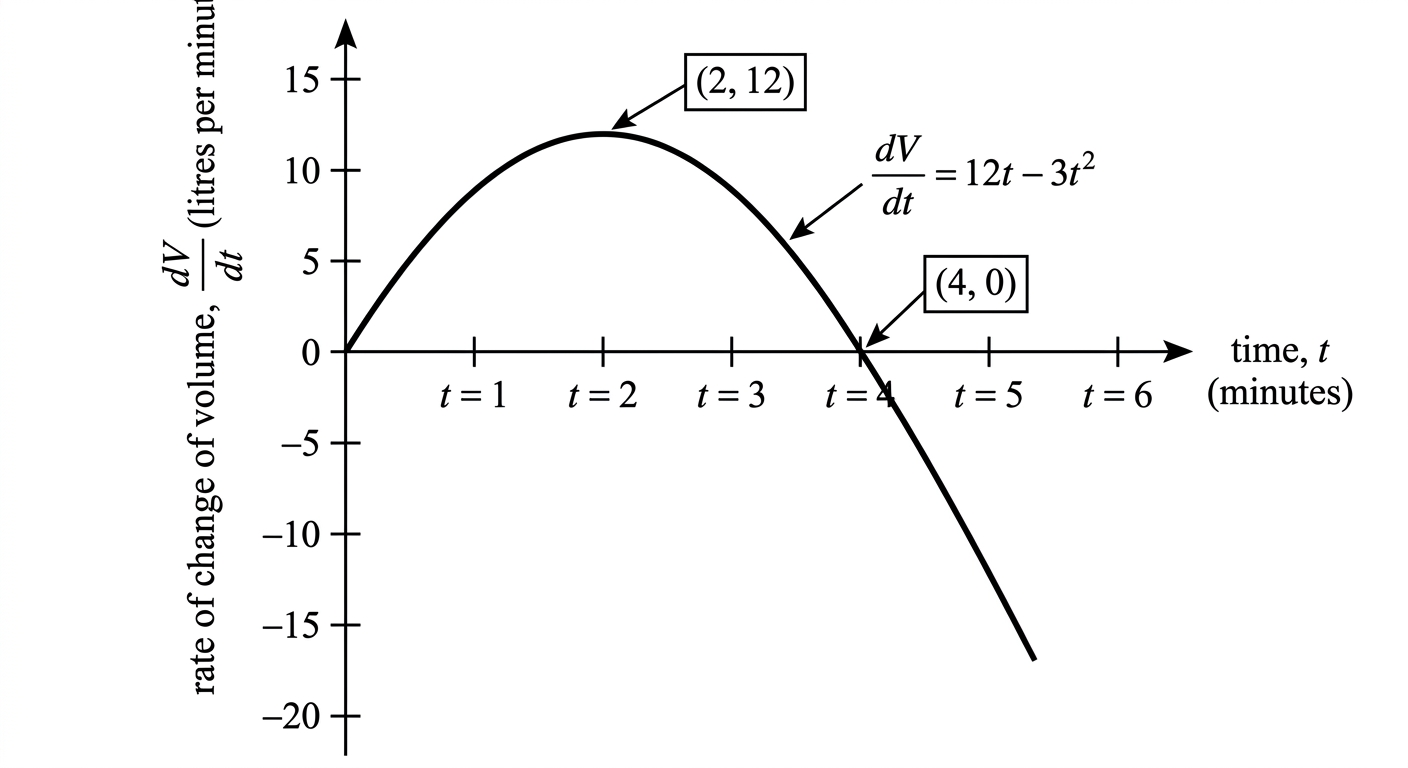
The rate of change of the volume of water in a tank, measured in litres per minute, is given by
where is the time in minutes, .
(a)
State the values of for which the volume of water in the tank is increasing. [1 mark]
(b)
Find , given that the tank initially contains litres of water. [4 marks]
(c)
Determine the maximum volume of water in the tank and justify that is a maximum. [3 marks]

Solutions
2MasterySAQ-SIndefinite integrals and their properties5 marksPaper 1~8 min
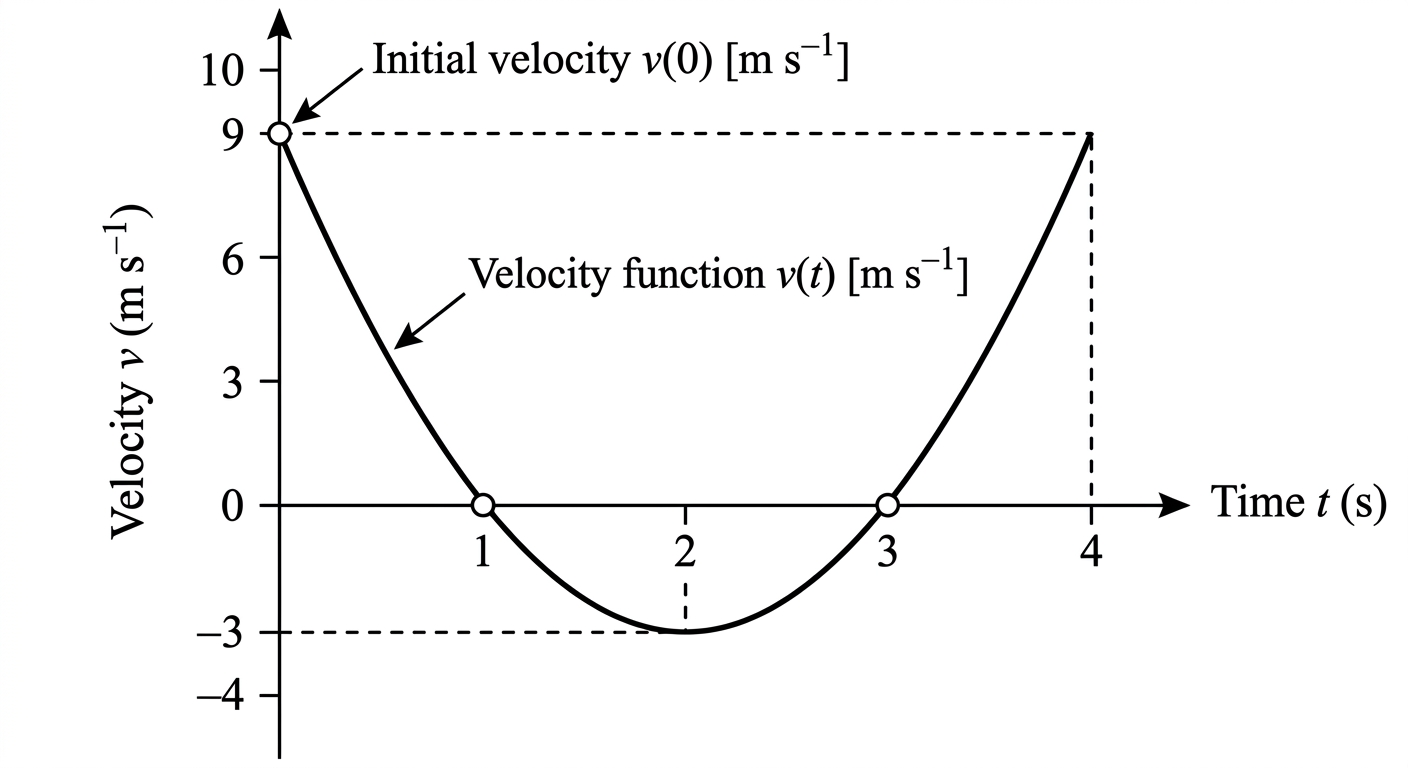
A particle moves along a straight line. Its velocity at time seconds is given by , for .
(a)
Show that the displacement metres of the particle from its starting point is . [2 marks]
(b)
Calculate the total distance travelled by the particle in the first seconds. [3 marks]
Solutions
3ChallengeSAQ-LIndefinite integrals and their properties8 marksPaper 1~12 min
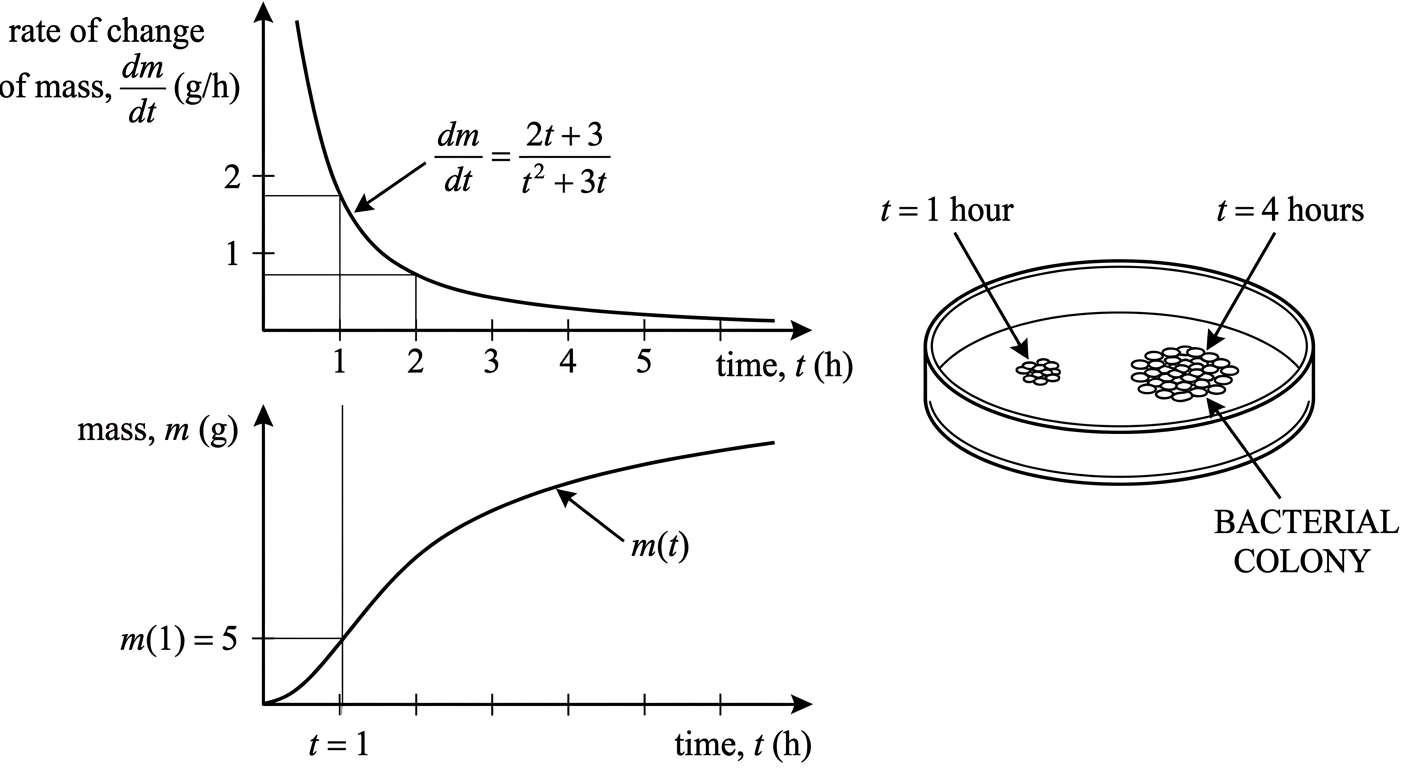
A biologist is modelling the growth of a bacterial colony. The rate of change of the mass (in grams) of the colony with respect to time (in hours) is given by
At time hour, the mass of the colony is grams.
(a)
Determine an expression for , the mass of the colony at time . Give your answer in the form , where is a function of and is a constant. [4 marks]
(b)
Calculate the mass of the colony after hours, correct to 3 significant figures. [2 marks]
(c)
A second biologist claims this model predicts that the colony's mass will eventually exceed any fixed value, no matter how large. Evaluate this claim by analysing the behaviour of as , and comment on whether the model is realistic for large . [2 marks]
Solutions
That's every free question here — 3 of 272.
+269 more questions, plus Mock Papers & Worksheets, are waiting in Premium.