You're viewing 1 free preview question for Maths AI HL — subscribe to unlock 7 more, plus the Full Question Bank, Mock Papers & Worksheets.Upgrade
Differential Equations · Paper 3 — Free Maths AI HL Practice Questions
1ChallengeLAQSolving first-order differential equations6 marksPaper 3~9 min

A pharmaceutical company is developing a new drug. The rate at which the drug is absorbed into the bloodstream is modelled by the differential equation
where is the concentration of the drug (in ) at time hours after administration, and is a positive constant. Initially, .
(a)
Prove that the general solution to the differential equation is
[5 marks]
(b)
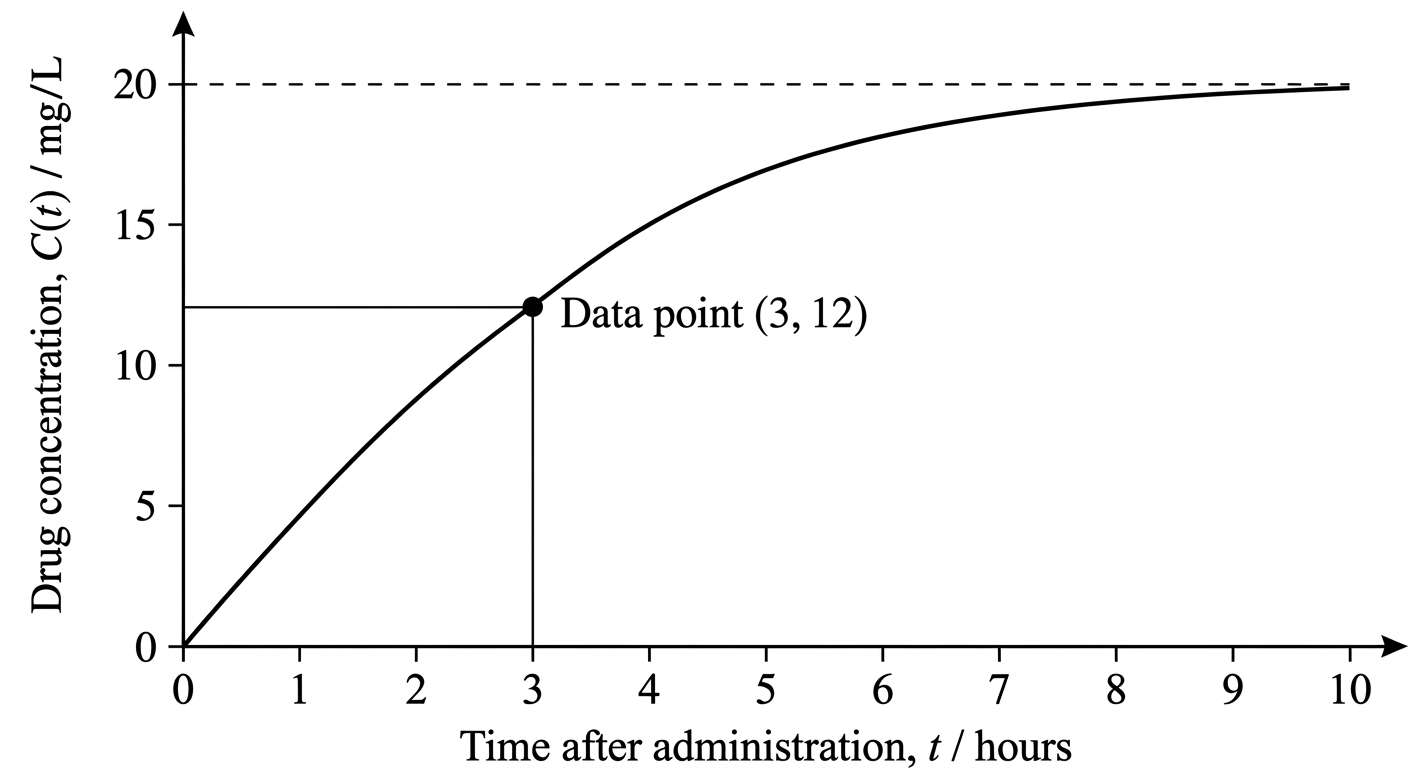
After 3 hours, the concentration is measured as .
(i) Calculate the value of , giving your answer correct to three significant figures. [2 marks]
(ii) A concentration of at least is required for the drug to be therapeutically effective. Determine the time, to the nearest minute, at which this threshold is first reached. [2 marks]
(iii) The drug is considered unsafe if the concentration ever reaches . Using your model, evaluate whether the drug can be administered safely for an indefinite period. Justify your answer with reference to the behaviour of as . [1 mark]
(ii) A concentration of at least is required for the drug to be therapeutically effective. Determine the time, to the nearest minute, at which this threshold is first reached. [2 marks]
(iii) The drug is considered unsafe if the concentration ever reaches . Using your model, evaluate whether the drug can be administered safely for an indefinite period. Justify your answer with reference to the behaviour of as . [1 mark]

Solutions
That's every free question here — 1 of 8.
+7 more questions, plus Mock Papers & Worksheets, are waiting in Premium.