Modelling with Functions · Paper 2 — Free Maths AI HL Practice Questions
Free questions
Open in full, with answers, mark scheme and examiner insights.
Linear and quadratic models
The value of a delivery van, dollars, years after it is bought is modelled by . The graph of the model is shown.
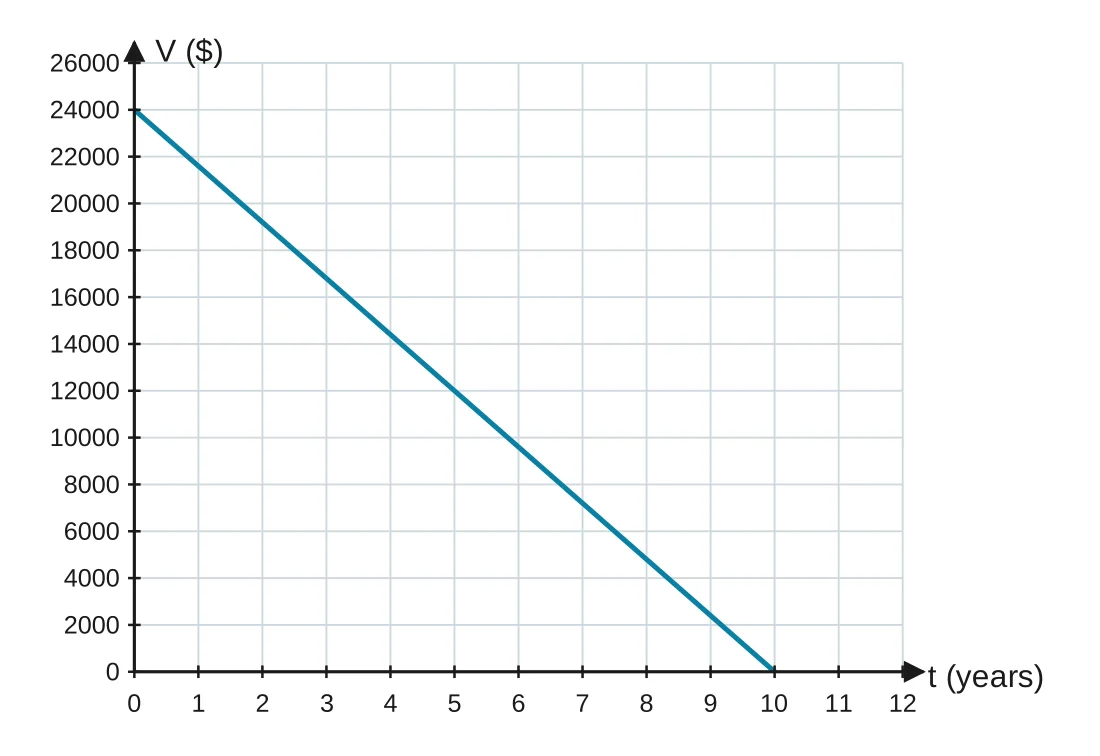
Interpret the value in context.
Find the value of the van after 3 years.
Find the time taken for the value to fall to USD 6000.
State a suitable domain for this model.
A second van is bought at the same time for USD 28 800 and loses USD 3000 in value each year. Find the time at which the two vans have the same value, and this value.
revisionprep.com
Summary Answer
Not available for this question.
Model Answer
Not available for this question.
Marking Scheme
Not available for this question.
Examiner Insights
Not available for this question.
Sinusoidal models
The graph shows the daily average temperature, , in a city, months after 1 January, over two years. The curve passes through and . It is modelled by , where the angle is in degrees.
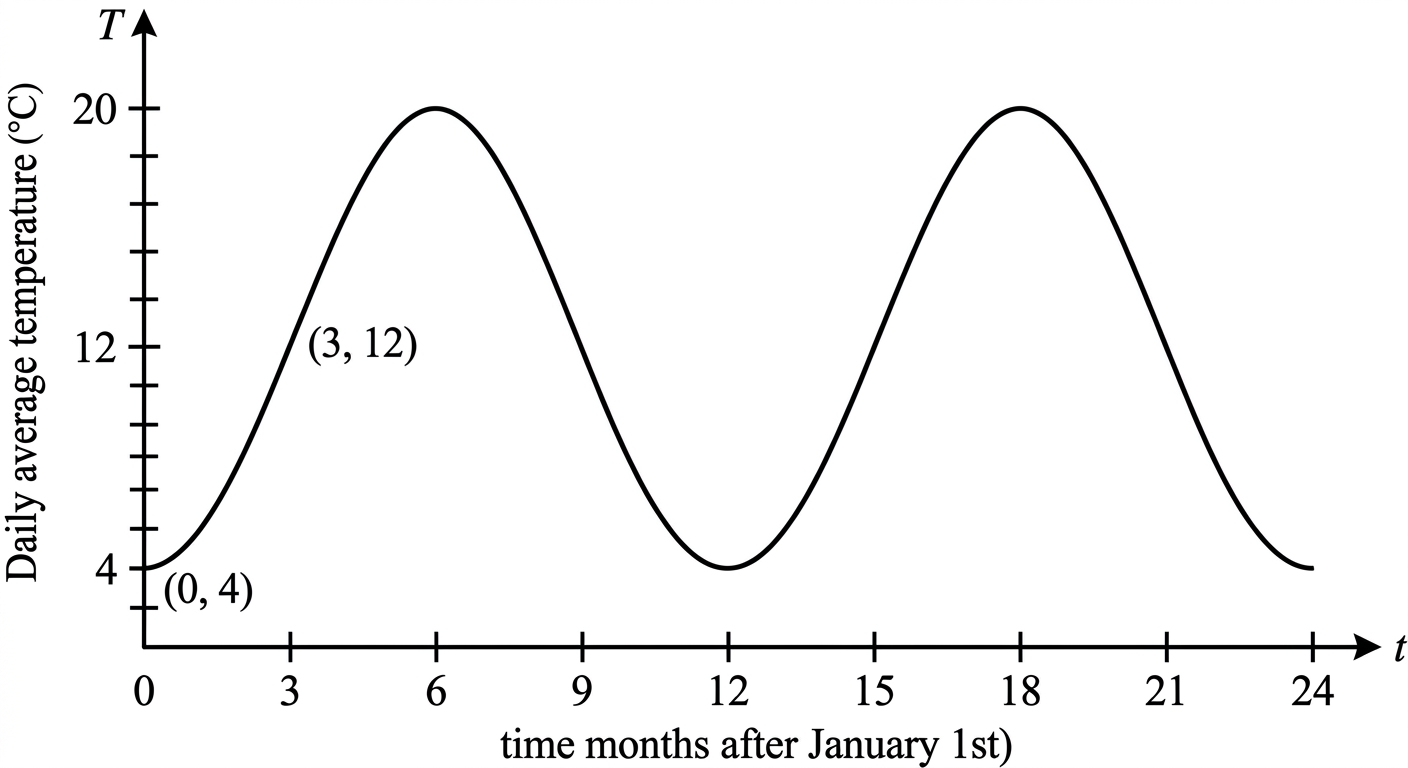
Use the graph to find the values of , and .
Show that the model passes through .
Find the temperature predicted for .
Find the number of months each year with a daily average temperature above .
Explain why the graph shows the same pattern in both years.
Write down the lowest daily average temperature given by the model.
revisionprep.com
Summary Answer
Not available for this question.
Model Answer
Not available for this question.
Marking Scheme
Not available for this question.
Examiner Insights
Not available for this question.
Exponential models
The population of a bee colony, thousand, years after it is established is modelled by . The graph of passes through , as shown.
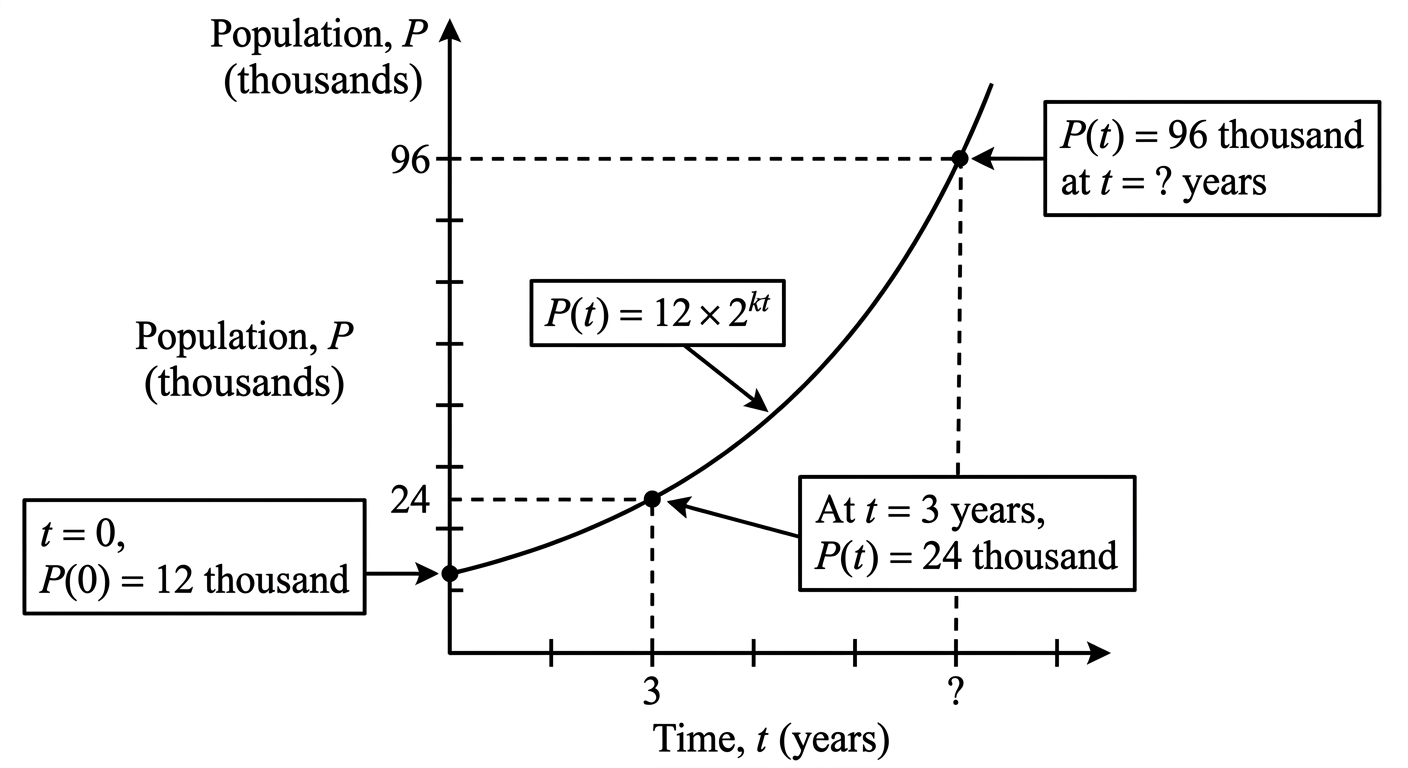
Find the value of .
Find the value of at which the population reaches 96 thousand.
A second colony is modelled by . Find the value of at which the two colonies have the same population. Give your answer correct to three significant figures.
Find the population of each colony when , and state which colony is larger at that time.
revisionprep.com
Summary Answer
Not available for this question.
Model Answer
Not available for this question.
Marking Scheme
Not available for this question.
Examiner Insights
Not available for this question.
The modelling process
A café in Zürich sells hot chocolate. On six days the manager records the midday temperature, °C, and the number of cups of hot chocolate sold, . The results are shown in the table.

Write down the value of Pearson's product-moment correlation coefficient, , and describe the correlation between and .
Find the equation of the regression line of on .
Interpret the gradient of the regression line in context.
Use the regression line to predict the number of cups sold when the temperature is 10 °C.
The café makes €1.50 profit on each cup and has fixed costs of €75 per day for this drink. Show that the daily profit from hot chocolate, euros, is modelled by , with the coefficients correct to three significant figures.
Find the highest temperature at which the café makes no loss on hot chocolate.
Use the regression line to predict the number of cups sold at 25 °C, and comment on your answer.
Suggest one factor other than temperature that may affect the number of cups sold.
revisionprep.com
Summary Answer
Not available for this question.
Model Answer
Not available for this question.
Marking Scheme
Not available for this question.
Examiner Insights
Not available for this question.
Direct and inverse variation and cubic models
A shop sells circular rugs and square rugs, all of the same material, as shown in the diagram.
The price, , of a circular rug varies directly as the square of its diameter, metres. A circular rug of diameter 1.2 m costs £72.
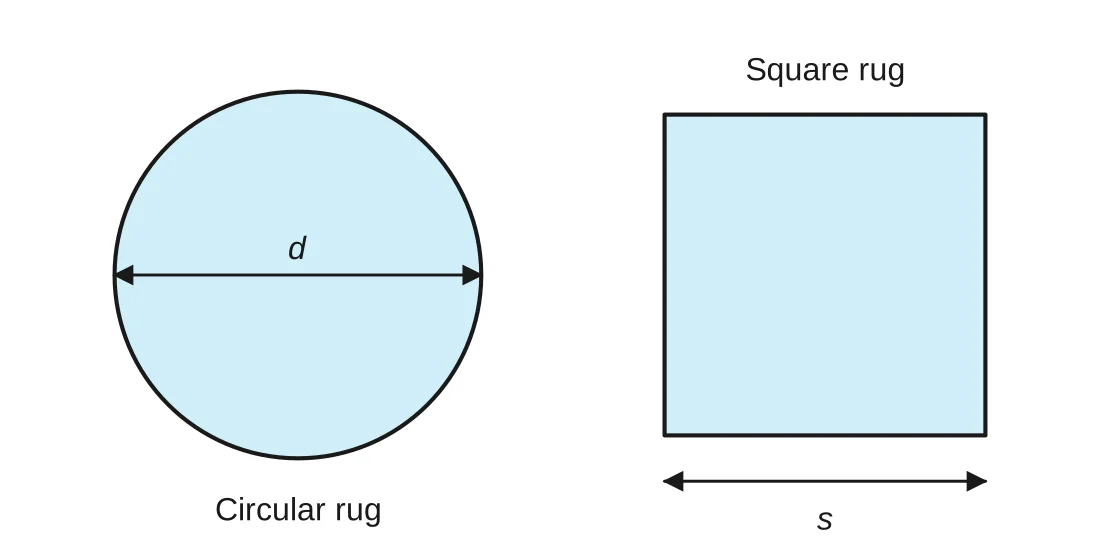
Find the price of a circular rug of diameter 1.8 m.
Find the largest diameter of circular rug that can be bought for £200.
The price of a square rug varies directly as the square of its side length, metres. A square rug with side 1.5 m costs £90.
Show that the price per square metre of a circular rug is the same for every diameter, and find this price.
Hence determine which shape gives the cheaper floor covering per square metre. Justify your answer.
revisionprep.com
Summary Answer
Not available for this question.
Model Answer
Not available for this question.
Marking Scheme
Not available for this question.
Examiner Insights
Not available for this question.
Exponential, logistic and natural logarithm models
A metal casting is left to cool in a workshop. Its temperature, °C, minutes after it is removed from a furnace is modelled by
where , and are positive constants. The table shows three readings.

By considering and , show that .
Hence find the value of .
Find the value of and the value of .
Interpret the value of in this context.
Find the time taken for the casting to cool to °C.
revisionprep.com
Summary Answer
Not available for this question.
Model Answer
Not available for this question.
Marking Scheme
Not available for this question.
Examiner Insights
Not available for this question.
That's every free question here — 6 of 194.
+188 more questions, plus Mock Papers & Worksheets, are waiting in Premium.