Graph Theory · Paper 2 — Free Maths AI HL Practice Questions
Free questions
Open in full, with answers, mark scheme and examiner insights.
Graph theory: graphs, degree, connected and complete graphs
An airline flies direct return routes between six European cities: Lisbon , Madrid , Paris , Amsterdam , Rome and Berlin . The graph shows the routes.
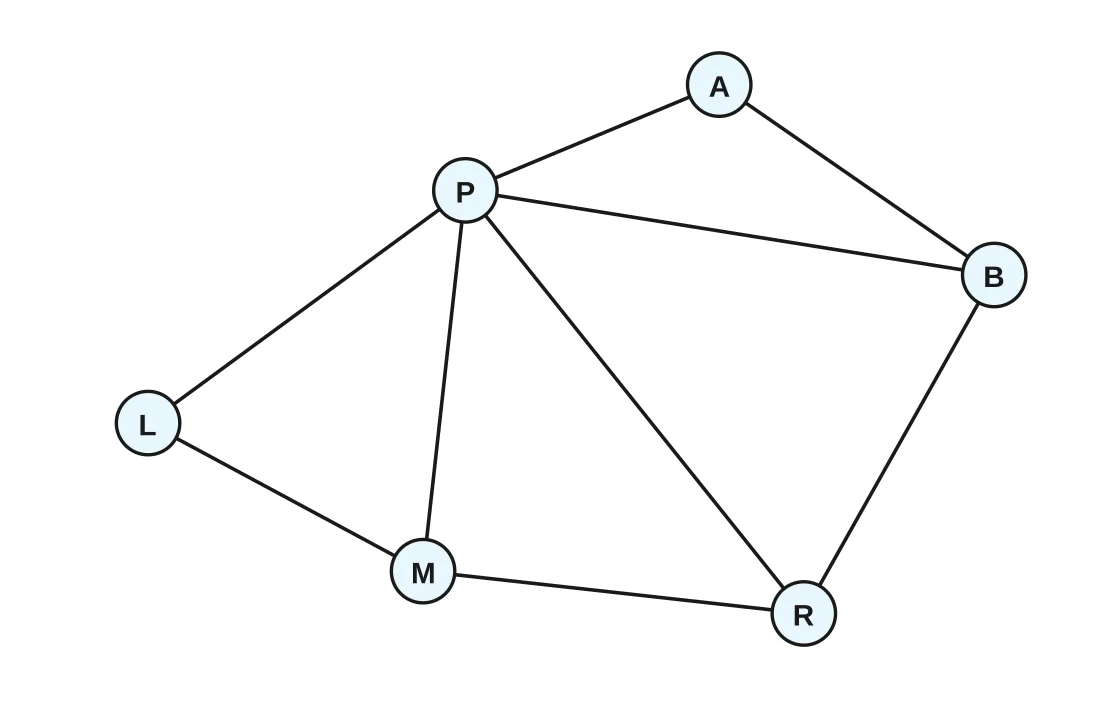
Write down the degree of each vertex.
Use the handshake lemma to find the number of routes.
The airline calls a city a hub if it has a direct route to at least half of the other cities. Identify the hubs.
Find the number of extra routes needed for every pair of cities to have a direct route.
revisionprep.com
Summary Answer
Not available for this question.
Model Answer
Not available for this question.
Marking Scheme
Not available for this question.
Examiner Insights
Not available for this question.
Adjacency matrices and walks
The graph shows the roads between five farms , , , and .
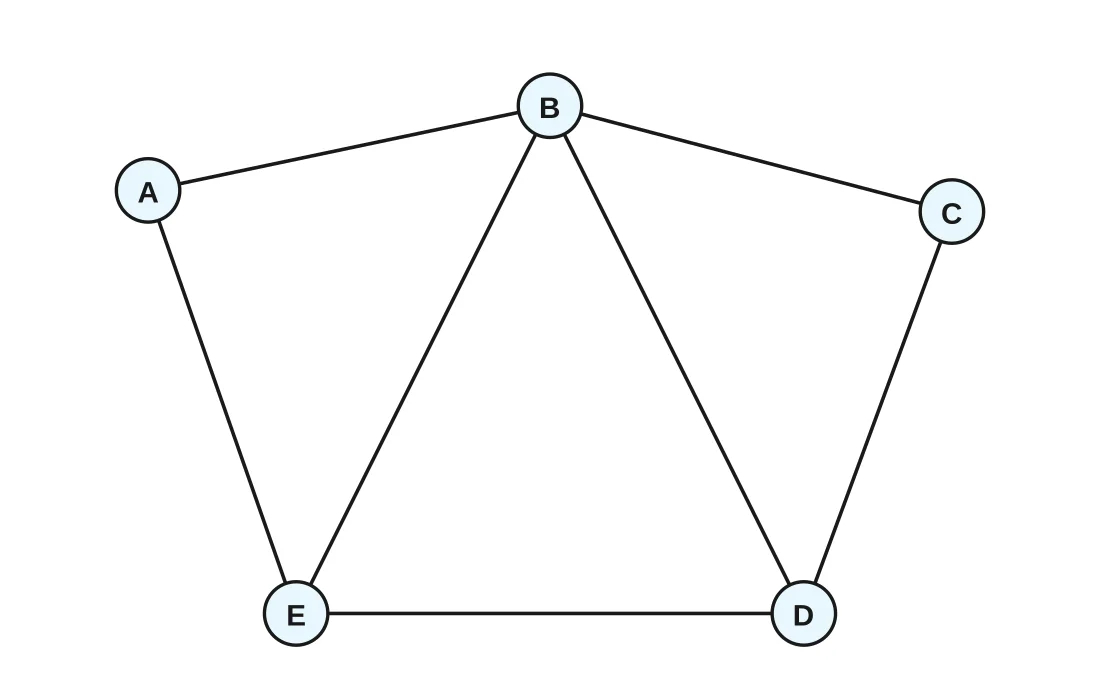
Write down the adjacency matrix , with the farms in the order .
Use to write down the degree of , explaining your method.
Find the number of walks of length from to , and list them.
Use your graphic display calculator to find the number of walks of length from to .
revisionprep.com
Summary Answer
Not available for this question.
Model Answer
Not available for this question.
Marking Scheme
Not available for this question.
Examiner Insights
Not available for this question.
Graph theory: graphs, degree, connected and complete graphs
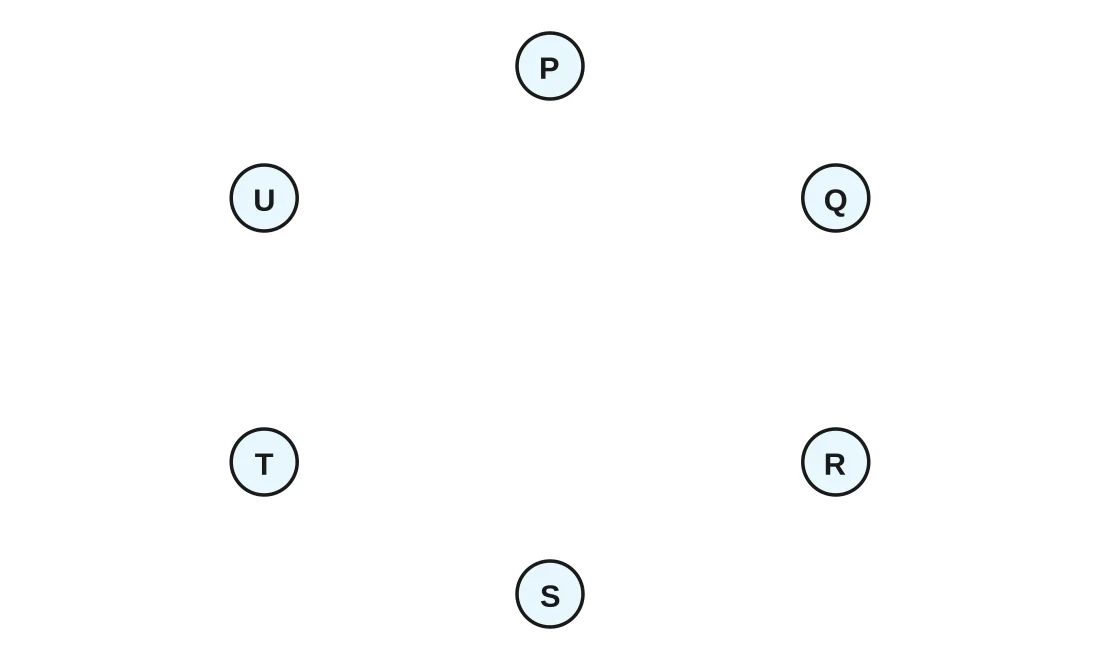
In a school volleyball competition there are six teams, , , , , and . Each team plays exactly three matches, and no two teams play each other more than once. The diagram shows one vertex for each team.
Use the handshake lemma to find the total number of matches.
Copy the vertices and draw one possible graph of the matches.
Explain why it is impossible for seven teams each to play exactly three matches.
Write down the number of matches if every team plays every other team once.
Hence find how many more matches would be needed to turn the competition in (a) into a full round robin.
revisionprep.com
Summary Answer
Not available for this question.
Model Answer
Not available for this question.
Marking Scheme
Not available for this question.
Examiner Insights
Not available for this question.
Adjacency matrices and walks
The weighted adjacency table shows the number of cars per minute that use each road between four junctions , , and in a city. A traffic engineer models the route of a single car as a random walk: at each junction the car chooses a road with probability proportional to the weight of that road.
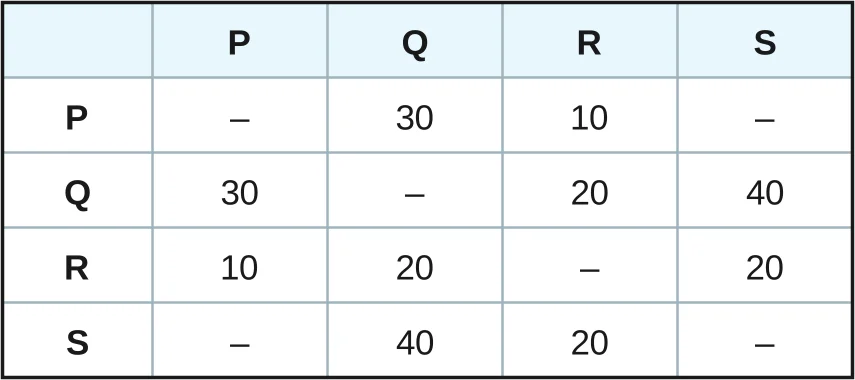
Construct the transition matrix , with columns for the current junction and rows for the next junction, in the order .
A car starts at . Find the probability that it is at after three junction-to-junction moves.
Find the long-term proportion of time that the car spends at each junction.
State which junction the engineer should expect to be the busiest.
revisionprep.com
Summary Answer
Not available for this question.
Model Answer
Not available for this question.
Marking Scheme
Not available for this question.
Examiner Insights
Not available for this question.
Graph theory: graphs, degree, connected and complete graphs
In chemistry, a molecule can be modelled by a graph: atoms are vertices and bonds are edges. Each carbon atom (C) has degree and each hydrogen atom (H) has degree . The diagram shows the graph of propane.
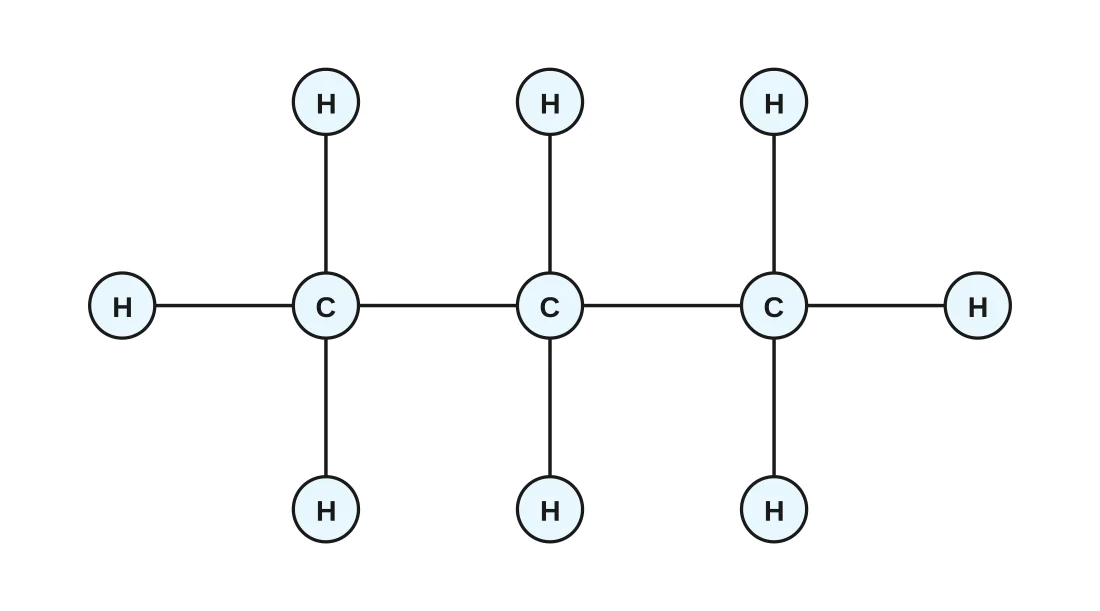
Write down the number of vertices and edges of the propane graph.
Verify the handshake lemma for the propane graph.
Explain why the propane graph is a tree.
An alkane is a molecule whose graph is a tree with carbon atoms and hydrogen atoms.
Show that .
Hence write down the formula of the alkane with carbon atoms.
Cyclohexane has carbon atoms and hydrogen atoms, with the same degrees.
Show that the graph of cyclohexane has the same number of edges as vertices, and deduce that it contains a cycle.
revisionprep.com
Summary Answer
Not available for this question.
Model Answer
Not available for this question.
Marking Scheme
Not available for this question.
Examiner Insights
Not available for this question.
Tree and cycle algorithms: Kruskal, Prim, Chinese postman, travelling salesman
A maintenance engineer must inspect five pumping stations , , , and , starting and finishing at . The graph shows the direct roads between stations, with driving times in minutes. The engineer may pass through a station more than once.
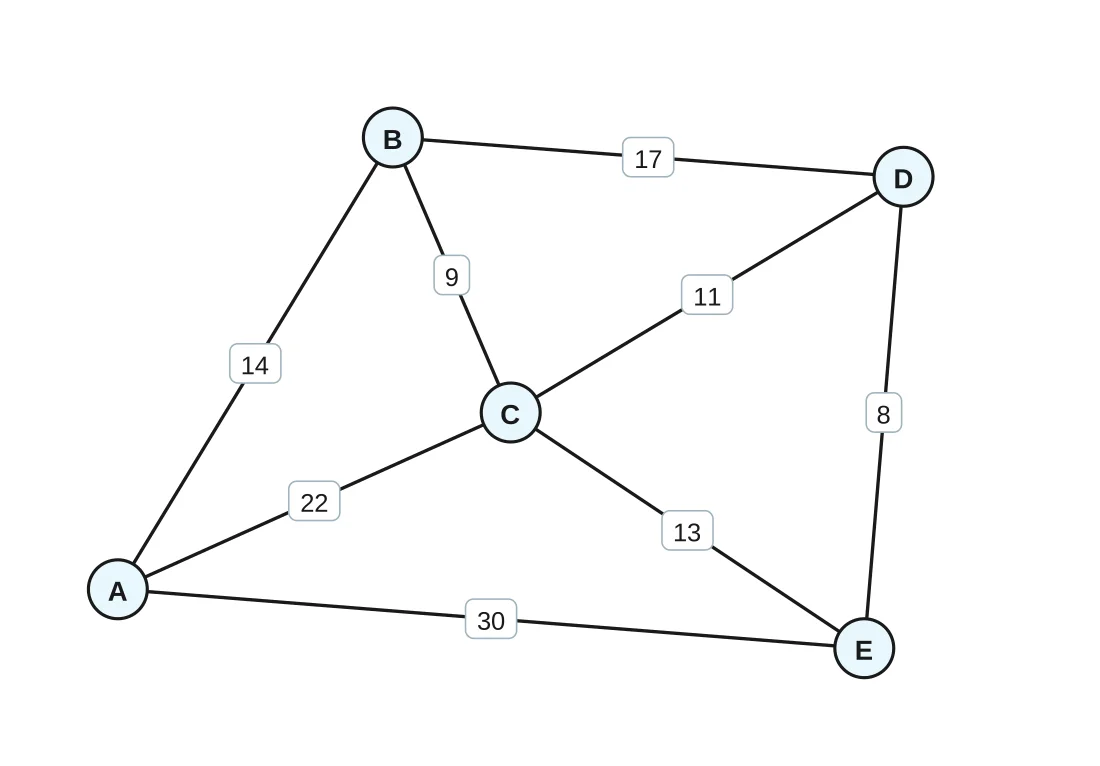
Find the least driving times between and , and , and , and and .
Using the table of least driving times, apply the nearest neighbour algorithm starting at to find an upper bound for the engineer's total driving time.
By deleting vertex , find a lower bound for the total driving time.
By deleting vertex the lower bound is minutes. State which lower bound is more useful, giving a reason.
Write down an inequality for the least total driving time , and explain whether the tour found in part (b) uses any road that is not a direct road between consecutive stations.
revisionprep.com
Summary Answer
Not available for this question.
Model Answer
Not available for this question.
Marking Scheme
Not available for this question.
Examiner Insights
Not available for this question.
That's every free question here — 6 of 63.
+57 more questions, plus Mock Papers & Worksheets, are waiting in Premium.