You're viewing free preview questions. Upgrade to access more Maths AI HL questions.Upgrade
Arithmetic Sequences and Series · Paper 1 — Free Maths AI HL Practice Questions
1FoundationSAQ-SDefinition and general term of arithmetic sequences5 marksPaper 1~8 min

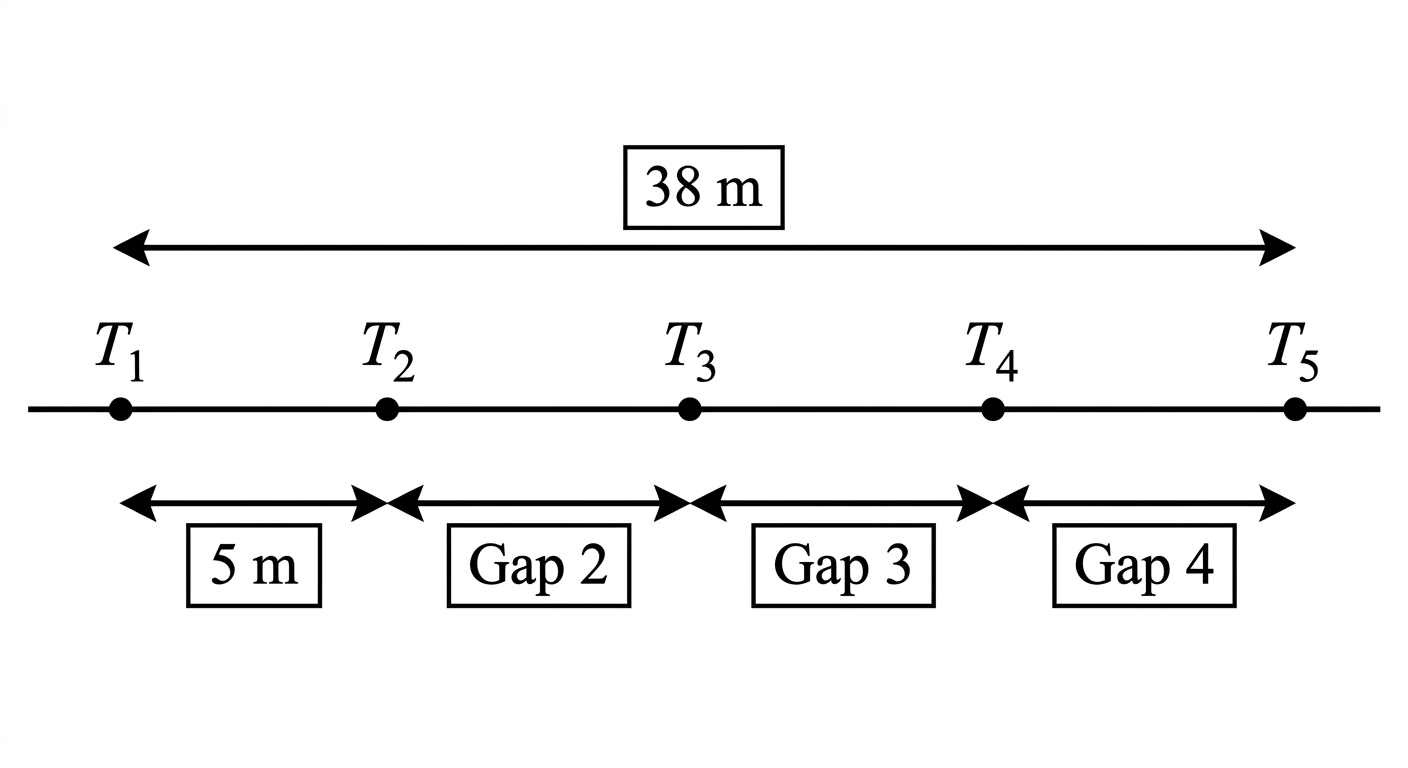
Data
The total distance from the first tree to the fifth tree is the sum of the four consecutive gaps.
A farmer is planting trees in a straight line. The distance from the first tree to the second tree is . The distance between consecutive trees increases by a constant amount, forming an arithmetic sequence. The total distance from the first tree to the fifth tree is .
(a)
State the value of , the first gap, and the value of , the total of the first four gaps. [2 marks]
(b)
Calculate the common difference, , of the arithmetic sequence of gaps. [2 marks]
(c)
Hence, find the total distance from the first tree to the tenth tree. [1 mark]

Solutions
2FoundationSAQ-SDefinition and general term of arithmetic sequences5 marksPaper 1~8 min
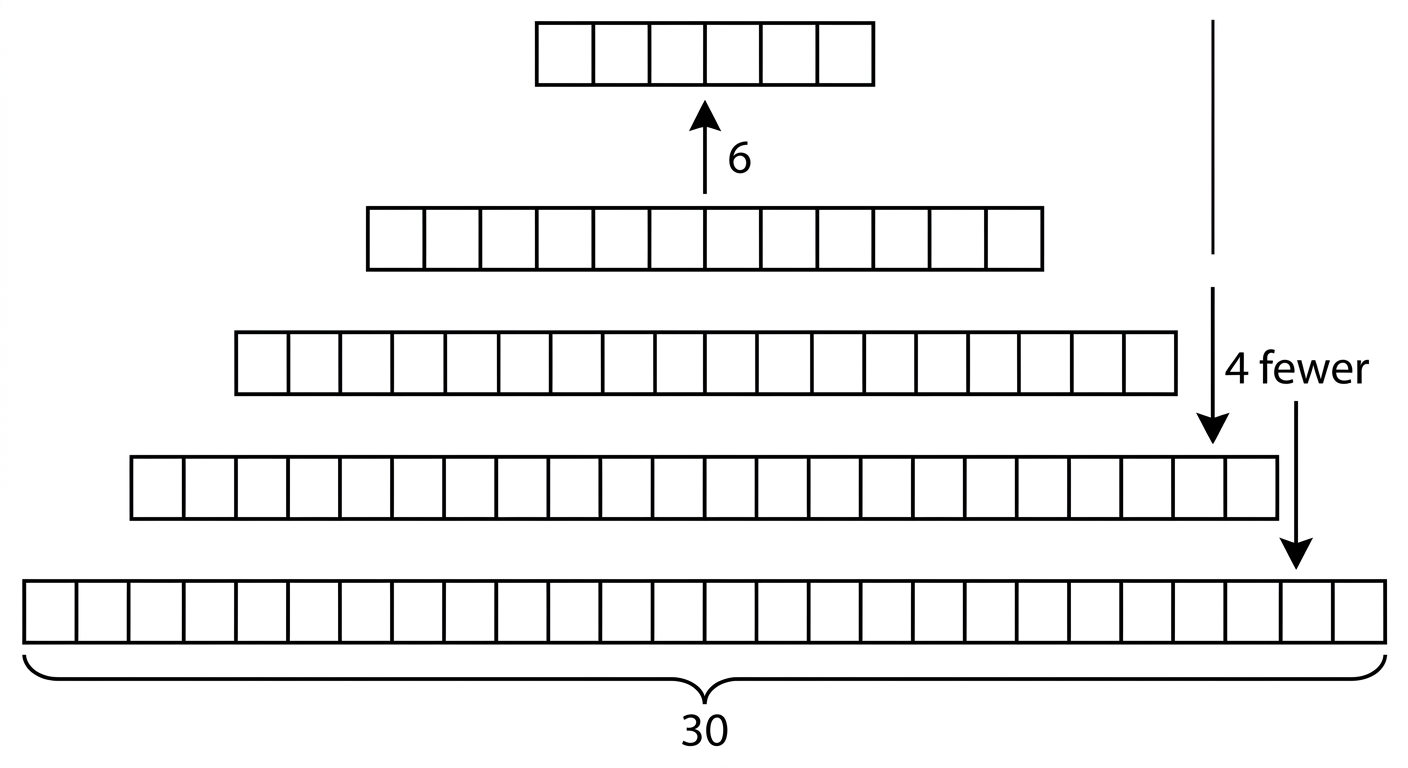
A company is stacking boxes in a warehouse. The bottom row has boxes. Each row above has fewer boxes than the row below, forming an arithmetic sequence. The top row has boxes.
(a)
State the value of and the common difference . [1 mark]
(b)
Calculate the number of rows of boxes. [2 marks]
(c)
Find the total number of boxes in the stack. [2 marks]
Solutions
3FoundationSAQ-SSum of an arithmetic sequence5 marksPaper 1~8 min
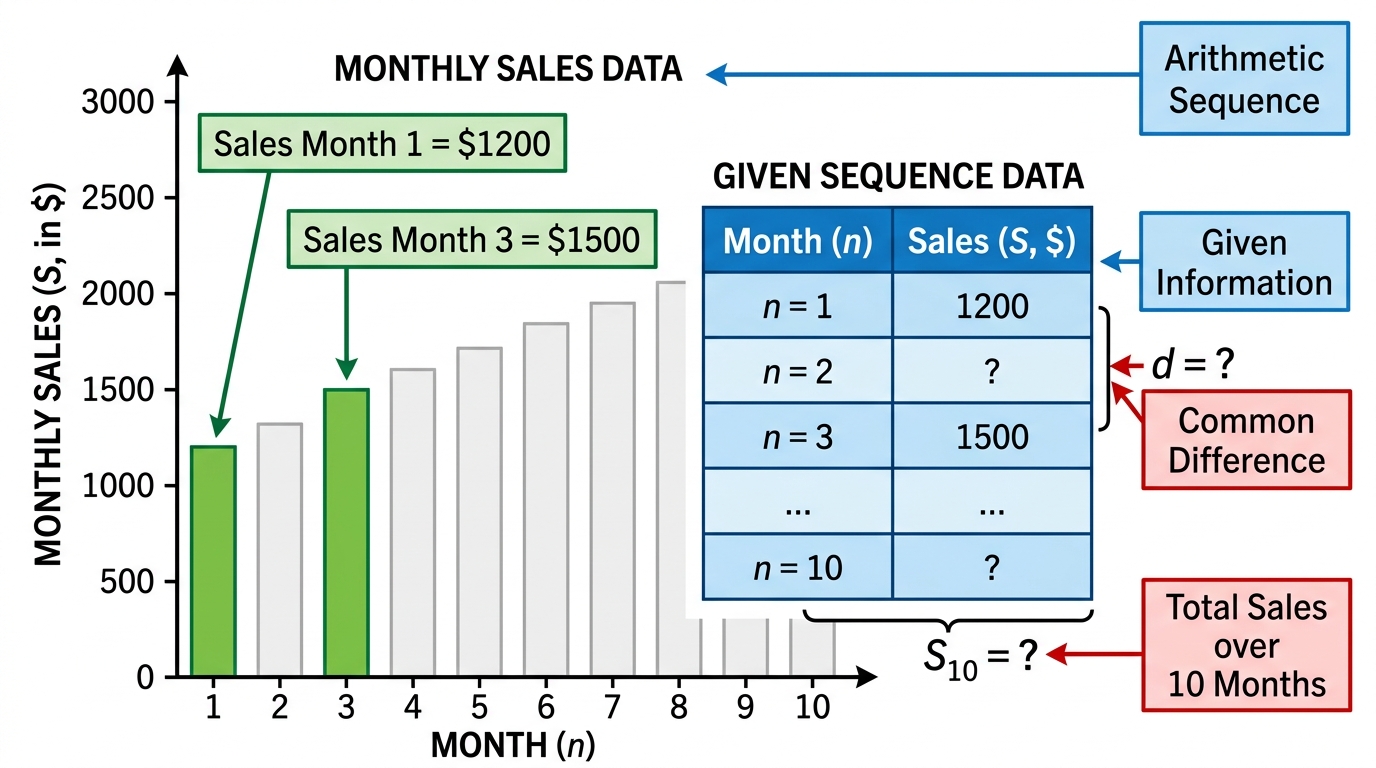
Data
In a small business, the monthly sales of a product form an arithmetic sequence. The sales in the first month were USD 1200, and the sales in the third month were USD 1500.
(a)
State the common difference of the sequence. [1 mark]
(b)
Calculate the total sales over the first months. [2 marks]
(c)
The business owner claims that monthly sales will exceed USD 3000 for the first time during the second year of trading (months 13–24). Determine whether this claim is correct, justifying your answer. [2 marks]
Solutions
4FoundationSAQ-SDefinition and general term of arithmetic sequences5 marksPaper 1~8 min
A small business owner tracks the monthly profit of her company. In month 1, the profit was USD 2000. The profit increases by a fixed amount each month, forming an arithmetic sequence. The profit in month 10 was USD 3800.
(a)
Write down an equation, in terms of , for the profit in month 10. [1 mark]
(b)
Calculate the common difference, , of the sequence. [2 marks]
(c)
Hence, find the profit in month 15. [2 marks]
Solutions
5FoundationSAQ-SDefinition and general term of arithmetic sequences5 marksPaper 1~8 min
A theatre has rows of seats. The number of seats in each row forms an arithmetic sequence. The first row has seats and the second row has seats.
(a)
Write down an expression for , the number of seats in the -th row. [1 mark]
(b)
Calculate the number of seats in the th row. [2 marks]
(c)
The theatre management claims that one row contains exactly seats. Determine which row this is, and verify that this row exists within theatre. [2 marks]
Solutions
6FoundationSAQ-SSum of an arithmetic sequence5 marksPaper 1~8 min
Data
;
A concert hall has rows of seats. The number of seats in each row forms an arithmetic sequence. The first row has seats and the second row has seats.
(a)
Write down the common difference and the first term of the sequence. [1 mark]
(b)
Calculate the number of seats in the th row. [2 marks]
(c)
The concert hall is extended by adding further rows, each following the same arithmetic sequence. The venue manager requires a total capacity of at least seats across all rows. Determine the minimum number of rows needed to meet this requirement. [2 marks]
Solutions
7FoundationSAQ-SSum of an arithmetic sequence5 marksPaper 1~8 min
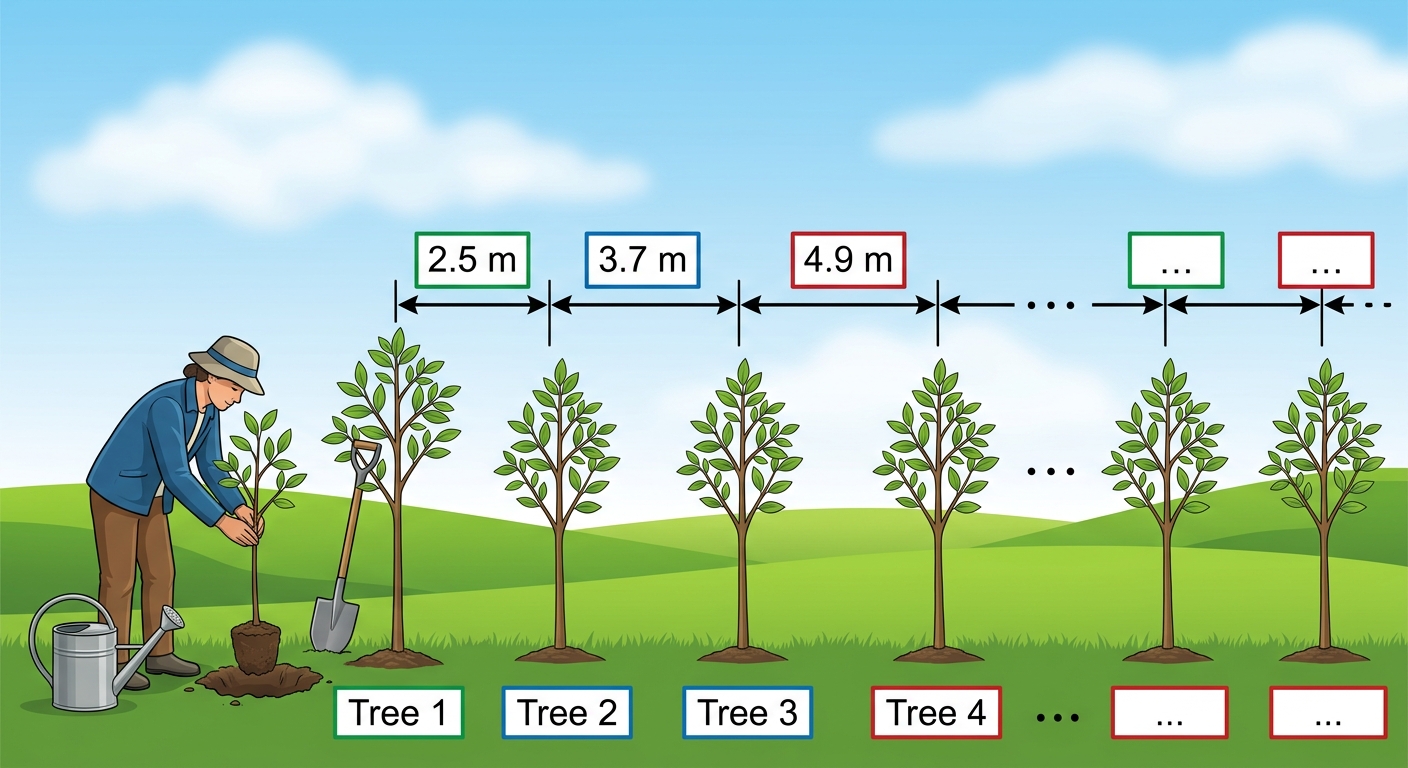
A gardener plants trees in a straight line. The distance from the first tree to the second tree is , and each subsequent gap between consecutive trees is more than the previous gap. The gaps form an arithmetic sequence.
(a)
State the first term and common difference of this arithmetic sequence. [1 mark]
(b)
Find the value of such that the gap between the th and th trees first exceeds . [2 marks]
(c)
The gardener has a plot of length . Determine the maximum number of trees that can be planted in a single straight line within this plot. [2 marks]
Solutions
8FoundationSAQ-SApplications of arithmetic sequences in real-world contexts5 marksPaper 1~8 min
A water tank contains litres of water at the start of day 1. Each day, litres of water are added to the tank.
(a)
State the value of the first term, , and the common difference, , for the arithmetic sequence representing the volume of water in the tank at the start of each day. [1 mark]
(b)
Calculate the volume of water in the tank at the start of the th day. [2 marks]
(c)
The tank has a maximum capacity of litres. Determine the day on which the volume of water in the tank first reaches or exceeds litres, and state the volume on that day. [2 marks]
Solutions
9FoundationSAQ-SApplications of arithmetic sequences in real-world contexts5 marksPaper 1~8 min
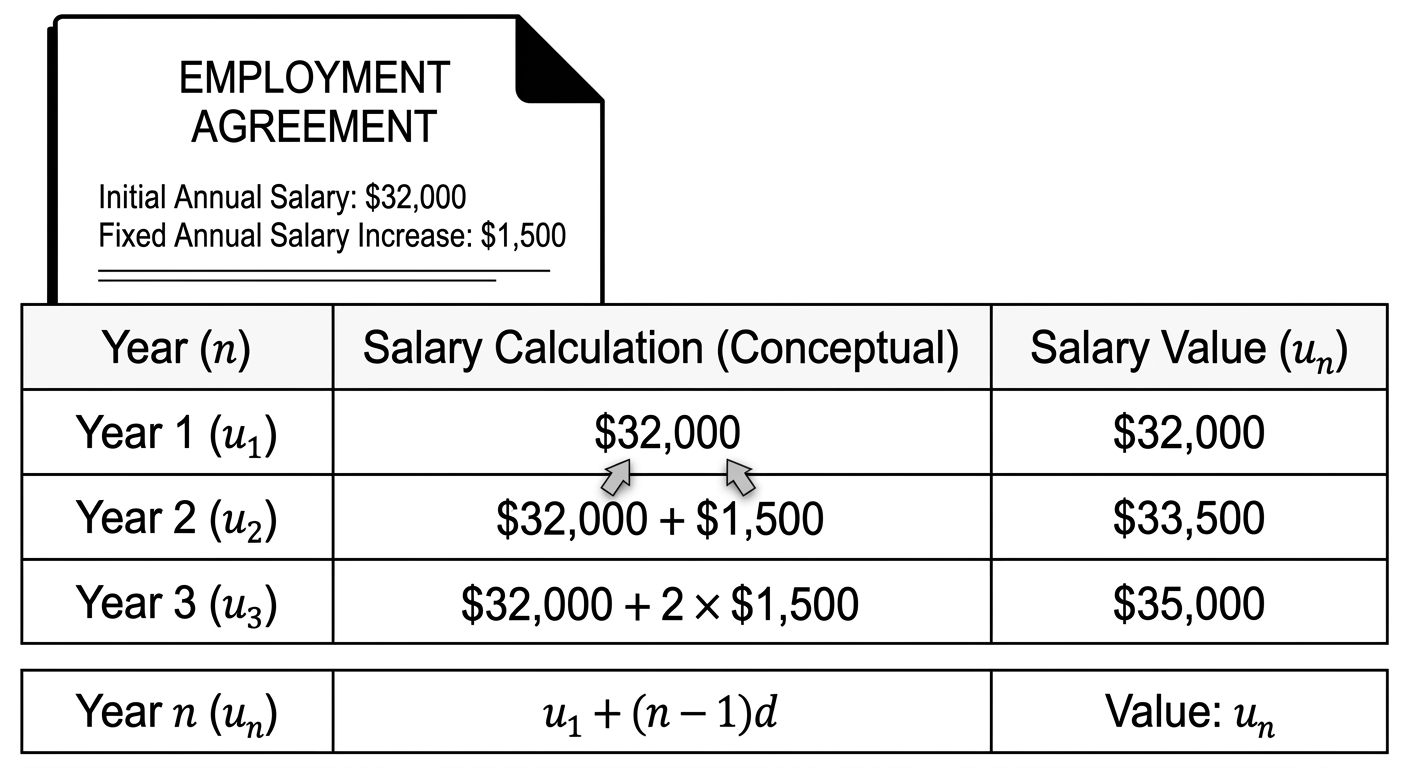
Mia starts a new job with annual salary of dollars. She receives a fixed annual pay rise of dollars each year at the end of each year of employment.
(a)
State the value of the first term, , and the common difference, , for the arithmetic sequence representing her annual salary. [1 mark]
(b)
Calculate her annual salary in her th year of employment. [2 marks]
(c)
Determine the first year of employment in which her total cumulative earnings exceed dollars. [2 marks]
Solutions
10FoundationSAQ-SApplications of arithmetic sequences in real-world contexts7 marksPaper 1~11 min
A farmer plants trees in rows. The first row contains trees. Each subsequent row contains more trees than the previous row.
(a)
Calculate the number of trees in the th row. [2 marks]
(b)
Determine the first row number in which the number of trees exceeds . [2 marks]
(c)
The farmer has space for exactly rows but a total budget allowing for at most trees. Determine whether the farmer can plant trees in all rows without exceeding the budget. Justify your answer. [3 marks]
Solutions
11FoundationSAQ-SDefinition and general term of arithmetic sequences5 marksPaper 1~8 min
A cyclist trains for a race by increasing her daily cycling distance by a fixed number of kilometres each day. On day 1 she cycles , and on day 7 she cycles .
(a)
Calculate the common difference, , of the arithmetic sequence. [2 marks]
(b)
Find on which day she first cycles more than . [2 marks]
(c)
The cyclist's training plan lasts 20 days. Determine the total distance she cycles over the full 20-day period. [1 mark]
Solutions
12FoundationSAQ-SApplications of arithmetic sequences in real-world contexts5 marksPaper 1~8 min
A concert hall has seats in the first row. Each row behind the first has more seats than the row in front of it.
(a)
State the value of the first term, , and the common difference, , for the arithmetic sequence representing the number of seats per row. [1 mark]
(b)
Calculate the number of seats in the th row. [2 marks]
(c)
The hall has complete rows. Given that the total number of seats must exceed , find the minimum value of . [2 marks]
Solutions
13FoundationSAQ-SSum of an arithmetic sequence6 marksPaper 1~9 min
Data
;
A runner is training for a race. On the first day, she runs . Each subsequent day, she runs more than the previous day. The distances she runs each day form an arithmetic sequence.
(a)
State the first term and the common difference of the sequence. [1 mark]
(b)
Determine the first day on which she runs more than . [2 marks]
(c)
Find the minimum number of complete days of training required for her total distance to exceed . [3 marks]
Solutions
14FoundationSAQ-SSum of an arithmetic sequence6 marksPaper 1~9 min
A construction company is building a staircase. The first step has a height of , and each subsequent step is higher than the previous one. The heights of the steps form an arithmetic sequence.
(a)
State the first term and the common difference of the sequence. [1 mark]
(b)
Determine the step number that first has a height exceeding . [2 marks]
(c)
The total height from the ground to the top of the th step must not exceed . Determine the maximum number of complete steps that can be built. [3 marks]
Solutions
15FoundationSAQ-SDefinition and general term of arithmetic sequences7 marksPaper 1~11 min
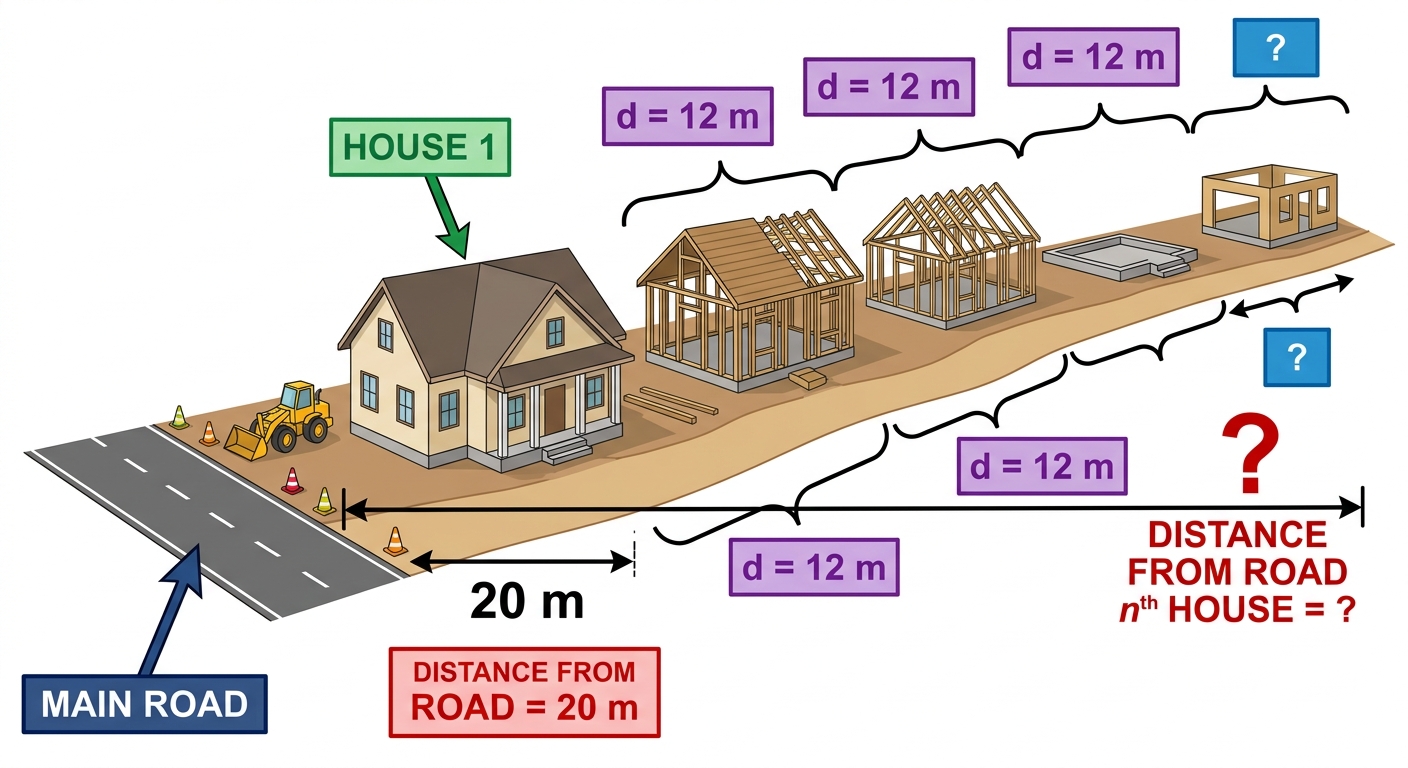
A construction company is building a new housing estate. The first house is built from the main road. Each subsequent house is built further from the road than the previous house.
(a)
State the value of and the value of for this arithmetic sequence. [2 marks]
(b)
Find the distance from the main road to the th house. [2 marks]
(c)
The estate has houses in total. The furthest house must be built no more than from the main road. Find the maximum value of . [3 marks]
Solutions
16FoundationSAQ-SDefinition and general term of arithmetic sequences7 marksPaper 1~11 min
A gardener plants trees in a straight line. The first tree is planted from the garden gate. Each subsequent tree is planted further from the gate than the previous tree.
(a)
Find the distance from the gate to the th tree. [2 marks]
(b)
The distance from the gate to the th tree is . Find the value of . [2 marks]
(c)
The gardener has a section of garden that extends from the gate. Determine the maximum number of trees that can be planted within this section, and find the total distance covered from the gate to the last tree planted. [3 marks]
Solutions
17FoundationSAQ-SDefinition and general term of arithmetic sequences5 marksPaper 1~8 min
Data
A cinema has seats in the first row. Each subsequent row has more seats than the previous row. The last row has seats.
(a)
State the value of and the common difference . [1 mark]
(b)
Find the number of the row that has seats. [2 marks]
(c)
Find the total number of seats in the cinema. [2 marks]
Solutions
18FoundationSAQ-SDefinition and general term of arithmetic sequences7 marksPaper 1~11 min
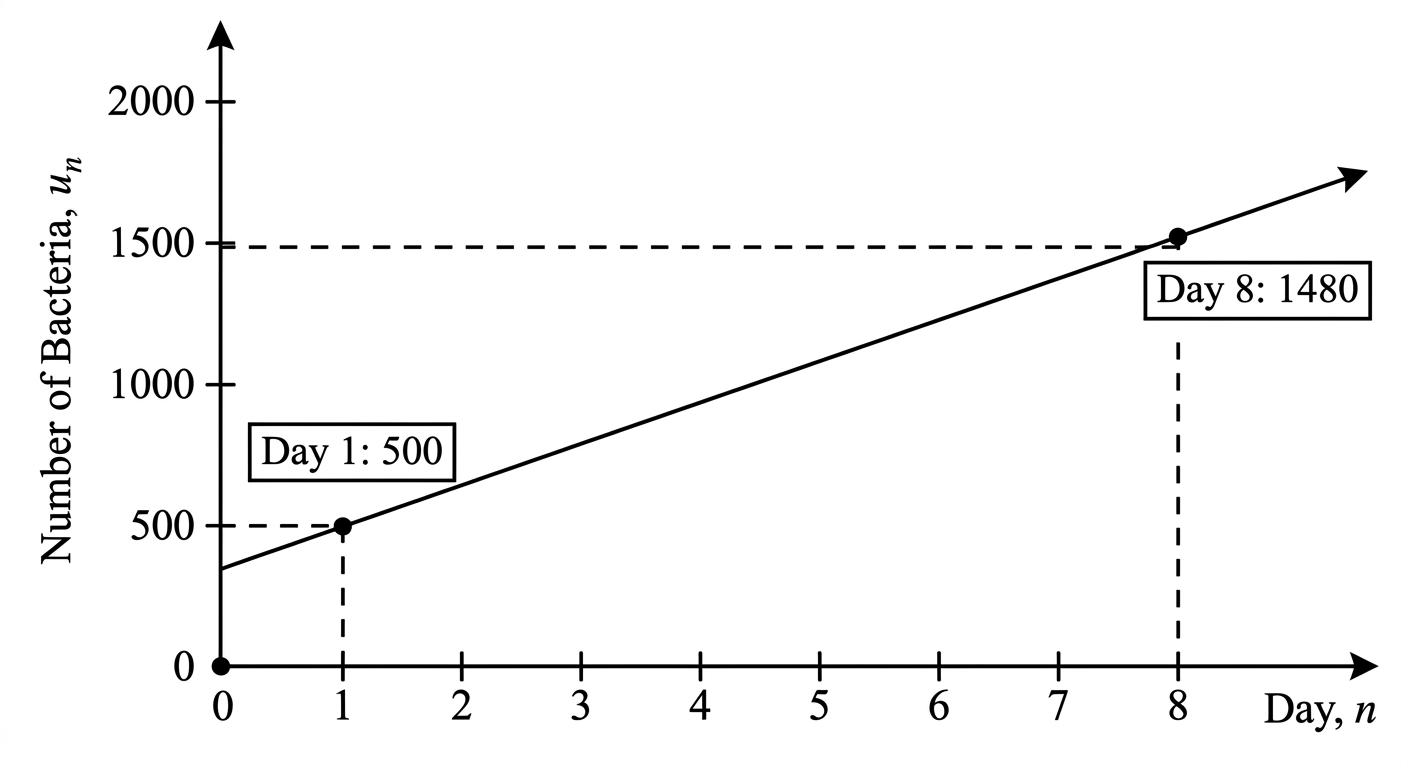
A scientist monitors the growth of a bacterial colony. On day 1 there are bacteria. The number of bacteria increases by the same amount each day. On day 8 there are bacteria.
(a)
Write down the general term for the number of bacteria on day , identifying the values of and . [1 mark]
(b)
Show that the common difference . [2 marks]
(c)
Find the number of bacteria on day 15. [2 marks]
(d)
The scientist claims the colony will exceed bacteria before day 35. Determine whether this claim is correct. [2 marks]
Solutions
19FoundationSAQ-SDefinition and general term of arithmetic sequences7 marksPaper 1~11 min
A small business owner deposits USD 2000 into a new savings account on January 1st, 2023. Each subsequent year, on January 1st, they deposit USD 150 more than the previous year's deposit. The deposits form an arithmetic sequence.
(a)
Write down the values of and for this arithmetic sequence. [1 mark]
(b)
Calculate the amount deposited on January 1st, 2030. [2 marks]
(c)
Calculate the total amount deposited from January 1st, 2023 to January 1st, 2030 inclusive. [2 marks]
(d)
Determine the first year in which the annual deposit exceeds USD 3500. [2 marks]
Solutions
20FoundationSAQ-SDefinition and general term of arithmetic sequences5 marksPaper 1~8 min
A scientist records the temperature of a chemical solution every minute. The temperature at the start (minute 0) is . The temperature increases by a constant amount each minute, forming an arithmetic sequence. After 8 minutes, the temperature is .
(a)
Find the common difference of the sequence. [3 marks]
(b)
Find the sum of all temperatures recorded from minute 0 to minute 12 inclusive. [2 marks]
Solutions
Showing 20 of 244 free questions