Matrices · Paper 2 — Free Maths AI HL Practice Questions
Free questions
Open in full, with answers, mark scheme and examiner insights.
Matrix operations, determinants and inverses; solving systems
Priya invests a total of USD 20 000 in three funds, , and , for one year. Fund pays interest, fund pays and fund pays . She invests USD in , USD in and USD in .
At the end of the year she has earned USD 940 in interest. She invested twice as much in fund as in fund .
Show that .
Write down two more equations in , and , and write the three equations as a matrix equation.
Use your graphic display calculator to find , and .
In the second year the rates change to , and for , and , and Priya leaves the same amounts in each fund. Use a matrix product to find her interest in the second year, and express it as a percentage of her total investment.
revisionprep.com
Summary Answer
Not available for this question.
Model Answer
Not available for this question.
Marking Scheme
Not available for this question.
Examiner Insights
Not available for this question.
Eigenvalues and eigenvectors; diagonalization
Every customer in a city owns a phone from brand or brand and replaces it once a year. The transition diagram shows the probabilities that a customer's next phone is from each brand, given the brand of their current phone.
The market shares after years are , where . At present each brand has half of the market.
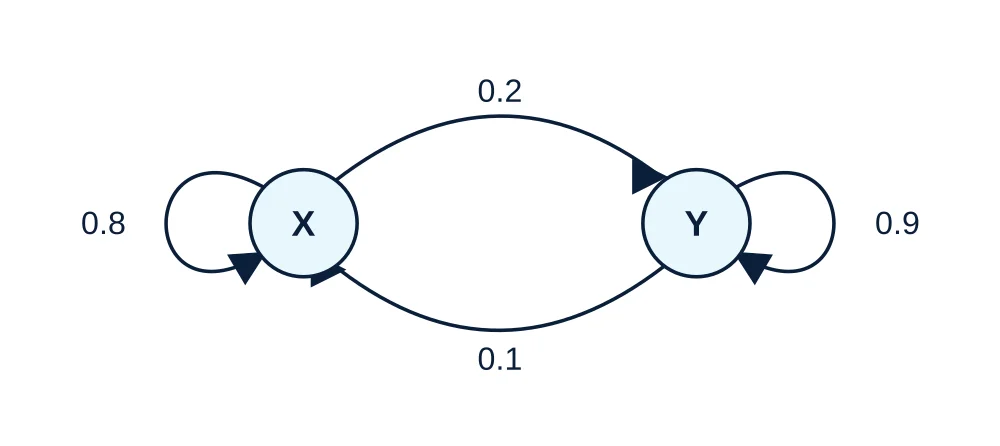
Write down the transition matrix .
Find the market share of brand after year and after years.
Find the eigenvalues of .
Find the eigenvector for the eigenvalue whose entries add up to .
Interpret your answer to part (d) in context.
revisionprep.com
Summary Answer
Not available for this question.
Model Answer
Not available for this question.
Marking Scheme
Not available for this question.
Examiner Insights
Not available for this question.
Matrix operations, determinants and inverses; solving systems
A ball is thrown across a field. Its height, metres, at a horizontal distance metres from the thrower is modelled by . The ball passes through the three points shown on the graph: , and .
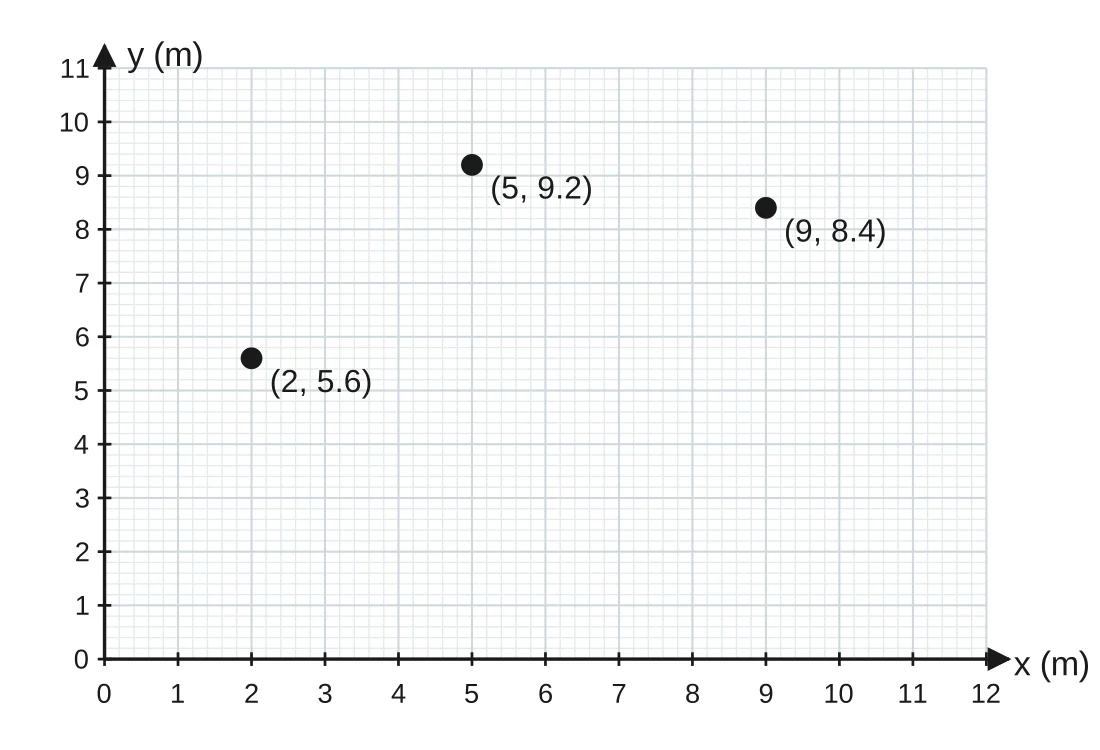
Show that .
Write down two more equations and express the three equations as a matrix equation.
Use your graphic display calculator to find , and .
Find the maximum height of the ball and the horizontal distance at which it occurs.
Find the horizontal distance from the thrower at which the ball hits the ground.
revisionprep.com
Summary Answer
Not available for this question.
Model Answer
Not available for this question.
Marking Scheme
Not available for this question.
Examiner Insights
Not available for this question.
Eigenvalues and eigenvectors; diagonalization
A car rental company has cars and two depots: the airport () and the city centre (). Cars are hired for one day and returned to either depot. The transition diagram shows the proportions of cars from each depot that are returned to each depot the next day. On day all cars are at the airport.
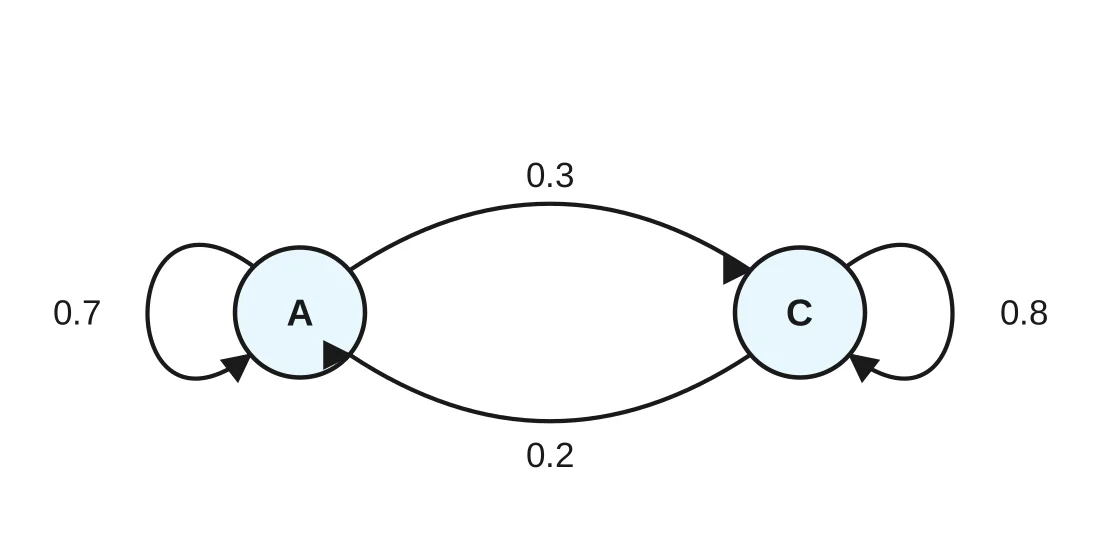
Write down the transition matrix such that , where gives the numbers of cars at each depot on day .
Find the number of cars at each depot on day and on day .
Find the characteristic polynomial of and hence its eigenvalues.
Find an eigenvector for each eigenvalue.
Express as a combination of the eigenvectors and hence show that .
State the long-term number of cars at the airport, and find the first day on which there are fewer than cars at the airport.
revisionprep.com
Summary Answer
Not available for this question.
Model Answer
Not available for this question.
Marking Scheme
Not available for this question.
Examiner Insights
Not available for this question.
Matrix operations, determinants and inverses; solving systems
Consider the system of equations
where .
Write the system in the form and find the values of for which the system does not have a unique solution.
For , find the value of for which the system has infinitely many solutions, and state what happens for every other value of .
For and , use to solve the system, giving and as exact fractions.
revisionprep.com
Summary Answer
Not available for this question.
Model Answer
Not available for this question.
Marking Scheme
Not available for this question.
Examiner Insights
Not available for this question.
Eigenvalues and eigenvectors; diagonalization
Let .
Find the eigenvalues of .
Find an eigenvector for each eigenvalue.
Write in the form , stating , and .
By considering a diagonal matrix with , find a matrix with positive eigenvalues such that .
Find a matrix , with eigenvalues and , such that .
revisionprep.com
Summary Answer
Not available for this question.
Model Answer
Not available for this question.
Marking Scheme
Not available for this question.
Examiner Insights
Not available for this question.
That's every free question here — 6 of 42.
+36 more questions, plus Mock Papers & Worksheets, are waiting in Premium.