Number, Exponents and Logarithms · Paper 2 — Free Maths AI HL Practice Questions
Free questions
Open in full, with answers, mark scheme and examiner insights.
Standard form a × 10ᵏ
Lena builds a scale model of the Solar System. The table shows the real diameters of the Sun and three planets, and their mean distances from the Sun. In the model the Sun is a ball of diameter m. Every length in the model is the real length multiplied by the same scale factor .
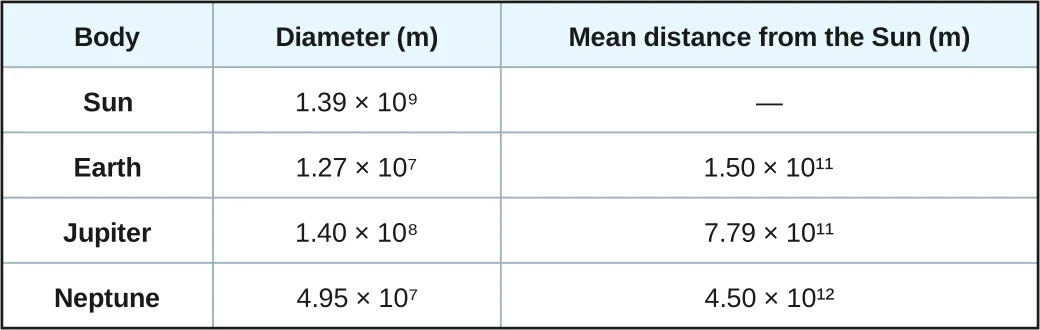
Show that , correct to three significant figures.
Find the diameter of the model Earth, in millimetres.
Find the distance of the model Earth from the model Sun, in metres.
Find the distance of the model Neptune from the model Sun, in kilometres.
Find the diameter of the model Jupiter, in centimetres.
Write down the ratio of the diameter of Jupiter to the diameter of the Earth, correct to three significant figures.
revisionprep.com
Summary Answer
Not available for this question.
Model Answer
Not available for this question.
Marking Scheme
Not available for this question.
Examiner Insights
Not available for this question.
Laws of logarithms
The power loss in an optical fibre, in decibels, is , where and are the powers, in milliwatts (mW), entering and leaving the fibre. A fibre cable loses dB for every kilometre of its length. A laser sends mW into the cable.
Write down the total loss in a km length of this cable.
Find the power leaving a km length of cable.
Show that .
The receiver needs at least mW. Find the greatest length of cable that can be used without an amplifier.
revisionprep.com
Summary Answer
Not available for this question.
Model Answer
Not available for this question.
Marking Scheme
Not available for this question.
Examiner Insights
Not available for this question.
Approximation, upper and lower bounds, percentage error and estimation
A ladder of length m, correct to the nearest m, leans against a vertical wall. The foot of the ladder is on horizontal ground, m from the wall, correct to the nearest m, as shown in the diagram.
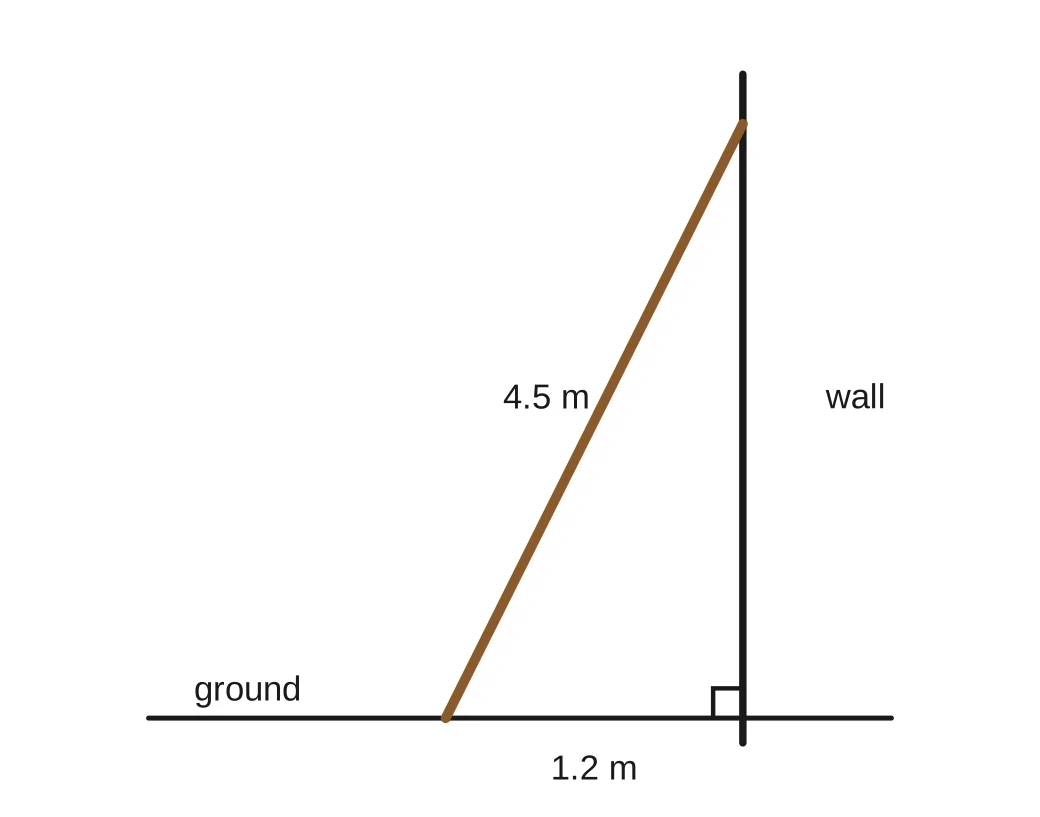
Write down the lower bound and the upper bound of the length of the ladder.
Find the greatest possible height that the top of the ladder can reach up the wall.
Find the least possible height that the top of the ladder can reach up the wall.
A window sill is m above the ground. State whether the ladder will certainly reach the window sill.
The height is calculated using the measured values. Find the greatest possible percentage error in this height.
revisionprep.com
Summary Answer
Not available for this question.
Model Answer
Not available for this question.
Marking Scheme
Not available for this question.
Examiner Insights
Not available for this question.
Rational exponents
An urban planner records the population and the number of petrol stations in six towns, as shown in the table. She models the data by .

Use your graphic display calculator to find the values of and .
The planner suggests that is close to . Write the model with and the value of found in (a), using a rational exponent.
Interpret, in context, the fact that .
Use your model from (a) to predict the number of petrol stations in a town of people.
Using , show that when the population doubles, the number of petrol stations is multiplied by about .
revisionprep.com
Summary Answer
Not available for this question.
Model Answer
Not available for this question.
Marking Scheme
Not available for this question.
Examiner Insights
Not available for this question.
Standard form a × 10ᵏ
The diagram shows a logarithmic scale of size, in metres, where each marked interval represents multiplication by . The points A, B, C and D represent the following objects.
A: a hydrogen atom, of diameter m B: a virus, of diameter m C: a bacterium, of length m D: a grain of sand, of diameter m
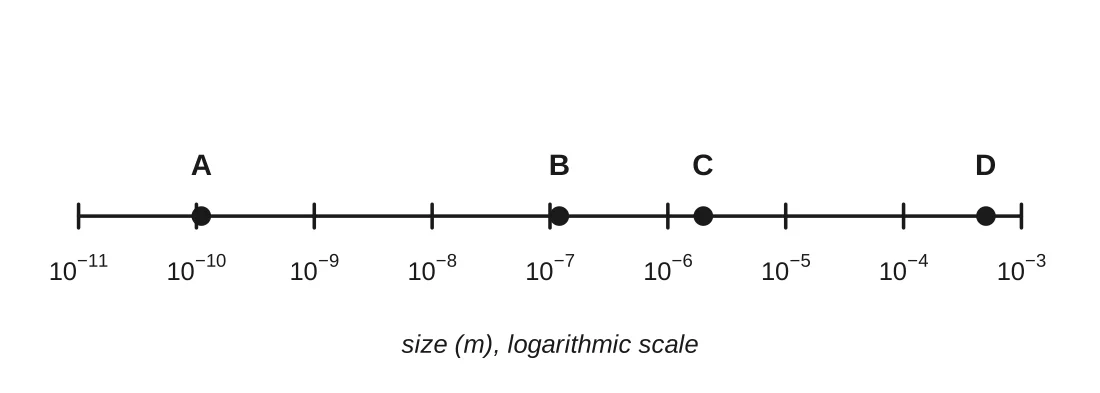
Find how many times larger the grain of sand is than the hydrogen atom. Give your answer in the form , where and , correct to three significant figures.
An electron microscope produces an image times larger than the object.
Find the length, in millimetres, of the image of the virus.
Find the magnification needed for the image of the hydrogen atom to have a diameter of mm. Give your answer in the form , correct to three significant figures.
Rafael says that the size halfway between A and D on this scale is .
Explain why Rafael is incorrect.
Find the size, in metres, that lies halfway between A and D on this scale.
revisionprep.com
Summary Answer
Not available for this question.
Model Answer
Not available for this question.
Marking Scheme
Not available for this question.
Examiner Insights
Not available for this question.
Laws of exponents with integer exponents; introduction to logarithms
The sound level dB of a sound of intensity W m is . At a distance of 2 m from a concert speaker the sound level is 100 dB. The intensity at a distance of m from the speaker is modelled by , where is a constant.
Find the intensity at a distance of 2 m.
Show that .
Find the sound level at a distance of 20 m.
The sound level in the front row must not exceed 85 dB. Find the least distance from the speaker at which the front row can be placed.
Find the decrease in sound level when the distance from the speaker increases from 5 m to 10 m.
Hence write down the decrease in sound level each time the distance from the speaker doubles.
revisionprep.com
Summary Answer
Not available for this question.
Model Answer
Not available for this question.
Marking Scheme
Not available for this question.
Examiner Insights
Not available for this question.
That's every free question here — 6 of 127.
+121 more questions, plus Mock Papers & Worksheets, are waiting in Premium.