You're viewing free preview questions. Upgrade to access more Maths AI HL questions.Upgrade
Arithmetic Sequences and Series · Paper 3 — Free Maths AI HL Practice Questions
1ChallengeLAQSum of an arithmetic sequence6 marksPaper 3~9 min

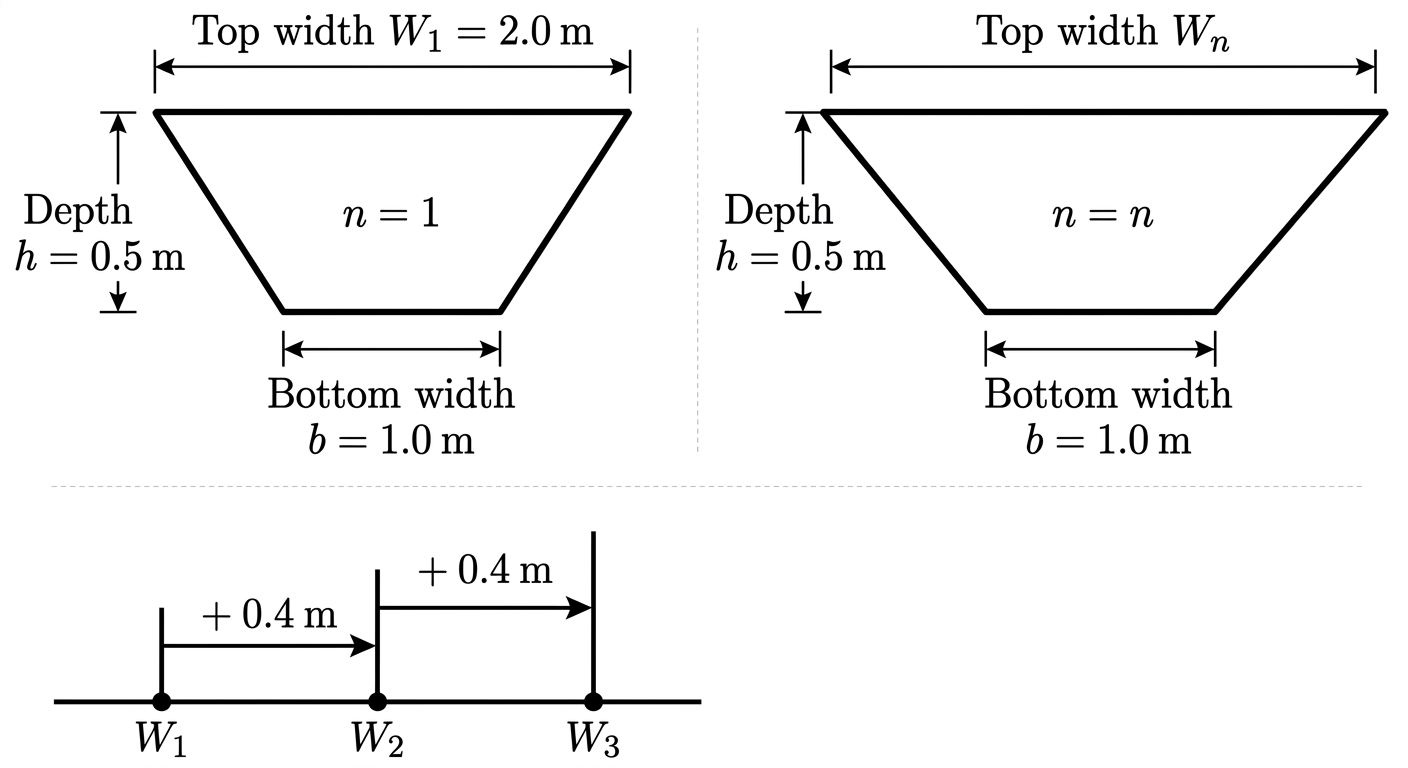
A farmer constructs a series of trapezoidal irrigation channels. The cross-section of each channel is a trapezium with a constant bottom width of and a constant depth of . The first channel has a top width of , and each subsequent channel has a top width wider than the previous one.
(a)
Prove that the cross-sectional area of the th channel satisfies
[3 marks]
(b)
The cross-sectional areas form an arithmetic sequence.
(i) Write down the first term and common difference of this arithmetic sequence. [2 marks]
(ii) Find the total cross-sectional area of the first channels. [2 marks]
(iii) The farmer wants to build channels until the total cross-sectional area first exceeds . Find the minimum number of channels needed. [3 marks]
(ii) Find the total cross-sectional area of the first channels. [2 marks]
(iii) The farmer wants to build channels until the total cross-sectional area first exceeds . Find the minimum number of channels needed. [3 marks]

Solutions
2ChallengeLAQApplications of arithmetic sequences in real-world contexts9 marksPaper 3~14 min
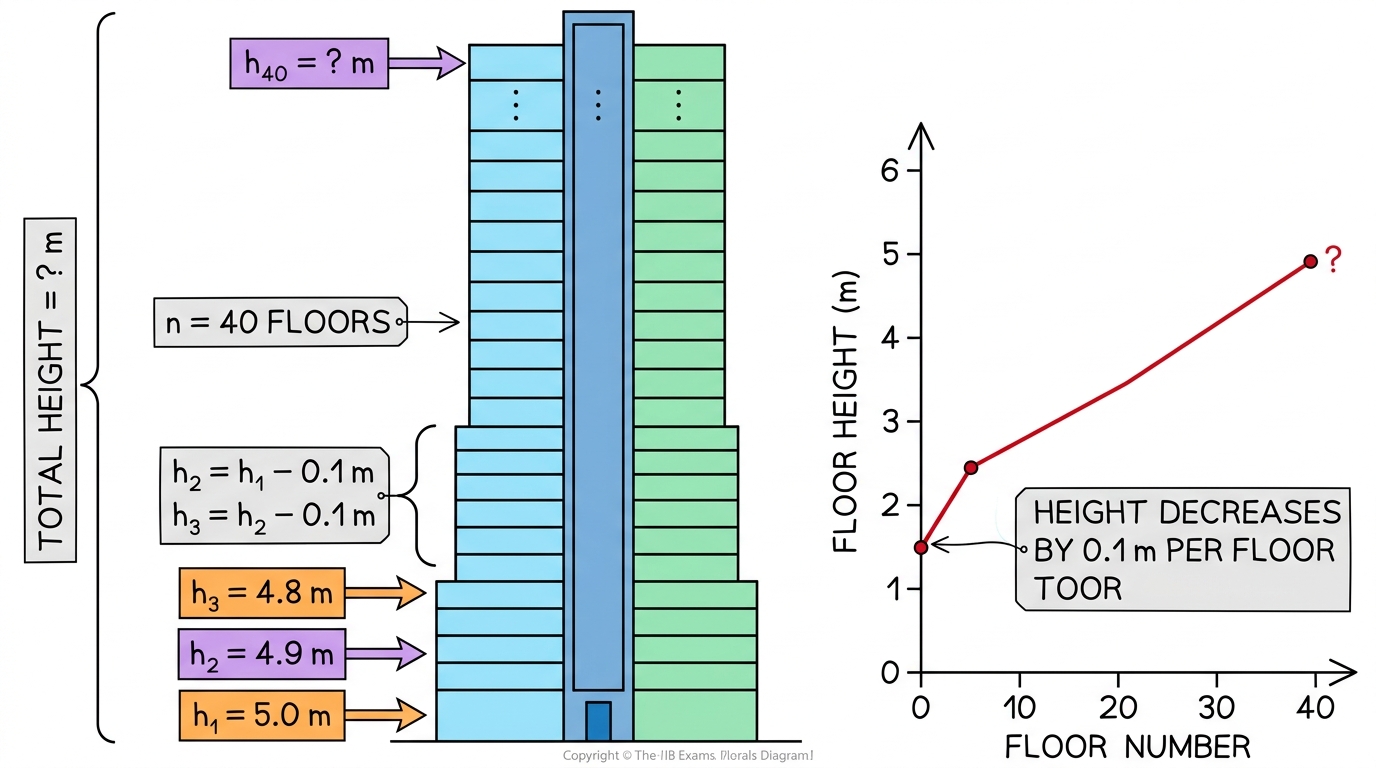
A construction company is building a high-rise tower. The first floor has a height of . Each subsequent floor has a height less than the floor below it. The building has floors in total.
(a)
Show that the height of the th floor is given by metres, and state the height of the 40th floor. [2 marks]
(b)
Calculate the total height of the building from ground level to the top of the 40th floor. [3 marks]
(c)
The building must comply with a regulation stating that the average floor height must be at least . Evaluate whether this building meets the regulation. Justify your conclusion. [2 marks]
(d)
A second tower has the same number of floors. Its floor heights also form an arithmetic sequence, with a first floor height of and a 40th floor height of . Show that the common difference of this sequence differs from that of the first tower. [1 mark]
(e) Determine which tower has the greater total height, and calculate the difference in total heights between the two towers. [2 marks]
Solutions
3ChallengeLAQApplications of arithmetic sequences in real-world contexts11 marksPaper 3~17 min
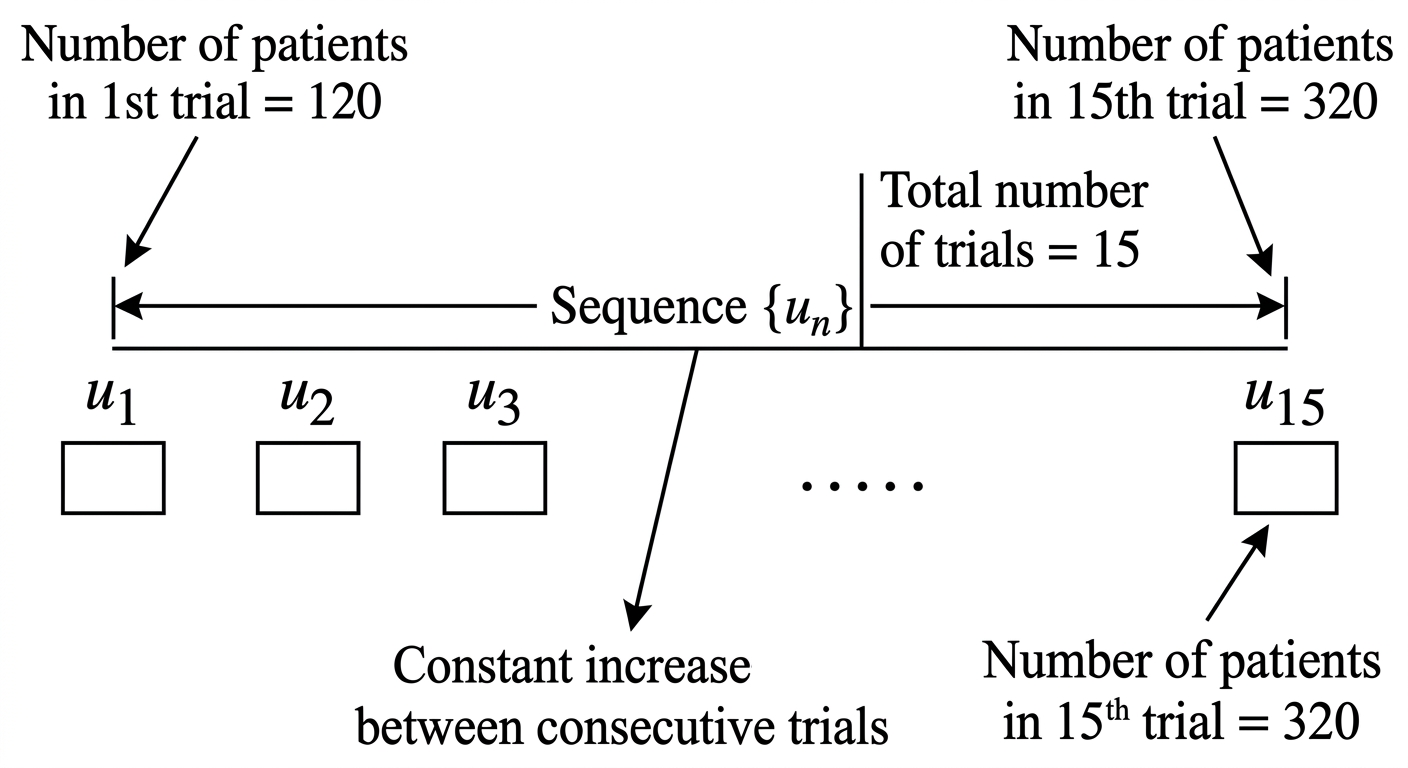
A pharmaceutical company is testing a new drug. In the first clinical trial, patients receive the drug. The number of patients in each subsequent trial increases by a constant amount. The company runs trials in total. In the th trial, patients participate.
(a)
Show that the number of patients across the trials forms an arithmetic sequence with first term , th term , and common difference . [2 marks]
(b)
Calculate the number of patients in the th trial. [2 marks]
(c)
Calculate the total number of patients across all trials. [3 marks]
(d)
The company's budget allows for a maximum of patients across all trials. Evaluate whether the total number of patients exceeds this budget. Justify your conclusion. [2 marks]
(e) In a separate study, a different drug is trialled over trials. The number of patients in each trial again increases by a constant amount. The total number of patients across all trials is , the last trial has patients, and the common difference is . Determine the value of . [4 marks]
Solutions
4ChallengeLAQDefinition and general term of arithmetic sequences6 marksPaper 3~9 min
A manufacturing company produces cylindrical metal rods. The lengths of the rods, in millimetres, form an arithmetic sequence with first term and common difference .
(a)
Show that the length of the th rod is given by , by considering the recurrence relation . [3 marks]
(b)
The 5th rod has length and the 12th rod has length .
(i) Find the value of and the value of . [4]
(ii) Find the total length, in mm, of the first 15 rods placed end to end. [2]
(iii) The company claims that the total length of the first rods exceeds for the first time when . Determine whether this claim is correct, showing all working. [3 marks]
(ii) Find the total length, in mm, of the first 15 rods placed end to end. [2]
(iii) The company claims that the total length of the first rods exceeds for the first time when . Determine whether this claim is correct, showing all working. [3 marks]
Solutions
5ChallengeLAQDefinition and general term of arithmetic sequences7 marksPaper 3~11 min
A company manufactures storage tanks. The volume of the smallest tank is litres. Each subsequent tank has a volume that is litres larger than the previous one, forming an arithmetic sequence. The total volume of the first tanks is litres.
(a)
Show that . [3 marks]
(b)
The company redesigns the range so that, instead of a constant difference, the volume increases by a fixed percentage each time. The smallest tank remains litres, and the volume of the th tank equals the volume of the th tank in the original arithmetic design.
(i) Find the value of , correct to significant figures. [3 marks]
(ii) Calculate the total volume of the first tanks in the percentage-increase design, and hence determine whether it is greater than, less than, or equal to litres. [4 marks]
(ii) Calculate the total volume of the first tanks in the percentage-increase design, and hence determine whether it is greater than, less than, or equal to litres. [4 marks]
Solutions
6ChallengeLAQSum of an arithmetic sequence10 marksPaper 3~15 min
A company is developing a new energy storage system. During testing, the amount of energy (in megawatt-hours) stored during each full charge-discharge cycle follows an arithmetic sequence. In the first cycle the system stores . In the fifth cycle it stores . The total energy stored over the first cycles is denoted .
(a)
Prove that the sum of the first terms of an arithmetic sequence with first term and common difference is
[3 marks]
(b)
Determine the common difference and hence show that
[3 marks]
(c)
The system is retired immediately after the cycle in which the cumulative total energy stored first exceeds . Determine the cycle number at which retirement occurs, justifying your answer fully. [4 marks]
Solutions
7ChallengeLAQSum of an arithmetic sequence9 marksPaper 3~14 min
A company designs a tiered bonus structure for its employees. In the first year, an employee receives a bonus of dollars. Each subsequent year, the bonus increases by a fixed amount of dollars compared to the previous year. The total bonus received over years is denoted .
(a)
Prove that the sum of the first terms of an arithmetic sequence with first term and common difference is
[4 marks]
(b)
The total bonus received over the first years is dollars.
(i) Show that . [3 marks]
(ii) Hence, find the bonus received in the th year. [2 marks]
(ii) Hence, find the bonus received in the th year. [2 marks]
(c)
The company requires the total bonus paid over the first years to be at least dollars. Determine the minimum value of for which this possible. [3 marks]
Solutions
8ChallengeLAQSum of an arithmetic sequence10 marksPaper 3~15 min
A biologist is studying the growth of a bacterial colony. The number of bacteria (in thousands) counted at the start of each hour forms an arithmetic sequence with first term and common difference . At the start of hour 1 (), there are thousand bacteria. At the start of hour 4 (), there are thousand bacteria.
(a)
Show that the total number of bacteria (in thousands) counted from the start of hour 1 to the start of hour is given by
by writing as a sum in two orders and adding the results. [3 marks]
(b)
Find the common difference , and hence show that
[3 marks]
(c)
The biologist requires a cumulative total of at least thousand bacteria. Determine the smallest integer value of for which . [2 marks]
(d)
The arithmetic model predicts that the number of bacteria at the start of hour is . The biologist observes that, after hour 15, the growth rate begins to slow because of nutrient depletion. Evaluate whether the value of found in part (c) is likely to be an underestimate or an overestimate of the true number of hours required, justifying your answer. [2 marks]
Solutions