You're viewing 1 free preview question for Maths AI HL — subscribe to unlock 8 more, plus the Full Question Bank, Mock Papers & Worksheets.Upgrade
Geometric Sequences and Series · Paper 3 — Free Maths AI HL Practice Questions
1ChallengeLAQSum of a geometric sequence10 marksPaper 3~15 min

A geometric sequence has first term and common ratio , where . The sum of the first terms is .
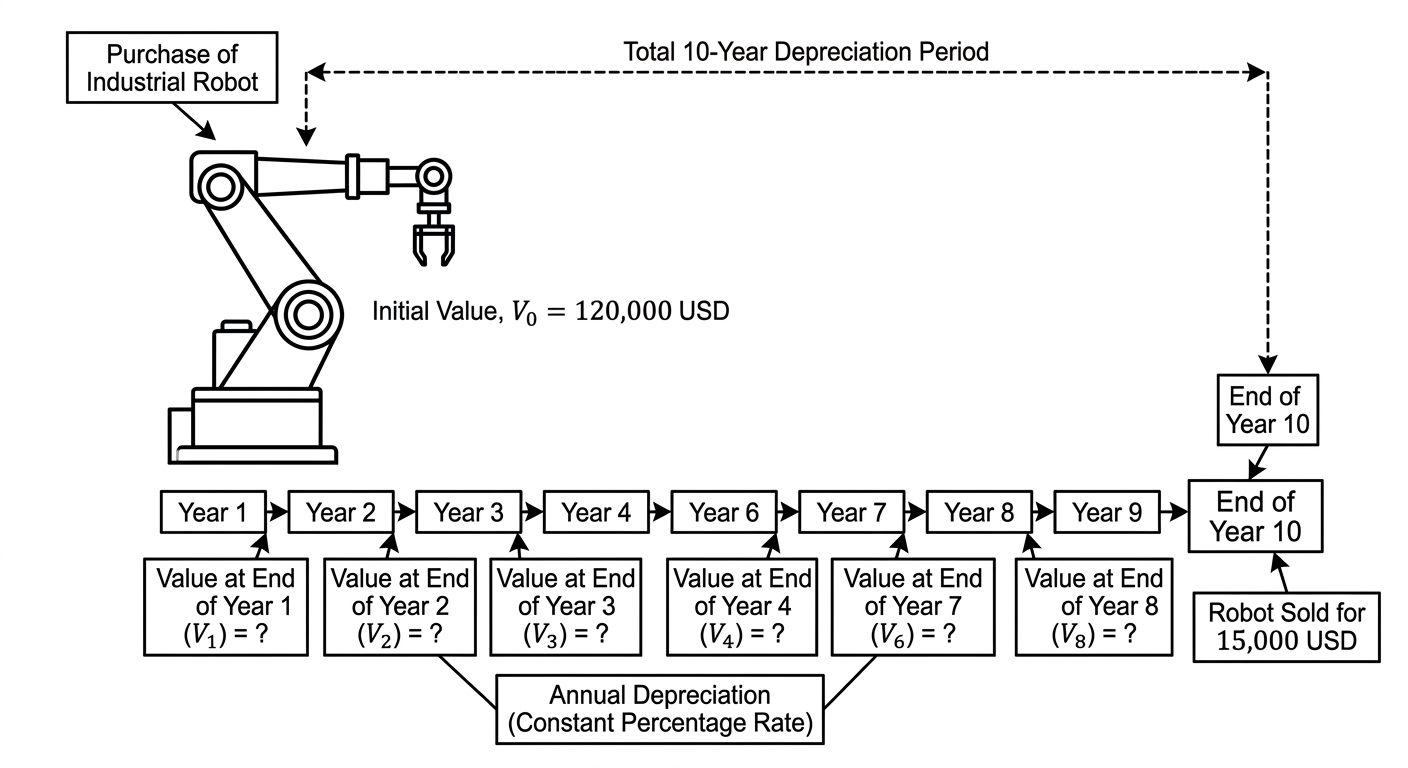
An industrial robot is purchased for dollars. Its value at the end of each year is modelled as a fixed percentage of its value at the start of that year, forming a geometric sequence. After years the robot is sold for dollars.
(a)
Prove that . [4 marks]
(b)
Show that the value of the robot after complete years is dollars, and hence calculate the annual percentage rate of depreciation, correct to three significant figures. [3 marks]
(c)
The total depreciation over the 10-year life is defined as the difference between the purchase price and the final sale value. Using your value of from part (b), calculate the total depreciation as a percentage of the purchase price. Evaluate whether this percentage would change if the robot had instead been purchased for dollars but depreciated at the same annual rate for the same number of years. Justify your answer. [3 marks]

Solutions
That's every free question here — 1 of 9.
+8 more questions, plus Mock Papers & Worksheets, are waiting in Premium.