You're viewing free preview questions. Upgrade to access more Maths AI SL questions.Upgrade
Arithmetic Sequences and Series · Paper 1 — Free Maths AI SL Practice Questions
1FoundationSAQ-SDefinition and general term of arithmetic sequences7 marksPaper 1~11 min

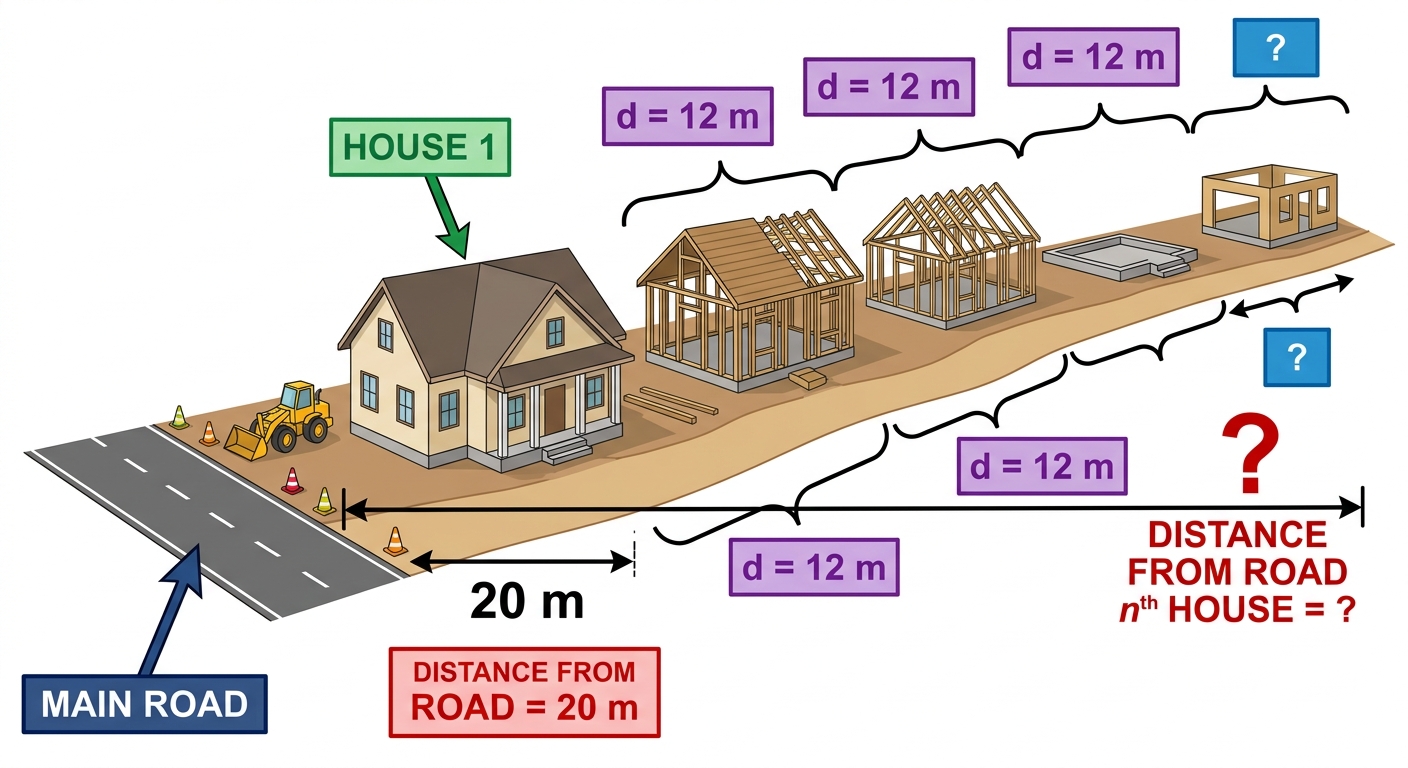
A construction company is building a new housing estate. The first house is built from the main road. Each subsequent house is built further from the road than the previous house.
(a)
State the value of and the value of for this arithmetic sequence. [2 marks]
(b)
Find the distance from the main road to the th house. [2 marks]
(c)
The estate has houses in total. The furthest house must be built no more than from the main road. Find the maximum value of . [3 marks]

Solutions
2FoundationSAQ-SDefinition and general term of arithmetic sequences7 marksPaper 1~11 min
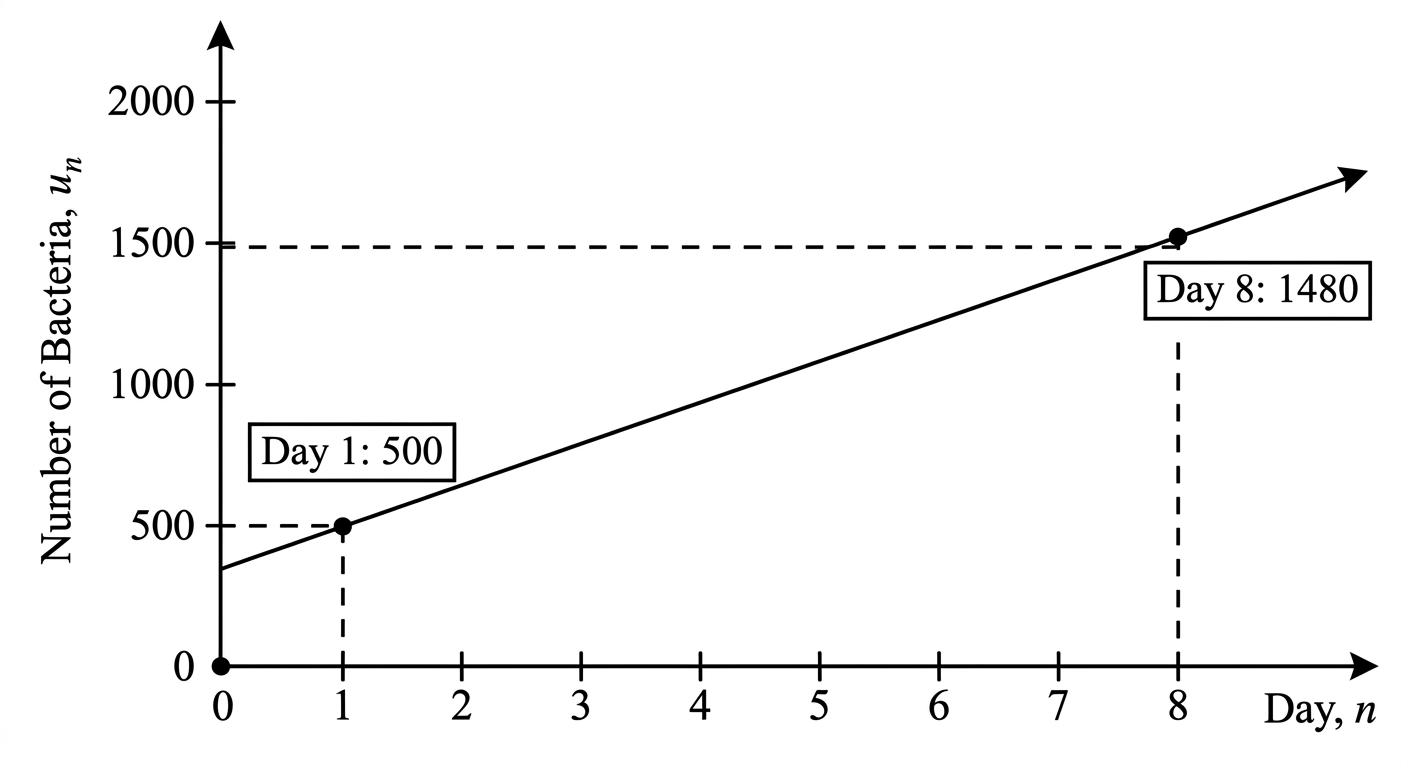
A scientist monitors the growth of a bacterial colony. On day 1 there are bacteria. The number of bacteria increases by the same amount each day. On day 8 there are bacteria.
(a)
Write down the general term for the number of bacteria on day , identifying the values of and . [1 mark]
(b)
Show that the common difference . [2 marks]
(c)
Find the number of bacteria on day 15. [2 marks]
(d)
The scientist claims the colony will exceed bacteria before day 35. Determine whether this claim is correct. [2 marks]
Solutions
3FoundationSAQ-SDefinition and general term of arithmetic sequences8 marksPaper 1~12 min
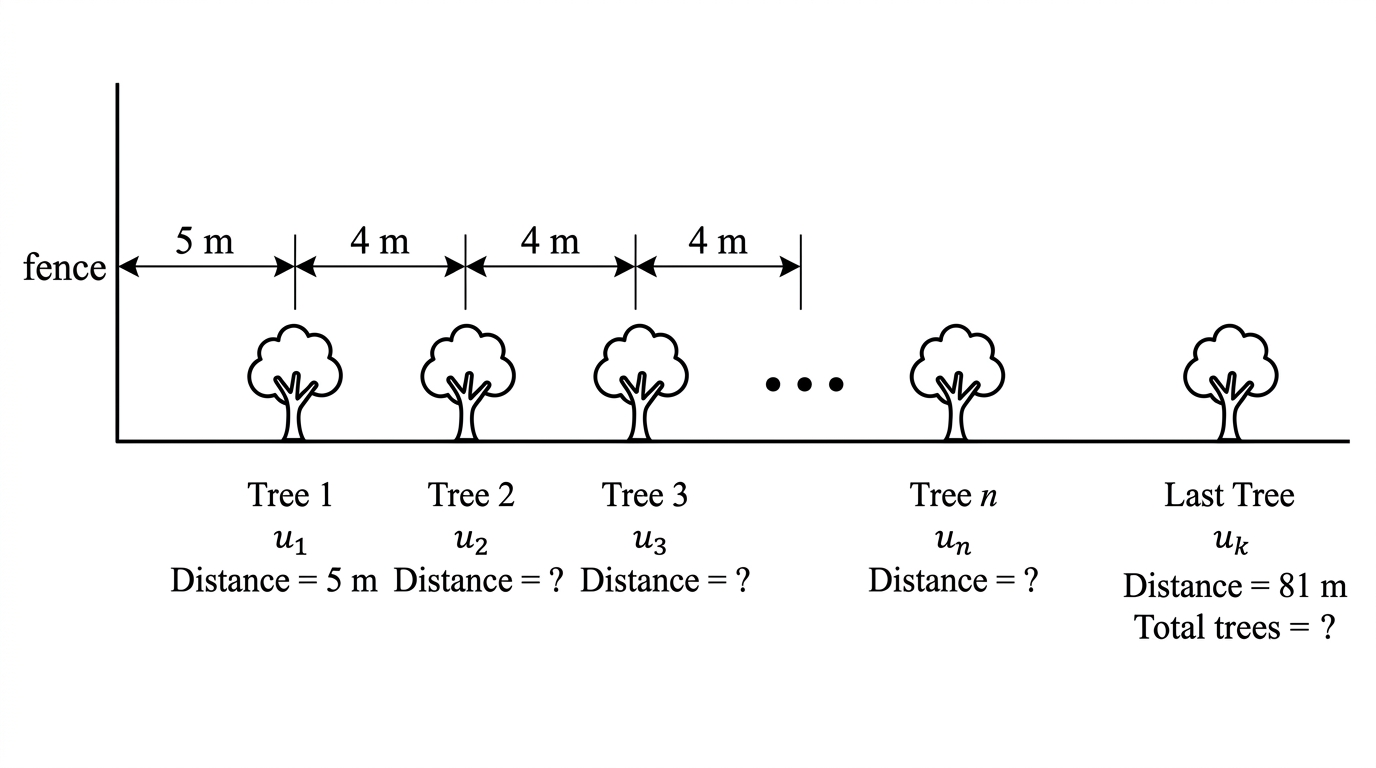
A gardener plants trees in a straight line. The first tree is planted from a fence. Each subsequent tree is planted further from the fence than the previous tree.
(a)
State the value of the first term and the common difference of the arithmetic sequence of distances. [1 mark]
(b)
Calculate the distance from the fence of the th tree. [2 marks]
(c)
The last tree is from the fence. Find the total number of trees planted. [2 marks]
(d)
A path is to be laid from the fence to the last tree, passing each tree in order. The total length of path equals the sum of all tree distances from the fence. Determine whether the total length of path exceeds , justifying your answer. [3 marks]
Solutions
4FoundationSAQ-SDefinition and general term of arithmetic sequences7 marksPaper 1~11 min
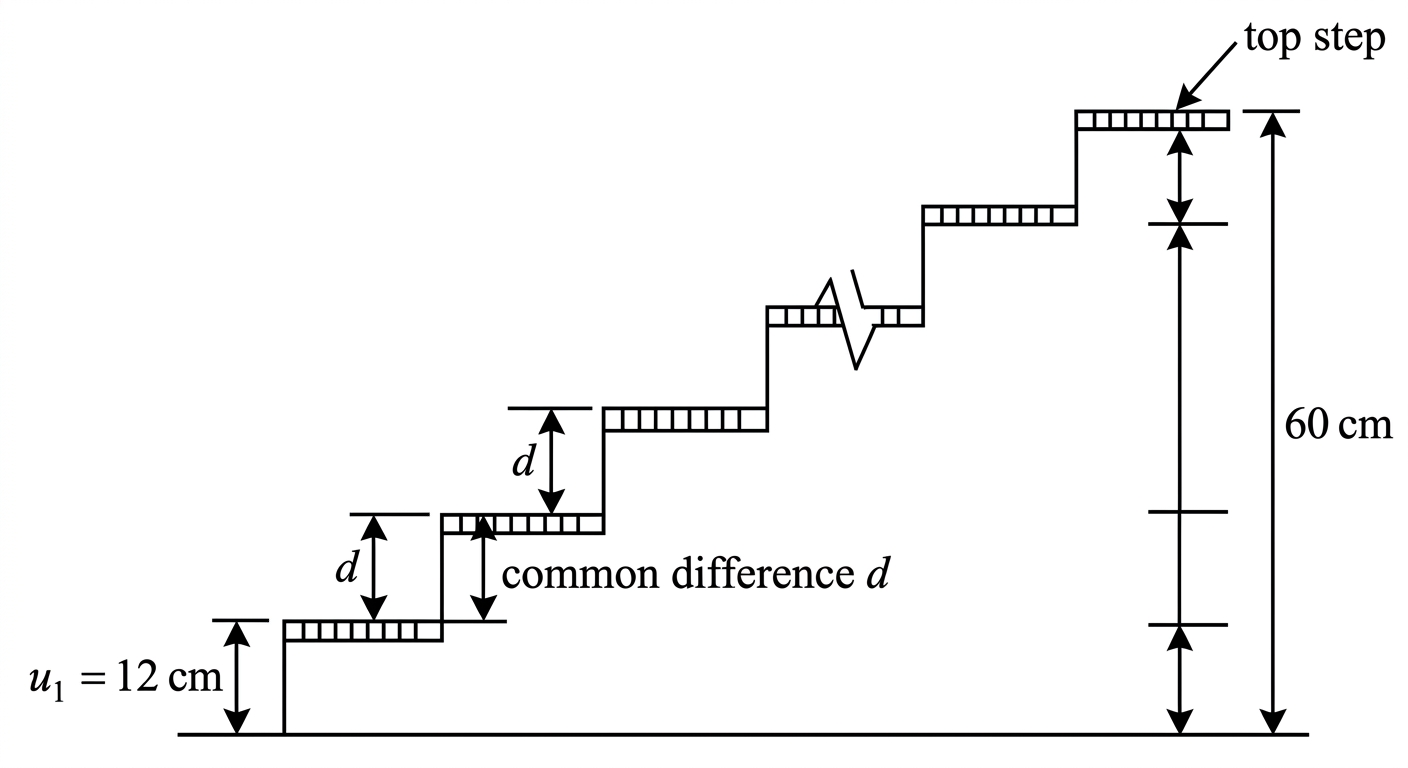
A construction company is building a staircase. The first step has a height of . Each subsequent step has a height that is greater than the previous step. The heights of the steps form an arithmetic sequence.
(a)
Write down the values of and for this sequence. [1 mark]
(b)
Calculate the height of the 8th step. [2 marks]
(c)
The top step has a height of . Find the total number of steps in the staircase. [2 marks]
(d)
Find the total combined height of all the steps in the staircase. [2 marks]
Solutions
5FoundationSAQ-SDefinition and general term of arithmetic sequences7 marksPaper 1~11 min
A gardener plants trees in a straight line. The first tree is planted from the garden gate. Each subsequent tree is planted further from the gate than the previous tree.
(a)
Find the distance from the gate to the th tree. [2 marks]
(b)
The distance from the gate to the th tree is . Find the value of . [2 marks]
(c)
The gardener has a section of garden that extends from the gate. Determine the maximum number of trees that can be planted within this section, and find the total distance covered from the gate to the last tree planted. [3 marks]
Solutions
6FoundationSAQ-SDefinition and general term of arithmetic sequences7 marksPaper 1~11 min
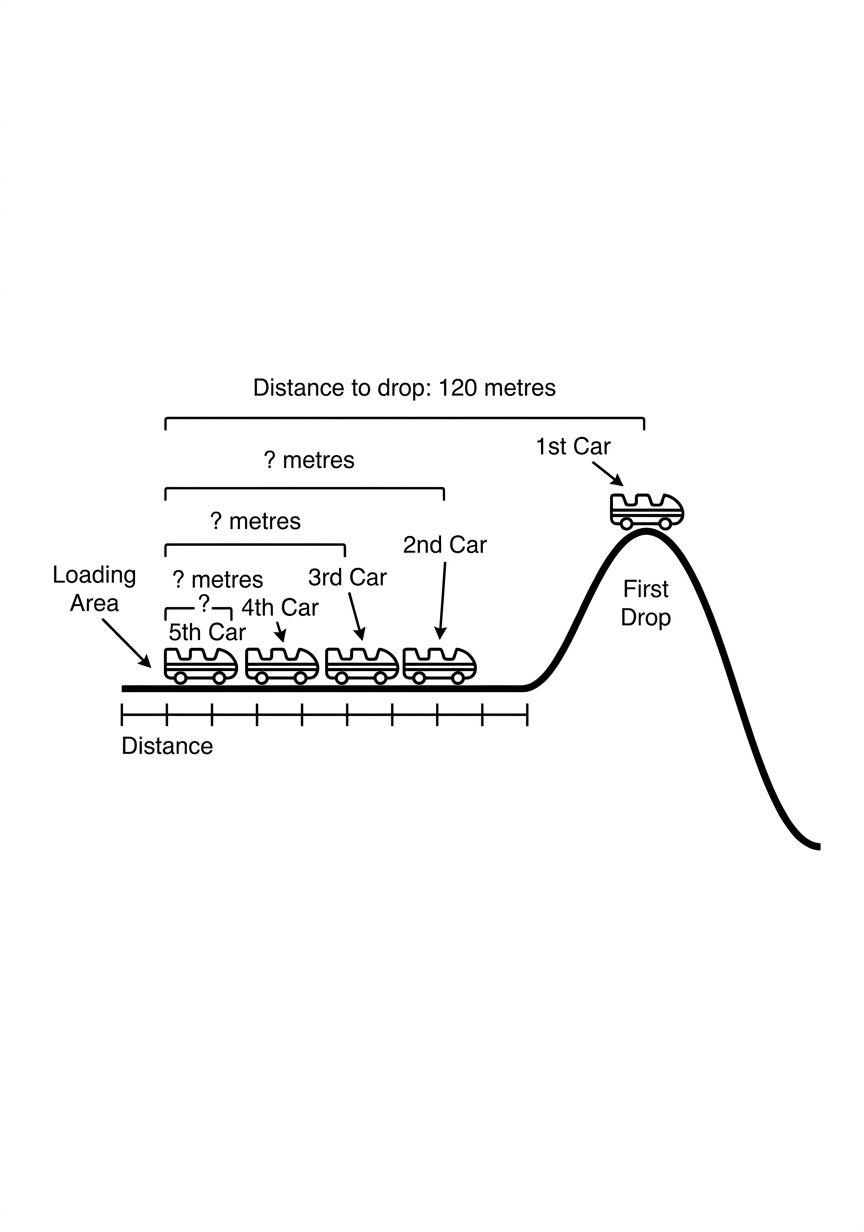
A theme park is building a new roller coaster. The first car travels before the first drop. Each subsequent car travels less than the previous car before reaching the first drop.
(a)
State whether the distances travelled by the cars form an arithmetic sequence. Justify your answer. [2 marks]
(b)
Find the distance travelled by the th car before the first drop. [2 marks]
(c)
The theme park states that any car travelling or less cannot reach the first drop and must be removed. Find the maximum number of cars that can reach the first drop. [3 marks]
Solutions
7FoundationSAQ-SDefinition and general term of arithmetic sequences7 marksPaper 1~11 min
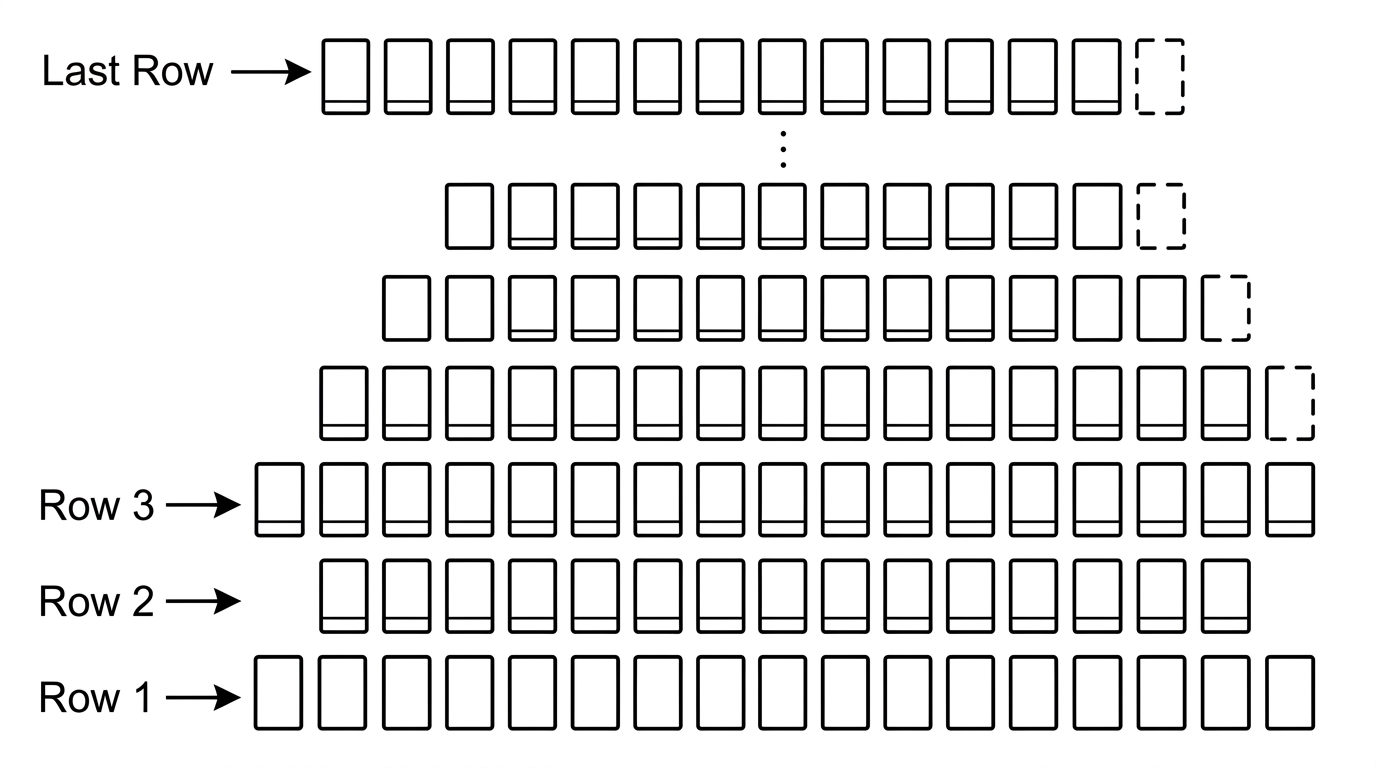
A movie theatre has seats in the first row. Each subsequent row has more seats than the previous row.
(a)
Write down the value of the first term and the common difference of the arithmetic sequence formed by the number of seats in each row. [1 mark]
(b)
Calculate the number of seats in the th row. [2 marks]
(c)
The last row has seats. Find the total number of seats in theatre. [4 marks]
Solutions
8FoundationSAQ-SSum of an arithmetic sequence7 marksPaper 1~11 min
A concert hall has rows of seats. The number of seats in each row forms an arithmetic sequence. The first row has seats and the last row has seats.
(a)
Find the common difference of the sequence. [2 marks]
(b)
Find the total number of seats in the concert hall. [2 marks]
(c)
The concert hall charges USD 45 per seat in the first rows and USD 30 per seat in the remaining rows. Determine the total ticket revenue when every seat is sold. [3 marks]
Solutions
9FoundationSAQ-SSum of an arithmetic sequence8 marksPaper 1~12 min
Data
,
A student saves money each week. In the first week, she saves dollars. Each week she saves dollars more than the previous week.
(a)
Find the amount she saves in the 8th week. [2 marks]
(b)
Calculate the total amount saved after 8 weeks. [3 marks]
(c)
Find the minimum number of weeks required for her total savings to exceed dollars. [3 marks]
Solutions
10FoundationSAQ-SSum of an arithmetic sequence8 marksPaper 1~12 min
Data
,
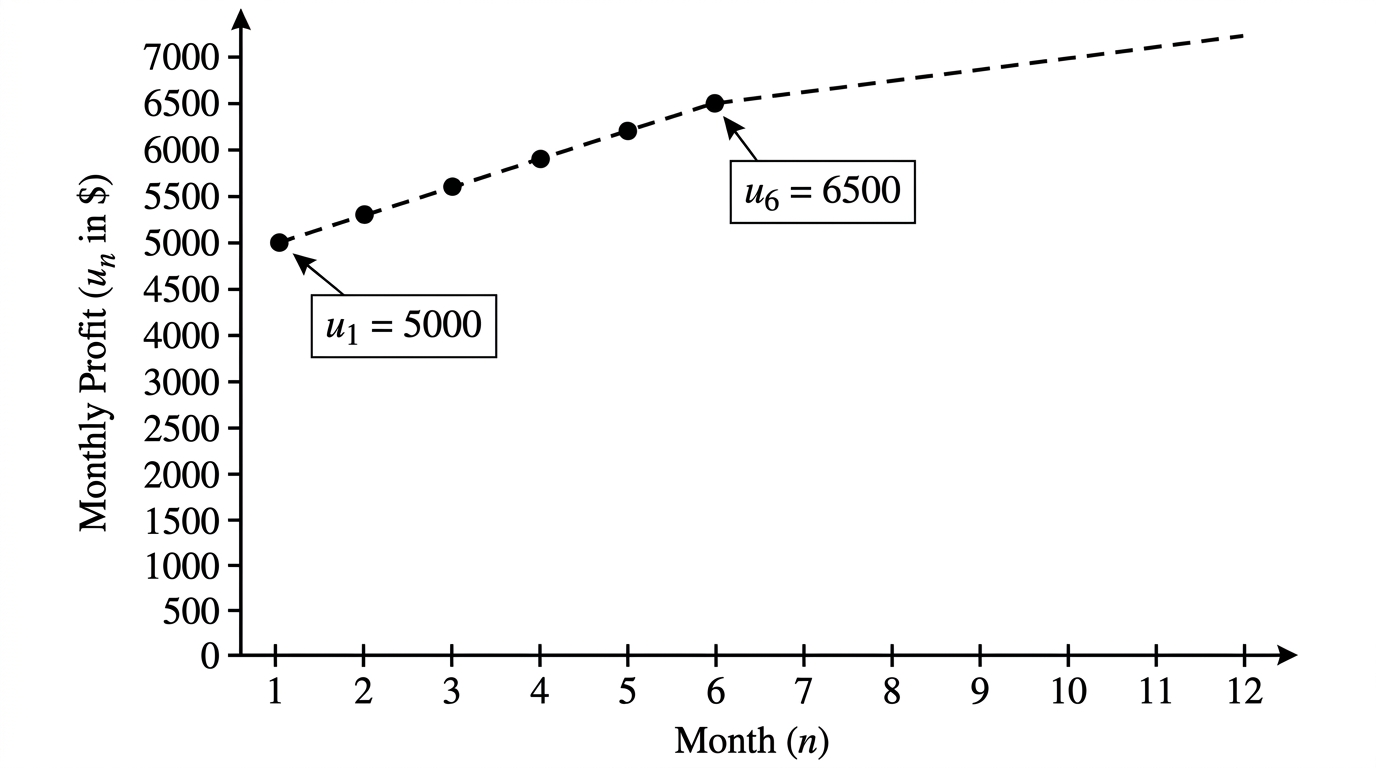
A small business records its monthly profit. In the first month, the profit is dollars. The profit increases by a fixed amount each month. In the sixth month, the profit is dollars.
(a)
Write down an equation, in terms of , for the profit in the sixth month. [1 mark]
(b)
Find the common difference of this arithmetic sequence. [2 marks]
(c)
Find the total profit over the first 12 months. [2 marks]
(d)
Determine the minimum number of months required for the total profit to exceed dollars. [3 marks]
Solutions
11FoundationSAQ-SSum of an arithmetic sequence7 marksPaper 1~11 min
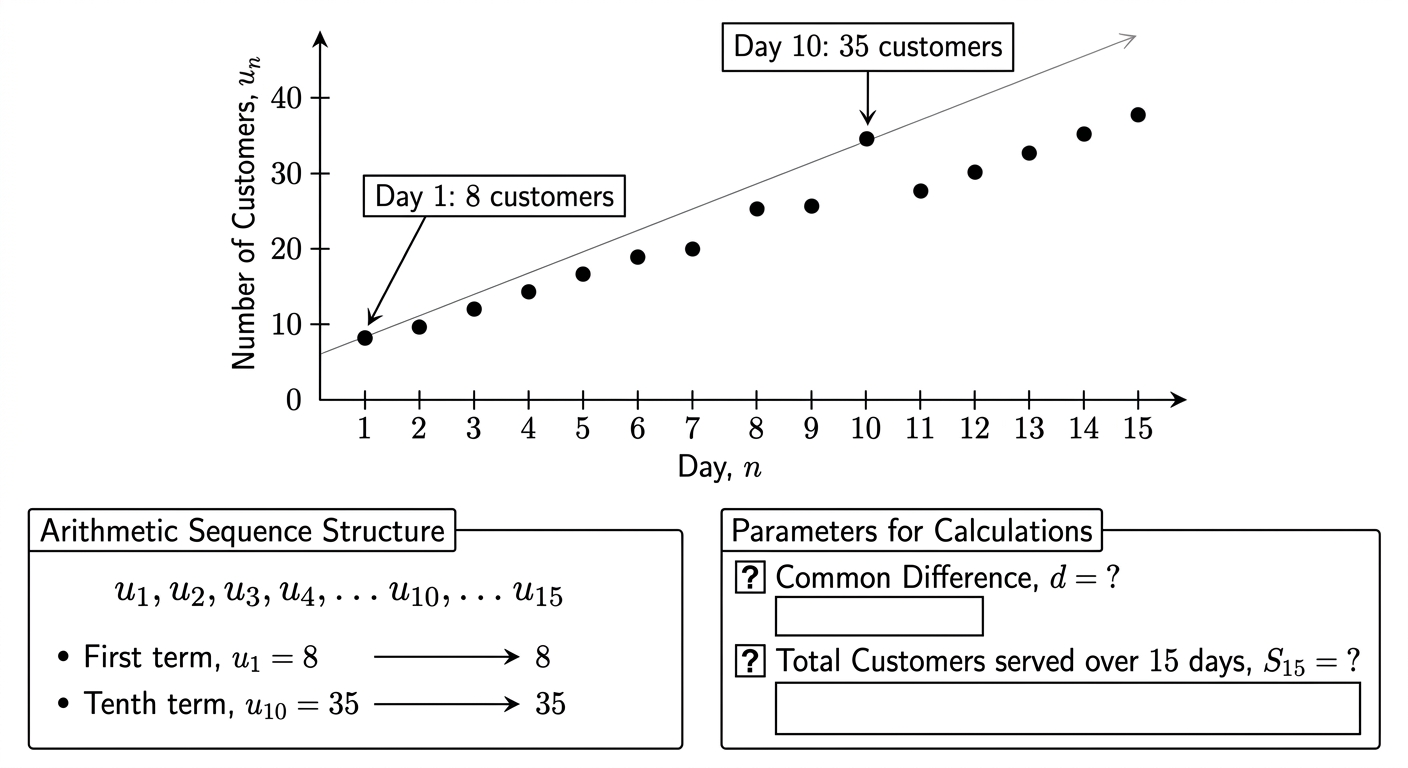
A small business owner records the number of customers served each day. The number of customers served forms an arithmetic sequence. On the first day, customers are served. On the tenth day, customers are served.
(a)
Calculate the common difference, , of the sequence. [2 marks]
(b)
Find the total number of customers served over the first days. [2 marks]
(c)
The business owner claims that the total number of customers served will exceed within the first days. Determine whether this claim is correct, showing your reasoning. [3 marks]
Solutions
12FoundationSAQ-SDefinition and general term of arithmetic sequences7 marksPaper 1~11 min
A student is saving money to buy a laptop. She saves dollars in week 1. Each week she saves dollars more than the previous week. The amounts saved each week form an arithmetic sequence.
(a)
Calculate the amount she saves in week 6. [2 marks]
(b)
Determine the week number in which she first saves dollars in a single week. [2 marks]
(c)
The laptop costs . Calculate the minimum number of weeks she must save before her total savings are enough to buy the laptop. [3 marks]
Solutions
13FoundationSAQ-SDefinition and general term of arithmetic sequences7 marksPaper 1~11 min
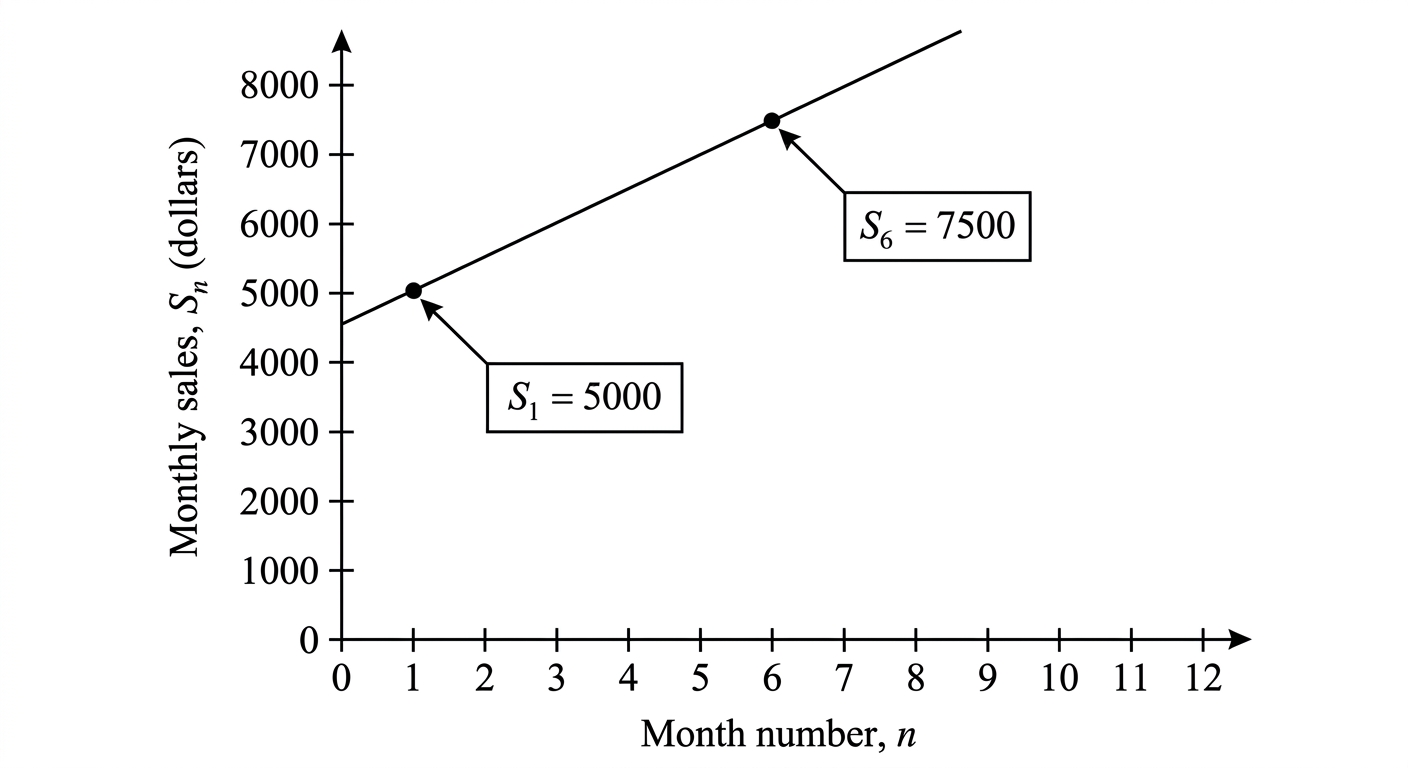
A small business owner tracks monthly sales. In January (month 1), sales were USD 5000. Sales increase by a fixed amount each month. In June (month 6), sales were USD 7500.
(a)
State the common difference of this arithmetic sequence. [1 mark]
(b)
Find the sales in the 10th month. [2 marks]
(c)
The owner needs total cumulative sales to exceed USD 200 000 to qualify for a business grant. Determine the minimum number of complete months required for cumulative sales to exceed USD 200 000, and state the month in which the owner first qualifies. [4 marks]
Solutions
14FoundationSAQ-SDefinition and general term of arithmetic sequences7 marksPaper 1~11 min
A library has books in its first year. Each year, the number of books increases by a constant amount. After years, there are books.
(a)
Find the common difference of this arithmetic sequence. [2 marks]
(b)
Find the number of books in the th year. [2 marks]
(c)
Determine the first year in which the number of books exceeds . [3 marks]
Solutions
15FoundationSAQ-SDefinition and general term of arithmetic sequences7 marksPaper 1~11 min
A small business owner deposits USD 2000 into a new savings account on January 1st, 2023. Each subsequent year, on January 1st, they deposit USD 150 more than the previous year's deposit. The deposits form an arithmetic sequence.
(a)
Write down the values of and for this arithmetic sequence. [1 mark]
(b)
Calculate the amount deposited on January 1st, 2030. [2 marks]
(c)
Calculate the total amount deposited from January 1st, 2023 to January 1st, 2030 inclusive. [2 marks]
(d)
Determine the first year in which the annual deposit exceeds USD 3500. [2 marks]
Solutions
16FoundationSAQ-SDefinition and general term of arithmetic sequences8 marksPaper 1~12 min
A cyclist trains by increasing her daily distance by a constant amount each day. On day 1 she cycles . On day 4 she cycles .
(a)
Calculate the common difference, , of this arithmetic sequence. [2 marks]
(b)
Calculate the distance she cycles on day 10. [2 marks]
(c)
Show that she first cycles on day 13. [1 mark]
(d)
The cyclist's training plan runs for 13 days. Her coach states that the total distance cycled over the 13 days must exceed for the plan to be considered successful. Determine whether the training plan is successful. [3 marks]
Solutions
17FoundationSAQ-SSum of an arithmetic sequence7 marksPaper 1~11 min
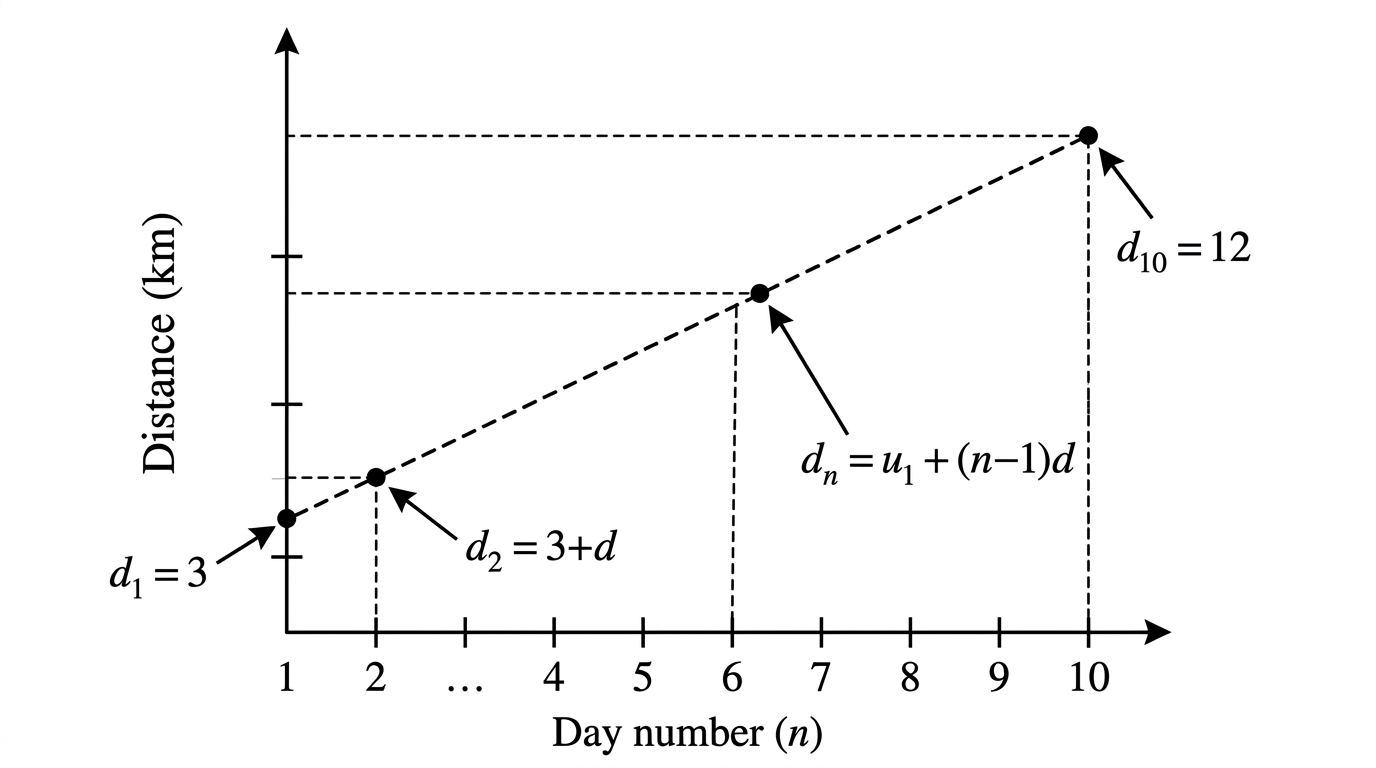
Elena is training for a charity run. She runs on her first day and increases the distance she runs each day by a constant amount. On her 10th day, she runs .
(a)
Find the common difference, , of this arithmetic sequence. [2 marks]
(b)
Find the total distance Elena runs over the first 10 days. [2 marks]
(c)
Elena's training programme lasts days. Find the minimum value of such that her total distance first exceeds . [3 marks]
Solutions
18FoundationSAQ-SSum of an arithmetic sequence7 marksPaper 1~11 min
A small business sells handmade candles. The number of candles sold each week forms an arithmetic sequence. In the first week, candles are sold. In the fifth week, candles are sold.
(a)
Find the common difference of the sequence. [2 marks]
(b)
Find the total number of candles sold over the first weeks. [2 marks]
(c)
The business needs to sell a total of at least candles to break even. Determine the minimum number of complete weeks required to reach this target, assuming the arithmetic sequence continues. [3 marks]
Solutions
19FoundationSAQ-SSum of an arithmetic sequence8 marksPaper 1~12 min
Data
, ,
A company sells a product. In week 1, they sell units. Each week after that, the number of units sold increases by a constant amount . In week 12, they sell units.
(a)
Write down an expression for , the number of units sold in week , in the form , stating the value of . [1 mark]
(b)
Calculate the weekly increase in sales, . [2 marks]
(c)
Find the total number of units sold over the first 12 weeks. [2 marks]
(d)
The company needs to sell a total of at least units to break even. Determine the minimum number of complete weeks required to reach this target. [3 marks]
Solutions
20FoundationSAQ-SSum of an arithmetic sequence10 marksPaper 1~15 min
A construction company is building a staircase. The heights of the steps, measured in centimetres, form an arithmetic sequence. The first step has a height of and the sixth step has a height of .
(a)
Find the common difference of the sequence. [2 marks]
(b)
Find the height of the th step. [2 marks]
(c)
Find the sum of the heights of the first steps. [2 marks]
(d)
The maximum total height of a staircase permitted by building regulations is . Determine the maximum number of complete steps the staircase can have. [4 marks]
Solutions
Showing 20 of 199 free questions